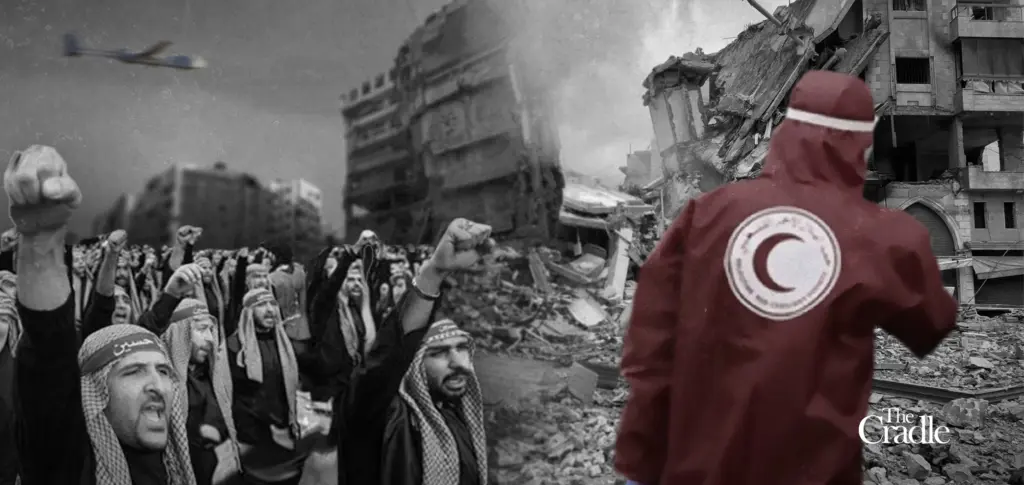
This photograph shows the aftermath of a devastating disaster, with collapsed buildings and widespread destruction in the background. In the foreground, a humanitarian worker wearing a Red Crescent jacket looks toward the rubble, while a crowd on the left raises their fists in protest. Photo: The Cradle.
By William Van Wagenen – Jun 30, 2026
A journey through south Lebanon reveals a resilient population refusing to abandon its land as Israel intensifies its campaign of destruction, ethnic cleansing, and permanent occupation.
When The Cradle arrived in the Lebanese town of Nabatieh on the afternoon of 18 June, the sight of the immense damage inflicted by months of Israeli bombing was shocking. Particularly hard hit was the town center, home to the city’s historical market. It was targeted in the last war in 2024 and rebuilt, only to be struck and destroyed again after the war resumed in early March.
Upon entering the town center, we saw pictures of the late Hezbollah leader Hassan Nasrallah and martyred Hezbollah fighters hanging on a light pole, overlooking the destruction on the main street passing the market.
One small restaurant was still open and serving food. As we sat down for a falafel sandwich, we almost immediately heard the boom of Israeli artillery.
Despite a so-called ceasefire in Lebanon under a US–Iran memorandum of understanding (MoU) reached just days earlier, Israeli troops continue to occupy positions on the hills overlooking Nabatieh, placing the town on the front lines of the Lebanese resistance’s campaign to drive them out.
In the next few minutes, we heard four more artillery strikes. As we rushed to finish our food, a procession began at the mosque across the street.
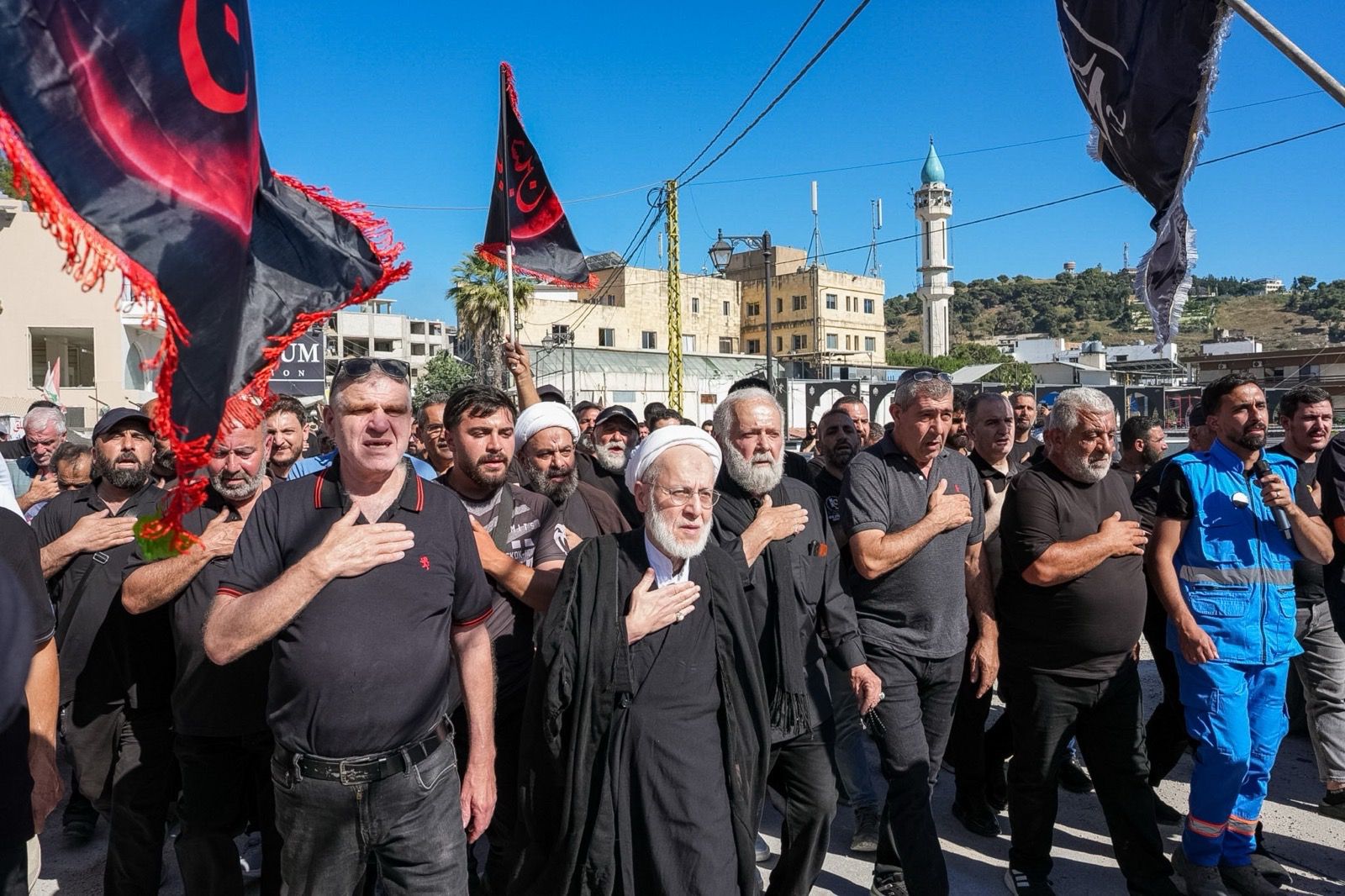
It was organized to mark the beginning of Ashura, a period of religious mourning during which Shia Muslims commemorate the slaying of Imam Hussein, the grandson of the Prophet Muhammad, at the Battle of Karbala in 680 CE.
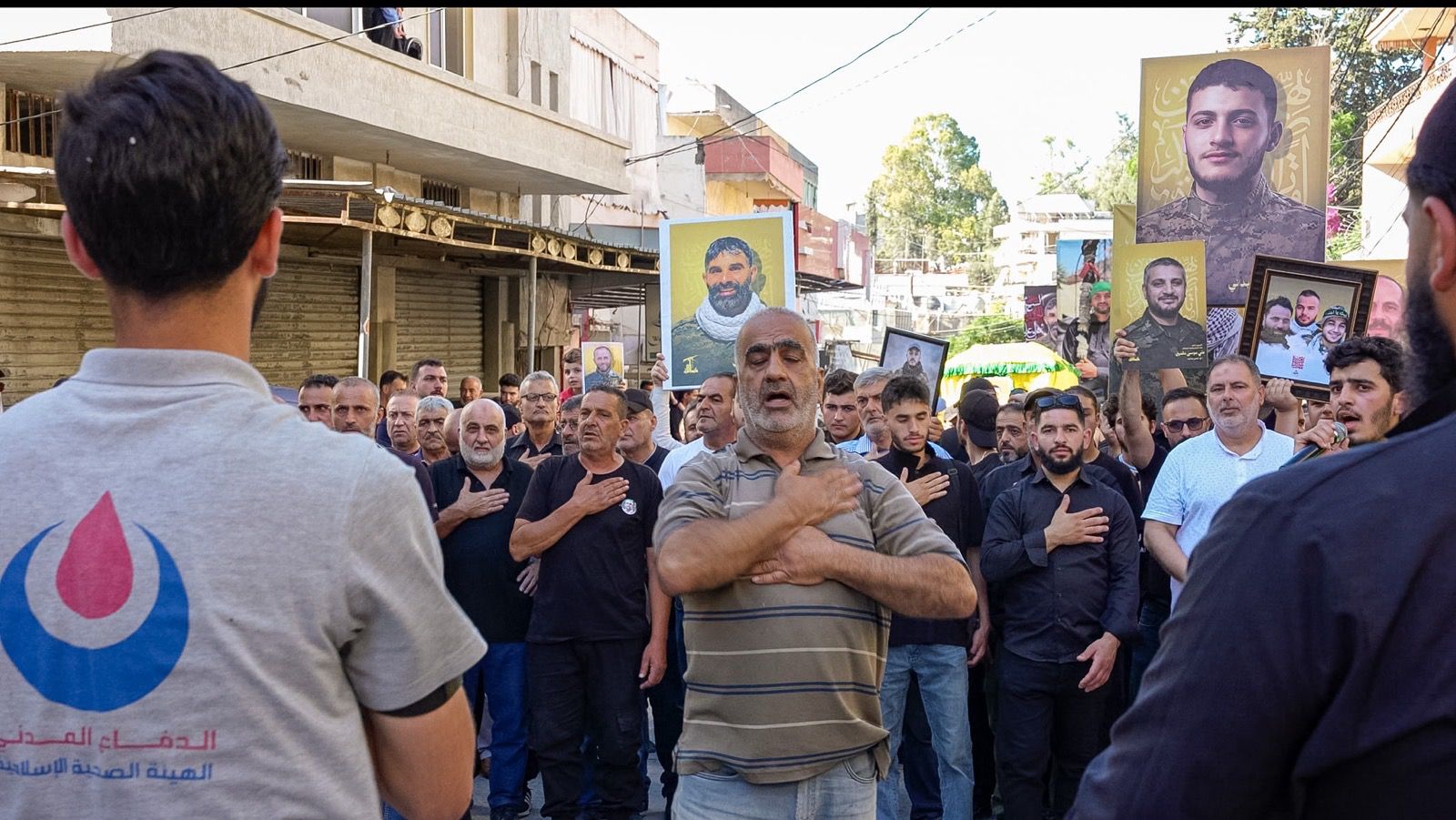
Marchers held flags and chanted slogans dedicated to Imam Hussein. After a few minutes, the marchers stopped in the rubble-strewn streets to perform the “latmiyah,” rhythmically striking their chests to commemorate the desecration of Imam Hussein’s body, which was trampled by enemy horses and pierced by spears and arrows.
The march circled around the old market, which has been reduced almost entirely to ruins after months of Israeli airstrikes. Marchers chanted “This is the tragedy of Karbala, O Imam Hussein, look. This is the tragedy of Karbala.”
Ashura procession in Nabatieh. (Photo credit: Nelson Scandela)
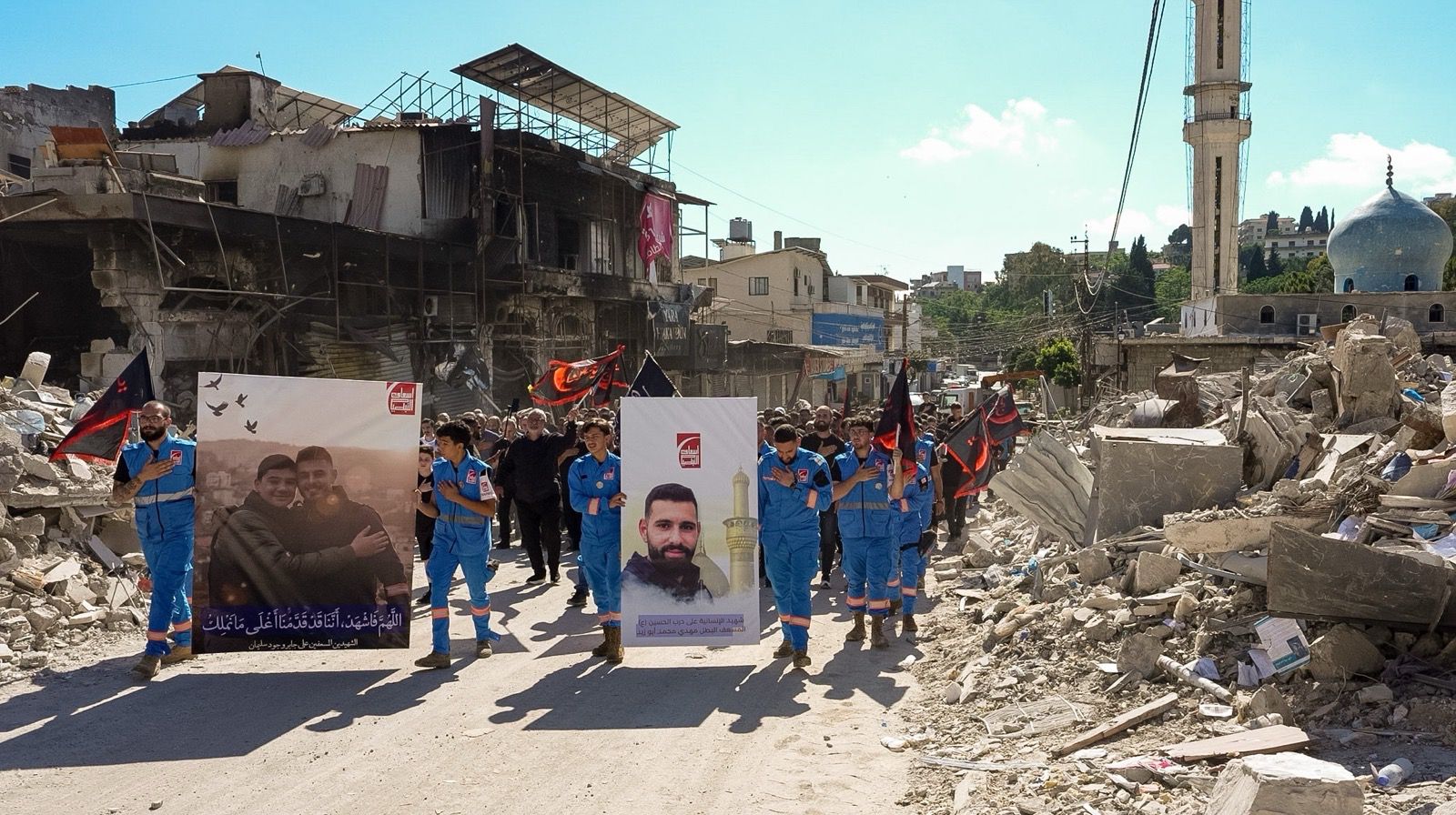
But this Ashura procession was not only to remember the martyrdom of the prophet’s grandson. It was also organized in memory of three members of the Nabatieh Ambulance Service – a local volunteer rescue team – killed by Israel during the war. With a shaky ceasefire in place, this was the first chance the rescuers had to formally mourn their fallen colleagues.
The procession was led by paramedics and first responders dressed in their bright blue uniforms and holding large placards of the three killed rescuers, viewed as martyrs for their service in saving others.
One of the slain paramedics, Joud Soleiman, would have turned 16 years old in October.
He was killed on 24 March by an Israeli drone strike. Joud was riding on a scooter with his colleague, 23-year-old Ali Jaber. As part of their daily routine, they were on their way to get food for the ambulance team.
Members of the Nabatieh Ambulance Service marching in the Ashura procession to commemorate their colleagues who were killed by Israel. (Photo credit: Nelson Scandela)
France TV had been filming with the team just hours before Israel carried out the strike on Joud and Ali, who were best friends.
Footage from the French journalists showed that the young men were clearly identifiable, wearing uniforms adorned with the Nabatieh Ambulance Service logo.
When the journalists queried the Israeli army, its representative acknowledged carrying out the strike, but bizarrely claimed Joud and Ali were killed in a car collision between two passing cars. However, footage taken by the France TV journalists, who quickly arrived at the scene after the strike, showed no such car collision had taken place.
The Israeli military acknowledged it had video footage of the incident taken by its killer drone but refused to provide it to the French channel.
Captain Mohammad Soleiman, the head of the ambulance service, told The Cradle that it was Joud’s dream to become a paramedic and perform rescue missions since he was just a young boy.
Soleiman knew this because Joud was not just a member of his team; he was also his son.
“From the time he was six years old, he used to come with me in the ambulance and participate in the trainings,” Soleiman said. “He used to dress up in my paramedic uniform, waiting for the day when he could join the team.”
“He was always with my team. He has nothing to do with politics. He was not a terrorist. Ali and Joud were always together. They were best friends from coming to the Ambulance center as kids.”
During the previous war in 2024, Soleiman sent Joud to Beirut by bus to keep him safe, but he kept returning. At the beginning of this war, he said, “Don’t make me leave, I am staying.”
When asked why Israel would seek to kill first responders and paramedics simply trying to save lives, he explained, “The Israeli people don’t love peace. They love to take everything for themselves; they want to take your house, your land.”
“They do this with support from America and elsewhere. We wish that this support will end.”
Quadruple tap strike Among the slain paramedics remembered during the Ashura procession was another Nabatieh Ambulance Service member, 31-year-old Mahdi Abou Zeid.
Mahdi was among three first responders killed by Israel in a “quadruple tap” strike in the nearby town of Mayfadoun on 15 April.
An Israeli drone first targeted paramedics from the Islamic Health Association as they were rescuing injured people from the site of an air strike. One paramedic was killed and a second remained missing.
When a second Islamic Health Association team rushed to the site to aid their colleagues, an Israeli drone attacked it as well, injuring three paramedics.
Finally, two additional ambulances, from the Risala Scout Association and the Nabatieh Ambulance Service, were dispatched to rescue their injured counterparts. Israel struck the two vehicles, killing two more paramedics and wounding three more.
One of the slain paramedics, 43-year-old Fadel Serhan of the Risala Scout Association, had been featured in a BBC report the same week Israel killed him.
Mohammad Jaber of the Nabatieh Ambulance Service was driving the vehicle transporting Fadel Serhan’s body.
Mohammad told The Cradle that “Mahdi was on a mission to save other paramedics who got struck. He was working with a team to extract them. As they were working to put the injured into the ambulance, Mahdi was struck and injured. His injury was fatal.”
Shrapnel from the missile fired by the Israeli drone dispersed in all directions, hitting Mahdi in areas not fully covered by his protective vest.
Mohammad explained that the first response teams never treat injured victims at the site of a strike, due to the risk of Israel targeting them. Instead, they put the victims in ambulances and start treating them as they drive to safer areas.
This makes it more difficult to treat the injured person. However, if they stay in the danger zone and Israel strikes them again, both the victim and the team of paramedics would die.
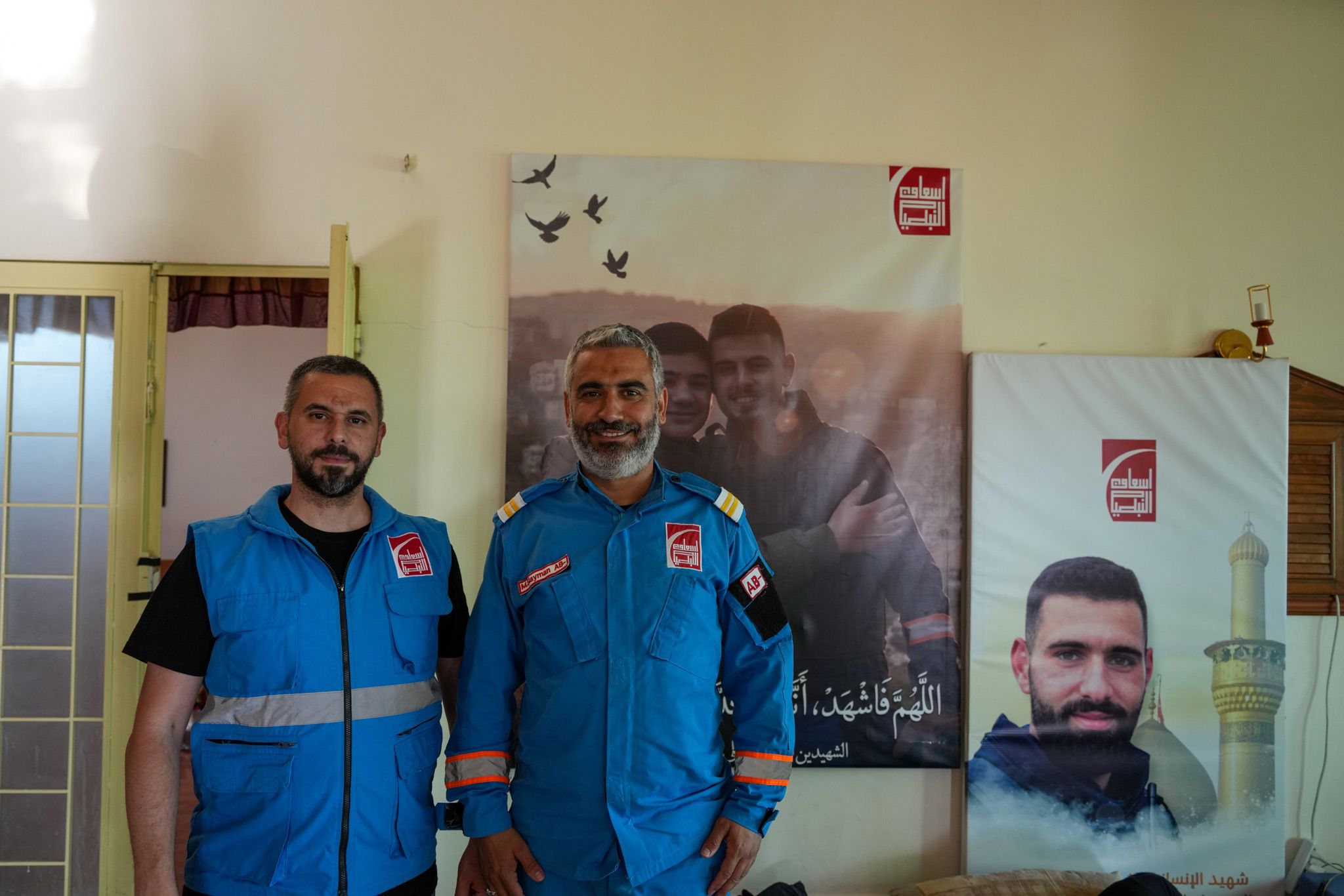
Nabatieh Ambulance Service paramedics Mohammad Soleiman and Mohammad Jaber in front of a placard of Joud Soleiman, Ali Jaber, and Mahdi Abou Zeid. (Photo credit: Nelson Scandela)
Funeral in Harouf Following the Ashura procession in Nabatieh, The Cradle drove to Harouf, a town in the hills above Nabatieh. A funeral procession was taking place for four Hezbollah fighters, Bilal Mahmoud Atawi, Amin Hassan Harb, Mohammad Baqir Hussein Harb, and Hassan Nazih Ayoub, killed in battles with invading Israeli troops.
As The Cradle walked to the starting point of the procession, cars and pick-up trucks full of teenage boys drove up and down the main street in the town, displaying massive photos of the martyred fighters.
Soon, four coffins arrived, carried by groups of men, both young and old, on their shoulders, while chanting “Labbaiki ya Zaynab” – an expression of devotion to Imam Hussein’s sister. Zaynab is revered for her courage in the wake of the Battle of Karbala. After her brother and his followers were killed, she protected the surviving members of his family and openly defied their captors through a series of powerful speeches.
As the procession commenced, men greeted each other with hugs and offered condolences. A father of one of the slain fighters held back tears as he walked. Two teenage boys accompanied him, carrying a large picture of his son to express pride at his having fought the occupying Israeli army.
The sides of the narrow street through Harouf were lined with crowds of women and girls, dressed in chadors. Many of them also wore yellow scarves, the color of the Hezbollah flag, and placard pins showing the face of a young man, a husband, brother, or father killed fighting against Israel. Other women proudly held photos of their loved ones killed in the war. Many cried as the coffins of the most recent martyrs passed by.
Once the procession reached the cemetery, the coffins were placed in a row in the street. Hundreds of men lined up behind them to perform a prayer before the martyrs were taken to be buried.
Funeral procession in Harouf for Hezbollah fighters Bilal Mahmoud Atawi, Amin Hassan Harb, Mohammad Baqir Hussein Harb, and Hassan Nazih Ayoub who were killed by Israel in battle. (Photo credit: Nelson Scandela)
A night of terror But the mourning did not end with the funeral. Though Israel was supposed to halt attacks on Lebanon as part of the agreement between the US and Iran, Israeli forces continued their assault on a strategic hill above Nabatieh.
Known as Ali al-Taher, Israelis claim it is home to a fortified Hezbollah base, dug deeply into the mountain and connected by tunnels. The hill is critical high ground, overlooking much of southeastern Lebanon, including the historic Beaufort Castle.
Hezbollah said its fighters ambushed the invading Israeli forces on 19 June with guided missiles and rocket and artillery fire, destroying three Merkava tanks. Israeli media announced that four members of a tank crew were killed by a Hezbollah anti-tank missile or drone, including the a battalion commander.
Israel responded with a wave of new airstrikes, including 25 on towns surrounding Nabatieh. The strikes killed 47 people in one night across southern Lebanon.
Just hours after the funeral procession in Harouf ended, an Israeli strike destroyed a home in the village, killing nine people, including two young women and three young girls. A video circulated online of desperate first responders working in near darkness to dig the victims from the rubble.
Elsewhere in the Nabatieh district, Israeli bombing killed seven in the village of Haboush, and six in the village of Al-Duwayr, including a child. Lebanon’s state news agency described the overnight bombardment as one of the “most intense of the war.”
Mass killing in Qannarit The following day, on 20 June, Israel carried out another horrific strike. In the town of Qannarit, on the outskirts of the coastal city of Sidon (Saida), Israeli forces dropped a massive bomb on a residential building, totally obliterating it.
Israeli media claimed that a Hezbollah commander was targeted. But the enormous blast killed at least seven people, according to a preliminary toll.
When The Cradle arrived several hours after the bombing, dozens of civil defense workers and other rescuers were using a bulldozer and basic tools to try to find survivors. A civil defense worker said that the death toll had now reached 17, including several children. While we were there, the civil defense managed to rescue one person, who was swiftly taken away by ambulance.
Perhaps most shocking was the level of destruction created by the bomb. The residential building, located in a quiet neighborhood in the hills above Sidon, was completely gone, with a giant crater some 20 feet (7 meters) deep and 30 feet (9 meters) wide taking its place.
Israel is known for using US-made 2,000-pound (907 kilograms) MK-84 bombs in Lebanon. Nicknamed “The Hammer,” the MK-84 is known for its destructive power. Its use in residential areas makes Israel’s killing of civilians inevitable, and by extension, deliberate.
The purpose of Israeli violence?
Israeli officials say they are targeting only Hezbollah fighters, but this is belied by the many civilian deaths resulting from the Israeli attacks on residential buildings and homes.
Even US President Donald Trump acknowledged that Israeli Prime Minister Benjamin Netanyahu was using shocking levels of violence in Lebanon. “You don’t have to knock an apartment down every time you’re looking for somebody,” Trump said, referencing Israel’s practice of killing entire families, or multiple families, to target one member of Hezbollah or Hamas.
Strangely, the president then floated the idea that forces loyal to self-proclaimed Syrian President Ahmad al-Sharaa – the former Al-Qaeda leader who went by the nom de guerre Abu Mohammad al-Julani – could be used to attack Hezbollah in a more “precise” way.
Trump’s comments ignore that Sharaa sent his forces to massacre over 1,600 Alawite civilians in March 2025, in an alleged effort to suppress an insurgency of former army officers. Four months later, Sharaa’s forces also massacred hundreds of Druze civilians under similar pretexts.
They filmed themselves committing horrific atrocities, including forcing young Alawite men to bark and crawl like dogs before executing them en masse, and beheading and even burning Druze men alive.
The real motivation for Israel’s use of horrific violence was revealed the day after its killing of the family in the village of Harouf. Israeli National Security Minister Itamar Ben Gvir stated that “All of Lebanon needs to burn!”
“For every teardrop of an Israeli mother, a thousand Lebanese mothers need to cry,” he said.
Expanding ‘Greater Israel’ But why terrorize Lebanon in this way? While Israeli military officials publicly claim they must defeat Hezbollah and Hamas to assure Israel’s security, Ben Gvir and other Jewish settler leaders provide another motivation: to expand “Greater Israel.”
They say they wish to occupy Palestinian and Lebanese territory, flatten their cities and villages, and expel the indigenous populations to replace them with Jewish settlers.
In May, Ben Gvir made his intentions for Lebanon and Gaza clear while speaking at an event to mark the Hebrew calendar anniversary of Israel’s 1967 conquest and occupation of East Jerusalem.
“We have more plans to encourage migration from Gaza, encourage migration from Judea and Samaria (the West Bank), and settlement in Lebanon, and we will not fear eliminating everyone who rises up to kill us,” Ben Gvir said.
Ethnically cleansing south Lebanon Israel’s desire to ethnically cleanse and then settle southern Lebanon is further evidenced not only by the Israeli military’s mass “evacuation” orders issued to Lebanese civilians, but also by its “no return” orders.
As the US and Iran were close to a deal to end the fighting, Defense Minister Israel Katz announced on 15 June that Israeli forces would not only remain in Lebanon, Syria and Gaza “without any time limit,” but that the territory occupied by Israel would be “cleared of local residents and all terror infrastructure.”
Two days after Katz’s statement, the Israeli military published a new map designating six percent of Lebanon’s entire territory as a “Forward Defense” zone. The area included a long list of villages, normally home to tens of thousands of civilians, that no one will be allowed to return to.
The Israeli military’s demolition of Lebanese villages is another part of the strategy to de-populate the country’s south and prepare the way for future Jewish settlement.
The UN reported on 23 June that more than 11,000 residential buildings were found to be completely destroyed and another 2,200 partially damaged.
“For many families, this means there is simply no home to return to,” UN Spokesperson Stephane Dujarric stated.
On 25 June, Israeli troops attempted to enforce such “no return” orders by killing three people and wounding a fourth in the Nabatieh region, despite the alleged ceasefire.
A drone hit a Honda CR-V vehicle on a road linking the towns of Zawtar and Mayfadoun in a bid to prevent Lebanese men from returning to their villages to check on their homes.
Conclusion Israel’s actions in southern Lebanon – from targeting paramedics and killing entire families with 2,000-pound US-made bombs to razing villages and enforcing mass “evacuation” and “no return” orders – point to a campaign that extends beyond military objectives. The goal is to ethnically cleanse southern Lebanon and incorporate it into ‘Greater Israel.’ Whether Israel succeeds in its ambition to empty southern Lebanon remains uncertain. However, what is definitely certain is that every village rebuilt, every family that returns, and every act of defiance signals that the project will not go unchallenged. The people of south Lebanon have no intention of surrendering their land, and will continue to resist every step of the way.