Trudeau in Pre-, Current and Post-Covid-19: Colonialism at Home, Imperialism Abroad – Need for Change


Orinoco Tribune – News and opinion pieces about Venezuela and beyond
From Venezuela and made by Venezuelan Chavistas
By Arnold August – May 25, 2020 (Exclusive for Orinoco Tribune)
Part I: A Flagrant Fusion of Colonialism and Imperialism
The pro-Trump foreign policy of Justin Trudeau is irritating in Canada. However, Ottawa’s disastrous approach should also be of interest to peace-loving people in the US, England, Ireland, Australia, New Zealand and elsewhere. Why? The current Canadian prime minister’s role consists of providing the so-called “peaceful Canada” image as camouflage for the aggressive foreign policy of the widely despised Donald Trump. This is examined particularly, but not exclusively, for Latin America, which is the focus of this Series. However, one should also keep in mind that Ottawa’s right-wing foreign policy toward Latin America is an integral part of Trudeau’s current global mindset of playing the faithful supporter of Trump imperialism.
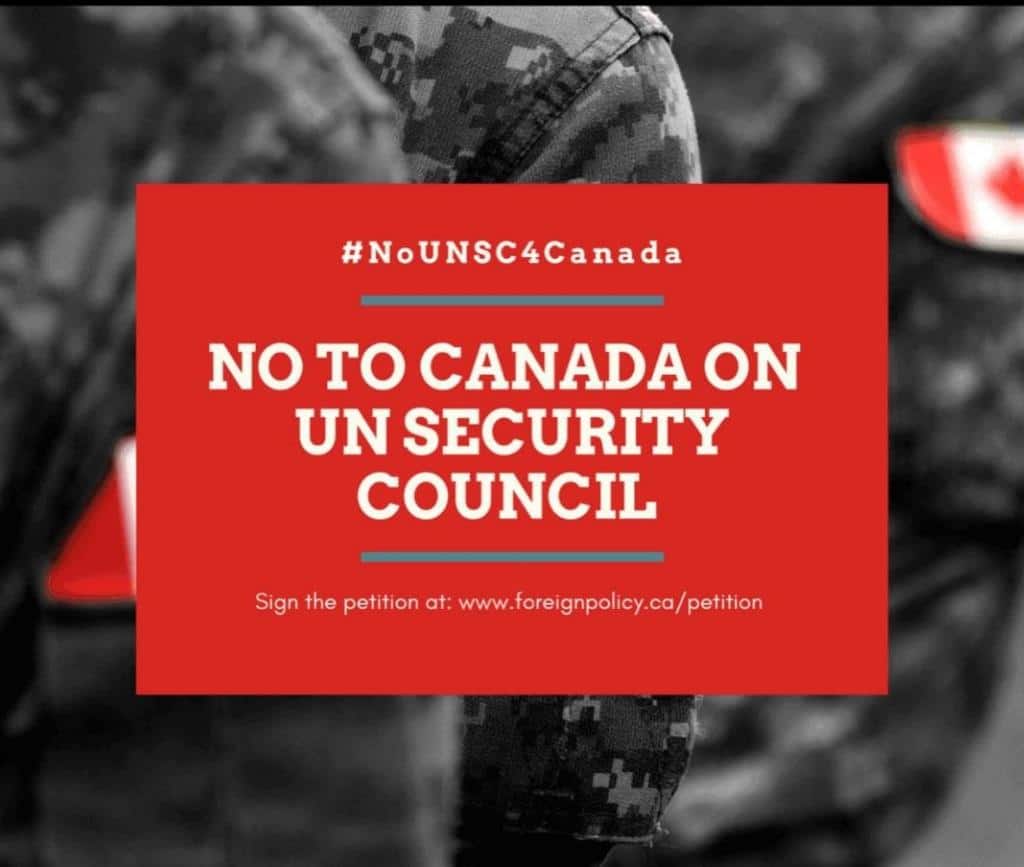
There is another important reason for the international progressive community to join us in our push-back against Trudeau. He is leading the charge to win one of the two temporary seats available to Canada on the United Nations Security Council (UNSC) for 2021. The other countries vying for these seats in the UN elections in June are Norway and Ireland. The world doesn’t need another servile ally of the US on that body. Growing opposition among Canadians to Trudeau’s UNSC bid erupted into the public arena on May 19, when one of Canada’s leading newspapers, The Star, carried the story. The article is based on a petition currently being circulated. It calls out the Canadian government for its foreign policy around the world, including toward Venezuela. Domestically, it points to Canada’s ongoing colonial policy, the latest pre-COVID-19 example being the Wet’suwet’en First Nation’s struggle in British Columbia. They stood and defended their land, sovereignty and the environment against construction of a gas pipeline on their unceded territory. This is an ongoing story to be dealt with in other parts of this Series. With respect to these issues, Trudeau replied to a journalist during his daily COVID-19 press conference on May 19, as follows (translated):
“Christian Noël, Radio-Canada [in French]: “There is an international petition that says Canada is not worthy to sit at the United Nations Security Council and a number of Canadians have even signed it. How do you respond to people who say that Canada isn’t worthy of sitting there, particularly for its position on Palestine, Venezuela and Indigenous peoples, and how can Canada continue to run its campaign and in what way is the fact that we are divided on this issue reducing our chances?”
“I think there is no division on this issue whatsoever. Canadians all want Canada to speak with a loud and reasonable voice on the international scene and that’s what we are always seeking to do.
Trudeau continues: “The United Nations Security Council is one means to ensure that our values are shared, and that we are trying to urge for better collaboration between different countries at a multilateral level, and we will be able to do that with this seat at the UN [UNSC] , but it is a means of continuing Canada’s pacts around the world and not an aim in itself. “With respect to those who do not agree with our position on Venezuela, the dictator Maduro is illegitimate and he is creating a terrible humanitarian crisis in Venezuela that is sending refugees to every country in South America, and we stand wholeheartedly with all our allies and our friends in South America in order to find a solution to this awful crisis.”
Trudeau ignored the reporter’s question on the Indigenous peoples entirely. This Series will go on to deal with accusations against the increasingly notorious Canadian treatment of First Nations issued in two United Nations reports, and even a Trudeau-appointed commission. In his response to the journalist, Trudeau also ignored Palestine, but was happy to zero in on Venezuela. His Venezuela fetish is directly linked to Trump’s Venezuela policy, and this will be developed in other parts of this Series.
For now, let us note that in his response, he just dismissed all opposition by Canadians to his UNSC campaign by declaring that there is “no division on this issue whatsoever!” One of the main features of colonialists and imperialists is their thoroughly arrogant attitude towards the peoples of the world. In this case, it includes the peoples of Canada. The world cannot afford to continue having illusions about the image of a “peaceful Canada.” Its true nature cannot be disguised by the liberal poster-boy image of a carefully-groomed Trudeau. He does not seem the least bothered by the irony of labeling Maduro a “dictator” on the one hand, while violating one of the principles of his own “democracy” on the other, by failing to acknowledge the growing protests surrounding his UNSC bid. Considering the facts above, one may conclude that Trudeau is in no position to be giving lessons in democracy to Venezuela.
RELATED CONTENT: Canadians Must Ask Questions About the Mercenary Raid on Venezuela
Colonialism at Home
“Colonialism at home, imperialism abroad” was one of the popular themes of the International Speaking Tour which discussed Canadian and American roles in Latin America. Interest was especially manifested on social media leading up to the 10th Canadian stopover in Ottawa, February 27, 2020, before the COVID-19 crisis, and during the event itself. The Ottawa meeting turned out to be the last Canadian stop for the time being, of a tour that was interrupted by the virus.
The February meeting in Ottawa took place in the midst of a Canada-wide conflict that was at the center of public attention for weeks. It dramatically pitted the Wet’suwet’en First Nations in BC, along with other First Nations and non-Native allies across Canada, against those constructing the Coastal GasLink pipeline, who were also assisted by the RCMP. #ShutDownCanada in defense of Wet’suwet’en trended on social media and in the streets across the country. Canada-wide disruptions to this Canadian colonialist endeavour was at the center of public discourse for over a month, until halted by the virus.
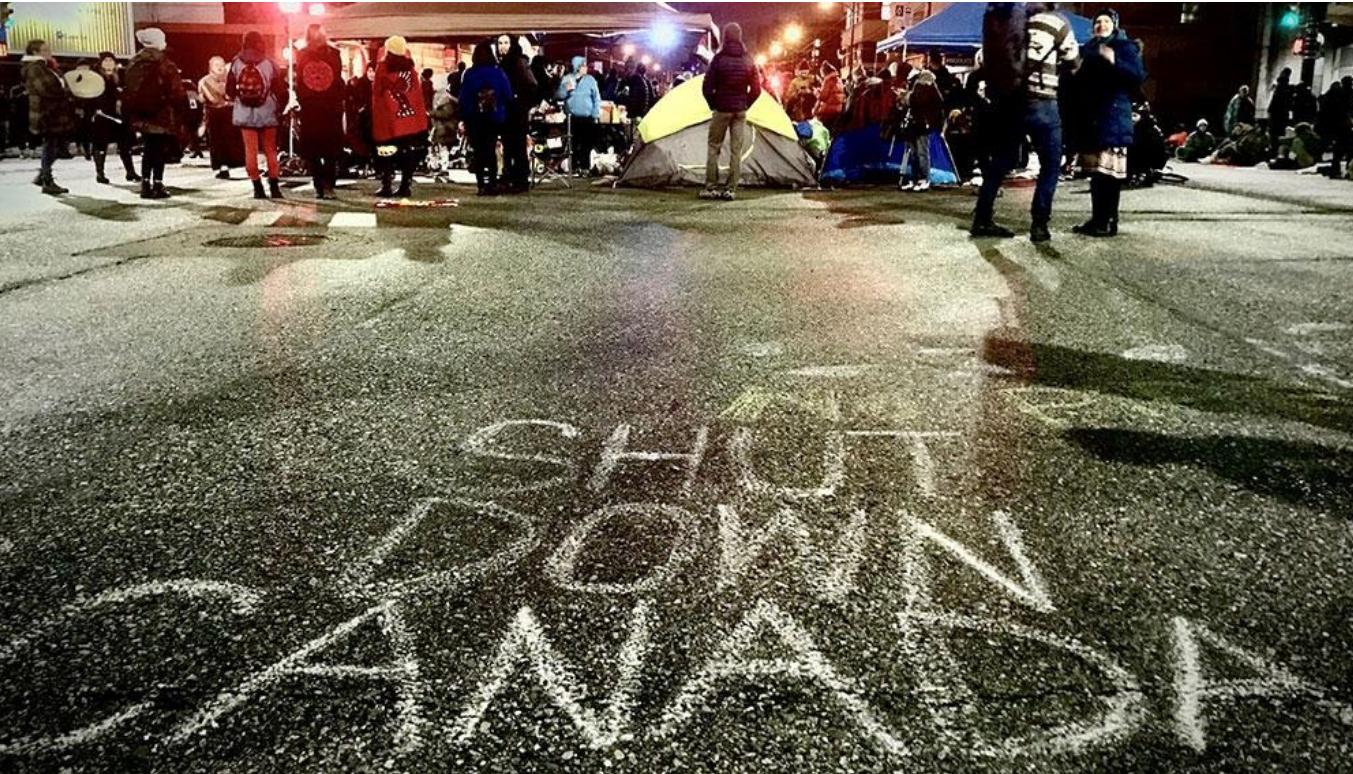
In late 2019, during the fall conferences on the International Speaking Tour, yet another anti-colonial conflict erupted, demonstrating yet again just how profound the issue of colonialism is in Canada today. This one concerned the First Nations and their allies including environmentalists in B.C., protesting against the construction of the Trans Mountain pipeline on First Nation territory. This cause also had repercussions across Canada and paved the way for the Wet’suwet’en conflict.
What has changed since the pandemic erupted? The Trudeau government’s domestic and foreign policies have both become far worse. COVID-19 has sharpened the contradictions nationally and internationally, by shining a bright light on them and making them more conspicuous. We can see a proportional increase in media disinformation by weaponizing COVID-19 to manufacture consent. For example, Trudeau was so sure he has Canadians on side that his response to the journalist’s query about opposition to his UNSC bid was a categorical denial.
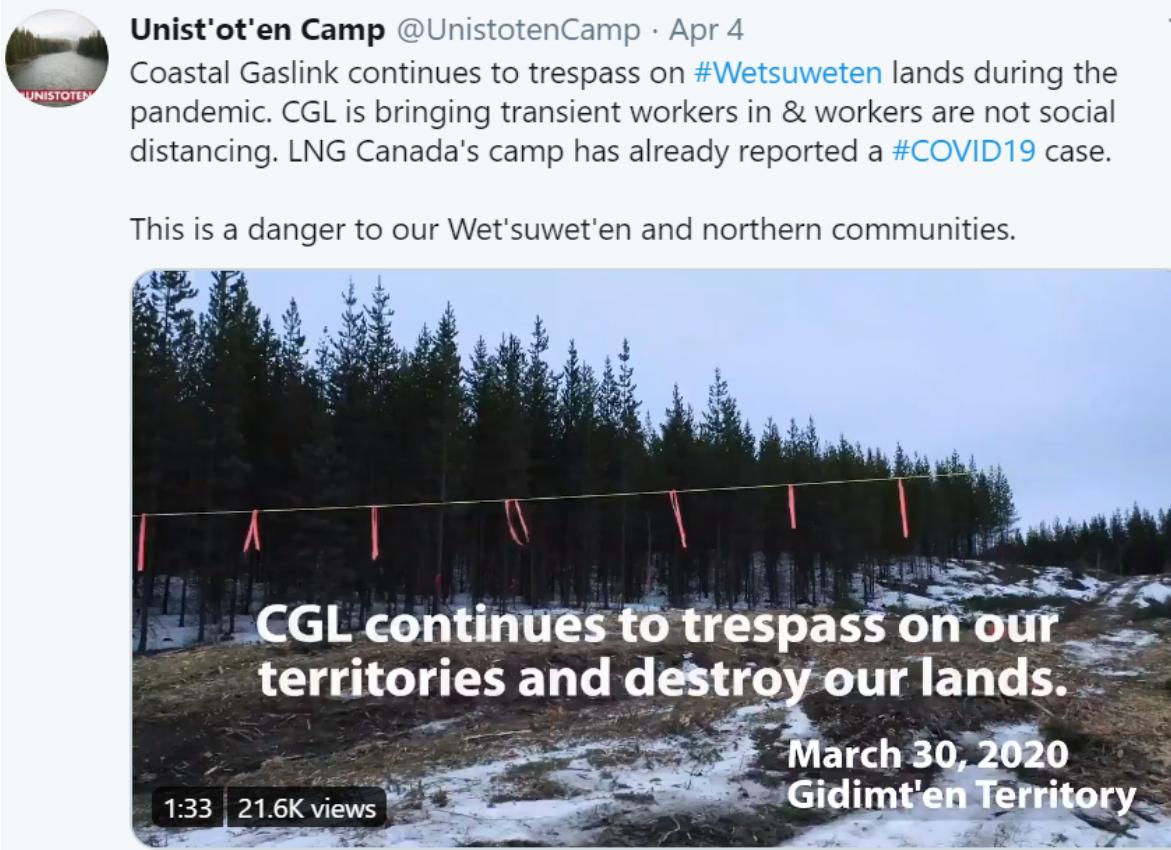
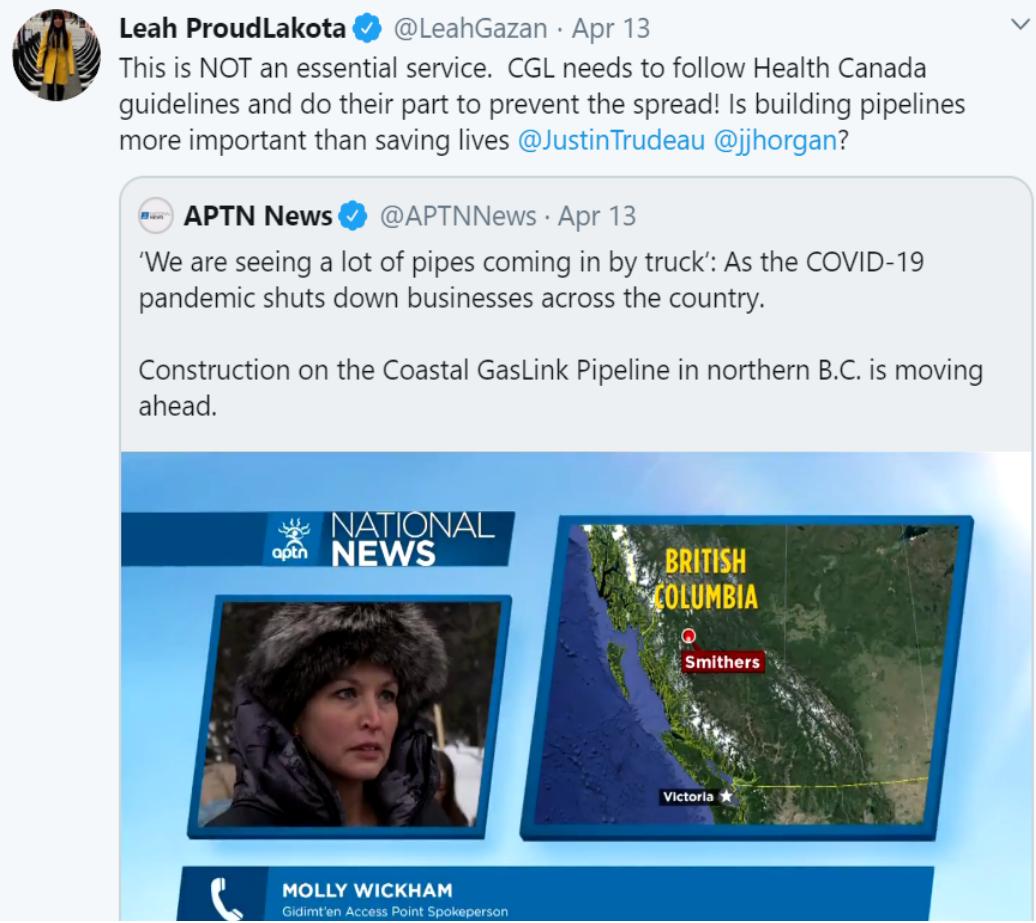
COVID-19 has not softened Canada’s colonial pursuits in any way. In the initial stages of the pandemic in mid-March, who would have guessed that while much of the country was in lock down, quarantine and social distancing, the BC government and the RCMP would again be escorting Coastal GasLink workers to the pipeline site. This was in clear violation of sovereign territory, as well as endangering local communities with imported cases of COVD-19. We would not have been aware had it not been for First Nation’s social media, their allies and some New Democratic Party Members of Parliament, such as Leah Gazan from Winnipeg.
Moreover, in the current COVID-19 period, Canada is being “opened up,” in many cases prematurely, into the “post-pandemic age” and once again, the First Nations are most affected.
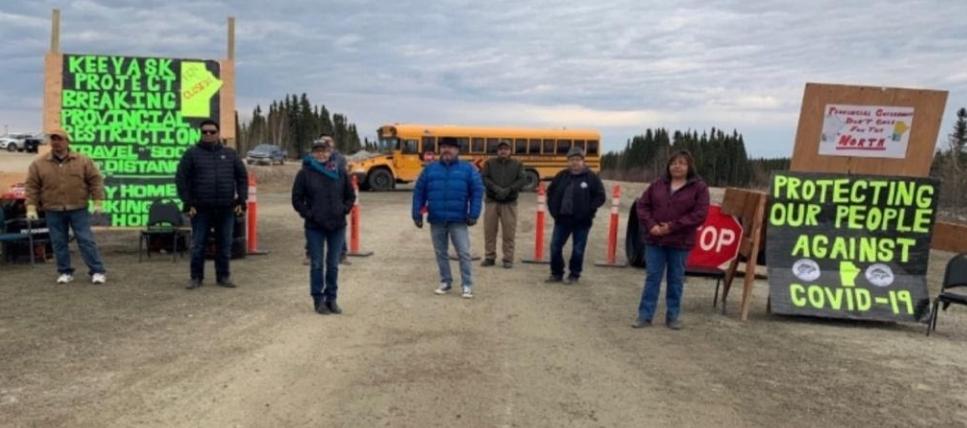
On May 19, in Manitoba,
“Leadership from Tataskweyak Cree Nation have shut down a portion of a highway in northern Manitoba leading to the Keeyask Generating Station construction camp over concerns of the COVID-19 pandemic, and will continue to block traffic despite provincial court issuing an injunction to cease blockades.
More than 1,000 workers are expected to make their way to the camp beginning Tuesday.
Nathan Neckoway, a band councillor with Tataskweyak, said the move puts First Nations at risk.”
And in Canadian “democracy”, while it moralizes with other countries, the response came on May 20:
“The Manitoba Court of Queen’s Bench has issued an injunction against a blockade into a Manitoba Hydro work site in Northern Manitoba.
However, members of northern Manitoba First Nations who are worried about the spread of COVID-19 say they will maintain the blockade.
“Is life more important than a job? If that virus comes into our area and people start getting sick, they won’t be able to work,” Tataskweyak Cree Nation band councillor Nathan Neckoway said…”
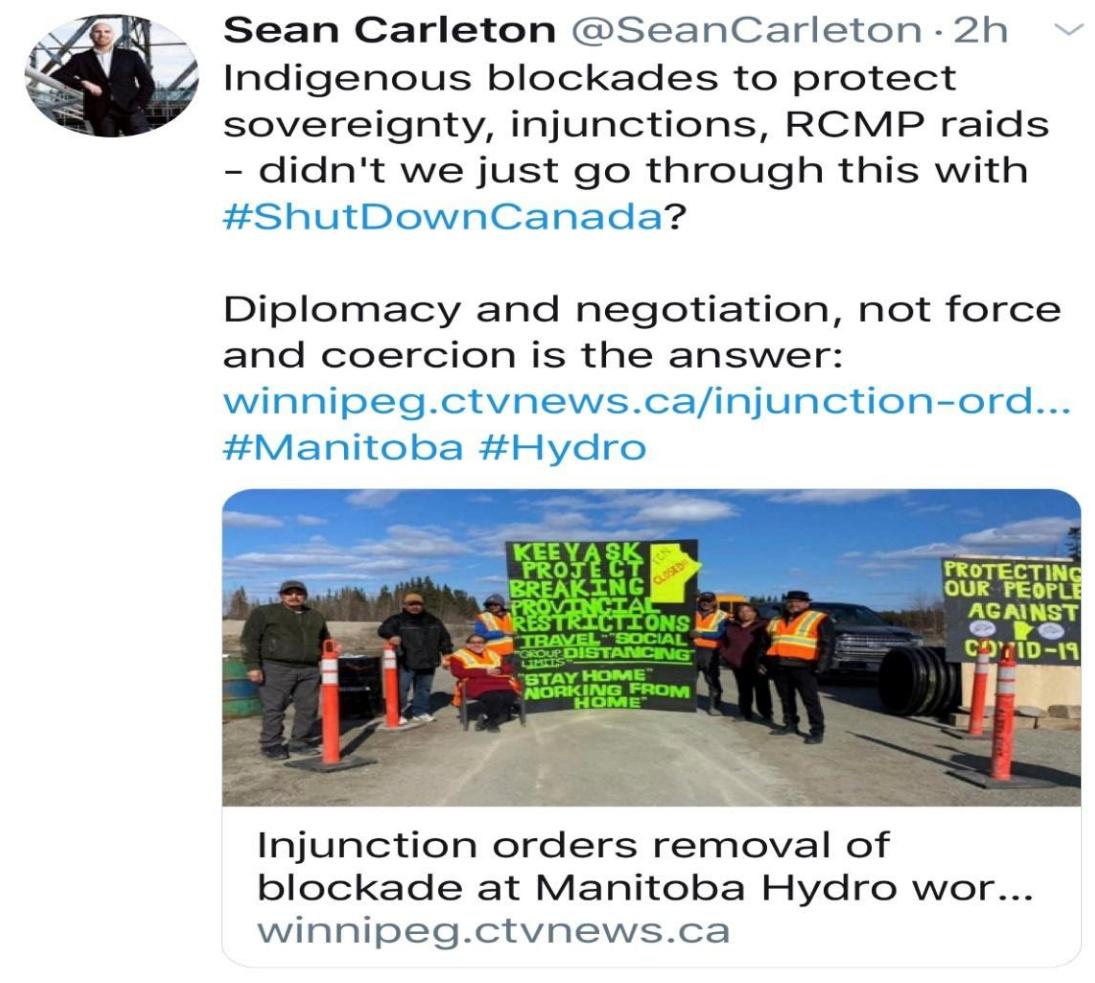
The situation as it is evolving in Manitoba, even prompted one of Canada’s top experts on First Nations and settler colonialism, Sean Carleton, to ask rhetorically if we are heading into another #ShutDownCanada period.
RELATED CONTENT: Canada May Covet Seat at the UN Security Council But it’s Far From a Sure Bet
On May 22, according to the Globe and Mail, “Tensions are still rising.”
One of the main Canadian corporate media went on to quote Indigenous Chief Spence in opposition to the often maligned “blockade” and taking into consideration that none of Manitoba’s 292 cases are in the province’s First Nations or northern communities:
The article quotes the Chiefs:
“We just prefer the word ‘lockdown’ now, because we’re trying to lock out this COVID-19 virus.”
On May 22, in his daily presser, Trudeau was asked about the communities’ right to protect their members using the barricades. As usual he was conveniently non-committal:
“We need to make sure that all different orders of government, including Indigenous governments, are working together with the same goal, which we all share, which is keeping Canadians as safe as possible, recognizing that certain communities and certain individuals are more vulnerable,” he said
Trudeau’s daily message that “we are all in this together” and “solidarity” in the abstract overlooks the injunction that was delivered by the RCMP to the First Nation to take down the lockdown. This Canadian Government “peaceful” narrative is dealt with in ensuing parts of this Series. In the same way, ensuing parts in this Series deals further with the Manitoba Hydro construction issue and similar First Nation examples of resistance to Covid–19 contamination in this period which is being heralded by the mainstream media as the beginning of the post–Covid period.
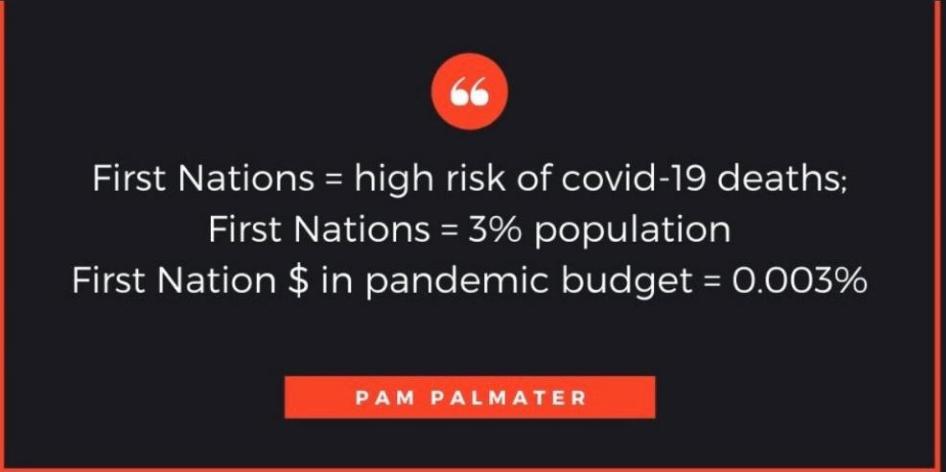
First Nations: 3% of Population but 0.003% of Funding
In addition, back in March, First Nations writer, activist and Mi’kmaq citizen Pam Palmater, gave a voice to the First Nations when she reported what Indigenous people knew by instinct. The pre-COVID-19, underfunded and colonially oppressed First Nations are at high risk to succumb to COVID-19 as a result of their inferior historical socio-economic situation. Now, in the COVID-19 period, they are woefully underfunded: while representing 3% of the population of Canada, they receive only 0.003% of the Trudeau pandemic budget.
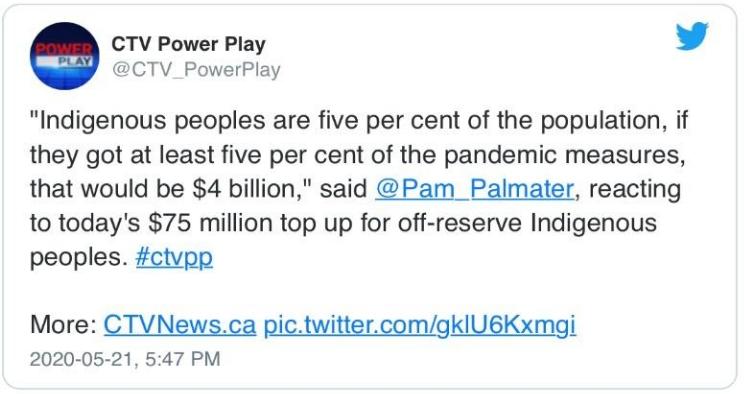
Here we are in May and despite all the paternalistic Trudeau statements and meagre funding allotments to struggling First Nations, his May 21 press conference highlighting the funds was greeted with:
Cuba and First Nations: A Flagrant Fusion of Colonialism and Imperialism
On March 27, Manitoba First Nations’ Chiefs sent an official request to the Trudeau government for assistance being offered by Cuban doctors. In his March 28 press conference, Trudeau failed to mention it. Nor did he mention it on March 29 or 30. It also seemed that no journalist dared ask him.
However, on March 31 one journalist did venture to ask Deputy Prime Minister Crystia Freeland during her daily press conference:
CBC reporter Jorge Barrera: “Minister Freeland, there has been some First Nations leaders, particularly the southern Chiefs organization in Manitoba who would like to see Cuban doctors come in to help deal with the potential outbreaks in their communities. I’m just wondering how your government feels about this request.”
Crystia Freeland: “Our government has every confidence in the excellence of the Canadian medical system, in the excellence of Canadian healthcare workers. People have been hearing over the past few days a lot from Mark Miller, the Minister charged with Indigenous Services, and he has really been emphasizing the extent to which the government is aware of the particular vulnerabilities Indigenous communities face. So, I have huge faith and trust in Canadian frontline medical workers. They’re doing a great job and they are going to continue doing that. I wonder if Doctor Tam wants to say anything more about our medical workers?”
Dr. Tam: “I certainly work very closely with the Chief Medical Officer of Indigenous Services Canada and absolutely, if there’s any request and need, there are mechanisms in place. We also have mechanisms for mutual aid between different jurisdictions and should that be required it can also be channelled through the Public Health Agency of Canada.”
CBC reporter Jorge Barrera: “Yes, so, what I’m hearing is that, through the mutual aid it is possible to bring in Cuban doctors to help if particular First Nations want that help. Because there’s reports of doctors being pulled out to deal with other regions. I’m just wondering if this is something that is a possibility on the table right now.”
Freeland: “Let me just say, and be very clear, that we are very confident that Canada’s healthcare system, which is staffed by outstanding healthcare professionals, has the capacity to deal with this extraordinary challenge. Our job as the government is to work very hard to provide our healthcare system with all the resources it needs to take care of Canadians. Indigenous and non-Indigenous and we are very aware of the particular challenges’ vulnerable communities face.”
Neither Chief Public Health Officer Dr. Theresa Tam nor Chrystia Freeland answered the question. By so doing, they side-stepped the Indigenous request and ignored the issue of Cuba. Instead, they both went on to laud the Canadian health system. It was a cover-up hiding an obvious truth. The Canadian rejection of the Manitoba Chiefs’ request is the result of deliberate Trudeau government policy to conform with the Trump administration and thus prevent Cuban medical brigades form serving abroad.
From the US:
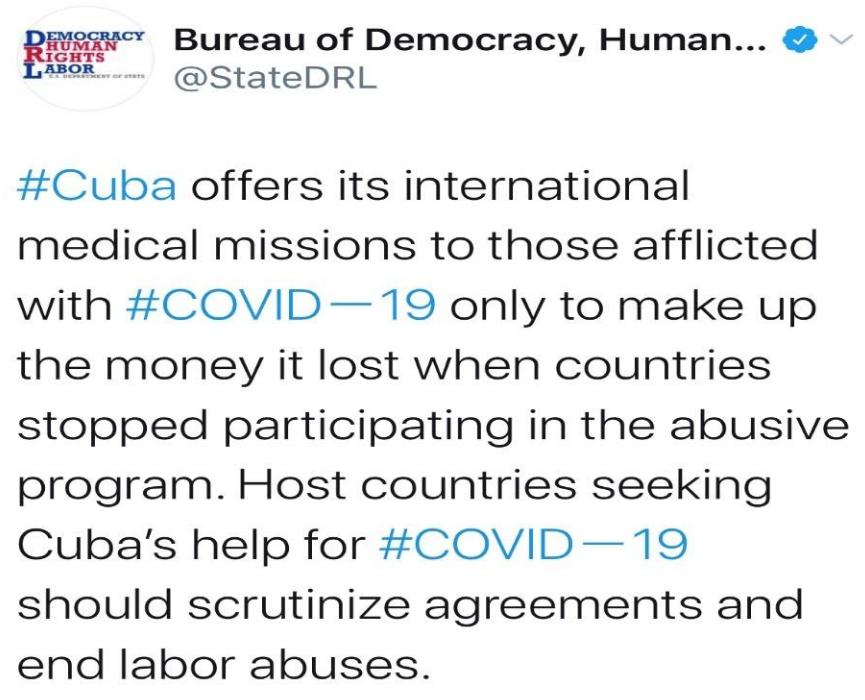
This is part of the Trump administration’s long-standing and cynical disinformation war on Cuban medical brigades, predating COVID-19. During the current COVID-19 period, the US has even ratcheted this up with almost weekly tweets and statements against the Cuban international medical efforts to fight the pandemic. Canada obediently bowed. This article provides a thorough refutation of the Trump allegations which Trudeau chose to indirectly support.
Trump applauds those countries that refuse to take doctors (US allies such as Brazil, Bolivia and Ecuador), while denouncing others such as South Africa and Qatar who have invited Cuban medical brigades.
The Trudeau government is siding with the Trump administration, even if it negatively affects the First Nations in Canada. The controversy surrounding the Trudeau government’s choosing to ignore the Manitoba Chiefs’ request is another clear example of the flagrant fusion of colonialism at home, imperialism abroad. It simply confirms how the long-standing policies of colonialism at home and imperialism abroad are well and truly linked. Furthermore, it is an indication as to why there is significant opposition in Canada to the Trudeau government’s campaign for a seat on the UNSC, even if Trudeau himself denies it.
OT/AA (exclusive for Orinoco Tribune)

Arnold August is a Canadian journalist and lecturer, the author of Democracy in Cuba and the 1997–98 Elections, Cuba and Its Neighbours: Democracy in Motion and Cuba–U.S. Relations: Obama and Beyond. As a journalist, he collaborates with many websites in Latin America, Europe, North America and the Middle East. He is a contributor to Orinoco Tribune. His website: www.arnoldaugust.com