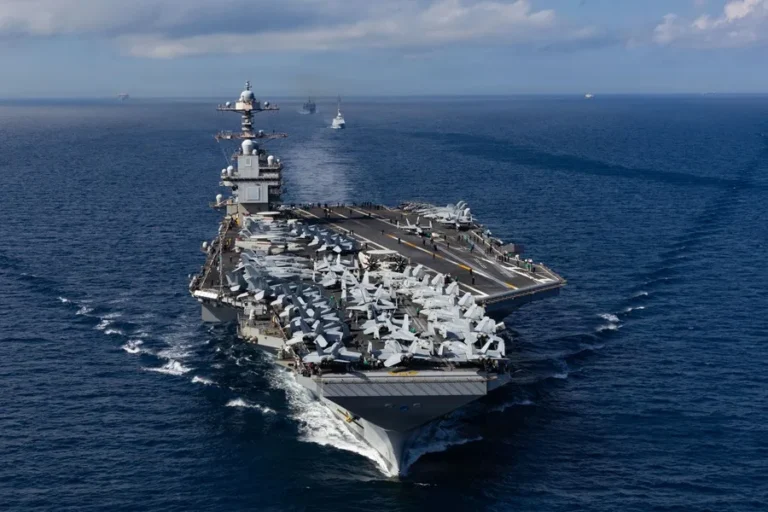
The USS Gerald R. Ford, in the Strait of Gibraltar. Photo: US Navy/Getty Images.
The USS Gerald R. Ford, in the Strait of Gibraltar. Photo: US Navy/Getty Images.
US Caribbean military costs surpass 20 million dollars daily under Operation Southern Spear, with USS Gerald R. Ford strike group alone at 11.4 million, diverting funds from domestic needs amid regional tensions.
US Caribbean military costs have reached staggering levels under the ongoing deployment known as Operation Southern Spear (Lanza del Sur). Recent estimates place daily operational expenses above 20 million dollars at peak periods from mid-November 2025 to mid-January 2026.
This massive outlay supports a naval buildup that at times concentrated 20 percent of the U.S. Navy’s surface fleet in the region. The effort projects power while targeting perceived threats to U.S. interests, including drug trafficking and sanctioned regimes.
At the core stands the USS Gerald R. Ford carrier strike group. Its daily operations, including escorts like destroyers and submarines, run approximately 11.4 million dollars. This covers crew salaries, fuel for aircraft, maintenance, and readiness.
Additional forces amplify the burden. Amphibious response groups, featuring the USS Iwo Jima and Marine contingents, add roughly 8.59 million dollars per day. Logistics and support vessels contribute another 1 million dollars daily.
Geopolitical Context
US Caribbean military costs reflect a broader strategy of coercion in Latin America and the Caribbean amid shifting global power dynamics. Operation Southern Spear, launched in late 2025 under President Trump, initially targeted drug trafficking but expanded to include the January 3, 2026, capture of Venezuelan President Nicolás Maduro.
This intervention, followed by oil seizures and threats against Cuba, Colombia, and Mexico, challenges regional sovereignty and revives memories of past U.S. interventions. The high financial toll—potentially billions overall—diverts resources from domestic priorities while straining alliances. It risks inflaming anti-U.S. sentiment across the Global South, accelerating multipolar alignments with China and Russia. Persistent presence undermines diplomatic solutions, heightens migration pressures, and tests international law, as unilateral actions bypass multilateral frameworks like the OAS or UN.
The Ford Strike Group’s Heavy Burden
The USS Gerald R. Ford, the Navy’s newest supercarrier, anchors the deployment. Its advanced systems demand intensive support.
Daily expenses encompass nuclear propulsion maintenance, extensive air wing operations, and constant patrols. Estimates from defense analysts place standalone carrier costs at 6 to 8 million dollars per day, rising sharply with full strike group assets.
Escort ships protect the carrier while conducting intercepts. Submarines provide stealth surveillance. Together, they form a formidable presence.
This concentration marks an unprecedented commitment. Rarely has such a proportion of surface combatants operated in Caribbean waters simultaneously.
Amphibious and Support Elements Add to Expenses
The USS Iwo Jima amphibious assault ship plays a pivotal role. It supports Marine Expeditionary Units for rapid response.
Daily costs for the Iwo Jima group reach 8.59 million dollars. This includes Marine sustainment, helicopter and Osprey operations, and deck maintenance.
Logistics vessels ensure steady resupply. Fuel, munitions, and spare parts flow continuously, preventing shortages during extended missions.
Since August 2025, ammunition and weapons replenishment alone exceeded 2 billion dollars. Unplanned escalations drive budgets up by 10 percent or more.
Congressional Scrutiny and Budget Strains
Lawmakers label the strategy extremely costly. The scale of forces deployed raises questions about fiscal responsibility.
Pentagon budgets lack dedicated contingency funds for such operations. Overruns force reallocations or supplemental requests.
Taxpayers ultimately bear the load. Resources shift from social programs to sustain military posture abroad.
Critics argue priorities favor coercion over cooperation. Diplomacy and mutual respect could achieve stability at far lower cost.
Related Link: For detailed analysis of U.S. military operations in the Caribbean and associated costs, see Bloomberg’s reporting on Trump’s Caribbean Surge
Broader Policy Implications
US Caribbean military costs underscore a preference for force projection. The deployment aims to restore questioned hegemony.
It responds to challenges from sovereign nations pursuing independent paths. Control over resources and influence takes precedence.
The astronomical spending reveals systemic priorities. Territorial dominance overshadows peaceful collaboration.
Regional voices condemn the approach. It erodes trust and fuels resistance to external domination.
As costs mount, pressure grows for reevaluation. Sustainable diplomacy offers alternatives to endless expenditure.
The operation continues amid debate. Its financial weight highlights tensions between ambition and fiscal reality.
US Caribbean military costs serve as a stark reminder. Military solutions carry heavy price tags—both monetary and diplomatic.
(teleSUR)