By W.T. Whitney – Oct 13, 2021
Chilean author and human rights advocate Ariel Dorfman recently memorialized Orlando Letelier, President Allende’s foreign minister. Agents of dictator Augusto Pinochet murdered Letelier in Washington in 1976. Dorfman noted that Chile and the United States were “on excellent, indeed obscenely excellent, terms (like they are today, shamefully, between the United States and the corrupt regime in Honduras).”
The Honduran government headed by president Juan Orlando Hernández does have excellent relations with the United States. The alliance is toxic, however, what with the continued hold of capitalism on an already unjust, dysfunctional society. Hondurans will choose a new president on November 28.
Honduras, a dependent nation, is subject to U.S. expectations. These center on free rein for businesses and multi-national corporations, large foreign investment, low-cost export goods, low wages, foreigners’ access to land holdings and sub-soil resources, and a weakened popular resistance.
Meanwhile, the U.S. government casts a blind eye on Hernández’s many failings. These include: fraud and violence marking his second-term electoral victory in 2017, an illegal second term but for an improvised constitutional amendment, testimony in a U.S. court naming him as “a key player in Honduras’ drug-trafficking industry” and, lastly, his designation by U.S. prosecutors as a “co-conspirator” in the trial convicting his brother Tony on drug-trafficking charges.
Some 200 U. S. companies operate in Honduras. The United States accounted for 53% of Honduras’s $7.8 billion export total in 2019. U.S goods, led by petroleum products, made up 42.2 % of Honduran imports.
Honduras’s Economic Development and Employment Zones (ZEDE) reflect planners’ exuberant imagination. They envision privately owned and operated “autonomous cities and special investment districts” attracting foreign investment and welcoming tourist and real estate ventures, industrial parks, commercial and financial services, and mining and forestry activities.
RELATED CONTENT: Turkey Denounces Sanctions Against Nicaragua and Strengthens Cooperation
Banks and corporations active in the ZEDEs will appoint administrative officers, mostly from abroad and many from the United States. They, not Honduras’s government, will devise regulations and arrangements for taxation, courts, policing, education and healthcare for residents.
The first ZEDEs are taking shape now. The idea for them cropped up following the military coup in 2009 that removed president Manuel Zelaya’s progressive government. Hernández, as congressional leader and as president from 2014 on, led in promoting them. Honduras’s Congress in 2013 amended the Constitution to legitimize legislation establishing the ZEDEs. The recent end of litigation before the Supreme Court resulted in their final authorization.
For most Hondurans, who are treated as if they were disposable, capitalism has its downside.
Honduras’s poverty rate is 70%, up from 59.3% in 2019. Of formally employed workers, 70% work intermittently; 82.6% of Honduran workers participate in the informal sector. The Covid-19 pandemic led to more than 50,000 businesses closing and almost half a million Hondurans losing their jobs. Some 30,000 small businesses disappeared in 2020 owing to floods caused by hurricanes.
Violence at the hands of criminal gangs, narcotraffickers, and the police is pervasive and usually goes unpunished. Victims are rival gang members, political activists, journalists, members of the LGBT community, and miscellaneous young people. According to insightcrime.org, Honduras was Latin America’s third most violent country in 2019 and a year later it registeredthe region’s third highest murder rate. Says Reuters: “Honduras has become a sophisticated state-sponsored narco-empire servicing Colombian cartels.”
Associated with indiscriminate violence, corruption, and narco-trafficking, Honduras’s police are dangerous. President Hernández eight years ago created “The Military Police for Public Order” (PMOP), the Interinstitutional National Security Force, and the “Tigres” (Tigers). These are police units staffed either by former soldiers or by “soldiers … specializing in police duties.” Police in Honduras numbered 13,752 in 2016 and 20,193 in 2020.
Honduras’s military has grown. Defense spending for 2019 grew by 5.3 %; troop numbers almost doubled. For Hernández, according to one commentator, “militarism has been his right arm for continuing at the head of the executive branch.” The military forces, like the police, are corrupt, traffic illicit drugs, and are “detrimental” to human rights. The looming presence of security forces is intimidating as they interfere, often brutally, with voting, protest demonstrations, and strikes.
According to Amnesty International, “The government of … Hernández has adopted a policy of repression against those who protest in the streets … The use of military forces to control demonstrations across the country has had a deeply concerning toll on human rights.”
The U.S. government has provided training, supplies, and funding for Honduras’s police and military. Soto Cano, a large U.S. air base in eastern Honduras, periodically receives from 500 to 1500 troops who undertake short-term missions throughout the region, supposedly for humanitarian or drug-war purposes.
Not only does serious oppression exist, but, according to Reuters, severe drought over five years has decimated staple crops [and] … Nearly half a million Hondurans, many of them small farmers, are struggling to put food on the table.” The UN humanitarian affairs agency OCHA reports that as of February 2021, “The severity of acute food insecurity in Honduras has reached unprecedented levels.”
For the sake of survival, many Hondurans follow the path of family and friends: they leave. Among Central American countries, Honduras, followed by Guatemala and Mexico, registered the highest rate of emigration to wherever between 1990 and 2020. The rate increases were: 530%, 293%, and 154%, respectively. Between 2012 and 2019, family groups arriving from Honduras and apprehended at the U.S. border skyrocketed from 513 in 2012 to 188,368 in 2019.
The undoing of Honduras by U.S. imperialism follows a grim pattern, but is also a special case. Rates of migration from Central American countries to the United States correlate directly with levels of oppression and deprivation in those countries. As regards hope, the correlation is reversed.
Differing rates of apprehension of Honduran and Nicaraguan migrants at the U.S. southern border are revealing. Capitalist-imbued Honduras specializes in oppression, while optimism is no stranger in a Nicaragua aspiring to socialism.
Department of Homeland Security figures show that between 2015 and 2018 the yearly average number of Nicaraguans apprehended at the border was 2292. The comparable figure for Hondurans was 63,741. Recently the number of Nicaraguan migrants has increased; 14,248 presented themselves at the border in 2019 – as did 268,992 Honduran refugees.
Recent reflections of Carlos Fonseca Terán, the FSLN international secretary, show why hope has persisted in Nicaragua. He points out that, since 2007, poverty, inequality, illiteracy, infant mortality, and murders have dropped precipitously. Citizens’ safety, electrification, renewable energy sources, women in government, healthcare funding, and the minimum wage have increased, markedly. Fonseca adds that the “percentage of GDP produced … under associative, cooperative, family and community ownership went from less than 40% to more than 50%.”
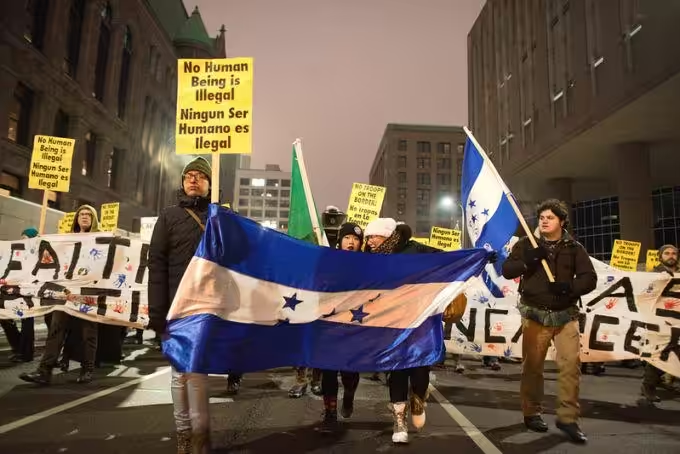
Featured image: Photograph Source: Fibonacci Blue – CC BY 2.0