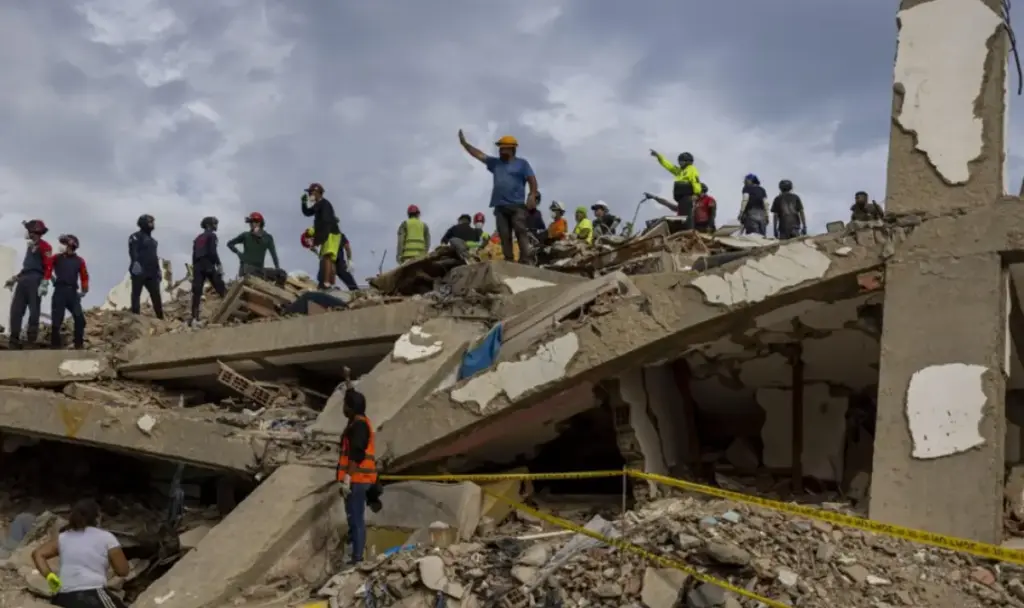
Rescue personnel search for survivors in the debris of a collapsed building. Photo: EFE.
Rescue personnel search for survivors in the debris of a collapsed building. Photo: EFE.
This July 24, 2026 marks exactly one month since a 7.2- and 7.5-magnitude double earthquake shook the central-northern axis of Venezuela, leaving a trail of unprecedented destruction and damage in La Guaira, Caracas, Carabobo, Miranda, Aragua, and Falcón.
The citizens’ response was crucial in the early hours of the event. Residents of areas like Catia La Mar and Caraballeda—in La Guaira, the hardest-hit state—organized human chains to remove debris with basic tools and managed to rescue hundreds of people.
The government’s first measures were the declaration of an emergency, the dispatch of heavy machinery and hundreds of rescuers to La Guaira, the call for healthcare personnel to return to their posts, and the activation of the digital platform VenApp to report missing persons and structural damage. A week of national mourning was also declared.
The official toll confirms 5,398 dead, 16,740 injured, and thousands missing under the rubble after the catastrophe, with the highest lethality in Caracas and the central coast of La Guaira, considered “Ground Zero.” Just 39 seconds separated the two earthquakes.
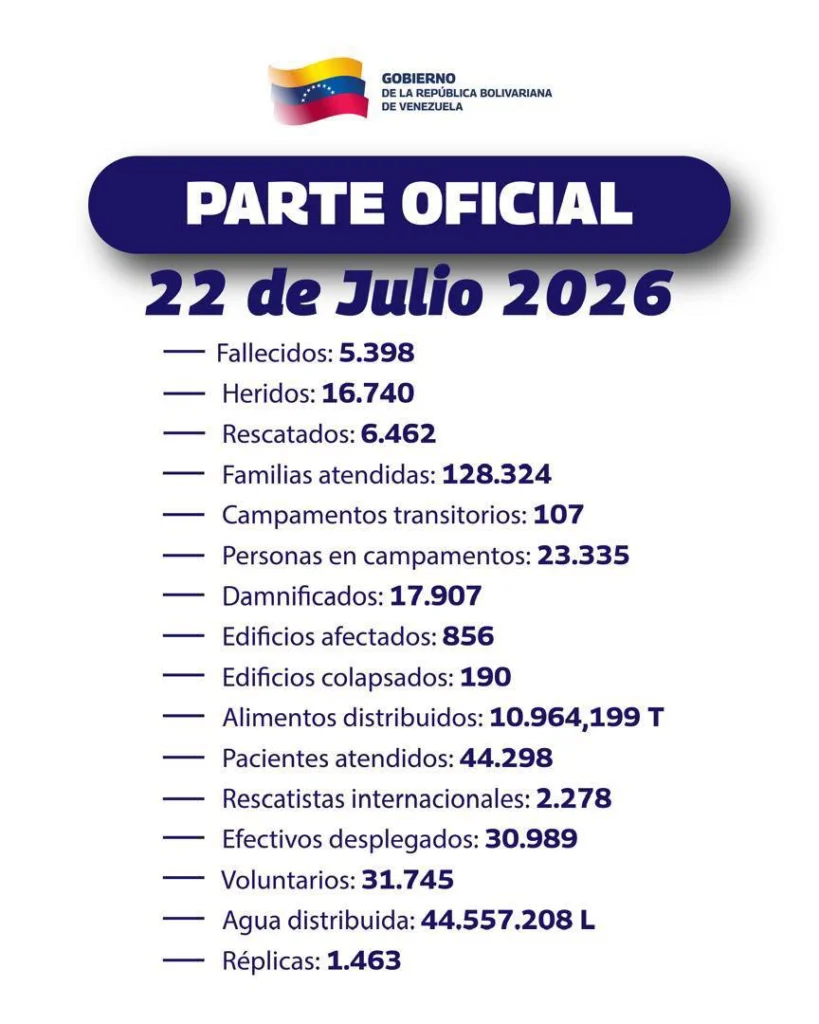
Nevertheless, the response to assist the affected remains steadfast one month after the tragedy. According to official figures, nearly 6,500 victims have been rescued from under the rubble, and over 128,000 families have been assisted so far.
Currently, around 23,122 people are living in the 107 temporary camps set up by the authorities. One month after the tragedy, the Venezuelan government has already delivered the first 200 apartments to the affected families.
As part of the support efforts, 31,745 volunteers are involved, and 30,989 personnel remain deployed on the ground. There are still 2,278 international rescuers in Venezuela.
As for infrastructure damage, 190 buildings suffered total collapse, and another 856 suffered severe damage. Meanwhile, there have been more than 1,400 aftershocks, keeping the people in a state of permanent alert.
The Bolivarian National Armed Force (FANB) plays a strategic role in La Guaira, facilitating access to technical resources, civil protection, and fire department personnel.
Moreover, the authorities have designated a cemetery to give a proper burial to the victims, allowing the affected families to bid farewell to their deceased relatives.
Venezuela’s Minister Garcés: 6,907 Buildings Evaluated in La Guaira
Under the slogan “Venezuela Reborn,” the efforts remain active and stronger than ever to continue helping those affected. The unity of Venezuelan society, volunteers, and the government remains strong as they continue providing the necessary support to the victims.
It is projected that 4,000 homes will be delivered to earthquake victims this year. Meanwhile, over 10,000 housing solutions are expected by 2027 through the completion of pending constructions, the purchase of properties in the secondary market, the review of land, and reforms to the Leasing and Real Estate Guarantees Law to boost the rental supply.
Venezuela is slowly rising from the tragedy that caused national and international shock, being one of the most impactful seismic events in world history.
(Telesur)
Translation: Orinoco Tribune
OT/SC/SF