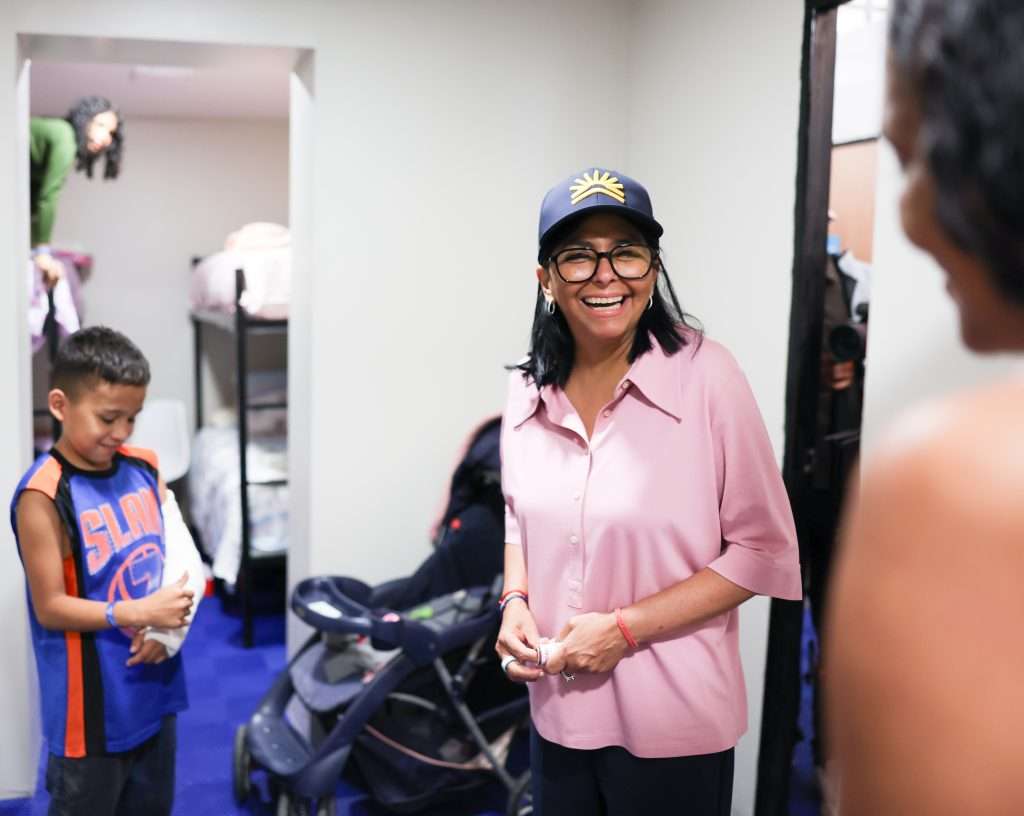
Venezuelan Acting President Delcy Rodríguez speaks to an earthquake-affected family relocated to the Poliedro de Caracas. Photo: Presidential Press.
Venezuelan Acting President Delcy Rodríguez speaks to an earthquake-affected family relocated to the Poliedro de Caracas. Photo: Presidential Press.
The acting president of Venezuela, Delcy Rodríguez announced the start of the relocation process for families who lost their homes in the June 24 double earthquakes. The measure, announced on Tuesday, August 25, aims to vacate the temporary camps located in educational institutions and move the affected people to single-family units that ensure greater privacy.
At an event at the Poliedro de Caracas, Rodríguez announced that the relocation of the people from schools to the temporary camps at the Poliedro de Caracas and the Estadio Monumental de Caracas have already begun. Both facilities have single-family units equipped with comprehensive care services and greater privacy.
She highlighted the importance of vacating the schools to ensure the start of the new school year. “We are in this process: delivering new homes, relocating families, and vacating schools in the Valle-Coche area. 80% of the schools that were being used as shelters are already being vacated for the return of students to classes,” she said.
“We need to vacate the schools, start the process for the people who are in temporary camps in schools, relocate them to spaces where they have privacy,” she added. “These are single-family spaces, and the schools can again be available for the return to classes. We are at the Poliedro, but we are also setting up [the units] at the Estadio Monumental de Caracas.”
She detailed that the Estadio Monumental was adapted to accommodate 1,023 people in single-family structures, while a special tent was set up at the Poliedro to receive 200 people.
Promulgation of Law on the Promotion and Protection of Housing Construction
The acting president signed the Law on the Promotion and Protection of Housing Construction and thanked the National Assembly deputies for their work.
“This law aims to promote housing development, and remove any type of obstacle, limitation, or bureaucratic complexity, to ensure greater availability of housing for the access of people — the Venezuelan people,” she said.
She stated that the law will facilitate the work of private investment to complement the state’s efforts in housing. She emphasized that Venezuela is a country with high seismic activity, so public policies should be oriented under this premise.
Acting President Delcy Rodríguez Orders Civil Protection Activation as Tropical Storm Hits Venezuela
Rodríguez stressed that the affected families may rest assured that they will receive their housing, as the government is implementing a comprehensive plan on various fronts.
“Construction of new homes, finishing the homes of the Great Venezuela Housing Mission,” she said in this regard. “We are constructing new homes, completing existing ones, and rehabilitating those that can be rehabilitated to provide a multidimensional and global approach to the housing problem. That is why this law is so important, because it will help not only with the situation caused by the double earthquake, but also with the housing problem that Venezuelans, Venezuelan women, and families who still do not have housing are facing. So let us go together, let us keep marching in this joint effort.”
Translation: Orinoco Tribune
OT/SC/SH