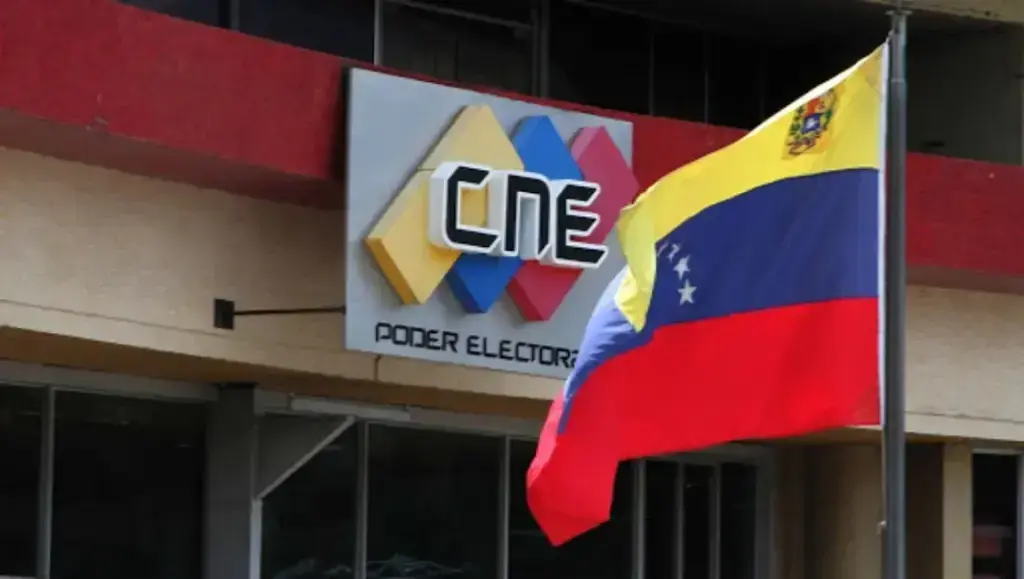
Venezuela's National Electoral Council offices. Stock photo.
Venezuela's National Electoral Council offices. Stock photo.
By José A. Amesty Rivera – Aug 24, 2026
There are moments in the history of nations when politics cease to be merely a discussion between leaders, parties, or ideological currents and become something much deeper: a defense of sovereignty.
Venezuela is experiencing one of these moments, and therefore, we cannot analyze what is happening solely from the perspective of internal differences within the Chavista movement, from social media, or from the opposing positions within the left. We must look at the complete picture.
In Venezuela, there is a reality that some sectors of the left seem to forget: the country has been subjected for years to intense political, economic, and geopolitical pressure from the United States and its allies. When a country possessing the world’s largest oil reserves, along with gold, gas, and a strategic position on the continent, is subjected to sanctions, blockades, threats, and political maneuvering, it becomes difficult to maintain that everything happening within its borders is simply a consequence of its leaders’ mistakes.
Of course, mistakes exist, problems exist, things must change, and leaders must be questioned. The left cannot become a movement where criticizing the government is considered a mistake, but nor can we fall into the other extreme and end up conducting political analyses that, under a supposed revolutionary purity, coincide with the objectives of those who have historically sought to weaken Venezuelan sovereignty.
It is one thing to criticize the Bolivarian Government of Venezuela and quite another to contribute to generating despair in a people who have been facing intense external pressure for years. There are comrades on the left who today speak of betrayal, of a definitive break, and of the absolute failure of the process.
Some even seem to have forgotten that for years, they were part of the political structures they now question, and this does not mean that they do not have the right to criticize; of course they do. What we must ask ourselves is where that criticism leads politically, and above all, who it ultimately benefits.
Because, when a people is under pressure and constantly repeating that all is lost, it can become, even unintentionally, a useful tool for the adversary.
This is precisely what we must understand when we talk about cognitive warfare; it is no longer just about bombs, invasions, or soldiers. It is also about contesting people’s perceptions, their hope, and their trust.
The aim is to convince the people that their own organization is useless, that their leaders are all traitors, that there is no way out, and that any alternative is better than continuing to resist.
Despair can also become a political instrument, and Venezuela has enough experience in this arena to know better than to ignore it.
Chavismo, with all its problems and contradictions, retains something its adversaries have been unable to destroy: an organized popular base, a political identity, and a territorial structure built over decades. This largely explains the resilience of the Bolivarian process and also helps explain why some international actors have such a vested interest in dividing it.
On the other hand, the Venezuelan opposition knows that facing an organized Chavismo in elections is not the same as receiving political support from abroad.
For years, some opposition sectors relied on international pressure, sanctions, and foreign intervention instead of building a political alternative capable of competing at the ballot box. Because the reality is that, sooner or later, politics end up returning to the electoral arena.
And here we find one of the most important issues of the moment. The constitutional and electoral path is not a concession from Chavismo; it is part of the very political conception that Chávez defended. If constitutional mechanisms exist to resolve differences, they must be used. If there are elections, one must participate. If the opposition believes it has a majority, it must demonstrate it at the ballot box, and if Chavismo wants to continue governing, it must also demonstrate it to the people. This is democracy.
What cannot be accepted is that the will of the Venezuelan people be replaced by the will of a foreign power. Herein lies one of the central problems.
The United States cannot be the one to decide who governs Venezuela, who manages Venezuelan oil, or who controls Venezuelan gold. It cannot decide which institutions are legitimate and which are not, and much less can it appropriate the assets of a sovereign nation only to then present itself as a defender of democracy. The contradiction is all too obvious.
For this reason, we must also closely examine the political negotiations currently underway. If sectors of the opposition begin to return to the constitutional framework, if they agree to dialogue with existing institutions, and if they participate again in electoral processes, this could be an opportunity for Venezuela to gradually recover some political normalcy. Some may see this as a weakness; we see it differently.
Bringing the adversary onto the ground where one has organization and political strength can also be a strategy. If the opposition wants elections, let them participate. If they want governorships, mayoralties, municipal councils, legislative councils, or other institutional positions, let them compete for them with votes. And if Chavismo has the majority, it will have to demonstrate it.
This is far healthier for Venezuela than continuing to depend on sanctions, threats, foreign pronouncements, or parallel governments.
The same applies to Venezuelan assets abroad. The gold deposited in London, Venezuela’s resources and assets, and the entire debate surrounding companies like CITGO are not secondary matters. They are part of the struggle for the country’s economic sovereignty; a country that cannot control its own resources can hardly be considered fully sovereign.
And here again the fundamental question arises: who has the right to Venezuela’s wealth? The answer, for any committed Latin Americanist, should be simple: the Venezuelan people.
The same applies to international politics. Anyone who views Venezuela solely from Caracas is missing the whole picture. Venezuela is embroiled in a vast geopolitical dispute. China has strategic interests, Russia has strategic interests, Iran has strategic interests, India has strategic interests, Europe also has them, and, of course, the United States has enormous interests, and Venezuelan oil is part of this equation.
The relationship between the Orinoco Oil Belt, China, Iran, and the technology needed to process certain types of crude oil demonstrates that current international relations are far more complex than some simplistic analyses would have us believe.
In this case, it is not just about ideologies or political alliances; very concrete factors are also at stake: oil, energy, technology, markets, reserves, trade routes, and ultimately, global power.
This is why it is important for Venezuela to diversify its international relations. Looking toward China, India, Russia, Iran, and other countries does not necessarily mean that Venezuela is seeking new patrons. It could mean the exact opposite: seeking an international scenario in which no country can unilaterally impose its conditions on the rest. In this sense, recent diplomatic moves are significant.
While some argue on social media about who is more revolutionary, the Venezuelan government is seeking agreements, opening channels, negotiating, and building international relationships. This is what any state trying to stay afloat in a difficult situation does. International politics is not built solely on slogans; it is built through negotiation, resistance, and alternatives, and Venezuela needs every possible alternative.
We must also understand that the fragmentation of the Latin American left is not a minor phenomenon. For decades, the United States has worked to weaken progressive and revolutionary processes on our continent.
The experiences of Argentina, Bolivia, Brazil, Colombia, and other countries show that the struggle for power is not limited to elections: it is also waged in the courts, the media, institutions, social networks, and economic spheres.
The politicization of the judiciary has become an important tool, and so has the division of progressive forces. When the left ends up turning against itself while conservative forces reorganize their structures, the result can be very negative.
This is why we must be wary of the trap of ideological purity. The Latin American left cannot become a collection of small groups that consider themselves morally superior because they are capable of questioning their neighbor.
A revolution is not built on social media. A country is not defended solely through digital platforms. And a foreign power isn’t confronted with slogans alone; it requires organization, strategy, the people, and above all, an understanding of the main contradictions.
Defending Venezuela does not mean saying that everything is fine, justifying every government error, or refraining from questioning our leaders. It means something much more fundamental: understanding that internal differences must be resolved among Venezuelans themselves and that the country’s destiny cannot be decided from Washington.
This should be a point of agreement for the entire Latin American Left. We can debate Maduro, Delcy Rodríguez, Jorge Rodríguez, the PSUV, the economy, corruption, institutions, the direction of the process, and anything else we deem necessary.
However, when the alternative lurking behind those debates is foreign intervention, control over national resources, or the loss of sovereignty, then we must know where we stand.
Latin American history has taught us a lesson we must not forget: the United States has never needed the entire left to disappear in order to defeat it; often, it has sufficed to divide it—having one faction call the other traitors, having the other respond by accusing them of abandoning their principles, letting the debate devolve into insults, and watching revolutionary sectors exhaust their energy fighting one another. Meanwhile, economic interests keep working; this is the trap, and we must not fall into it.
Venezuela needs criticism, yes, but it needs criticism that helps build rather than destroy. It needs debate, but debate that empowers the people. It needs elections, institutions, and constitutional mechanisms to resolve its contradictions. It needs to revive its economy and improve its people’s living conditions. It needs to fight corruption and correct errors. But it needs to do so while maintaining its own sovereignty.
For Venezuela has the right to make its own mistakes; it has the right to change—to choose a different government if its people so decide—and to keep the government it has, if its people so decide as well.
What makes no sense is expecting other countries to decide for Venezuelans. Ultimately, the discussion is much simpler than some would have us believe.
Do we want a Venezuela beholden to the interests of a foreign power or a Venezuela that is the master of its own destiny? From the perspective of the Latin American left, from an anti-imperialist stance, and standing with those of us who still believe our peoples have the right to forge their own path, the answer should leave little room for doubt.
One can criticize the government while defending Venezuela. One can demand change while defending the Bolivarian Revolution. One can question a leader without handing the country over to outside interests. And one can be deeply critical without becoming a tool for those seeking to regain control over Venezuela’s wealth.
Today, more than ever, Venezuela needs a cool head, an active populace, and sovereignty. For when a foreign power ramps up the pressure, the left’s primary responsibility should not be to destroy a comrade but to prevent the people from being weakened.
In this struggle, those of us who believe in Latin American independence know where we must stand: on the side of Venezuela, its people, its sovereignty, and its inalienable right to determine its own destiny.
Translation: Orinoco Tribune
OT/CB/SL