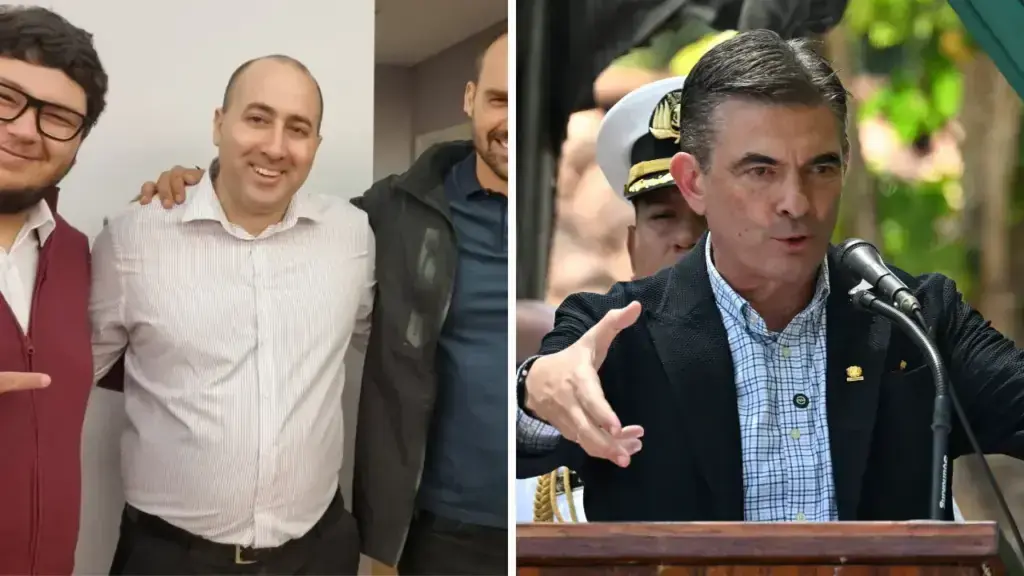
Fernando Cerimedo (left), political advisor to Bolivian President Rodrigo Paz (right), accused of attempted femicide of his ex-partner. Photo: Chequeado.
Fernando Cerimedo (left), political advisor to Bolivian President Rodrigo Paz (right), accused of attempted femicide of his ex-partner. Photo: Chequeado.
By Susana Bejarano – Aug 22, 2026
The situation of Fernando Cerimedo changed definitively with the report from the Forensic Investigation Institute (IDIF) of Bolivia. The investigation now includes digital evidence extracted from his phone that supports the attorney general’s accusation of him being the alleged mastermind of the attempted femicide of his ex-partner, lawyer Nadia Beller.
In a conversation prior to the attack, a message appears: “Nadia. Either we eliminate her now or we are screwed. Do you know anyone who can do the job?”
Then the attack happened.
Nadia Beller was called to a hotel in Santa Cruz, Bolivia. Two men dressed as delivery workers arrived at the location and shot her. She was shot three times, but she survived.
The IDIF report also found a communication immediately following the attack. At 8:54 p.m., a contact named as “ECG” wrote to Cerimedo: “Brother, they shot her right now.”
According to the information in the report, Cerimedo later called ECG and the record of that communication was deleted. The Attorney General’s Office has yet to establish who ECG is, what role they played, why they immediately reported the attack, and what was discussed in the call with Cerimedo.
According to the investigations, the sequence of the events is that, before the attack, on Cerimedo’s phone there were discussions on “eliminating” Beller and finding someone who could “do the job”; subsequently, Nadia was shot, and as soon as the attack occurred, someone directly reported it to Cerimedo’s phone, sending photos of her being carried into an ambulance.
This means that ECG was on site or received real-time information about what was happening there.
The Attorney General’s Office has requested 180 days of preventive detention for Cerimedo in the Chonchocoro prison. The final criminal responsibility must be determined by a court, but the case no longer depends solely on Beller’s statement, as it did at the beginning.
From moral prophet to potential murderer of women
The case also strikes at the political discourse that Cerimedo and company have promoted for years. He is one of the operators of the Latin American far right that has made campaigns presenting the left as a “moral enemy.” This discourse appropriated concepts such as God, family, homeland, freedom, honesty, and order, while placing his political adversary, the left, in the role of the corrupt, the criminal, or the enemy of society.
Cerimedo arrived in Bolivia as part of the evangelist movement that was sweeping through Latin America and promised to restore “dignity” to the State. Today he is detained and charged with the attempted femicide of a woman who was his partner and is pregnant with his child. The moral contradiction strongly speaks for itself and strikes at the entire far right.
Rodrigo Paz no longer has any leeway
The problem directly affects the Bolivian government. Cerimedo worked in the electoral campaign that brought Rodrigo Paz to the presidency and then remained by his side as “personal advisor to the president.” Several government ministers acknowledged that he worked in presidential communication.
So far, it is not known who paid for his services. He did not have an established public position in the state system, a salary, or formal duties. However, he participated in meetings and activities within the presidential circle and had central influence in the government.
The opposition wants Paz to explain why Cerimedo had that level of influence, who financed his work, what information he had access to, and why he remained close to the president even after allegations of violence against Nadia Beller began to circulate.
A government is not only defined by its public policies but, above all, by the people to whom it grants power. What kind of people are governing Bolivia?
Today, Rodrigo Paz has no choice but to let go of Cerimedo, although this neither resolves nor exempts the government from its responsibilities.
The money in Cerimedo’s pockets
The attempted femicide also opened other investigations. Cerimedo is being investigated for alleged illicit enrichment. In raids conducted in an apartment in Santa Cruz, another in La Paz (where he supposedly resided), and two more houses in La Paz, the Attorney General’s Office found in one of the premises more than $440,000 in cash, substantial amounts in Bolivians, cards identifying him as an advisor to the president, a national police shirt, and equipment associated with bot farms.
Prosecutor Miguel Cardozo also reported that people close to Cerimedo had collected hundreds of thousands of dollars on different occasions from one of the raided houses to later deliver the money “in person.”
The investigations must determine the origin of this money. It will be necessary to determine what Cerimedo’s businesses in Bolivia were, who participated in them, and if they are related to the complaints made by Beller.
The bot farm and the “self-attack” version
The discovery of equipment associated with a bot farm is related to Cerimedo’s professional activity.
Digital communication, social media management, and negative campaigns have been his work for years.
After the attack on Beller, a narrative began to circulate that claimed that she herself might have organized a “self-attack” to “harm Cerimedo and destabilize the government of Rodrigo Paz.” Even Cerimedo’s defense publicly adopted this thesis.
Argentinian President Javier Milei, whom Cerimedo advised during his campaign and later in his government, also intervened. He reposted the publications that questioned Beller’s version and called the case of attempted femicide a “farce.”
Argentinian media reported around a dozen messages shared by Milei along these lines. What will the far right say now that the content of the accused’s phone has been revealed?
The existence of a bot farm explains to us why the “self-attack” version is so prevalent on social media. These operations do not align with the truth; instead, they create truths, invalidating the reality with outlandish theories.
What Nadia started to say in Argentina
Beller claims that Cerimedo wanted to silence her because she had information about corruption cases in Bolivia, but her statements also reached Argentina.
From the hospital, she told Argentinian media: “Fernando told me that Milei’s sister was involved in corruption.”
Beller stated that Cerimedo had told her that he had distanced himself from Milei because his government had a “very rotten environment.” She also linked Cerimedo and his ex-wife and business partner Natalia Basil to the corruption scandal in the National Disability Agency (ANDIS) of Argentina.
Basil was the CEO of Numen, Cerimedo’s company that was used as a platform to provide political strategy and communication services to the right in different countries. Additionally, Basil worked for nine months at ANDIS.
Beller said that Cerimedo told her that Basil had participated in the leaking of the audios attributed to Diego Spagnuolo, former head of ANDIS, that triggered the case. “He told me that they did leak the audios,” she declared. She added that Cerimedo defended Basil by saying that he had participated in the leak “to stop the corruption of Milei and his sister.”
Numen was one of the platforms used by the Cerimedo-Basil couple to provide political and communication services to the right wing outside of Argentina. In particular, Cerimedo was linked to Jair Bolsonaro’s circle in Brazil, participated in Javier Milei’s campaign, later appeared in Honduras, and finally worked with Rodrigo Paz in Bolivia.
The Brazilian Federal Police investigated Cerimedo for disinformation strategies aimed at discrediting the electoral system after Bolsonaro’s defeat, although he was ultimately not included among the accused by the Brazilian Attorney General’s Office.
Cerimedo and Numen were also mentioned in the publications about HondurasGate, uncovered by Canal Red, in which a transnational network of political and communication operators interfered in the Honduran elections that brought the far right back to power.
What did Nadia Beller know?
Beller claims that she has information regarding businesses related to fuel, gold, and other operations linked to the close circle of the Bolivian President Rodrigo Paz.
She also told Argentinian media La Nación that Cerimedo told her that he earned $800,000 a month, that he kept money in his apartment and inside suitcases. These claims were partially corroborated by the raids.
Beller claims that she has information that could compromise Cerimedo and other people in power. Was this what triggered the attempt to kill her?
A hypothesis proposed by an Argentinian analyst is that Cerimedo not only has interests in Bolivia but also in Argentina, and these are managed by Natalia Basil, with whom, according to Beller, he supposedly had not ended things affectionately. Could it then have been Beller’s pregnancy that put her life at risk?
The moral and political problem
This moral blow impacts the political group to which Cerimedo belongs and which for years presented itself to Latin Americans as the owner of values that the left had supposedly lost: God, family, homeland, order, honesty, and dignity.
Cerimedo made this supposed moral superiority a political tool. Today, the Bolivian justice system accuses him of having ordered the murder of the woman who is carrying his child.
The Cerimedo case caused astonishment and left a feeling of disappointment among Bolivians regarding those who govern Bolivia. What kind of people did the Bolivians bring to power and put in charge of the country’s most important affairs?
Translation: Orinoco Tribune
OT/SC/DZ