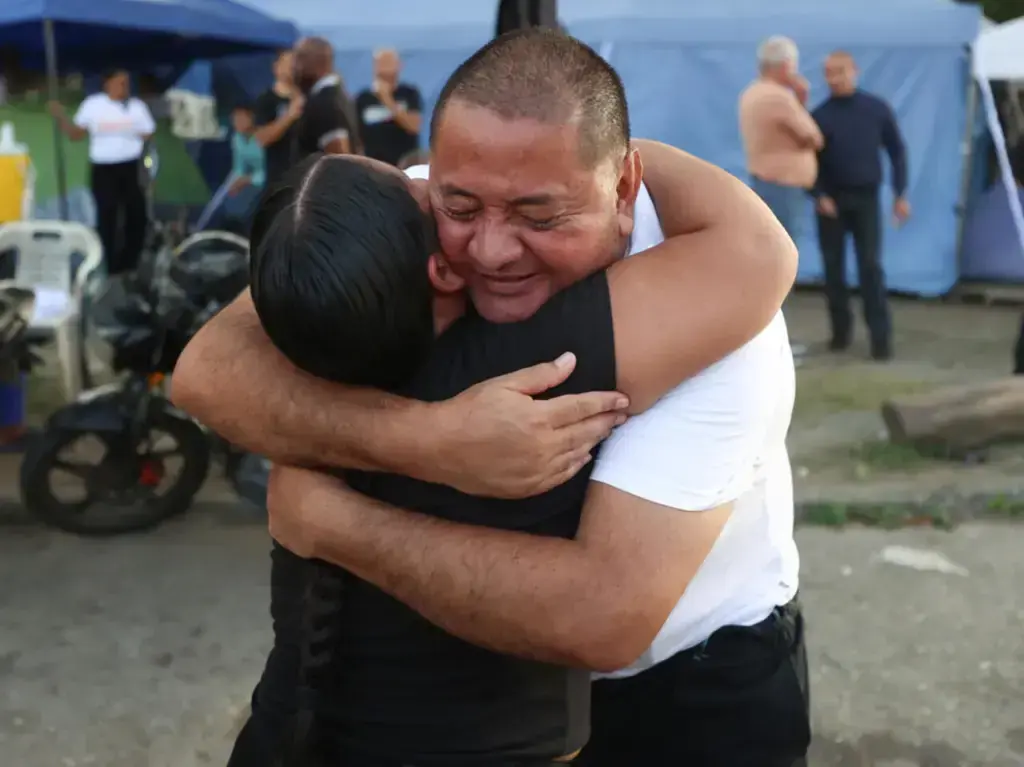
Arturo Sairias embraces a family member after being released from the Rodeo 1 prison in Guatire, Venezuela, June 14, 2026. Photo: Ronald Peña R/EFE.
Arturo Sairias embraces a family member after being released from the Rodeo 1 prison in Guatire, Venezuela, June 14, 2026. Photo: Ronald Peña R/EFE.
Caracas (OrinocoTribune.com)—Venezuela’s Program for Peace and Democratic Coexistence announced that Venezuelan courts granted alternative measures to incarceration to 131 people detained for their alleged or proven participation in crimes established under Venezuelan law.
The decision was announced in a communiqué issued on Friday, August 14. The program was created by Acting President Delcy Rodríguez as part of a government initiative aimed at promoting national reconciliation and democratic coexistence just days after the January 3 US bombing of the country that resulted in the kidnapping of President Nicolás Maduro.
According to the statement, the measures were ordered by Venezuelan courts at the request of the Attorney General’s Office after the program asked the country’s criminal justice institutions to review the legal status of people prosecuted or convicted for offenses connected to attacks against Venezuela’s democratic institutions, peace, and national development.
El Programa para la Paz y la Convivencia Democrática informa sobre el otorgamiento de medidas alternativas a la privación de libertad para 131 personas, acordadas por los tribunales de la República tras la solicitud presentada ante el Sistema de Justicia Penal.
#Venezuela #Paz pic.twitter.com/zfl4MJKu2c
— Programa de Paz y Convivencia Democrática (@ProgramaPazVEN) August 14, 2026
The communiqué did not name the 131 beneficiaries, nor specified the alternative measures granted in each case, nor claim that all of them had received unconditional freedom.
Decision follows first round of talks
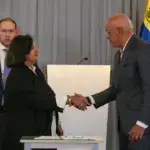
The announcement came only two days after the Venezuelan government and a delegation of former deputies from the defunct 2015 National Assembly concluded the first round of their controversial negotiations.
The delegations announced the conclusion of the round on Wednesday, August 12, after holding five plenary meetings and five sessions of two technical working groups. One group addressed recovery from the devastating double earthquake of June 24, while the other focused on the judiciary, the electoral branch, and what the negotiating parties have described as the “strengthening of democracy.”
The first agreements included proposals to reform Venezuela’s judicial institutions and to recover Venezuelan international reserves seized by the Bank of England for use in earthquake reconstruction programs.
The timing of the alternative detention measures has therefore reinforced the perception that prisoner cases constitute one of the concessions being discussed in the negotiations, despite not being explicitly stated in the joint announcement closing the first round.
Debate within Chavismo and the left
The measure has generated conflicting reactions among sectors of Chavismo and the Venezuelan left.
Many Chavistas question the decision to ease the detention conditions of opposition-linked individuals accused or convicted of grave crimes. They note that the far-right opposition and Washington-aligned organizations have repeatedly presented people involved in violent actions and destabilization operations as alleged “political prisoners,” despite the criminal charges or evidence presented in their cases.
The government communiqué appeared to acknowledge this concern by emphasizing that the beneficiaries had been detained for their “alleged or proven participation” in crimes and that the measures were issued by the courts following a request from the Attorney General’s Office.
Some sectors of the left have criticized the Venezuelan government from a different position. They accuse the acting government of offering concessions to the far right while failing to conduct equivalent reviews of incarcerated Venezuelans whom these groups consider to have been unjustly prosecuted.
These competing criticisms highlight the political complexity of prisoner measures in Venezuela, where Washington and the far-right routinely use the term “political prisoner” to erase the circumstances surrounding serious criminal prosecutions, while sectors of the left denounce what they consider selective justice.
More measures expected as negotiations advance
Analysts following the talks expect more alternative detention or release measures to be announced in the coming weeks as negotiations continue between the Venezuelan government and the former deputies of the defunct 2015 National Assembly.
The former lawmakers are represented by a delegation headed by former Justice First Deputy Dinorah Figuera, who acknowledged that her return to Venezuela and participation in the initiative followed an invitation from the US Department of State. Numerous Chavista and anti-imperialist analysts highlight that the participating former deputies are operating under the State Department’s political patronage—or, more bluntly, on its payroll.
From this perspective, the negotiation is not an autonomous Venezuelan initiative but a mechanism constructed by Washington to reorganize its failed regime-change operation.
Most analysts within Chavista and anti-imperialist circles agree that the United States is attempting to retire the increasingly untenable political and financial architecture of the failed Juan Guaidó operation, particularly the mechanisms through which the defunct 2015 National Assembly and its representatives claim control over Venezuelan assets seized abroad.
Under this interpretation, Washington is seeking to replace the discredited Guaidó operation without relinquishing its imperial control over Venezuela’s political process or stolen resources. At the same time, it is using the negotiations to advance the so-called “democratic transition” repeatedly invoked by US Secretary of State Marco Rubio as the central objective of US policy toward Venezuela.
Venezuela Government and 2015 National Assembly Delegation Conclude First Round of Dialogue
The coming rounds—and the concessions emerging from them—will reveal how far Washington intends to push that agenda and what limits Venezuela’s acting government is prepared to impose on a process taking place under extraordinary US pressure.
Full unofficial translation of the statement by the Program for Peace and Democratic Coexistence:
Communiqué
The Program for Peace and Democratic Coexistence, created by Acting President of the Republic Delcy Rodríguez Gómez, announces the granting of alternative measures to incarceration to a total of 131 people who were under detention for their alleged or proven participation in the commission of crimes established under Venezuelan law.
The aforementioned measures were ordered by the courts of the Republic at the request of the Attorney General’s Office after this program requested the Criminal Justice System to evaluate the legal status of people prosecuted or convicted for crimes related to various attacks against democratic institutions, peace, and development of the Republic.
The Program for Peace and Democratic Coexistence reaffirms that it will continue to resolutely support the initiatives of the Venezuelan government and organized civil society aimed at promoting reunion among Venezuelans, strengthening the nation’s social fabric, and consolidating peace in the Republic.
Caracas, August 14, 2026
Special for Orinoco Tribune by staff
OT/JRE/SC