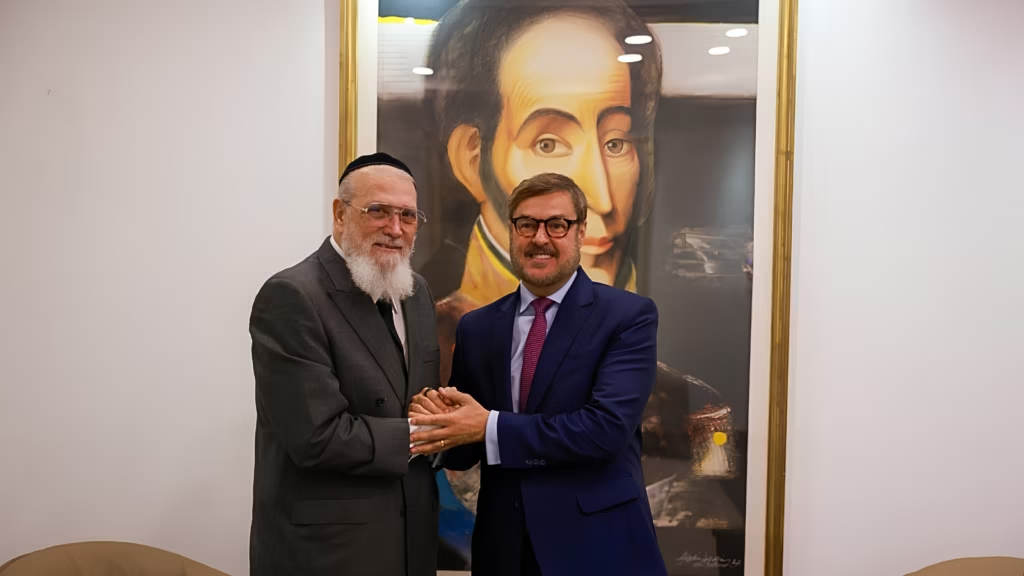
Venezuelan Foreign Minister Felix Plasencia shakes hands with the head of the Jewish community in Venezuela, Rabbi Isaac Cohen, in Caracas on Sunday, August 9, 2026. Photo: X/@Cancilleria_ve.
Venezuelan Foreign Minister Felix Plasencia shakes hands with the head of the Jewish community in Venezuela, Rabbi Isaac Cohen, in Caracas on Sunday, August 9, 2026. Photo: X/@Cancilleria_ve.
Caracas (OrinocoTribune.com)—After weeks of speculation and mounting criticism from leftist organizations in Venezuela and abroad, the Venezuelan government announced Tuesday the establishment of a mechanism to provide consular services with the Zionist entity of “Israel,” a step that could precede the eventual restoration of formal diplomatic relations.
The controversial decision was announced by the Venezuelan Foreign Ministry on social media. The statement also confirmed the continuation of bilateral technical cooperation arising from emergency and recovery efforts following the double earthquake that struck Venezuela on June 24.
According to the communiqué, the two parties agreed to “establish a coordination mechanism that allows the provision of consular services to their respective citizens residing in the other country as needed.”
Los Gobiernos de la República Bolivariana de Venezuela y del Estado de Israel informan que han acordado dar continuidad a la cooperación técnica bilateral derivada de los esfuerzos de emergencia y recuperación tras el doble terremoto, así como establecer un mecanismo de… pic.twitter.com/ZJUbNI77gJ
— Félix Plasencia González (@plasenciafelixr) August 11, 2026
Although the statement does not formally announce the reestablishment of diplomatic relations, the consular mechanism represents a significant rapprochement between Caracas and the Zionist regime.
A break with Chávez’s policy
Venezuela and “Israel” have not maintained formal diplomatic relations since January 2009, when President Hugo Chávez severed ties in condemnation of the Israeli military offensive against the Palestinian people in Gaza. The Israeli Occupation Forces called the attack Operation Cast Lead, while the Palestinian Resistance referred to it as the Battle of al-Furqan.
The decision formed part of Chávez’s consistent support for the Palestinian struggle and his repudiation of Zionism as a colonial and genocidal project. President Nicolás Maduro maintained that position, repeatedly defending the Palestinian Resistance and condemning the crimes committed by the Israeli occupation.
Acting President Delcy Rodríguez’s rapprochement with Tel Aviv therefore marks a significant departure from one of the clearest international positions maintained by the governments of Chávez and Maduro. Chavista and anti-imperialist organizations have warned that the move cannot be treated as a merely technical or consular matter because normalization provides political legitimacy to an occupation regime carrying out genocide against the Palestinian people.
The unofficial translation of the Venezuelan statement follows:
The governments of the Bolivarian Republic of Venezuela and the State of Israel report that, following the visit of the Israeli humanitarian delegation to Venezuela in connection with the double earthquake that occurred on June 24, and as a follow-up to the conversations held between senior authorities of both parties, the two countries have agreed to allow the continuation of bilateral technical cooperation arising from the emergency and recovery efforts following the double earthquake.
Likewise, the two countries agree to establish a coordination mechanism that allows the provision of consular services to their respective citizens residing in the other country, as needed.
Both governments recognize the importance of the ties between the State of Israel and the Jewish community residing in Venezuela, which constitutes an important historical bridge of friendship between the two countries.
Caracas, August 11, 2026
Jewish community request preceded announcement
The announcement came two days after Isaac Cohen, chief rabbi of the Israelite Association of Venezuela, formally requested that Acting President Rodríguez consider restoring diplomatic and consular relations between Venezuela and “Israel.”
Foreign Minister Félix Plasencia received Cohen at the Foreign Ministry headquarters in Caracas on Sunday. Cohen delivered a letter addressed to Rodríguez arguing for the restoration of relations to “address the needs of the Jewish community in our country,” according to the official press release.
“Venezuela has historically welcomed, with open arms, an important Jewish community, whose contributions have added and continue adding to the well-being and development of our nation,” Plasencia stated.
The Foreign Ministry also thanked Cohen for the humanitarian assistance provided following the June 24 earthquakes. An Israeli delegation reportedly participated in assessments of collapsed structures, evaluations of vulnerable buildings, and the design of emergency contingency plans.
The Jewish community in Venezuela is relatively small compared with those of some other Latin American countries. It is estimated that Venezuela is home to approximately 3,000 to 4,000 Jewish citizens. Nevertheless, critics of the rapprochement argue that Cohen’s request cannot be separated from Washington’s longstanding political, diplomatic, and military support for the Zionist regime. These critics stress that opposition to normalization must not be confused with hostility toward Jewish Venezuelans but should instead be understood as rejection of Zionism, occupation, apartheid, and genocide.
Another meeting with US officials
The decision also followed a Monday meeting between Acting President Rodríguez and mid-level officials from the US Treasury and State departments. The Venezuelan government described the meeting as a comprehensive review of bilateral relations, with particular emphasis on commercial, financial, and energy matters.
The US delegation was led by Treasury Under Secretary for International Affairs Jonathan Greenstein and Assistant Secretary for Terrorist Financing and Financial Crimes Jonathan Burke.
The Venezuelan delegation included Vice President for Economy and Finance Calixto Ortega, Foreign Minister Félix Plasencia, Central Bank of Venezuela President Luis Pérez, Vice Foreign Minister for Europe and North America Oliver Blanco, and Vice President for Administrative Affairs and Digital Government Anabel Pereira.
According to the official account, the talks addressed energy market stability, the reactivation of financial mechanisms, and an economic agenda involving trade, finance, and energy. The composition of both delegations reinforces indications that economic and financial issues were at the center of the meeting.
Some Chavista analysts have suggested that the negotiations may be connected to Venezuela’s repeated demand for the complete removal of illegal US sanctions. Nevertheless, they warn that Washington has historically used sanctions as instruments of political coercion and is unlikely to surrender that leverage without demanding major concessions from Caracas.
Other Chavista and anti-imperialist voices have expressed growing concern over Delcy Rodríguez’s increasingly frequent meetings with US diplomats, US treasury officials, financial institutions, and representatives of governments aligned with Washington. They argue that these engagements, combined with the rapprochement with the Zionist entity, risk transforming emergency diplomacy into a pattern of political subordination.
Those concerns have intensified since the January 3 US bombing of Venezuela; the abduction of President Maduro and his wife, Deputy Cilia Flores; and the killing of more than 100 people. For critics within the Chavista movement, Washington’s aggression should have reinforced Venezuela’s anti-imperialist alliances and historic solidarity with Palestine, not opened the way for renewed relations with the Zionist regime and deeper dependence on the institutions of the US empire.
Special for Orinoco Tribune by staff
OT/JRE/SL