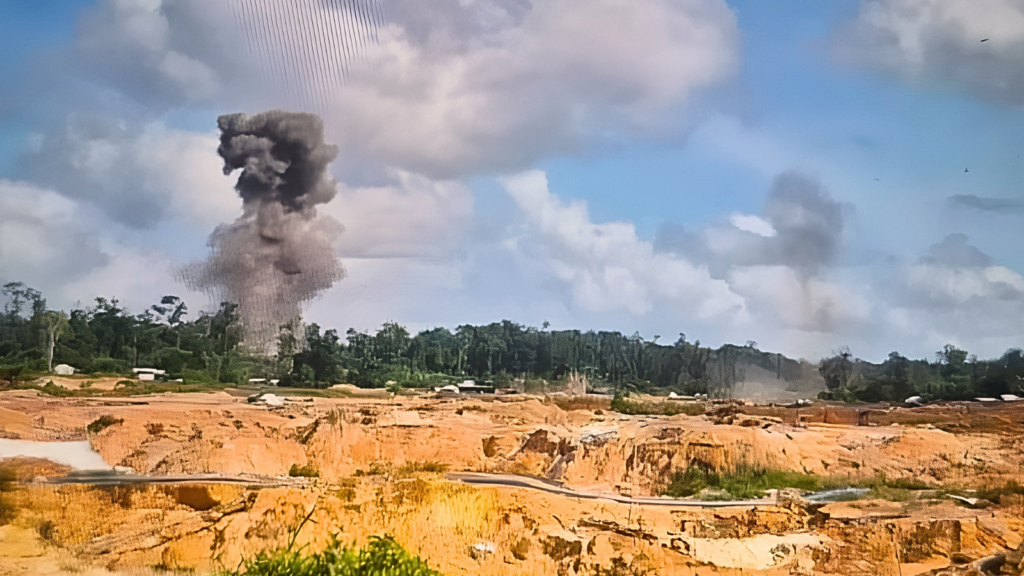
AI-enhanced image showing explosions reported on June 10 close to the Brisas del Cuyuní gold mine, near Las Claritas, Bolívar state, Venezuela. Some analysts believe it might be the "kinetic strike" launched by US SOUTHCOM to target Tren de Aragua leader "Niño Guerrero." Photo: X/@Fritz_A_Sanchez.
Caracas (OrinocoTribune.com)—Venezuelan Mining Minister Héctor Silva led a meeting with a group of miners in the gold-rich town of Las Claritas, Bolívar state, to address workers’ concerns and consolidate an environmentally friendly production model following several days of social unrest in the area. The meeting was reported by the Mining Ministry on Sunday, June 14.
In response to the community’s demands, officials announced a plan to establish a Miner’s Assistance Office in the town, which will serve as a direct point of contact to provide timely, effective responses to the realities of the sector.
The meeting followed a recent major military operation carried out in the region by Venezuelan forces using armed helicopters. The operation displaced numerous illegal miners and resulted in the neutralization of the leader of the Tren de Aragua gang, Héctor Rusthenford Guerrero Flores, alias “Niño Guerrero,” with US assistance.
Minister Silva, accompanied by Vice Minister of Gold Luis Pérez and Vice Minister of Strategic Non-Gold Minerals Jesús Mieres, highlighted the State’s efforts to organize the sector. For over two decades, the region has been under the partial control of illegal mining groups, which has progressively eroded State territorial control.
“We are here to serve our people firsthand, to listen to them, and to provide every man and woman involved in mining with the necessary training tools to boost their academic and technical growth,” Silva stated.
Government outreach and socioproductive pillars
During the meeting, officials outlined three fundamental pillars for the socioproductive development of the area: maximizing production to strengthen the local economy by optimizing extraction processes; promoting responsible mining through environmentally friendly practices that safeguard natural resources; and ensuring comprehensive safeguards by protecting the health, safety, and labor rights of all workers.
As part of the government’s outreach, Silva and his technical team toured the Las Claritas Type II Community Medical Clinic to inspect medical facilities and assess logistics and medical supply requirements.
Tensions and security deployments
The government also conducted inspections at mining processing plants in El Callao and executed preventive actions in El Dorado. Meanwhile, it denied rumors of massive ground deployments in the areas affected by the operations.
Last week, local outlets reported that although tactical bombings of strategic points by military Cougar helicopters had ceased, law enforcement patrols remained active. On June 10, residents described the situation in Las Claritas and Kilometer 88 as tense, with roads leading to the nearby towns of El Dorado and Santa Elena de Uairén blocked.
Efforts to regulate mining activities in the region date back to 2008, when the area—previously controlled by multinational mining corporations with histories of environmental mismanagement—was integrated into a state project aimed at curbing illegal mining. However, the initiative was stalled by resistance from non-governmental organizations, the death of President Hugo Chávez, and the subsequent illegal US blockade, which severely impacted the Venezuelan economy and its capacity to attract foreign investment.
Some analysts claim that the recent deployment of the Bolivarian National Armed Force (FANB) in the area reflects a growing US interest in the mining sector, suggesting that the underlying objective is to quantify resources and pave the way for transnational corporations to regain control of the region.