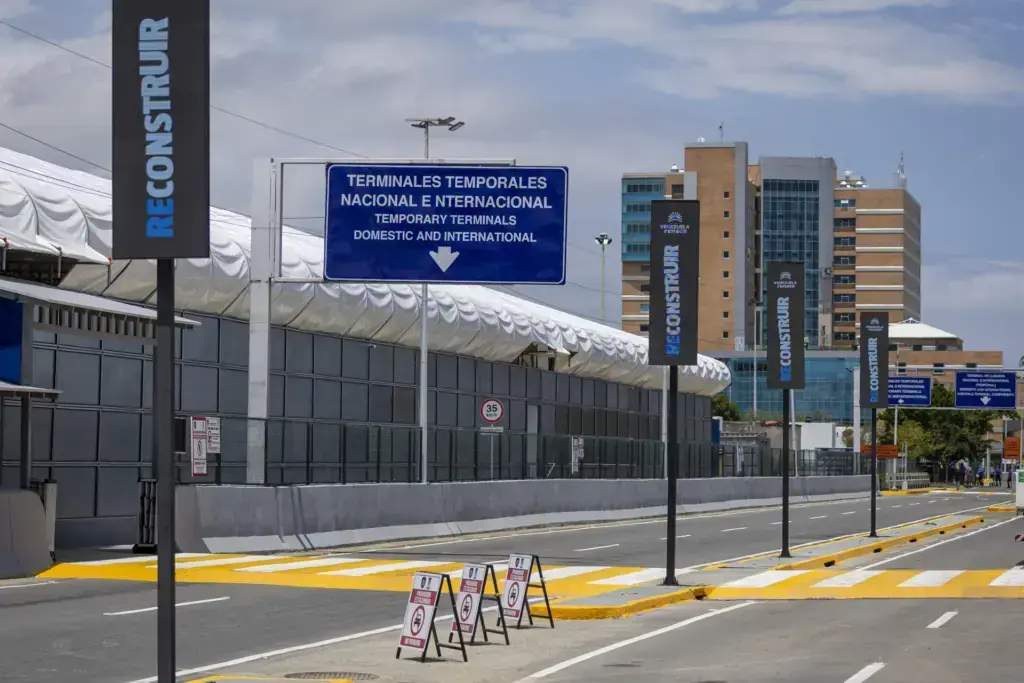
Entrance to the new Simón Bolívar International Airport provisional facilities, in a parking lot in front of the terminal. Photo: Miguel Gutierrez/EFE.
Entrance to the new Simón Bolívar International Airport provisional facilities, in a parking lot in front of the terminal. Photo: Miguel Gutierrez/EFE.
Caracas (OrinocoTribune.com)—Venezuela is set to formally begin domestic and international flight operations at the temporary terminals of Simón Bolívar International Airport in Maiquetía, La Guaira state, according to an official statement made by the Maiquetía International Airport Institute (IAIM).
The airport administration reported that the reopening will take place on Tuesday, September 1. This has been made possible by an accelerated reconstruction process following the catastrophic earthquakes of June 24, which severely damaged the runways and main passenger terminals of Venezuela’s principal international airport.
“This opening is possible thanks to our unbreakable resilience,” the IAIM stated, “and a reconstruction process carried out under high-quality standards and using the latest technologies.”
The airport authority described the reopening as more than the recovery of infrastructure, emphasizing its importance for reconnecting Venezuela with the world and reuniting Venezuelan families.
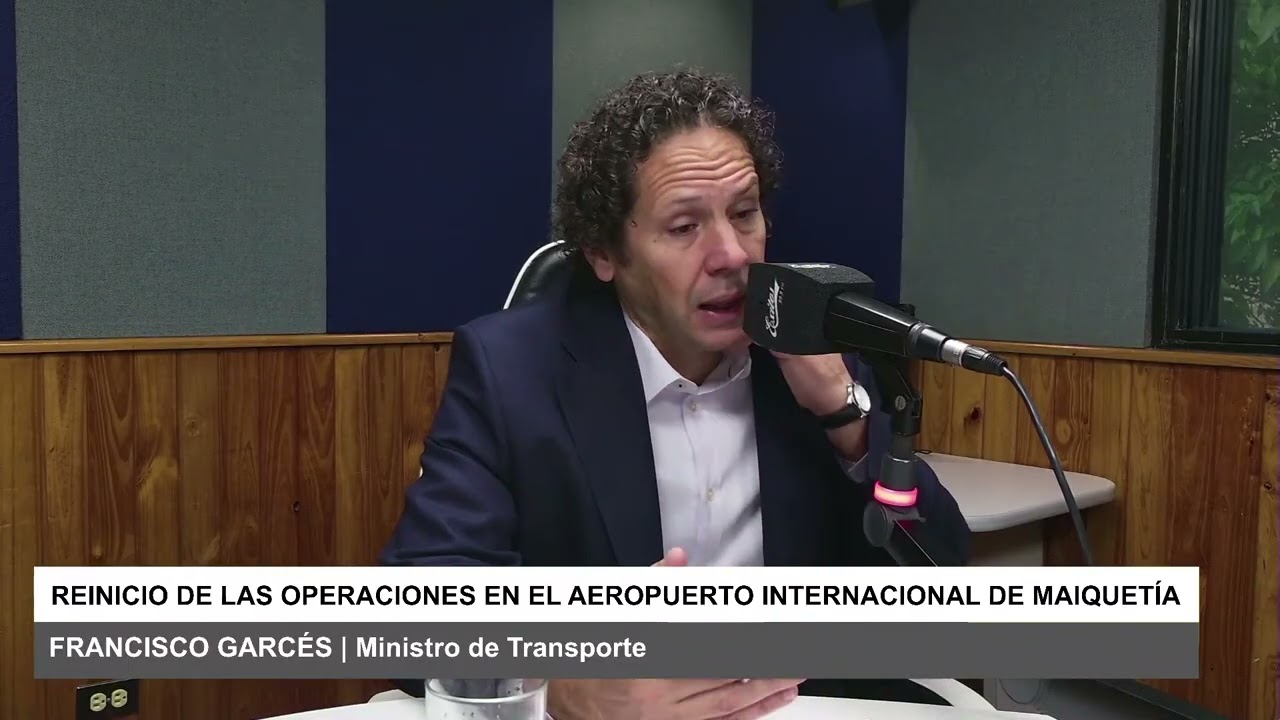
During an interview with Unión Radio, Transport Minister Francisco Garcés clarified that, despite early unofficial rumors suggesting that passenger operations would resume on August 24, Venezuelan authorities had never officially confirmed that date. He explained that additional drills were necessary to fine-tune the temporary facilities and guarantee a safe and successful reopening.
According to many Venezuelans, even before the earthquakes, Venezuela’s main airport was operating under suboptimal conditions after more than a decade of illegal sanctions led by the US empire and its allies, compounded by insufficient investment and administrative shortcomings. Deficient air conditioning and lengthy delays at passport control were among the problems most frequently reported by travelers.
Garcés stated that he expects the new provisional terminals to provide passengers with better service than that available before the earthquakes.
Progressive post-earthquake recovery
The June 24 earthquakes, with magnitudes of 7.2 and 7.5, caused significant damage to the airport’s principal runway and passenger terminals, forcing the suspension of commercial passenger operations. Most airlines temporarily rerouted their flights to Arturo Michelena International Airport in Valencia, Carabobo state, and the General José Antonio Anzoátegui International Airport in Barcelona, Anzoategui state.
In early July, Acting President Delcy Rodríguez inspected the airport and ordered the implementation of an alternate-runway plan to restore commercial flights as quickly as safety conditions permitted.
Hundreds of workers subsequently participated in the construction of provisional facilities under the Venezuela Reborn Plan, while rehabilitation and reinforcement work continued on the airport’s permanent structures. The temporary terminals include check-in areas, immigration and customs controls, baggage-claim systems, air conditioning, restrooms, medical assistance, surveillance systems, and accessibility infrastructure.
Cargo operations had already resumed on August 5 as the first phase of the airport’s gradual reactivation, reopening a vital logistics channel for the entry of supplies and the export of Venezuelan products.
Operational drills ahead of reopening
The government conducted operational tests at the temporary terminals in recent weeks, with the participation of Conviasa, the main Venezuelan publicly-owned airline, and Laser Airlines. The exercises evaluated passenger check-in times, security and immigration controls, boarding procedures, baggage handling, air conditioning, waiting areas, and other essential services.
The provisional facilities are expected to operate at approximately 30% of the airport’s pre-earthquake capacity, with a maximum capacity of up to 480 domestic and 780 international passengers. Travelers will be transported between the terminals and aircraft in air-conditioned buses.
The IAIM urged passengers to contact their airlines directly to confirm whether their flights have been rescheduled to operate from the temporary terminals. It also called on travelers to follow official channels for subsequent announcements and operational updates.
The reopening constitutes another concrete advance in the reconstruction of Venezuela following the catastrophe, despite the enormous material difficulties compounded by Washington’s criminal blockade. As permanent reconstruction continues, the temporary scheme will allow the country’s primary international gateway to reconnect Venezuelans with domestic and international destinations.
Venezuela’s Delcy Rodríguez: We Want a State That Solves Problems
Below, you can read an unofficial translation of the IAIM statement:
The Maiquetía International Airport Institute (IAIM) informs the public that, beginning Tuesday, September 1, 2026, operations will formally commence at the authorized temporary terminals for both domestic and international flights.
This opening is possible thanks to our unbreakable resilience and a reconstruction process carried out under high-quality standards and using the latest technologies.
More than infrastructure, this space represents a profound reconnection with the world and with what is ours: a reunion with our roots, family unity, and the certainty that Venezuela’s gateway remains open to the future.
Information for passengers:
Rescheduling: We invite passengers to contact their respective airlines directly to verify the rescheduling of their flights to the temporary terminals.
Official channels: We urge users to remain attentive to our social media platforms for upcoming announcements and updates.
Venezuela is reborn, and Maiquetía is reborn as well.
IAIM
Translation: Orinoco Tribune
OT/JRE/AU