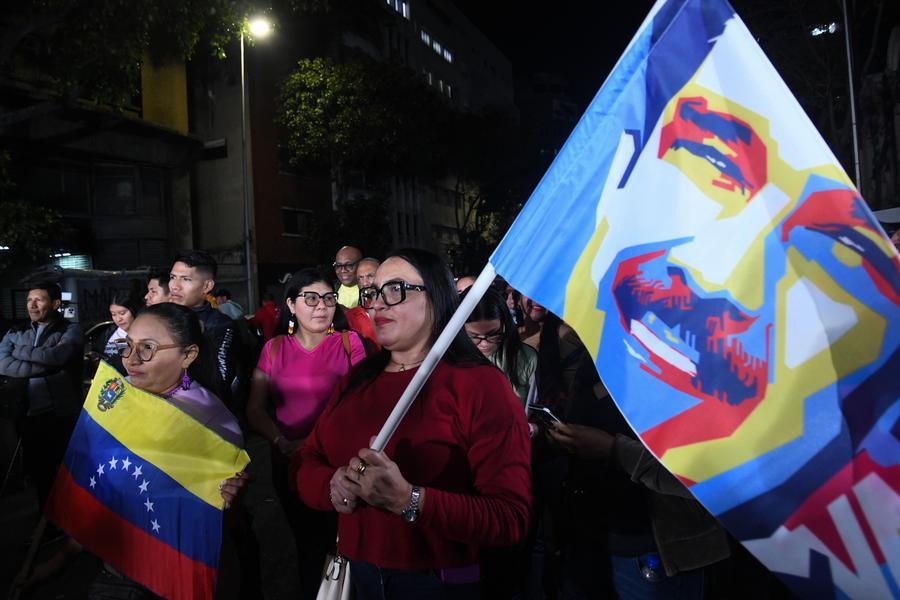
Caracas residents hold a vigil on February 3, 2026, one month after the US bombing of Caracas and abduction of President Nicolás Maduro and First Lady Cilia Flores. Photo: Marcos Salgado/Xinhua.
Caracas residents hold a vigil on February 3, 2026, one month after the US bombing of Caracas and abduction of President Nicolás Maduro and First Lady Cilia Flores. Photo: Marcos Salgado/Xinhua.
By Rubén Lovera – Feb 3, 3036
February 3, 2026 marked one month since the US bombing of Venezuela. Thirty days after the events, the sound of the explosions still echoes in the collective memory of us, the citizens of Caracas.
Those of us who closely follow the discourse on matters of public interest agree that the impact of the January 3 attack will not fully dissipate as long as a foreign military deployment persists, keeping our beloved land under pressure.
Since then, Washington has not withdrawn its naval or air forces. On the contrary, it has maintained a military blockade accompanied by public statements that, intermittently, include warnings aimed at influencing political decisions in Caracas under a logic of coercion.
Dialoguing under these conditions is an imposition. And let us be clear: we Venezuelans want dialogue but not with a gun pointed at our heads.
In recent days, Venezuelan authorities confirmed the existence of talks with US President Donald Trump and US Secretary of State Marco Rubio. These contacts are a sign of political will, not of submission, in a context marked by military aggression.
Rubio himself stated on January 28 that the United States is “prepared to use force to ensure maximum cooperation if other methods fail.” That phrase was interpreted by Venezuelan analysts as a message that departs from traditional diplomatic language and veers toward intimidation.
Talking about oil negotiations while threatening new military attacks reveals a deep contradiction. No lasting process of understanding can be built on the foundation of armed blackmail.
Venezuela has insisted on respect as the guiding principle of any dialogue. Respect for sovereignty, Venezuelan laws, and its jurisdiction. From the official perspective, this respect is not a rhetorical position but a basic condition for any relationship between states.
After the January 3 attack, Venezuela did not experience an institutional collapse. The state structures continued to function, daily life went on, and society expressed its condemnation of foreign military violence in multiple ways.
In fact, on February 3, Acting President Delcy Rodríguez confirmed that she had spoken directly with Trump and Rubio, and clarified that Venezuela is willing to reach agreements and maintain a favorable relationship based respect and national sovereignty.
This fact causes discomfort to those who imagine Venezuela as a fragile territory, ready to give in to pressure. A month later, the country is still standing, insisting on peace without sacrificing its dignity.
The US military deployment in the Caribbean does not protect anyone. It only increases the risk of an unnecessary escalation in a region that declared itself a Zone of Peace.
Venezuelans know how to distinguish between dialogue and threats, between diplomacy and ultimatums, and between cooperation and subordination. It is not an ideological matter, but one of national conscience. The inhabitants of this land love peace, but they also love freedom. Our history confirms this.
Speaking today from Venezuela means doing so from a country that has been attacked, invaded, and blockaded but still continues to pursue political rather than military solutions.
We believe that peace is not built with aircraft carriers or statements of force. It is built by recognizing the other as a legitimate interlocutor, not as a strategic target.
The United States insists on considering itself as the guarantor of hemispheric order. However, its recent actions contradict any talk of stability and democracy.
One month after the bombing, Venezuela is not asking for privileges. In the streets and at our demonstrations, we demand that the threats cease and that dialogue no longer be conditioned by force.
Venezuelans want to engage in dialogue; we want agreements that lead to development, stability, and social well-being. And our social happiness is intimately linked to our notion of homeland, independence, sovereignty, and freedom, as a matter of principle.
It is regrettable that US foreign policy increasingly embraces the logic of might makes right, projecting a violent and intimidating attitude that conveys the feeling that humanity has regressed morally not only by two centuries, but perhaps by many more.
Translation: Orinoco Tribune
OT/SC/DZ