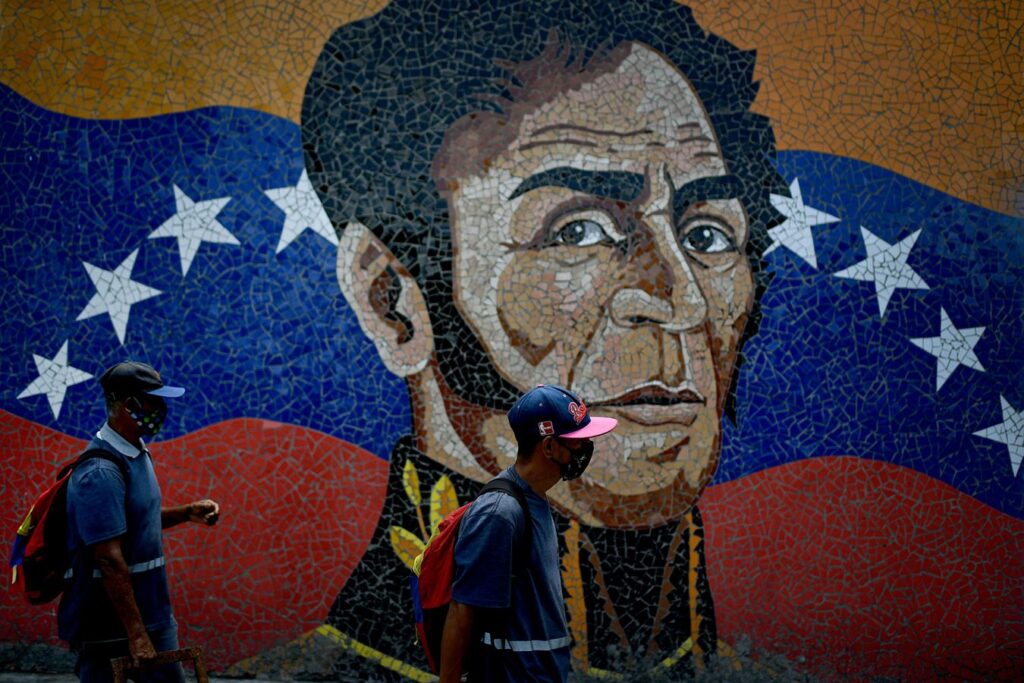
People walk past a mosaic mural of Simón Bolívar, the Liberator of South America, in Caracas. Photo: Matias Delacroix/AP/file photo.
People walk past a mosaic mural of Simón Bolívar, the Liberator of South America, in Caracas. Photo: Matias Delacroix/AP/file photo.
On Friday, 243 years after the birth of Simón Bolívar, the independence leader of six South American nations and one of the 19th century’s most influential political figures, Venezuelan social movements gathered in the Plaza Bolívar in Caracas to claim his integrationist and anti-imperialist thinking.
In statements to Sputnik, former Deputies Mario Silva and Fernando Rivero affirmed that the commemoration of the Liberator occurs at a time marked by the debate on national sovereignty, popular organization, and the response of social movements to foreign interference and geopolitical tensions in Venezuela and the region.
The activity, which was replicated in Bolívar squares across Venezuela, brought together popular, communal, and political leaders who linked the Bolivarian ideology to the defense of national sovereignty, the principle of self-determination of peoples, and anti-imperialism.
Sovereignty as a common front
For Mario Silva, the mobilization of social movements represents a response to what he described as a process that generates doubts about the future of national sovereignty.
“Then people can no longer view this as a tactic or strategy…” he said in reference to the Venezuelan government’s actions since the US January 3 invasion and kidnapping of President Nicolás Maduro.
Silva said the moment calls for a greater organization and unity of the grassroots. He pointed out that the political debate transcends internal differences to focus on defending the country’s independence.
In that context, he referred to the announcement of the August 1 initiation of a political dialogue process promoted by the United States, arguing that popular organizations must build a response of their own to this US “transition” push.
“We are obliged to counteract the US government. Our people must organize themselves from the ground to recover what has been lost: our sovereignty, our freedom, and the Bolivarian revolution… The revolution is in the people, it is in all the people we have here,” he said.
Silva has been a vocal critic of the direction taken by the Chavista leadership since the US imperialist bombing of Venezuela. Many claim that his connection to grassroots Chavismo is very weak, and others say that his recent belligerence comes from the loss of some privileges, such as bodyguards, thus weakening his political relevance.
When asked about the teachings left by Bolívar for present-day Venezuela, Silva established a link between the Liberator’s thinking and the political legacy of former President Hugo Chávez.
“Today, fight, just like Chávez. We cannot continue to erase Chávez or allow Chávez to be erased. Chávez set an example. Chávez was the one who woke us to Bolívar when, in the Fourth Republic, people would only visit Bolívar’s grave on the days of his birth and death to leave a flower,” he said.
According to the former deputy, the current moment demands the resumption of both Bolívar’s emancipatory thought and the political project promoted by Chávez. “We have to return to Bolívar’s emancipatory speech and Commander Chávez’s revolutionary discourse and fight,” he added.
Silva also addressed a message to the progressive movements of Latin America, calling for stronger coordination in the face of what he considers a regional political offensive.
“We are already advancing with the movements of Latin America so that, within our differences, we begin to wake up. The issue is nothing more,” he said.
In that sense, he said that different governments in the region are part of a strategy aimed at consolidating US influence on the continent.
“The ultimate victim is going to be Cuba, if we allow it. All movements now have to move beyond their differences and respond to imperialism,” he noted.
During the interview, Silva also questioned recent statements by US Secretary of State Marco Rubio about left-wing political organizations in the region.
“The fact that they continue to label those who fight Washington’s expansionist policy as terrorists or narcoterrorists demonstrates who they really are, who drive those policies. We have to respond as a people, with our own revolutionary characteristics and not according to what US imperialism dictates,” he said.
Reclaim the project of the Great Homeland
For his part, former Deputy Fernando Rivero said that the rally held in Caracas is part of a national mobilization convened by grassroots organizations.
“The people’s power organizations, the communities, and a wide range of groups representing our people have come here to the Plaza Bolívar in Caracas, as well as other Bolívar squares throughout Venezuela, to demonstrate against foreign interference, against Washington’s aggression, and against US imperialism,” he said.
Rivero added that the mobilization also seeks to condemn the kidnapping of President Nicolás Maduro and the foreign military presence in Venezuelan territory.
He also stressed that the event served to express solidarity with other countries and international causes.
“Today, the people of Venezuela raise their voices in support of Palestine, condemning the aggression against Cuba, affirming solidarity with Iran and with the peoples who fight, but, above all, endorsing their commitment to life,” he said.
Chavista Deputy Iris Varela: ‘Bolívar Teaches Us That National Independence Comes First’
For Rivero, the commemoration of Bolívar’s birth transcends the historical tribute and represents a reaffirmation of political principles.
“To celebrate the birth of Bolívar is to celebrate anti-imperialism, the unity of the peoples, and the Patria Grande project—an emancipatory project that, here in Venezuela, is called the Bolivarian Revolution and that, today, we are obliged to defend,” he concluded.
(Últimas Noticias) by Jose Negrón Valera with Orinoco Tribune content
Translation: Orinoco Tribune
OT/JRE/SF