“Virtual Crime Scenes” Become a Propaganda Tool in Nicaragua, Ukraine and Syria

A virtual crime scene

Orinoco Tribune – News and opinion pieces about Venezuela and beyond
From Venezuela and made by Venezuelan Chavistas
A virtual crime scene
By John Perry and Rick Sterling – May 26, 2022
This article shows how media uses computer modeling and “virtual crime scenes” to assign blame for some extremely important international events. In these examples from Nicaragua, Ukraine and Syria, many people died in complex circumstances. The deaths at the “Mother’s March” in Managua, Nicaragua precipitated an attempted coup. The Maidan Massacre in Kyiv led to an actual coup. The claims of a chemical attack in Douma led to the US, France and the UK bombing Syria.
The three incidents are in different continents but share some key characteristics: each is to some degree emblematic of the conflict of which it is part, cited as an important indicator of who is right and who is wrong. All three violent incidents are controversial, with both “sides” claiming to be right. Creating “virtual crime scenes” is a tool which enables establishment media such as the New York Times, the BBC or (in Spain) El Pais, to convey interpretations of the events which conveniently coincide with the way they are seen by the US government and its allies.
All three events have been described and analyzed elsewhere. Here we describe them briefly and then discuss how the “virtual crime scenes” were developed, what their conclusions were and why they are at best questionable and at worst completely mistaken.
Managua, Nicaragua, May 30th 2018
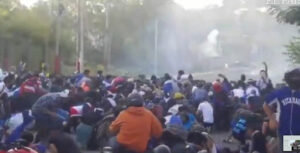
In April 2018, demonstrations sprang up against Daniel Ortega’s government and they quickly turned violent: demonstrators attacked police and vice versa. A “national dialogue” began in early May but, despite this, the violence became worse. Large numbers took part in demonstrations which were mainly peaceful, but with violent outbreaks at the fringes or after most participants had gone home. Large pro- and anti-government marches were planned for Managua on May 30, Mother’s Day. Authorities set the routes to keep them apart. Despite police efforts, at the end of the opposition march, violent groups headed towards the rival demonstration. In the resultant clashes two pro-government marchers and seven anti-government protesters were killed, while 20 police were injured and there were two deaths among bystanders.
RELATED CONTENT: Nicaragua, Virtual Reality and Human Rights
Two years after this day of violence, the Inter-American Commission on Human Rights (IACHR), through its Interdisciplinary Group of Independent Experts (GIEI, for its initials in Spanish) published a reconstruction of a “virtual crime scene,” focused on the deaths of three protesters. It was produced for the GIEI by the Argentine Forensic Anthropology Team (EAAF) and SITU Research of New York. The “forensic” examination was aimed at finding the likely culprits in the killings, which took place at a roadblock put in place by the protesters, close to Managua’s national baseball stadium. A website shows the evidence collected, including two specialist firearms reports, although access to the full video event reconstruction has recently been blocked and only clips are shown. The video acknowledges the lack of conclusive evidence but argues that “circumstantial evidence” overwhelmingly suggests that armed police officers or Sandinista supporters indiscriminately killed the three protesters and others shot dead in related incidents.
A detailed critique of the reconstruction was published by the Council on Hemispheric Affairs (COHA). This showed fundamental errors and gaps in the SITU/EAAF work. The most important were:
• A map which is key to the video shows the position of a group of police who were alleged to have fired the fatal shots. But it was incorrectly drawn: it placed them at the center of the zone from which the firearms expert judged the shots to have originated, whereas in fact their true location was outside that zone.
• The firearms expert’s judgment that conventional firearms (as well as homemade mortars) were being fired by the protesters was completely ignored.
• Video evidence that a group of protesters had conventional weapons, and fired them at other protesters, were omitted from the large volume of video material that the investigators collected.
• The deaths of two government supporters and the wounding by gunshot of 20 police officers were ignored.
These errors and omissions at best left the reconstruction in doubt or at worst completely invalidated it. For example, an equally plausible reason for the deaths could be that they were part of a “return of fire” incident, or even that the protesters may have been shot by other protesters. Nevertheless, for El Pais and for the BBC, the reconstruction proved that the police were the killers.
SITU and EAAF refused to respond to criticisms of their work. The IACHR and its parent body, the Organization of American States, has also ignored the contradictory information and revelations.
Maidan Square, Kyiv, Ukraine, Feb 20th, 2014
On Feb 20, 2014, 49 protesters and four police were killed at the central square known as Maidan in Kyiv, Ukraine. Many more were injured. The event led to the overthrow of the elected government and a radical change in national politics and policy. Who was responsible for the mass killings? Eight years later, there have been no convictions. How could this be, when there were dozens of videos, hundreds of victims and thousands of witnesses to a mass killing in the heart of a European capital?
Western media and the post-coup government blamed the security services of the previous Yanukovich government. Others claim the killings and chaos were organized by the militant opposition using snipers located in adjacent buildings, including the Hotel Ukraina and Arkada Bank.
After the killings and coup, a German news team visited. Their report quotes doctors saying that both police and protesters had been shot by identical bullets. The investigation was ongoing yet the newly appointed state prosecutor, a leader of the ultra-nationalist Svoboda Party, had already declared former President Yanukovich and Berkut police to be responsible.
Despite the state prosecutor’s efforts and numerous police being charged and imprisoned, there were no convictions.
In 2018, the New York Times (NYT) published a lengthy story titled “Who Killed the Kiev Protesters? A 3-D Model Holds the Clues”. It was accompanied by a video titled “Did Police Kill these protesters? What the videos show.” The NYT story reports that Ukrainian prosecutors enlisted the help of SITU Research, who built a replica of the street where protesters were shot, then did 3D modeling of the buildings, location of protesters, police, etc.. They analyzed dozens of actual videos then produced their own video concluding “In all three cases, individual officers can be seen aiming and firing their rifles during the moments leading to the victims’ deaths.”

The “virtual crime scene” analysis focuses on three individuals killed in the same area. In all three cases, based on bullet wound locations, SITU alleges that the fatal shots were fired from the direction of the police barricade. An audio analysis, based on the time difference of a shockwave versus firearm discharge, approximates the distance of the shooter.
Looked at casually or superficially, this appears to be compelling evidence.
However, Canadian Professor Ivan Katchanovski has done rigorous research on the Maidan Massacre and reveals that the SITU model misrepresented the location of wounds in all three cases.
1/ In the case of Igor Dmytriv, the wound locations are not level and straight as portrayed by SITU; they are from right to left, with a distinct downward angle. The video shows a hole in his shield near the right edge which also points to his shooting from Arkada Bank to the right, not the police barricade directly in front. The shield evidence disappeared before the trial.
2/ The wound locations are also misrepresented in the case of Andriy Dyhdalovych. As discovered by Katchanovski, “The 3d model moved the exit wound location from around the middle line of the back of his body in forensic medical and clothing examinations to the right and changed a steep top and bottom direction and 17 cm difference in height.” SITU misrepresented the wounds to match up with the direction of the police barricade. The actual wound locations point to the killer also being in the upper floors of the Arkada Bank.
3/ The third victim was Yuri Parashchuk: his wounds were also misrepresented. He was killed by a bullet to the back of his head. “The single bullet in the back right helmet area, and exit wounds in the back left area of his head (parietal region) in forensic examination mean that it was physically impossible to shoot him from the police barricade, contrary to the SITU model,” Katchanovski argues. The victim’s wife confirmed the gunshot wound locations.
The NYT story falsely characterized any critics as “pro-Russia sources” and “Kremlin-funded media.” University of Ottawa Professor Katchanovski has presented his findings to high interest before numerous academic conferences.
In addition to misrepresenting the body wounds, the “virtual crime scene” analysis ignores a crucial question: Who would have a motive to kill both protesters and police?
Douma, Syria, April 7th, 2018
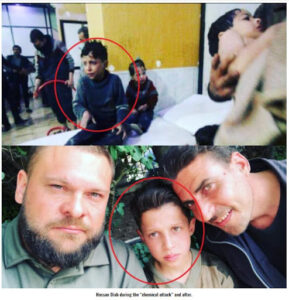
On 7 April 2018 there were sensational claims of a chemical weapons attack in Douma, Syria. Social media lit up with a video showing dead and living victims plus a chaotic scene in a medical clinic. The “White Helmets” claimed these were victims of a chemical attack by the Syrian military. Western media and governments quickly endorsed this accusation. The Syrian government denied it and called for a factual investigation by the Organization for the Prohibition of Chemical Weapons (OPCW).
Without waiting for an inspection, the US declared, “The Assad regime and its backers must be held accountable.” One week later, the US, UK and France launched air attacks on Damascus.
In late April, OPCW inspectors visited the site of the incident, interviewed witnesses, took photos and collected evidence.
While the OPCW team were making their analysis, the NYT created a reconstruction of the event, using photos, videos and computer modeling. The “visual investigation” was presented in a 12-minute video, “One Building, One Bomb: How Assad Gassed His Own People”. With seven producers, three editors and the collaboration of a private agency called “Forensic Architecture”, this was clearly a major and costly effort. It is a third example of how smooth video, computer modeling and professional voice-overs can lend an air of authority, whether true or not.
engineer on the OPCW’s Douma team, Ian Henderson. It contradicted the official narrative and concluded that “there is a higher probability that both cylinders were manually placed at those two locations rather than being delivered from aircraft.” It gives detailed evidence to support this argument – evidence that should have been included in the original OPCW report.
The OPCW fired Ian Henderson and made efforts to remove all evidence of his engineering report from the OPCW archives. On June 25th, 2018, just ten weeks after the event, the NYT published “How We Created a Virtual Crime Scene to Investigate Syria’s Chemical Attack,” They say, “Our investigation found that the Syrian government dropped a chlorine bomb on this apartment in Syria.” For western politicians and media, that was the end of the matter: Syria had been found guilty and the western attacks vindicated.
OPCW issued an interim report in July 2018 and full report in March 2019. They concluded there was evidence of reactive chlorine and there are “reasonable grounds that the use of a toxic chemical as a weapon took place.”
The governments which had attacked Syria claimed this was “proof” of guilt. The UK foreign ministry said the report provided “reasonable grounds to conclude that a toxic chemical was used as a weapon.” The NYT concluded that the OPCW had given “the most definitive finding yet to corroborate allegations that chemical weapons were dropped on the town, Douma, a suburb of Damascus, killing 43 people.” The Guardian similarly reported “Chlorine was used in attack on Syrian rebel town, watchdog says.”
Behind the scenes, OPCW staff were in turmoil. Investigators were complaining the investigation report was politically influenced and biased.
In May 2019, the “Engineering Assessment of Two Cylinders Observed at the Douma Incident” was published by an academic coalition. It was written by a lead.
Then in October 2019 a second OPCW whistle-blower emerged, giving more details of the report’s omissions. In a detailed interview, he told a British journalist that “Most of the Douma team felt the two reports on the incident, the Interim Report and the Final Report, were scientifically impoverished, procedurally irregular and possibly fraudulent.” He added that they had tried all possible internal channels before going public.
Because of the importance of these revelations about a biased and compromised OPCW investigation, an international panel was convened. It included experts from international law, military, intelligence agencies and the founding Director General of the OPCW. It expressed “alarm” at the “unacceptable practices” in the Douma investigation.
The scandal exposed the political manipulation of a crucial international organization, the OPCW.
The “virtual crime scene” and evidence presented by the NYT was shown to be fundamentally flawed. The on-site engineering assessment revealed that cylinder deformation did not match the hole in the roof or what would have occurred if the cylinder was dropped from an aircraft. The “criss-cross” pattern on the cylinder that the NYT “virtual crime scene” suggested was evidence, was dismissed as “inconsistent with the vertical, or near-vertical, angle of incidence of the cylinder”. The lead investigator concluded that it was more likely the cylinders were “manually placed”. In other words, the incident was staged.
Regarding the claim that “reactive chlorine” had been found in samples from the site, it was learned that these were trace levels that could be found in any location.
After publishing headline stories such as “How Assad Gassed His Own People” and creating a costly contrived “virtual crime scene” to “prove” Syria’s guilt, it is understandable that the NYT would be embarrassed at the revelations from these OPCW whistle-blowers. If the NYT were as factual as they claim to be, they would report these important stories and issue a correction and apology for their earlier false reports. Instead, there has been total silence.
Conclusion: What credibility should we give to “virtual crime scenes”?
Creating “virtual crime scenes” is clearly a growing business: SITU appears to have done at least 24 such reconstructions, while Forensic Architecture has well over 70, dating back more than a decade. A common factor is funding sources; as well as what are presumed to be specific contracts (for example with the NYT), both organizations receive funds from the Open Society Foundation, Oak Foundation, European Research Council and similar bodies aligned with conventional western political attitudes.
No doubt some of this work is in the public good (for example, SITU says it is helping a group of children sue the US government for its inaction on the climate crisis). But the case studies above show that such work can – whether intentionally or otherwise – push public opinion on controversial issues in a particular direction.
RELATED CONTENT: BBC Admits Documentary on Syria Chemical Attack Contained ‘False Claims’
Brad Samuels, founding partner of SITU, appeared to acknowledge this ambiguity in an interview quoted here: “…it’s about not allowing these narratives to become the reason that there’s no accountability … so that you can focus on what you do know and I just I think that that’s at play in all kinds of ways more than it ever has been … this question of competing narratives, truth claims and facts and that’s really what we’re, this work is about.”
In an article about the use of virtual crime scenes in legal cases, Sarah Zarmsky concedes that they can be “extremely compelling” but that “any political motives or biases must be taken into account.” In the Maidan Square example, which she examines, she points out that the reconstruction was presented as “flawless” whereas Katchanovski later accused those who created it of misrepresentation. Virtual crime scenes are expensive, sophisticated exercises, which once published are left open to interpretation by people who have no expertise in how they are created, she points out. Where witness statements, amateur videos and other material are used to build reconstructions, there is no outside control of the process. She concludes that “digital reconstructions need to be approached with caution and analyzed through a critical eye.”
Our conclusion is more definitive: digital reconstructions, especially in high-profile and controversial circumstances like the three examples presented here, are being used to serve political purposes. Their sophisticated and compelling approaches, obviously requiring considerable resources in their production and presentation, can be highly misleading. Whether or not this is the intention of those devising these virtual crime scenes, their work is used to add momentum to political arguments. In the cases examined here – Nicaragua, Ukraine and Syria – they have been explicitly used to endorse the US and European governments’ political narratives about those conflicts, creating apparent “proof” of one side’s culpability in violent incidents. However, objective analysis of the kind summarized in this article shows that digital reconstructions can hide the truth rather than reveal it. In Zarmsky’s words, “seeing should not always be believing.”
JP/RS/OT

John Perry is a writer based in Masaya, Nicaragua whose work has appeared in the Nation, the London Review of Books, and many other publications.

Rick Sterling is a journalist based in the Bay Area, California and he is also a board member of the Task Force on the Americas. He can be reached at rsterling1@protonmail.com