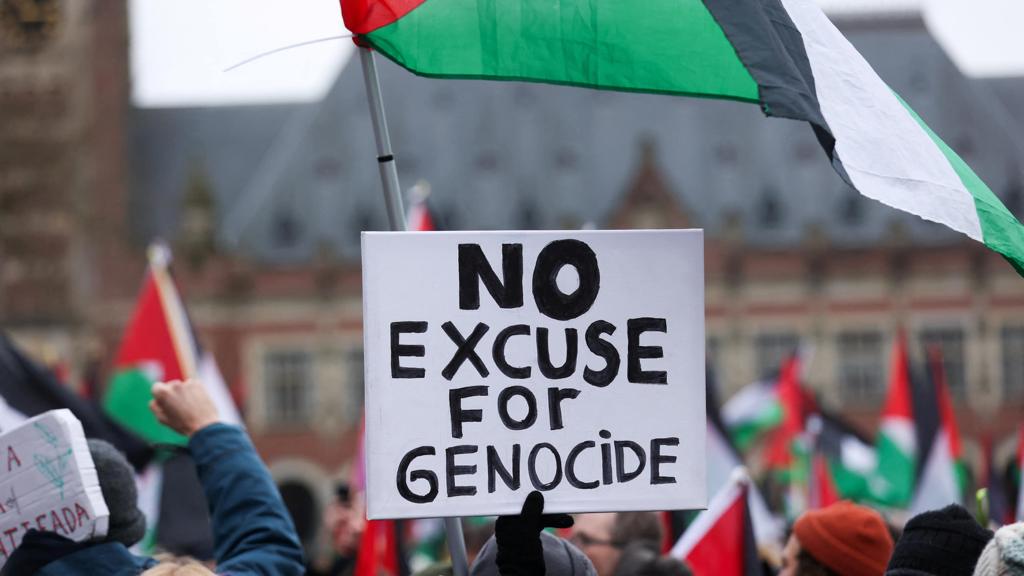
Pro-Palestinian protesters gather near the International Court of Justice (ICJ) carrying Palestinian flags and a poster reading “No Excuse for Genocide.” Photo: CBC.
Pro-Palestinian protesters gather near the International Court of Justice (ICJ) carrying Palestinian flags and a poster reading “No Excuse for Genocide.” Photo: CBC.
By Kit Klarenberg – Jan 14, 2024
Britain has been accused of “double standards” for formally accusing Myanmar of committing genocide against its Rohingya Muslim population in the International Court of Justice (ICJ), while simultaneously attempting to block South Africa’s heroic effort to hold Israel accountable for genocide in Gaza in the same Court.
In November, London submitted a 21-page-long “declaration of intervention” on Myanmar’s purported genocide with five other countries to the ICJ. It argues there is a lower threshold for determining genocide if harm is inflicted on children as well as adults. Speaking to The Guardian, a representative of leading international law firm Bindmans said the declaration’s value lay in Britain taking “a wide…not a narrow, definition of acts of genocide, and the intent to commit genocide.” They added:
“It would be wholly disingenuous if the UK, six weeks after advancing such a significant and broad definition of genocide in the case of Myanmar, now adopts a narrow one in the case of Israel.”
Given this context, it is vital to revisit the connivances in which Western powers previously engaged to reach a preordained and wished-for judgement of genocide, in past international legal struggles. Namely, long-running and ultimately successful efforts by the NATO-created and funded International Criminal Tribunal for the Former Yugoslavia (ICTY) to convict Serbs of that crime over the July 1995 Srebrenica massacre, in Bosnia.
The details should give Western citizens much pause for thought. It is evident that when North American and European powers wish to convict “enemy” states, and by extension their civilian populations, of crimes against humanity, this can and inevitably will be achieved by any means necessary, no questions asked. But when a Western ally ends up in the dock for war crimes and human rights abuses, concerns and disputes rapidly arise in Brussels, London, and Washington. Why?
‘Political Reasons’
In Srebrenica, July 1995, unarmed Bosniak males were massacred by the multi-ethnic Army of Republika Srpska (VRS). Its troops also purportedly committed grave crimes against civilians, which remain unpunished. Yet, many details of what happened that fateful month, including the total number of people killed and exact nature of their deaths, remain uncertain three decades on. Moreover, whether the horror constituted genocide remains a bone of contention among legal scholars.
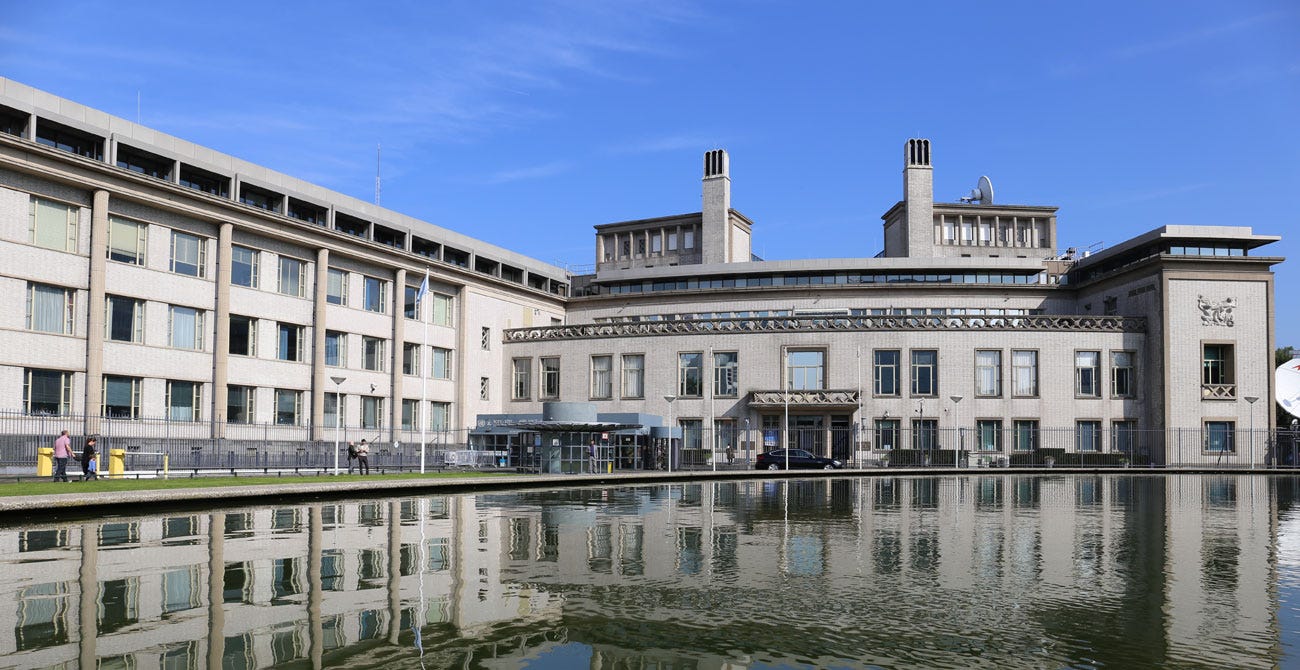
On the same grounds Srebrenica was ruled by the ICTY to be a genocide, many acts committed by all belligerents in the Yugoslav wars of the 1990s would likewise constitute genocide. For example, Croatia’s savage NATO-supported Operation Storm, which expelled the country’s entire 200,000-strong Serb population. Yet, these gruesome incidents are not regarded as such, and no one has faced justice, much less consequences, as a result.
The ICTY set evidentiary thresholds for proving the crime of genocide extraordinarily low. Over its 25-year-long existence, the Tribunal set various precedents; “existence of a [pre-existing] plan or policy is not a legal ingredient of…genocide”; “genocidal intent will almost invariably encompass civilians, but that is not a legal requirement”; “a conviction for genocide does not involve a numerical assessment of the number of people killed and does not have a numeric threshold.”
In other words, per the ICTY, any military force killing any number of people – including, if not exclusively, enemy soldiers – for any reason, even without evidence of a dedicated, prearranged plan to do so on any perpetrator’s part, can be classified as genocide. On this basis alone, the Zionist entity should be unequivocally convicted for that heinous crime, given its horrendous abuses against Palestinians since 1948, let alone following October 7th.
In respect of Srebrenica, behind-closed-doors Western officials openly admitted that the ICTY’s crusade to convict high-ranking members of the VRS, and Bosnian Serb leadership, of genocide for the assault was deeply politicised. It appears too Tribunal prosecutors worked backwards from the conclusion Srebrenica constituted genocide to secure convictions, rather than dispassionately surveying and following available evidence wherever it went.
An April 2004 cable dispatched from the US embassy in The Hague reported there was a “general sense” among ICTY prosecutors that the Tribunal Appeals Chamber “first decided” that Radislav Krstic, Chief of Staff of the VRS Drina Corps when it seized Srebrenica, “did not merit conviction as a principal perpetrator of genocide but that, for ‘political’ reasons [emphasis added], it did not want to set aside the finding that the massacres around Srebrenica constituted genocide”:
“The result, one prosecutor said, made it seem as if ‘an 18-year-old law clerk’ had written the judgment on the basis of a decision reached ‘by academics and diplomats’. In fact, a law clerk involved in the drafting confirmed to Embassy legal officers that the [ICTY] chamber had given the drafters general directions, ‘the bottom line,’ and that the law clerk drafters had to determine how to get there [emphasis added].”
The cable went on to note “many” prosecutors were “perplexed” that the ICTY Appeals Chamber had ruled Srebrenica to be a “genocide”, but failed “to identify perpetrators who in fact shared the specific intent to commit genocide, as required by the ICTY Statute and the 1948 Genocide Convention.” It was nonetheless considered a positive development that, “the Appeals Chamber seems to have made it easier to prosecute a person for aiding and abetting genocide.”
South Africa Accuses ‘Israel’ of Genocide in Palestine at International Court of Justice
Star Witness
The ICTY contravening its own statute and long-established international legal precepts on “specific intent” made its prosecutors’ well-remunerated job incredibly easy. This egregious sleight of hand further solved a major conundrum that bedevilled multiple prosecutions of Yugoslav officials – an often total lack of evidence defendants ever ordered, approved or even knew about the serious crimes of which the Tribunal accused them.
Kristic’s judgment, for example, acknowledged he was not only unaware of and uninvolved in crimes allegedly committed by his soldiers in Srebrenica, but explicitly ordered them not to harm civilians. Enormous time, energy, and money was invested by the ICTY and its army of investigators to specifically prosecute Bosnian Serb leaders for genocide – yet none of the trials ever uncovered evidence that an order was ever given by anyone at any command level to massacre Srebrenica’s male population.
Just one individual was convicted of direct involvement in Srebrenica – PTSD-ravaged VRS soldier Drazen Erdemovic. In return for testifying in multiple trials – despite experts ruling him mentally unfit to be tried himself – he served only three-and-a-half years in prison, then entered witness protection. Over many Tribunal appearances, his memory escaped him on almost every key fact, including his own military rank, how many people he personally executed, how many his unit killed in total, when the massacre happened, and who ordered it.

Erdemovic eventually settled on the implausible scenario that a low-rank soldier in his unit relayed the genocidal instructions to him on behalf of a lieutenant colonel, whose identity he claimed to not know and which has never been ascertained. Equally implausibly, he alleged his unit slaughtered up to 1,200 people in groups of 10 at a time, in just five hours. Despite implicating eight fellow soldiers in his testimony, they were never prosecuted, or even interviewed as witnesses by the ICTY.
Serb leader Slobodan Milosevic, who represented himself for much of his trial before the ICTY imposed legal representation upon him in September 2004 – which would be illegal in most countries – cross-examined Erdemovic repeatedly. The presiding judge aggressively blocked his attempts to grill the star witness on why he thought the Tribunal was uninterested in his fellow soldiers testifying. Many other extremely awkward questions raised by Milosevic throughout his long-running trial were likewise shut down, in absolutely blatant demonstrations of prosecutorial bias.
ICJ on Trial
At least one ICTY judge was nonetheless extremely critical of the Tribunal’s work on Srebrenica. In July 2015, the dissenting opinion of revered, veteran French justice Jean-Claude Antonetti on VRS commander Zdravko Tolimir’s genocide conviction two-and-a-half years earlier was published. He despaired, “the question is why did this military operation transform into a massacre of the prisoners of war? By failing to examine this avenue, the ICTY did not perform its duty to establish the truth”:
“[This] judgement does not…provide an answer to the legitimate question of the victims’ families as to who ordered the mass executions. The splitting up of the case files on Srebrenica, and the almost complete control over presentation of evidence by the parties, does not seem to me to have provided an answer to this question that is crucial to the victims’ families and the expectations of the international community.”
Now, in ICJ proceedings on Gaza, prosecutors have mountains of evidence to prove the “specific intent” of Israeli Occupation Forces, and their political controllers, to carry out a total genocide beyond any reasonable doubt. Witness testimony, photos and videos of innocent, unarmed Palestinians – including thousands of children – slaughtered en masse, and the endless stream of tubthumping calls for Nakba 2.0 since October 7th from Israeli officials have all been submitted to the Court.
One would think this an incontrovertible, open and shut case of genocide. Yet, as exiled dissident journalist Craig Murray observed in a first-person dispatch from The Hague on January 11th, ICJ judges appear conspicuously nervous about making that ruling:
“The people who really did not want to be in the Court at all were the judges, because it is in fact the judges and the Court itself on trial…Several of the judges are desperate to find a way to please the USA and Israel and avoid countering the current Zionist narrative, the adoption of which is necessary to keep your feet comfortably under the table of the elite. What counts more for them, personal comfort, the urgings of NATO, future wealthy sinecures?”
Today, the ICJ finds itself in a lose-lose situation. Should it not indict Israel so as to appease its Western masters, its global credibility will be irreparably tarnished, and by extension that of its UN parent. If the Court follows facts and rightly finds the Zionist entity guilty of genocide, the West and its Tel Aviv proxy will avowedly ignore the ruling, leaving their already moribund global standing in permanent tatters. Watch this space.
(Substack)

Kit Klarenberg is an investigative journalist exploring the role of intelligence services in shaping politics and perceptions.