By Joe Lauria – Dec 12, 2021
If the High Court knew that Julian Assange suffered a stroke on October 27, the first day of the US appeal hearing, would it have altered the court’s decision to allow his extradition?
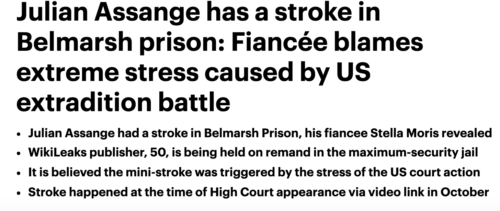
News on Sunday that imprisoned WikiLeaks publisher Julian Assange suffered a stroke on October 27 has raised the question of when the High Court knew about it and whether it would have influenced its ruling to overturn a lower court judgment, allowing his extradition to the United States.
Stella Moris, Assange’s financée and one of his lawyers, told the Mail on Sunday that doctors determined that the mini-stroke has left Assange with “a drooping right eyelid, memory problems and signs of neurological damage.”
The Mail reported:
A “transient ischaemic attack”—the interruption of the blood supply to the brain—can be a warning sign of a full stroke. Assange has since had an MRI scan and is now taking anti-stroke medication.
Ms Moris, 38, a lawyer, said, “Julian is struggling and I fear this mini-stroke could be the precursor to a more major attack. It compounds our fears about his ability to survive the longer this long legal battle goes on.”
Moris told the paper: “It urgently needs to be resolved. Look at animals trapped in cages in a zoo. It cuts their life short. That’s what’s happening to Julian. The never-ending court cases are extremely stressful mentally.”

She added:
I believe this constant chess game, battle after battle, the extreme stress, is what caused Julian’s stroke on October 27.
He was feeling really unwell, far too ill to follow the hearing, and he was excused by the judge but could not leave the prison video room.
It must have been horrendous hearing a High Court appeal in which you can’t participate, which is discussing your mental health and your risk of suicide and in which the US is arguing you are making it all up.
He had to sit through all this when he should have been excused. He was in a truly terrible state. His eyes were out of synch, his right eyelid would not close, his memory was blurry.
RELATED CONTENT: On Human Rights’ Day, UK Court Permits Extradition of Julian Assange to US
When did High Court know?
It is not clear when the High Court judges learned of this dangerous deterioration of the WikiLeaks founders’ health. His lawyers likely made submissions to the court in the weeks after the hearing, leading up to Friday’s ruling.
In that ruling, the judges accepted lower court Judge Vanessa Baraitser’s determination that Assange was too ill to be extradited. The court rejected three of the U.S. grounds of appeal, which challenged the medical evidence.
Confirmation of the stroke exposes the US contention that Assange is a “malingerer” as a lie. But the High Court did not accept that smear.
The court also did not challenge the second pillar of Baraitser’s judgment against extradition: that prison conditions in the US were too harsh and would lead to Assange’s suicide.
The entire reason for overturning Baraitser and allowing the extradition was the High Court’s belief that the US is sincere in promising not to put Assange into the worst of US penal isolation: Special Administrative Measures (SAMs) or into ADX Florence maximum security prison in Colorado.
The court also bought the line that U.S. prison authorities would provide adequate health care for Assange. [A defense witness testified, however, that there are no permanent doctors at the Alexandria Detention Center where Assange would be held pre-trial.]
So would knowing that he had suffered a stroke have altered the High Court’s thinking, even though it had already accepted Assange’s medical diagnosis? Would adding knowledge of the stroke have changed anything?
Burnett’s Remark
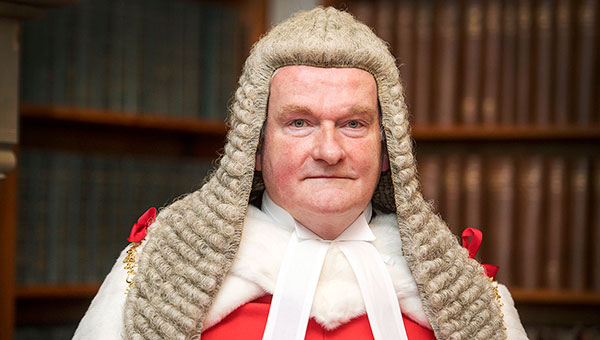
Lord Chief Justice Ian Burnett was on the High Court in the Assange case as well as in 2018 when the court overturned the extradition order of hacktivist Lauri Love. Love was accused by the US of hacking into US government computers. Like Assange, Love suffered from depression and Asperger Syndrome; and like Assange he was deemed by the High Court to be at high risk of suicide if extradited. However the court ruled against extraditing Love, and for extraditing Assange. Why?
The High Court found that Love also suffered from a physical ailment, namely eczema, that would be exacerbated with extradition.
The Burnett ruling overturning Love’s extradition said:
All the evidence is that this would be very harmful for his difficult mental conditions, Asperger Syndrome and depression, linked as they are; and for his physical conditions, notable eczema, which would be exacerbated by stress. That in turn would add to his worsening mental condition, which in its turn would worsen his physical conditions. There is no satisfactory and sufficiently specific evidence that treatment for this combination of severe problems would be available in the sort of prisons to which he would most likely be sent.
[Noteworthy is that Burnett in this judgement said there is “no satisfactory and sufficiently specific evidence that treatment for this combination of severe problems would be available in the sort of prisons to which [Love] would most likely be sent.” Yet in the Assange case Burnett accepted the US assurance that there would be such treatment available for Assange. Burnett also accepted, however, the US assurance that Assange would not be sent to that “sort of prison.”]
James Lewis QC, the prosecutor for the US, argued, ironically on the day of the stroke, that the Love case was not a precedent for Assange because Love had suffered from physical ailments, where Assange had not. Lewis said the purely psychological test from the Turner v. Government of the USA case was applied in Assange’s case, but not in Love’s.
RELATED CONTENT: Australia has Sacrificed Julian Assange to the United States
The Appeal will be heard by Lord Justice Holroyde and Lord Chief Justice Burnett. pic.twitter.com/MBEQgCYLkv
— Consortium News (@Consortiumnews) October 27, 2021
On the following day, Assange lawyer Edward Fitzgerald QC, made a strong argument that the Love case was indeed a precedent for Assange. He pointed out that both Love and Assange were diagnosed with depression and Asperger Syndrome, which increases a risk of suicide. Fitzgerald said the High Court in Love had looked into the future to see that extradition to the US would be oppressive because of the high risk of suicide.
At that point Burnett interrupted Fitzgerald from the bench. “It is a completely different case,” he said. According to former SBS Australian news presenter Mary Kostakidis, who viewed the appeal hearing via a video-link, Burnett said Love was different because he had a physical ailment, namely eczema.
Love had eczema said the judge during the Appeal Hearing, which made it ‘a very different case’
— 💧Mary Kostakidis (@MaryKostakidis) December 11, 2021
Burnett did not show up for the reading of the summary judgment on Friday at the High Court.
A Very Serious Physical Ailment
If indeed a physical ailment is the main legal matter separating Love from Assange then that would seem to change with the news that Assange had a stroke. The High Court may have considered that new evidence, though, because there are no physical ailments mentioned in Baraitser’s decision on Assange that was before the High Court.
In the end it probably would not have mattered. The High Court ruling accepted all of the medical evidence about Assange’s psychological condition and still ruled he should be extradited. That probably would not have changed had a stroke been added to his medical status before the ruling.
That is because despite accepting the medical evidence, the High Court ruled for extradition solely on the basis of the US assurances that Assange would not be put into SAMs and that he would receive adequate medical treatment, presumably for a stroke too.
There is another difference between Love and Assange. Love was expendable to the United States. Assange is not. He is Too Big to Free. By reporting the truth, Assange has threatened the legitimacy of an entire system built on lies. The British judiciary is part of that system.
It is very unlikely that knowledge of the stroke would have made any difference to the High Court.
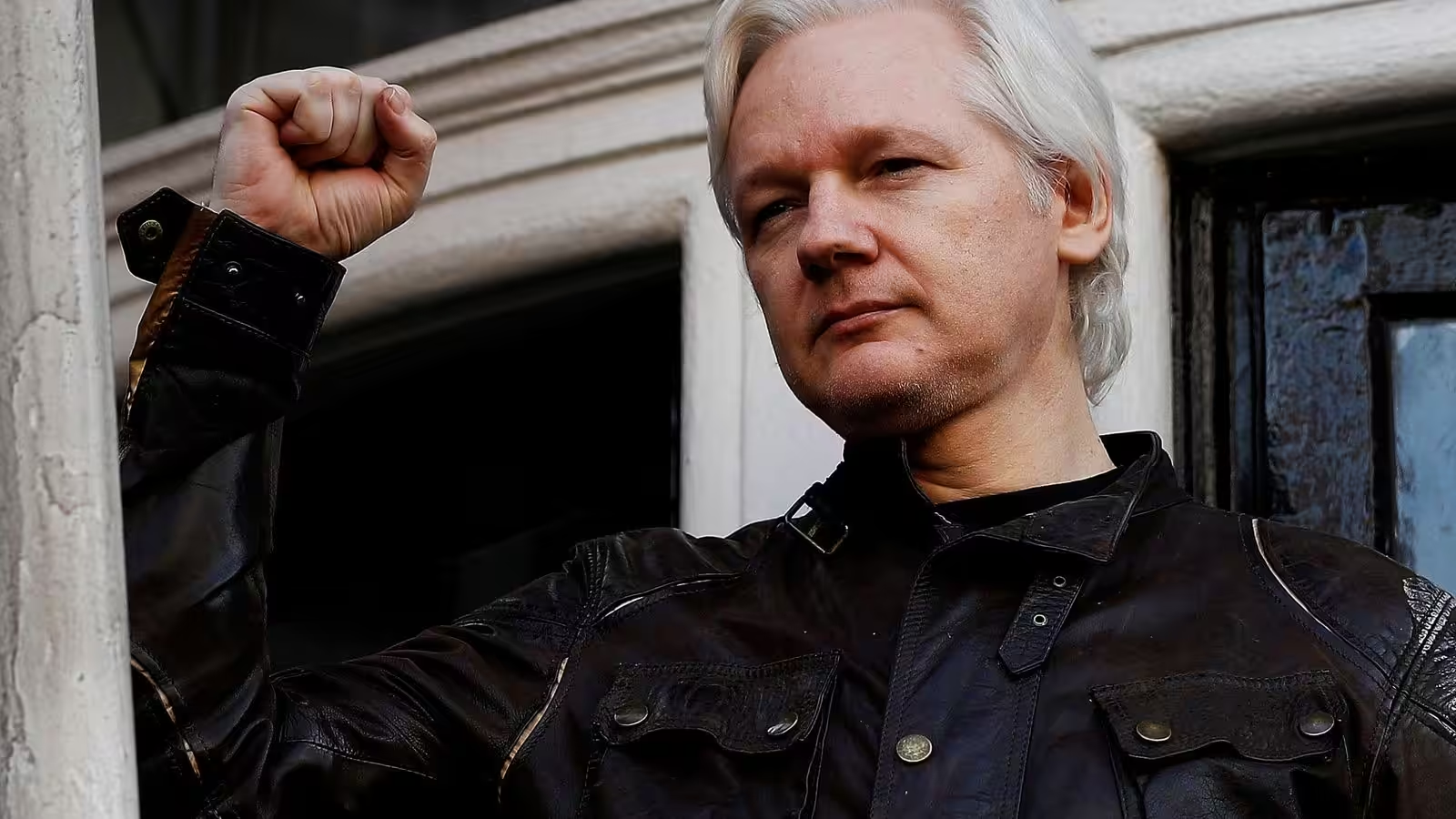
Featured image: Julian Assange addressing the press from the balcony of the Ecuadorian Embassy in London, after he had sought asylum there, in 2012. Photo: El Confidencial
Joe Lauria
Joe Lauria is editor-in-chief of Consortium News and a former UN correspondent for The Wall Street Journal, Boston Globe, and numerous other newspapers. He was an investigative reporter for the Sunday Times of London and began his professional career as a stringer for The New York Times. He can be reached at joelauria@consortiumnews.com and followed on Twitter @unjoe .