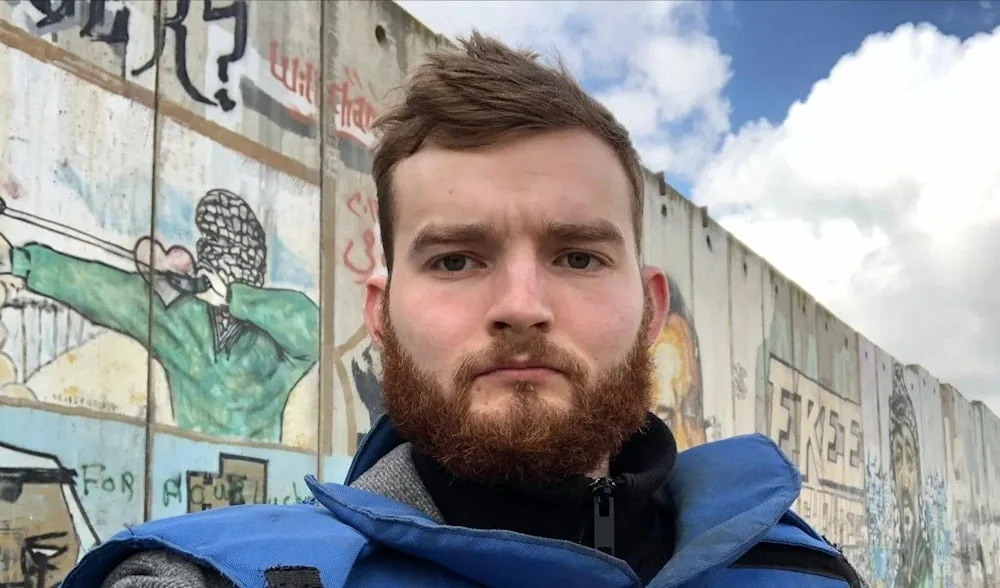
Robert Inlakesh in front of the separation wall at the Qalandia checkpoint, occupied West Bank, in February 2020. Photo: Robert Inlakesh/file photo.
Robert Inlakesh in front of the separation wall at the Qalandia checkpoint, occupied West Bank, in February 2020. Photo: Robert Inlakesh/file photo.
In February 2024, YouTube unexpectedly removed the account of independent British journalist Robert Inlakesh, a frequent contributor to Al Mayadeen English, The Intercept reported.
His channel held dozens of videos, including many livestreams documenting Israeli occupation in the West Bank. Over roughly ten years covering developments in occupied Palestine, he filmed Israeli forces tearing down Palestinian homes, police stopping and intimidating Palestinian drivers, and soldiers firing at Palestinians and journalists during demonstrations outside illegal settlements. All of that footage vanished instantly.
By July, YouTube had also taken down Inlakesh’s private backup channel. Then in August, Google, YouTube’s parent company, deleted his Google account entirely, wiping out his Gmail and archives of documents and written work.
The company initially claimed he had violated YouTube’s community guidelines. Months later, Google changed its explanation, claiming his channel contained spam or scam material.
But nearly two years after the deletion, when The Intercept pressed for details, YouTube offered yet another justification: alleging his account was connected to an Iranian influence operation.
YouTube deleted all my coverage of Israeli soldiers shooting civilians, including children targeted on a live stream, along with my entire account.
No community guidelines violated & 3 separate excuses given to me. Then Google deleted my email & won’t respond to appeals. https://t.co/0MREcPZOV2
— Robert Inlakesh (@falasteen47) November 5, 2025
No evidence for claims
YouTube would not provide evidence for the claim, saying the company does not disclose its methods for detecting influence campaigns. Inlakesh still cannot create new Google accounts, cutting him off from the world’s largest English-language video platform.
Inlakesh, now working as a freelance reporter, acknowledged that he had been employed from 2019 to 2021 at the London office of Press TV, Iran’s state-owned network sanctioned by the US. Still, he said that should not have led to erasing his entire channel, noting that nearly all of the content was independent work uploaded before or after his time at Press TV.
A publicly available Google document from the same month his channel was removed shows that the company had recently shut down more than 30 accounts it said were tied to Iran and had posted material critical of “Israel” and its war on Gaza. Google did not answer when asked if its account was part of that group.
He believes he was targeted not because of his past employer but because of his reporting on Palestine, especially amid what he described as a growing pattern of pro-“Israel” censorship across major tech platforms.
“What are the implications of this, not just for me, but for other journalists?” Inlakesh told The Intercept. “To do this and not to provide me with any information — you’re basically saying I’m a foreign agent of Iran for working with an outlet; that’s the implication. You have to provide some evidence for that. Where’s your documentation?”
Misdirection and lack of answers
Over the last two years, YouTube and Google have given shifting and often unclear explanations for deleting Inlakesh’s accounts.
YouTube’s first claim was that he had engaged in “severe or repeated violations of our Community Guidelines.” After Google employee Marc Cohen noticed Inlakesh’s public complaints in February 2024, he decided to investigate. Cohen submitted an internal support request using Google’s issue tracker, known as the Buganizer, seeking an explanation for why a journalist’s account had been terminated. When he couldn’t get answers inside the company, he raised the issue publicly that March. After capturing the attention of YouTube’s team on Twitter, he eventually received an internal response saying the account was removed for “scam, deceptive, or spam content.”
Cohen, who later resigned from Google over what he described as the company’s support for “Israel”’s war on Gaza, said that without his intervention, Inlakesh would have been left with virtually no information.
“They get away with that because they’re Google,” Cohen said. “What are you going to do? Go hire a lawyer and sue Google? You have no choice.”
Every breach possible cited
When Google deleted Inlakesh’s Gmail account this year, the company said he had “used to impersonate someone or misrepresent yourself,” which is against its policies. He appealed three times but received no reply.
It was only after The Intercept began asking questions that Google shifted its explanation toward alleged Iranian influence activity.
“This creator’s channel was terminated in February 2024 as part of our ongoing investigations into coordinated influence operations backed by the Iranian state,” a YouTube spokesperson told The Intercept. YouTube added that removing his main channel triggered the deletion of all connected accounts, including his backup.
When pressed for details, such as what content had supposedly linked him to an Iranian operation, YouTube said it does not “disclose specifics of how we detect coordinated influence operations” and pointed to quarterly bulletins published by Google’s Threat Analysis Group, or TAG, which focuses on countering government-linked cyber activity.
TAG’s bulletin from the time his account was deleted states that in February 2024, Google removed 37 YouTube channels as part of an investigation into alleged Iran-linked influence efforts. Four accounts had posted material “critical of the Israeli government and its actions in the ongoing Israel-Gaza war” and shared content about alleged cyberattacks on Israeli institutions. The remaining 33 channels shared material “supportive of Iran, Yemen, and Palestine and critical of the US and Israel.”
A pattern of censorship
Google has a long record of removing Palestinian content and material critical of “Israel”, as well as content documenting human rights violations in other war zones. That trend has only intensified during what many describe as “Israel’s” genocidal war on Gaza.
The company relies on several mechanisms for content removal: manual reviews by specialized teams, automated detection systems, checks against US sanctions and terror lists, and government takedown requests.
For years, “Israel’s” Cyber Unit has openly worked to pressure platforms like YouTube to remove content related to Palestine.
Among US allies, “Israel” has achieved the highest rate of successful takedown requests on Google platforms, close to 90 percent, since 2011. This surpasses countries such as France, Germany, the UK, and even the US itself. But Google’s public data does not include takedown requests from individual users, a channel reportedly used both by “Israel’s” Cyber Unit and by pro-“Israel” employees within companies.
Ban on Palestine-related content
Content removed because of US sanctions is also difficult to measure because such decisions often occur without transparency. A recent Intercept investigation revealed that YouTube quietly deleted the accounts of three major Palestinian human rights organizations due to the Trump administration’s sanctions against them for assisting the International Criminal Court’s war-crimes investigation into Israeli officials. Those deletions erased at least 700 videos documenting alleged Israeli abuses.
Technology and human rights consultant Dia Kayyali said that as platforms increasingly rely on automated systems linked to US sanctions and terror lists, more journalists in West Asia and North Africa have seen their Palestine-related content removed, even when it does not violate platform rules. Kayyali suggested the same dynamic may have affected Inlakesh.
“And that’s part of the problem with automation, because it just does a really bad job of parsing content that could be graphic, anything that has any reference to Hamas,” Kayyali said.
Google’s ‘overcompliance’
Google and other major companies often rely heavily on sanction lists to avoid potential conflicts with the State Department. But such caution can go too far, said Mohsen Farshneshani, principal attorney at the Sanctions Law Center.
Multinational corporations like Google tend to practice “overcompliance,” Farshneshani said, removing content even when the law does not require it, a pattern that harms journalists and human rights organizations.
Under the Berman Amendment to the International Emergency Economic Powers Act, informational materials, including journalism, are explicitly exempt from sanctions.
“Deleting an entire account is far from what the statutes or the regulations ask of US entities,” Farshneshani stressed.
Furthermore, Farshneshani said this carveout should have shielded Inlakesh’s channel. Instead of wiping everything, Google could have removed individual videos that raised concerns or demonetized them. (Inlakesh noted that years earlier, YouTube had demonetized certain videos documenting Israeli military violence.)
“Deleting an entire account is far from what the statutes or the regulations ask of U.S. entities,” Farshneshani said. “The exemption is meant for situations like this. And if these companies are to uphold their part of the bargain as brokers of information for the greater global community, they would do the extra leg work to make sure the stuff stays up.”
State-sponsored media
While Google and YouTube have not said whether Inlakesh’s past work for Press TV influenced their decision, the Iranian state-funded outlet has long faced scrutiny from the company. Google briefly removed Press TV’s YouTube channel in 2013 and permanently deleted it, along with its Gmail account, in 2019 amid the Trump administration’s sanctions on Iran. In 2021, the Biden administration seized and shut down dozens of Iran-linked websites, and in 2023 sanctioned Press TV over Iran’s crackdown on anti-government protesters following the death of Mahsa Amini.
Venezuela: President Maduro’s YouTube Channel Deleted Amid US Tensions
Out of all the videos on his channel, Inlakesh recalled only two related to his Press TV work: one documentary criticizing the “2020 Trump peace plan”, and a short video about Republican Islamophobic attacks on Rep. Ilhan Omar, D-Minn. Most of his content was posted either before or after his time there.
In older cached versions of his YouTube page, Press TV’s UK channel occasionally appeared as an “associated channel.” A YouTube spokesperson said the company uses “various signals to determine the relationship between channels linked by ownership for enforcement purposes” but did not specify which signals applied here.
Inlakesh insisted he worked independently while at Press TV and was never instructed to upload content to his personal YouTube page.
Jillian York, director for international freedom of expression at the Electronic Frontier Foundation, said she recognizes that Google needs to moderate content, but questioned why the company opted for full deletion instead of applying its label for state-funded media, a system she said has its own flaws. “More labels, more warnings, less censorship,” York said.
“The political climate around Palestine has made it such that a lot of the Silicon Valley-based social media platforms don’t seem particularly willing to ensure that Palestinian content can stay up,” she said.