Secret US Intelligence Files Provide History’s Verdict on Argentina’s Dirty War

Orinoco Tribune – News and opinion pieces about Venezuela and beyond
From Venezuela and made by Venezuelan Chavistas
Recently declassified documents constitute a gruesome and sadistic catalog of state terrorism.
By Peter Kornbluh- Nov. 18th, 2019
When Ambassador Héctor Hidalgo Solá was abducted off a busy Buenos Aires street on July 18, 1977, his family had little idea what had happened to him. Unlike many of the estimated 30,000 Argentine desaparecidos—the people disappeared by agents of the country’s military dictatorship—Hidalgo Solá was not a liberal, a leftist, or an armed militant opposed to the regime. He was, in fact, the military government’s appointed diplomatic representative to Venezuela.
In that capacity, however, Hidalgo Solá opened his embassy doors to prominent exiles, including labor leaders, politicians, and relatives of the disappeared seeking answers on the fate of their loved ones. When Emilio Mignone, whose daughter was one of the victims, met with Hidalgo Solá in Caracas, the ambassador told him he would go to Buenos Aires to persuade the military government to change its repressive policies. If he tried that, Mignone warned him that they would kill him.
This past spring, nearly 42 years after Hidalgo Solá’s disappearance, the Trump administration declassified some 47,000 pages of secret US intelligence files on the “Dirty War” that Argentina’s military government waged against its own people. More than 7,000 CIA, FBI, Pentagon, and National Security Council (NSC) records—now posted on a specially created US government website at the Office of the Director of National Intelligence—shed considerable light on the state of terror that existed in Argentina from 1976 to 1983, when the military held power. The detailed documents provide extensive new evidence on the infrastructure of repression, Argentina’s role in the international terrorism campaign known as Operation Condor, and most important, the fate of hundreds of desaparecidos who were kidnapped, tortured, and murdered—among them Hidalgo Solá.
“Suspicion will fall on military hardliners who were upset last year when Hidalgo Solá received at his embassy a labor leader ousted after the March 24, 1976 coup,” states one secret intelligence assessment filed just eight days after the ambassador disappeared. FBI sources believed he had been eliminated because the military suspected him of providing passports to exiled opponents of the regime in Venezuela, according to another report. “Hidalgo Solá was kidnapped and assassinated by a special group which has worked for the State Intelligence Secretariat (SIDE),” asserts a secret CIA intelligence cable, which identified the agents responsible and provided an address for the secret torture center where he was allegedly held.
On April 12, these documents were included in the thousands of declassified records formally turned over to Argentina during an official presentation at the National Archives in Washington, DC. Along with Argentine diplomats and US officials, several family members of victims attended the solemn ceremony. Among them was the ambassador’s granddaughter Azul Hidalgo Solá.
“DECLASSIFICATION DIPLOMACY”
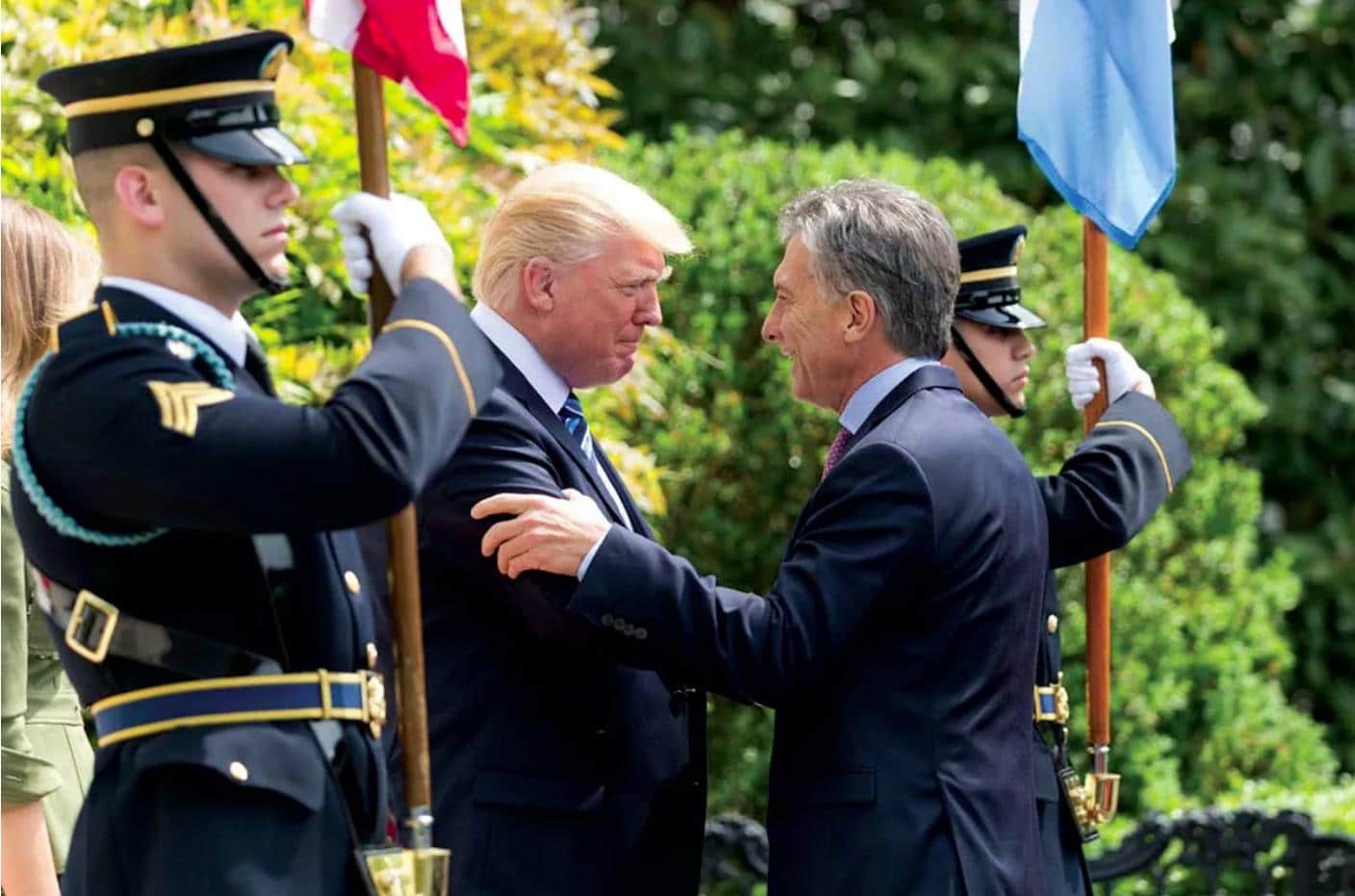
The Argentina Declassification Project, as it is officially known in US government circles, is one of those rare cases in which Donald Trump completed rather than reversed a policy initiated by his predecessor. When Fernando Cutz, then the NSC’s senior director for Western Hemisphere affairs, briefed the new president in preparation for the April 2017 state visit of Argentine President Mauricio Macri, he explained to Trump that Macri personally requested the special declassification when Obama visited Buenos Aires a year earlier. Trump had personal ties to Macri: Decades before, they bar-hopped together while their fathers negotiated real estate deals in New York; more recently, the Trump Organization sought Macri’s assistance in its plans to construct a Trump Tower in Buenos Aires. “It helped to be able to present the project as a Macri ask rather than an Obama initiative,” Cutz recalled.
The real genesis of the Argentina Declassification Project, however, started with a presidential scheduling faux pas. In the spring of 2016, the Obama administration arranged a historic two-day trip for the president to Havana and, from there, a three-day trip to Argentina. The timing of the high-profile state visits was determined, in part, by the fact that it was spring break for Obama’s two daughters, and he wanted them to vacation in Cuba as well as in Patagonia in southern Argentina.
But the White House announcement that the US president would be in Buenos Aires on March 24, 2016—by coincidence the 40th anniversary of the bloody military takeover—sparked an outcry from human rights groups in Argentina. The United States was still viewed, in the words of Argentine Nobel Peace Prize laureate Adolfo Pérez Esquivel, as “an accomplice of coups d’état in this region.” Massive protests, with banners declaring “Day of Memory: Obama Get Out,” were threatened. In meetings with Macri, human rights activists, led by the famed Grandmothers of the Plaza de Mayo, demanded that he ask Obama to declassify intelligence records that might help them to locate their missing sons and daughters, and even the grandchildren who had been born in secret detention centers and then adopted by military families after their mothers were executed.
RELATED CONTENT: Macri and the US Involvement in the Bolivian Coup Starting to Emerge
To redress this serious affront to the victims’ families, the White House and the Macri government orchestrated a round of what I call “declassification diplomacy”—the use of secret US documents to advance bilateral relations. On the morning of March 24, Obama and Macri visited the Parque de la Memoria (Remembrance Park) in Buenos Aires to pay their respects to the victims of the Dirty War. “Today, in response to a request from President Macri, and to continue helping the families of the victims find some of the truth and justice they deserve, I can announce that the United States government will declassify even more documents from that period, including, for the first time, military and intelligence records,” Obama stated in a poignant speech. “I believe we have a responsibility to confront the past with honesty and transparency.”
In June 2016, the White House issued a “tasker” to all US national security agencies; titled “Argentina Declassification Project,” it mandated an 18-month file search and review of relevant records. “The Administration continues to support efforts to clarify the facts surrounding human rights abuses, acts of terrorism, and political violence in Argentina during the ‘Dirty War’ period from 1975 through 1984,” the directive stated, and it called on the national security agencies “to prioritize support for this effort.” According to John Fitzpatrick, who directed the NSC’s Office of Records Access and Information Security Management at the time, almost 400 archivists, analysts, Freedom of Information Act officers, and records managers drawn from 16 different government agencies participated in finding and processing the documents, expending more than 30,000 work hours to complete the project.
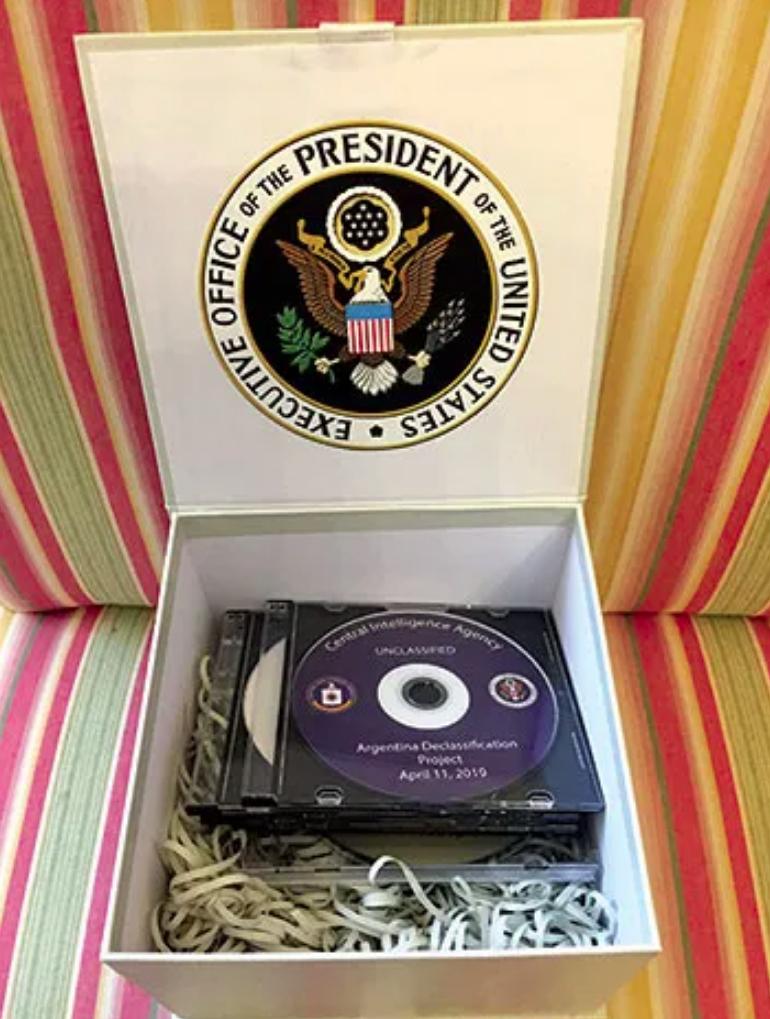
Before Obama left office, his administration released the first two tranches of records. And during an April 2017 summit, Trump handed Macri a pen drive containing the third tranche. Predictably, Trump marked the final release of these documents in April by proclaiming it the biggest ever. “The release of records,” Trump wrote in a letter to Macri, “constitutes the largest declassification of United States Government records directly to a foreign government in history.”
NAMING NAMES
When intelligence documents are declassified, they’re usually replete with heavy redactions—swaths of information blacked out in the name of national security or to protect covert “sources and methods.” But because of the meticulous quality control exercised by an unheralded NSC records manager named John Powers, the released CIA, FBI, and Defense Intelligence Agency records on Argentina are far less censored than previous special declassifications. This unique transparency has rendered them far more valuable to historians, as well as to the legal investigators who continue to prosecute these crimes against humanity.
As a collection, the documents constitute a gruesome and sadistic catalog of state terrorism. For example, one CIA cable reports that several months after the 1976 coup, federal police rounded up and murdered 30 militants en masse and then scattered their body parts—through the use of dynamite—in an open field “as a warning to leftist extremists.” Another FBI report provides details of how security forces intercepted and stole a funeral hearse carrying the remains of Marcos Osatinsky, a leader of a leftist guerrilla group called the Montoneros, “to prevent the body from being subjected to an autopsy, which would have clearly shown he had been tortured.” At least two dozen FBI and CIA cables record a SIDE operation to kidnap, torture, and execute two Cuban Embassy officers suspected of aiding militants in Argentina. After the Cubans were murdered, according to one FBI report marked “secret/eyes only,” “their bodies were cemented into one large storage drum and thrown into the Rio Lujan” near Buenos Aires. One State Department cable describes how security agents detained and tortured a wheelchair-bound psychologist for the purpose of gaining information about one of her patients.
Torture was routine, reported Patricia Derian, then the assistant secretary of state for human rights, after a fact-finding trip to Argentina. “The electric ‘picana,’ something like a supercharged cattle prod, is still apparently a favorite tool, as is the ‘submarine’ treatment (immersion of the head in a tub of water, urine, excrement, blood, or a combination of these),” she said in a declassified summary of abuses. “There is no longer any doubt that Argentina has the worst human rights record in South America.”
Of course, details about such atrocities have been in the public domain for years, as surviving victims have stepped forward and hundreds of human rights trials in Argentina have presented evidence and testimony. But in a break from the strictures of secrecy, many of the recently declassified documents go beyond a description of the human rights violations and identify the violators. “These documents name names. They name the names of the perpetrators and the names of their victims,” observes my colleague Carlos Osorio, a senior analyst at the National Security Archive, who provided extensive expertise and support to the Argentina Declassification Project. “And because they name those names, they provide a level of truth and accountability that many other declassification projects have failed to achieve.”
Moreover, hundreds of reports by FBI agent Robert Scherrer, who consistently provided the most detailed intelligence on the operations and abuses of the Argentine security forces, contain the unredacted identities of his confidential sources, thereby providing a master list of the individuals who witnessed, knew about, or were directly involved in the apparatus of repression. Although many of his sources are now deceased, the uncensored records will allow human rights investigators to pinpoint who inside the Argentine military, intelligence, and police were privy to details about specific atrocities—information that will advance a number of ongoing human rights investigations.
CONDOR 1
Based in Buenos Aires, Scherrer became the lead FBI investigator of the September 21, 1976, car-bomb assassination of former Chilean ambassador Orlando Letelier and his 25-year-old colleague Ronni Moffitt at the Institute for Policy Studies in Washington, DC. Scherrer’s famous “Chilbom” report was the first—and for years the only—partially declassified document that mentioned Operation Condor, identifying it as a “recently established [organization] between cooperating intelligence services in South America.” The intelligence Scherrer gathered suggested that the Letelier-Moffitt assassination was a possible “third phase” of the Condor mission spearheaded by Gen. Augusto Pinochet of Chile and his secret police, the DINA.
Scherrer’s Chilbom cable has now been declassified completely unredacted, and the identity of his source has been revealed as an Argentine Army intelligence operative involved in death squad efforts in Europe. “Source is Dr. Arturo Horacio Poire,” the document states, “who is a member of the Argentine special group, which will possibly participate in the third phase of ‘Operation Condor.’” The identification of the source has opened the door to renewed investigation into Condor’s efforts to extend its repression abroad.
But the unredacted version of Scherrer’s cable is only one of dozens of exceptionally detailed FBI and CIA records on Operation Condor found in the Argentina collection. They provide a far more comprehensive history of Condor’s infrastructure and operational capacity than was previously known. Among the substantive new revelations:
§ Argentina—not Pinochet’s Chile, which came up with the idea of a Murder Inc. in the Southern Cone—was designated Condor 1. Declassified CIA records make it clear that the numerical call signs for member nations were alphabetical: Argentina was Condor 1; Bolivia, Condor 2; Chile, Condor 3; Paraguay, Condor 4; Uruguay, Condor 5; etc. These designations were used in encrypted communications among the Condor nations.
§ Argentina hosted the operational headquarters for a special Condor program code-named Teseo—Spanish for Theseus, the mythical Greek king who slew the fearsome Minotaur and other foes of the social order—whose mission was “to liquidate selected individuals” abroad. Secret CIA cables describe Teseo as “a unit established by the Condor cooperative organization of South American intelligence services to conduct physical attacks against subversive targets,” first in Paris and then in other European cities.
§ In September 1976, the Condor nations signed an agreement, titled “Teseo Regulation, Operations Center,” to ratify their cooperation in planning, financing, logistics, communications, and “selection of targets.” The CIA obtained a copy of the accord, which describes, in banal detail, how each intelligence service would contribute to the international assassination program. The operations center would be staffed by “permanent representatives from each participating service.” Their daily work schedule would run from 9:30 am to 12:30 pm and from 2:30 pm to 7:30 pm. Each country would make a contribution of $10,000 for operational expenses, with monthly dues of $200 paid “prior to the 30th of each month.” Assassination teams dispatched to Europe would be made up of four individuals, “with a female eventually being included”—presumably to help provide cover for the mission. “Operational costs abroad are estimated at $3,500 per person for ten days,” the agreement stated, “with an additional $1,000 the first time out for clothing allowance.” Under the key section titled “Execution of the Target,” the accord stated that the operational teams would “(A) Intercept the Target, (B) Carry out the operation, and (C) Escape.”
§ CIA officials viewed these Condor murder plots as a potential scandal for the agency and proactively moved to thwart them in Europe. “The plans of these countries to undertake offensive action outside of their own jurisdictions poses new problems for the Agency,” wrote Ray Warren, the head of the Latin America division, sounding the alarm to the CIA’s acting deputy director in late July 1976. “Every precaution must be taken to ensure that the Agency is not wrongfully accused of being party to this type of activity.”
A month later, Warren again warned his superiors of the “adverse political ramifications for the Agency should ‘Condor’ engage in assassinations and other flagrant violations of human rights.” But he also reported on the “action” that CIA agents were taking to “preempt” those ramifications “should the ‘Condor’ countries proceed with the European aspect of their plans.” That section of Warren’s memorandum is still redacted. But another declassified document based on Warren’s memo and other CIA records—a top-secret sensitive Senate report on Condor researched and written by Senate legal counsel Michael J. Glennon—was released unredacted. “The CIA warned the governments of the countries in which the assassinations were likely to occur—France and Portugal—which in turn warned possible targets,” states that uncensored report. “The plot was foiled.”
As revealed in these records, the CIA’s ability to countermand Condor’s murderous missions in Europe renews questions about its failure to detect and deter a similar mission in downtown Washington—the September 1976 car bombing that took the lives of Letelier and Moffitt. Until now, “Operation Condor has been somewhat of a deadly mystery,” says investigative journalist John Dinges, who is using the declassified records to revise his pioneering book The Condor Years. “For decades, both the CIA and FBI kept us in the dark about what they knew and when they knew it.” But with the newly released documents, “that central question can be answered, and it’s embarrassing for the US government,” Dinges concludes. “There was an intimate liaison with Condor officials and ample early intelligence of Condor plans that could have prevented the assassination in Washington.”
THE CONTRIBUTION OF DECLASSIFICATION
Like so many records in the Argentina Declassification Project, the Condor papers provide names, dates, meeting places, and vivid descriptions of the clandestine programs undertaken by the intelligence and security services of the Southern Cone. This trove of new evidence will assist human rights investigators in the former Condor countries who are continuing to pursue the state-sponsored crimes of terrorism committed during the era of military rule.
Indeed, since the documents were released in April, teams of Argentine officials have been assessing them for their evidentiary value in human rights prosecutions. In mid-September, according to Argentine Embassy officials, the country’s justice ministry transmitted a set of inquiries and requests for clarification to Washington. US officials who worked on the declassification project are currently addressing those questions.
The documents are “already contributing to ongoing cases that are both in the investigative and trial phases,” according to a statement from the Office of the Public Prosecutor in Argentina provided to The Nation. They have revealed “new data on how institutions [of repression] functioned under the dictatorship” as well as “data on the responsibility of officials who participated in massive human rights violations.”
Human rights organizations, as well as the families of victims for whom the documents can provide a sad but poignant closure, are also reviewing these materials. Much of Argentina’s archives of repression has been disappeared—burned, buried, or perhaps thrown into the ocean—as were so many victims. “In a number of cases,” as Carlos Osorio told the audience at the April 12 release of the records, “these documents will provide those families with the only evidence they have ever had on the fate of their loved ones.”
The family members of Héctor Hidalgo Solá are among those reviewing the records. “The declassification process and results have been an emotional journey,” affirmed Azul Hidalgo Solá, who never had a chance to know her grandfather. But “the documents have helped me construct a full narrative of my family’s history.”
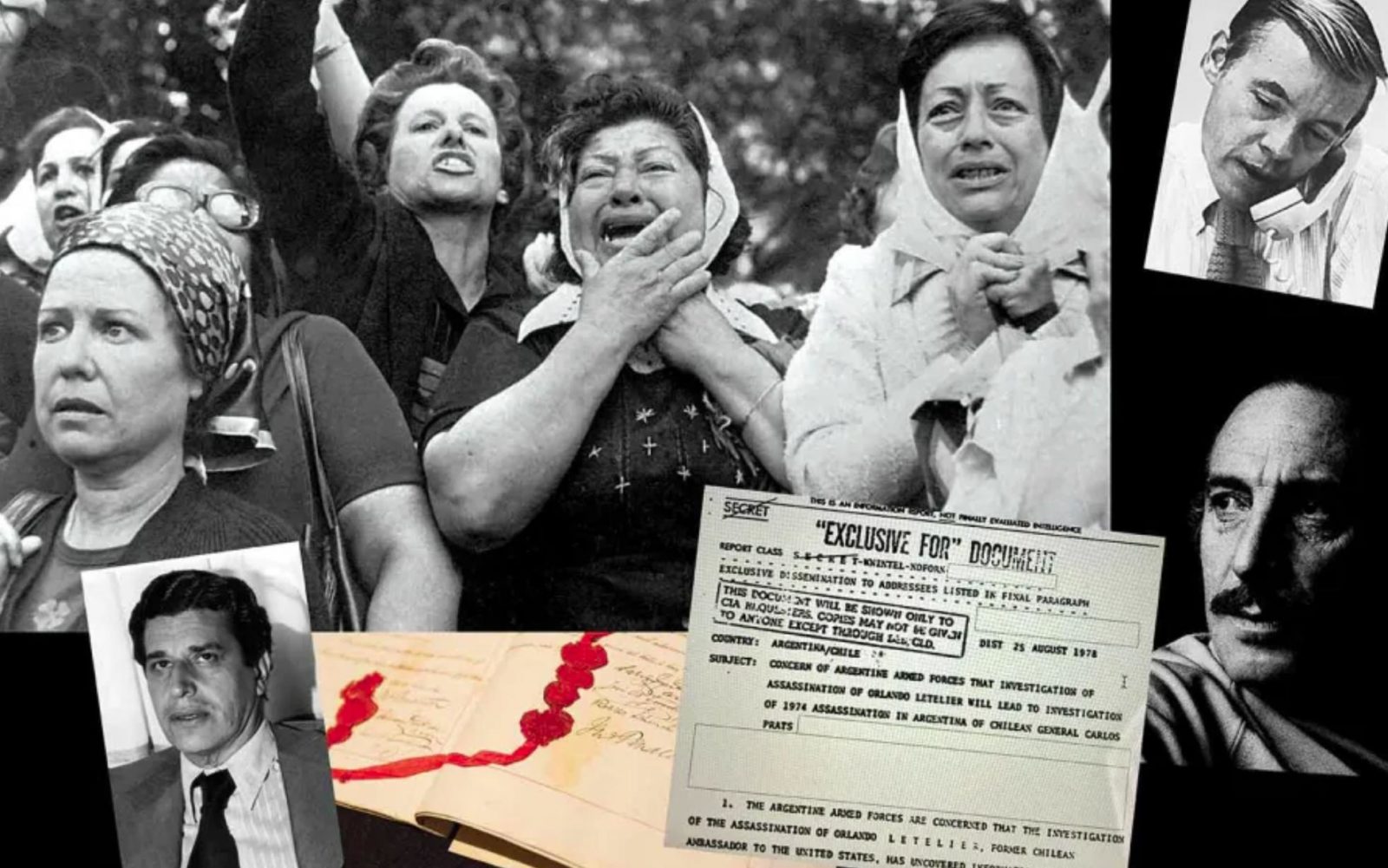
Featured image: Clockwise from top: Las Madres, women whose children were among the thousands “disappeared” during Argentina’s military dictatorship, protest in November 1977; Robert Scherrer, the lead FBI investigator on the Letelier assassination, gathered intelligence suggesting the killing was part of a mission led by Chilean dictator Augusto Pinochet’s secret police; Orlando Letelier; documents from the National Archives; Héctor Hidalgo Solá, Argentina’s ambassador to Venezuela, was abducted off the streets of Buenos Aires, then tortured and killed by the military regime in 1977. (AP Photo; US National Archives; Museum of Memory and Human Rights; US National Archives [2]; Public Consultation Database)
Source URL: The Nation