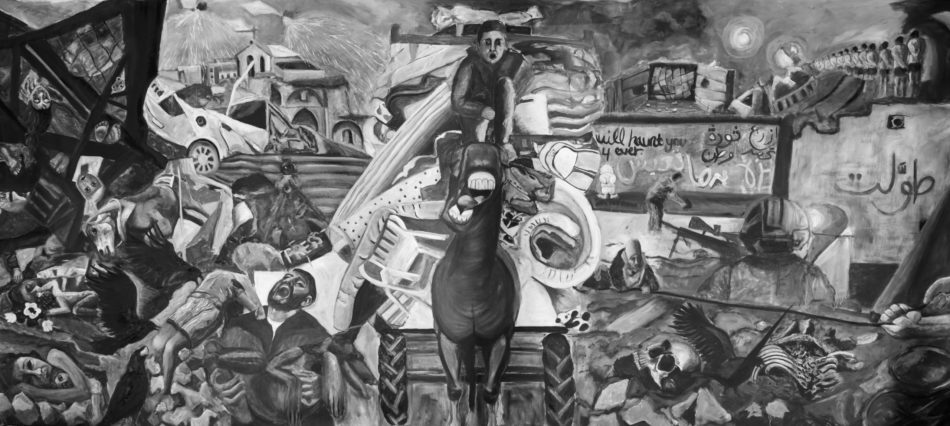
Malak Mattar (Palestine), Gaza, 2024. Photo: Tricontinental.
Malak Mattar (Palestine), Gaza, 2024. Photo: Tricontinental.
By Vijay Prashad – Feb 1, 2024
Dear friends,
Greetings from the desk of Tricontinental: Institute for Social Research.
On 26 January, the judges at the International Court of Justice (ICJ) found that it is ‘plausible’ that Israel is committing a genocide against Palestinians in Gaza. The ICJ called upon Israel to ‘take all measures within its power to prevent the commission of all acts’ that violate the UN Convention on the Prevention and Punishment of the Crime of Genocide (1948). Although the ICJ did not call explicitly for a ceasefire (as it did in 2022 when it ordered Russia to ‘suspend [its] military operation’ in Ukraine), even a casual reading of this order shows that to comply with the court’s ruling, Israel must end its assault on Gaza. As part of its ‘provisional measures’, the ICJ called upon Israel to respond to the court within a month and outline how it has implemented the order.
Though Israel has already rejected the ICJ’s findings, international pressure on Tel Aviv is mounting. Algeria has asked the UN Security Council to enforce the ICJ’s order while Indonesia and Slovenia have initiated separate proceedings at the ICJ that will begin on 19 February to seek an advisory opinion on Israel’s control of and policies on occupied Palestinian territories, pursuant to a UN General Assembly resolution adopted in December 2022. In addition, Chile and Mexico have called upon the International Criminal Court (ICC) to investigate crimes committed in Gaza.
Israel’s reaction to the ICJ’s order was characteristically dismissive. The country’s national security minister, Itamar Ben Gvir, called the ICJ an ‘antisemitic court’ and claimed that it ‘does not seek justice, but rather the persecution of Jewish people’. Strangely, Ben Gvir accused the ICJ of being ‘silent during the Holocaust’. The Holocaust conducted by the Nazi German regime and its allies against European Jews, the Romani, homosexuals, and communists took place between late 1941 and May 1945, when the Soviet Red Army liberated prisoners from Ravensbrück, Sachsenhausen, and Stutthof. However, the ICJ was established in June 1945, one month after the Holocaust ended, and began its work in April 1946. Israel’s attempt to delegitimise the ICJ by saying that it remained ‘silent during the Holocaust’ when it was, in fact, not yet in existence, and then to use that false statement to call the ICJ an ‘antisemitic court’ shows that Israel has no answer to the merits of the ICJ order.
Meanwhile, the bombardment of Palestinians in Gaza continues. My friend Na’eem Jeenah, director of the Afro-Middle East Centre in Johannesburg, South Africa, has been reviewing the data from various government ministries in Gaza as well as media reports to circulate a daily information card on the situation. The card from 26 January, the date of the ICJ order and the 112th day of the genocide, details that over 26,000 Palestinians, at least 11,000 of them children, have been killed since 7 October; 8,000 are missing; close to 69,000 have been injured; and almost all of Gaza’s 2.3 million residents have been displaced. The numbers are bewildering. During this period, Israel has damaged 394 schools and colleges, destroying 99 of them as well as 30 hospitals and killing at least 337 medical personnel. This is the reality that occasioned the genocide case at the ICJ and the court’s provisional measures, with one judge, Dalveer Bhandari of India, going further to say plainly that ‘all fighting and hostilities [must] come to an immediate halt’.
Amongst the dead are many of Palestine’s painters, poets, writers, and sculptors. One of the striking features of Palestinian life over the past 76 years since the Nakba (‘Catastrophe’) of 1948 has been the ongoing richness of Palestinian cultural production. A brisk walk down any of the streets of Jenin or Gaza City reveals the ubiquity of studios and galleries, places where Palestinians insist upon their right to dream. In late 1974, the South African militant and artist Barry Vincent Feinberg published an article in the Afro-Asian journal Lotus that opens with an interaction in London between Feinberg and a ‘young Palestinian poet’. Feinberg was curious why, in Lotus, ‘an unusually large number of poems stem from Palestinian poets’. The young poet, amused by Feinberg’s observation, replied: ‘The only thing my people have never been denied is the right to dream’.
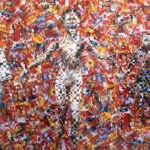
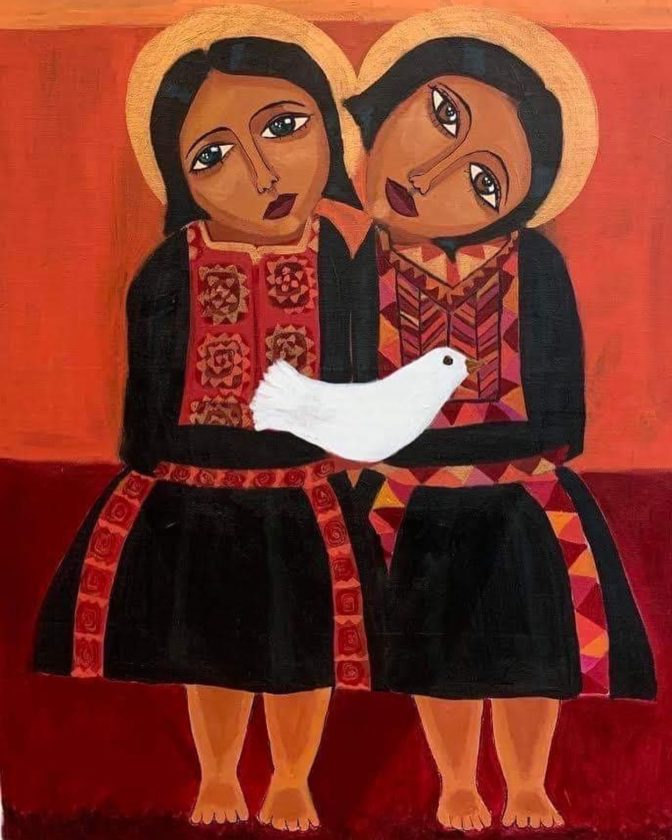
Malak Mattar, born in December 1999, is a young Palestinian artist who refuses to stop dreaming. Malak was fourteen when Israel conducted its Operation Protective Edge (2014) in Gaza, killing over two thousand Palestinian civilians in just over one month – a ghastly toll that built upon the bombardment of the Occupied Palestinian Territory that has been ongoing for more than a generation. Malak’s mother urged her to paint as an antidote to the trauma of the occupation. Malak’s parents are both refugees: her father is from al-Jorah (now called Ashkelon) and her mother is from al-Batani al-Sharqi, one of the Palestinian villages along the edge of what is now called the Gaza Strip. On 25 November 1948, the newly formed Israeli government passed Order Number 40, which authorised Israeli troops to expel Palestinians from villages such as al-Batani al-Sharqi. ‘Your role is to expel the Arab refugees from these villages and prevent their return by destroying the villages… Burn the villages and demolish the stone houses’, wrote the Israeli commanders.
Malak’s parents carry these memories, but despite the ongoing occupation and war, they try to endow their children with dreams and hope. Malak picked up a paint brush and began to envision a luminous world of bright colours and Palestinian imagery, including the symbol of sumud (‘steadfastness’): the olive tree. Since she was a teenager, Malak has painted young girls and women, often with babies and doves, though, as she told the writer Indlieb Farazi Saber, the women’s heads are often titled to the side. That is because, she said, ‘If you stand straight, upright, it shows you are stable, but with a head tilted to one side, it evokes a feeling of being broken, a weakness. We are humans, living through wars, through brutal moments… the endurance sometimes slips’.
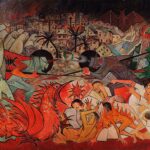
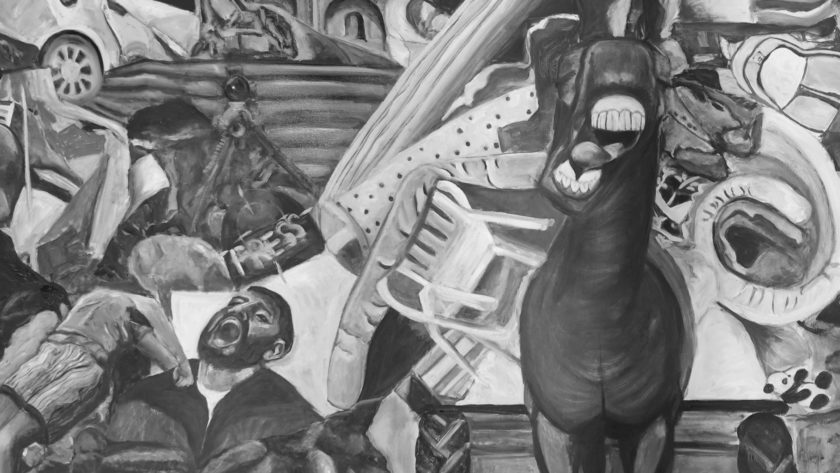
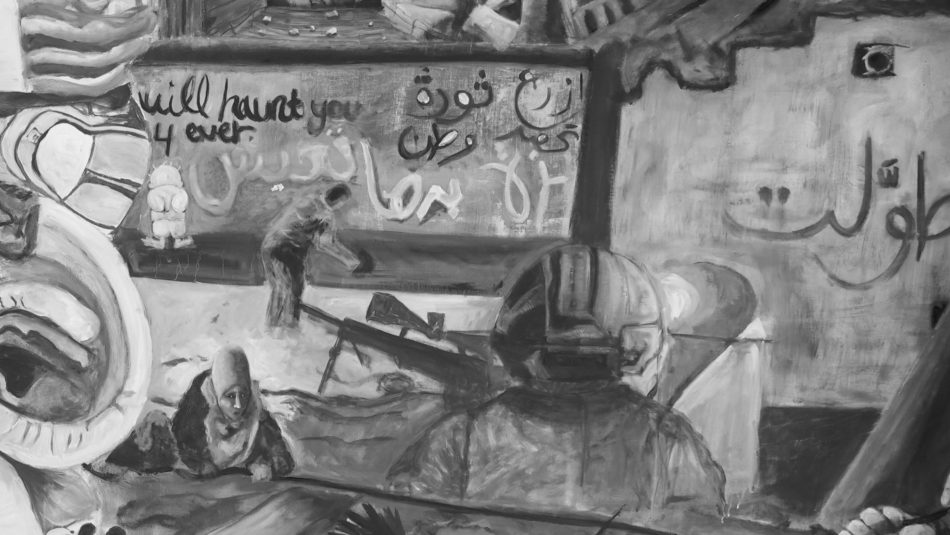
Malak and I have corresponded throughout this violence, her fears manifest, her strength remarkable. In January, she wrote, ‘I’m working on a massive painting depicting many aspects of the genocide’. On a five-metre canvas, Malak created a work of art that began to resemble Pablo Picasso’s celebrated Guernica (1937), which he painted to commemorate a massacre by fascist Spain against a town in the Basque region. In 2022, the United Nations Relief and Works Agency for Palestine Refugees in the Near East (UNRWA) published a profile on Malak, calling her ‘Palestine’s Picasso’. In the article, Malak said, ‘I was so inspired by Picasso that, in the beginning of my art journey, I tried to paint like him’. This new painting by Malak reflects the heartbreak and steadfastness of the Palestinian people. It is an indictment of Israel’s genocide and an affirmation of Palestinians’ right to dream. If you look at it closely, you will see the victims of the genocide: the medical workers, the journalists, and the poets; the mosques and the churches; the unburied bodies, the naked prisoners, and the corpses of small children; the bombed cars and the fleeing refugees. There is a kite flying in the sky, a symbol from Refaat Alareer’s poem ‘If I Must Die’ (‘you must live to tell my story… so that a child, somewhere in Gaza while looking heaven in the eye… sees the kite, my kite you made, flying up above and thinks there is an angel there bringing back love’).
Malak’s work is rooted in Palestinian traditions of painting, inspired by a history that dates back to Arab Christian iconography (a tradition that was developed by Yusuf al-Halabi of Aleppo in the seventeenth century). That ‘Aleppo Style’, as the art critic Kamal Boullata wrote in Istihdar al-Makan, developed into the ‘Jerusalem Style’, which brightened the iconography by introducing flora and fauna from Islamic miniatures and embroidery. When I first saw Malak’s work, I thought of how fitting it was that she had redeemed the life of Zulfa al-Sa’di (1905–1988), one of the most important painters of her time, who painted Palestinian political and cultural heroes. Al-Sa’di stopped painting after she was forced to flee Jerusalem during the 1948 Nakba; her only paintings that remain are those that she carried with her on horseback. Sa’di spent the rest of her life teaching art to Palestinian children at an UNRWA school in Damascus. It was in one such UNRWA school that Malak learned to paint. Malak seemed to pick up al-Sa’di’s brushes and paint for her.
It is no surprise that Israel has targeted UNRWA, successfully encouraging several key Global North governments to stop funding the agency, which was established by United Nations General Assembly Resolution 302 in 1949 to ‘carry out direct relief and works programmes for Palestine refugees’. In any given year, half a million Palestinian children like Malak study at UNRWA schools. Raja Khalidi, director-general of the Palestine Economic Policy Research Institute (MAS), says of this funding suspension: ‘Given the long-standing precarious nature of UNRWA’s finances… and in light of its essential role in providing vital services to Palestine refugees and some 1.8 million displaced persons in Gaza, cutting its funding at such a moment heightens the threat to life against Palestinians already at risk of genocide’.
I encourage you to circulate Malak’s mural, to recreate it on walls and public spaces across the world. Let it penetrate into the souls of those who refuse to see the ongoing genocide of the Palestinian people.
Warmly,
Vijay
Vijay Prashad is an Indian historian, editor, and journalist. He is a writing fellow and chief correspondent at Globetrotter, a project of the Independent Media Institute. He is the chief editor of LeftWord Books and the director of Tricontinental: Institute for Social Research. He has written more than 20 books, including The Darker Nations: A People’s History of the Third World (The New Press, 2007), The Poorer Nations: A Possible History of the Global South (Verso, 2013), The Death of the Nation and the Future of the Arab Revolution(University of California Press, 2016), and Red Star Over the Third World (LeftWord, 2017). He writes regularly for Frontline, the Hindu, Newsclick, AlterNet and BirGün.