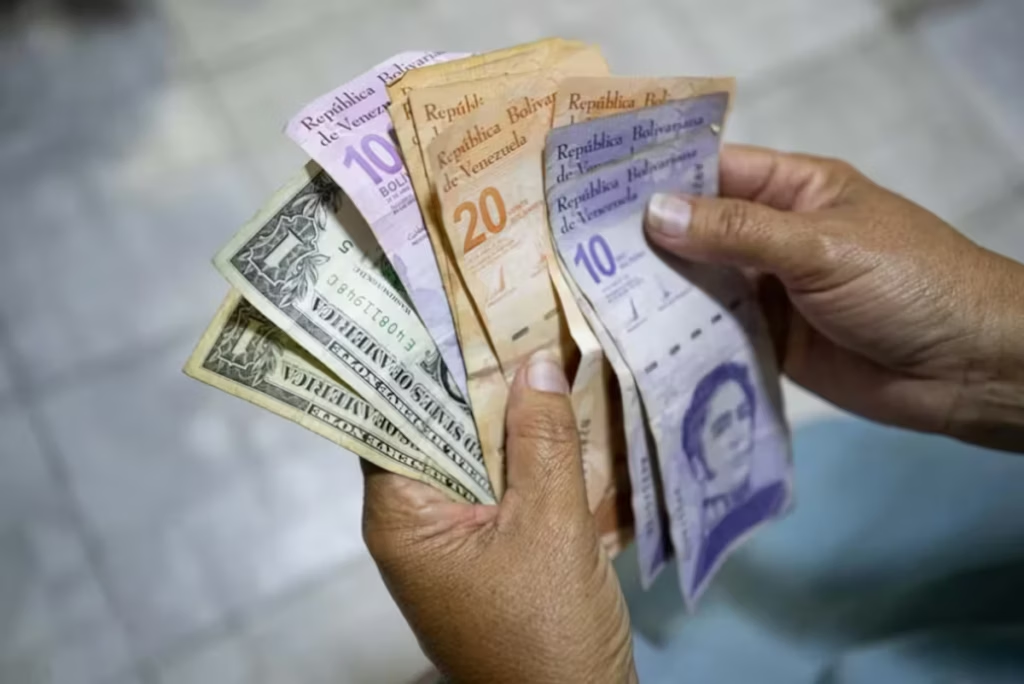
A person holds bolívar and dollar bills. File photo.
A person holds bolívar and dollar bills. File photo.
Following Venezuelan Acting President Delcy Rodríguez’s announcement of a comprehensive minimum income of $240 starting from May 1, 2026, Minister of Social Labor Process Carlos Alexis Castillo reported that the national government is working on a sector-specific table of wage increases.
In an interview on Thursday, April 30, conducted by Venezolana de Televisión (VTV), Minister Castillo stated, “We are not going to make the mistake of raising wages without having a base to support it.”
The minister addressed the following points:
A $50 increase
The minister explained that the comprehensive minimum wage was raised by $50.
“We are raising it by $50, which is the highest increase in comprehensive income that we have given, despite the resource deficiency,” Castillo said.
He added that the national government is establishing a mechanism that “will later enable seeking a solution in terms of salaries. This cannot be done all at once; it has to be gradual, phased, step by step.”
Private sector workers will also receive the benefit
Castillo explained that the increase in the comprehensive minimum wage also applies to private-sector workers, especially those earning below the base salary, which as of May 1 is set at $240.
He acknowledged that most private-sector workers earn more than $240. However, he highlighted that some employees are earning less than that amount, and their income will now need to be adjusted. “We are partly solving the problem for that group of workers, no matter how small it is.”
Wage increase retroactive from April 30
When asked by VTV about the payment schedule for the comprehensive minimum wage, applying to workers, pensioners, and retirees, Castillo said, “It starts with retroactive pay from today [Thursday, April 30].”
Table of increases by sector
“We are in the process of analyzing or have already analyzed the table of increases by sectors, and the president will announce it in the coming days,” announced Minister Castillo.
“Is it like a pay scale?” the VTV journalists asked, to which he responded, “Yes, what used to be called the pay scale, the ranking that exists in Public Administration.”
He highlighted that the government has started with five prioritized sectors: “Education, health, police, armed forces, and higher education.”
In this regard, he explained that as a result of the US economic blockade, professionals, especially those in the public sector, were “very affected by the decline in income… the pay scales—the public sector normally operated with pay scales, also called seniority lists—were diminished. Practically, a professional in medicine or education was earning the same as any other worker. We are already correcting that, with the decision made by the acting president of the republic.”
More announcements
Minister Castillo explained that the national government is making efforts to recover the economy, the productive apparatus, and the purchasing power of workers.”
He added that “in the coming days we will continue making announcements, which will be gradual, step-by-step announcements.”
“The announcements will come from the dialogue, from the consensus of all the sectors.”
No false increases
Referring to the increase in the comprehensive minimum wage announced on Thursday, Castillo said that it is a responsible measure. The aim is for the increase to have real backing in production and state resources.
In this context, he underscored that “we cannot announce increases that we cannot fulfill, and if we do not fulfilll them, they become inflationary increases.”
He added that all the increases the government is implementing are being done with “firm steps, scientifically studied, and agreed upon with all the parties involved in this matter.”
“We are on the path to economic recovery and, as the acting president pointed out, on the path to being a happy country once again. However, that requires us to make responsible decisions,” Castillo remarked.
Strengthening of labor inspections
As part of strengthening the Ministry of Labor, efforts are being made to bolster labor inspections.
He explained that the ministry’s most important operational unit is the inspectorates, because “they are the administrative units that defend the workers. Not like the labor courts, which defend workers judicially, the inspectorates defend them administratively.”
Minister Castillo said that the ministry is strengthening inspections so inspectors can properly carry out their work of evaluating companies and defending workers’ rights.
Translation: Orinoco Tribune
OT/SC/SF