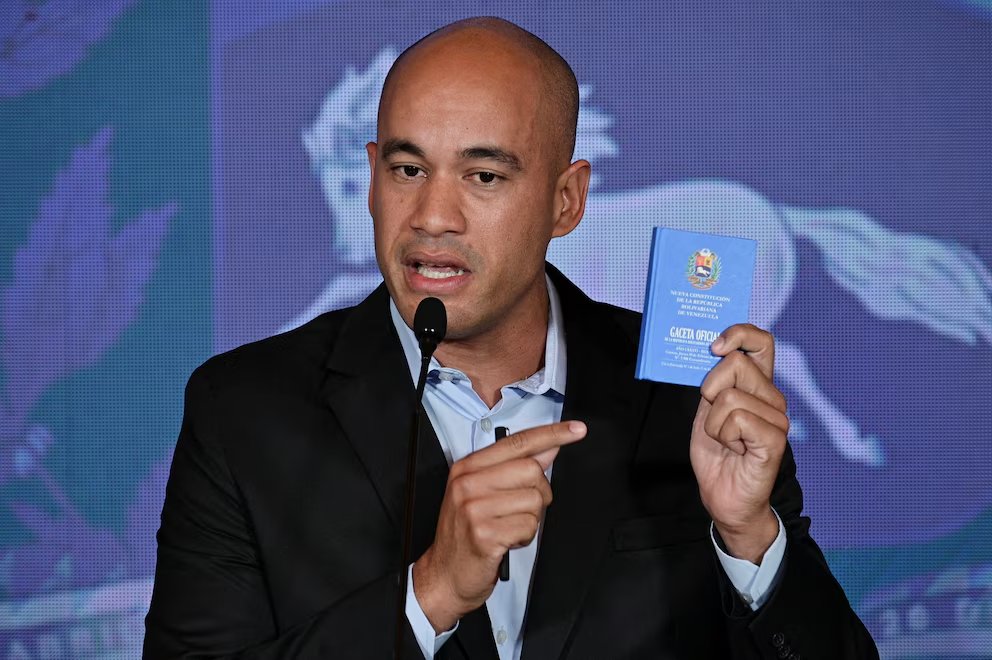
Venezuelan Education Minister and head of the Presidential Commission for the Restructuring and Reengineering of the Government, Héctor Rodríguez, holds the Venezuelan Constitution as he speaks. Photo: Gaby Ora/Reuters.
Venezuelan Education Minister and head of the Presidential Commission for the Restructuring and Reengineering of the Government, Héctor Rodríguez, holds the Venezuelan Constitution as he speaks. Photo: Gaby Ora/Reuters.
The head of the Presidential Commission for the Restructuring and Reengineering of the Government, Education Minister Héctor Rodríguez clarified that the government has no plans to dismiss public sector workers but rather “reassign them where they are needed.”
In his capacity as head of the commission, Rodríguez spoke on Tuesday, June 16, with members of the upper echelons of the judiciary. In the meeting, he dismissed allegations that the government plans to fire workers to reduce a workforce that, he said, comprises 3.5 million people.
He said that “the plan is not to fire public officials, but to reorganize them where they are needed,” and that several departments can operate in the same physical location, with an emphasis on municipalities.
The minister further emphasized that “sometimes the State is confused with the government. The number of public sector employees corresponds to the national, state, and municipal governments.”
“In principle, the other four public powers should be excluded,” commented a magistrate who attended the meeting.
According to Venezuelan analyst Luigino Bracci Roa, the clarification made by Héctor Rodríguez is important. A National Assembly deputy who participated in the meeting reported that Rodríguez stated that there are 2.9 million workers within the national government system, and the total number of public sector employees reaches 3.5 million when adding those who provide services in the 335 municipalities and 24 governorships of the country. The national government has 34 ministries, 150 deputy ministries, and more than a thousand companies and institutions.
The deputy added, “Rodríguez emphasized that resources are finite, that the average price of a barrel of oil is $60, so Venezuela receives about $630 million per month” from crude oil exports. The government’s income and the Venezuelan economy depend on the oil sector.
These discussions have come up as the Venezuelan government conducts consultations on its proposed “state re-engineering” aimed at optimizing public administration. On May 26, Acting President Delcy Rodríguez created the Presidential Commission for the Restructuring and Re-engineering of the Government that operates under three guiding principles: efficiency to streamline institutional processes, transparency in accountability, and participatory democracy to guarantee active public involvement. On June 9, the commission launched its digital platform, www.reingenieria.gob.ve, to gather citizen proposals. Simultaneously, the government is conducting an intensive series of in-person consultations with various social sectors, public administration specialists, and representatives of state institutions.
Diosdado Cabello on ‘State Re-Engineering’: Workers Will Not Be Laid Off (+Amnesty Law)
The announcement has caused alarm among various sectors, and especially among public sector employees, as critics consider this policy to resemble the neoliberal “state shrinking” recipes dictated by the US-controlled International Monetary Fund (IMF).
In this scenario, Interior Minister Diosdado Cabello, at a press conference of the ruling United Socialist Party of Venezuela, tried to dispel the “rumor” that “half of the public sector workers will be laid off,” emphasizing that there are no such plans, and that the aim of the restructuring proposal is to minimize bureaucracy and optimize administration. Héctor Rodríguez’s statements appear to align with Cabello’s declarations.
(Luigino Bracci Roa X) with Orinoco Tribune content
Translation: Orinoco Tribune
OT/SC/DZ