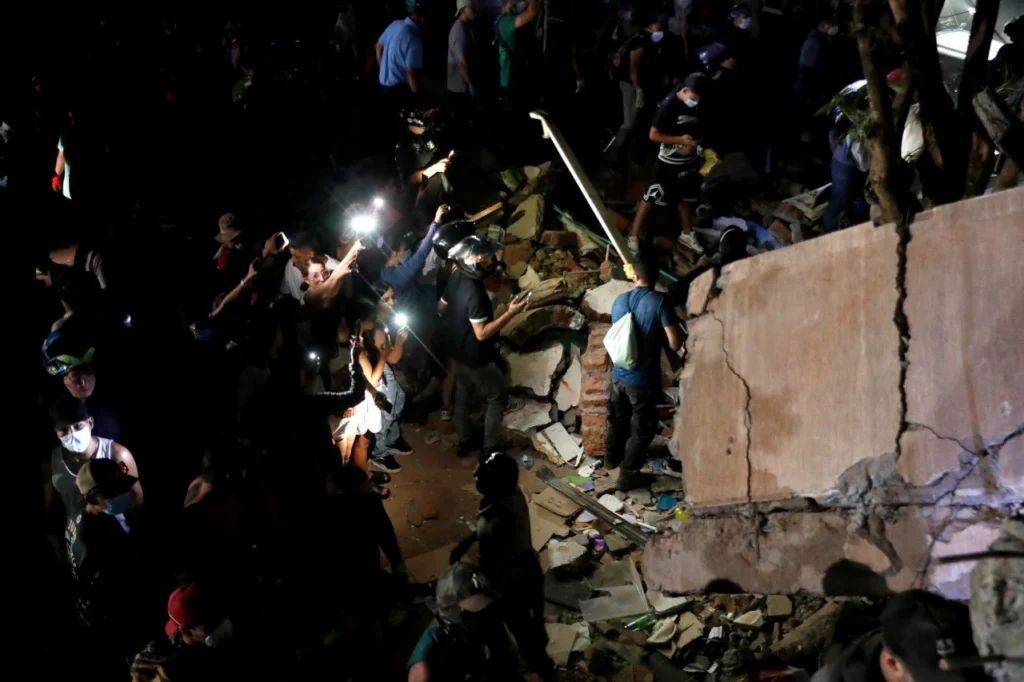
Cali residents search for survivors among the rubble of a building toppled in a 7.4 magnitude earthquake that struck Colombia on August 10, 2026. Photo: Telesur.
Cali residents search for survivors among the rubble of a building toppled in a 7.4 magnitude earthquake that struck Colombia on August 10, 2026. Photo: Telesur.
The magnitude 7.4 earthquake that shook Colombia on Monday left a preliminary national death toll of 132, 35 of whom are from Cali, a city with around 700 injured and 188 missing persons. The department of Valle del Cauca has been hit hardest by the earthquake, with Cali being the most affected.
Colombian President Abelardo de la Espriella appeared in the Valle del Cauca capital, accompanied by the governor of the department, Dilian Francisca Toro and Cali Mayor Alejandro Eder, to present the official report and outline the response strategy in the city of Cali.
En Cali, nuestra prioridad son las familias afectadas y las personas desaparecidas que ha dejado esta tragedia natural.
Desde el Gobierno Nacional, en articulación con las autoridades departamentales y locales, trabajamos sin descanso en la atención de los heridos, la búsqueda… pic.twitter.com/WFGLM3ofCm
— Abelardo De La Espriella (@ABDELAESPRIELLA) August 11, 2026
The numbers provided by the Colombian president highlight the magnitude of the earthquake. According to the report, around 5,000 homes were damaged, and the regional healthcare system was severely impacted: three hospitals are out of service, and another 18 are affected in various ways.
In the educational sector, 39 educational centers suffered damage, while the Cali airport is carrying out limited operations due to infrastructure damage.
De la Espriella placed special emphasis on the missing people. “What concerns us the most are the 188 missing people,” he said, and confirmed that the state will focus on searching for them. To this end, 228 rescuers are already in Cali, along with specialized dog teams.
He specified that this operation was coordinated directly with the governor and the mayor since the earthquake occurred. In parallel, he has arranged for the transfer of 105 military engineers to support technical work and the removal of fallen structures.
The 188 missing people: the focus of the emergency
The search operation is the priority of the state response. The coordination between the national, departmental, and municipal levels was made explicit in De la Espriella’s public appearance, and he announced the appointment of a team of officials to centralize the coordination of all the needs arising from the emergency.
The team is made up of the minister of Transport, Elsa Noguera; government official Carlos Suárez; and the deputy minister of Infrastructure, María Fernanda Santa, who is from Cali. Their task will be to coordinate the requirements between the national government and the local and regional administrations, including the provision of water, electricity, and tents for the victims.
Militarization and curfew in Cali
The emergency was accompanied by an additional public order problem. According to the authorities, since the moment of the earthquake, looting and disturbances have occurred in various parts of Cali. To contain the situation, Mayor Alejandro Eder declared a curfew from Monday 8:00 p.m. to Tuesday 6:00 a.m. Colombian time and the militarization of the most affected areas.
Estamos escuchando a las familias afectadas y actuando para protegerlas.
Ante las amenazas de saqueos, hemos tomado la decisión de militarizar Cali. Ya hay tropas recorriendo la ciudad para proteger a los ciudadanos y sus bienes, y contamos con ingenieros de las Fuerzas… pic.twitter.com/Is9NZ9Byxt
— Alejandro Eder (@alejoeder) August 11, 2026
De la Espriella confirmed that, at the request of the governor and the mayor, more than a thousand military officials will be deployed in the city to secure the area and prevent further disturbances.
Eder, for his part, reported on social media that the troops are already patrolling the city to “protect the citizens and their property.” Eder also declared a public calamity and a hospital red alert in order to prioritize medical care for the injured.
Colombia Declares ‘National Disaster’ After Earthquake; Venezuela Offers Assistance
Housing plan and rental subsidies for victims
Given the high number of damaged or destroyed homes, the Colombian government presented an emergency housing plan, announced in the presence of the Housing minister in the disaster area.
According to the promises of the new Colombian president, the strategy includes, in a first phase, the provision of rental subsidies so that affected families can temporarily relocate while the process of recovering the properties is evaluated.
“We are going to give them a subsidy so that they can move elsewhere, and then comes the recovery of those homes,” explained the president.
For now, authorities are focused on maintaining social order and conducting search efforts for the nearly 200 missing people. The first 48 hours are crucial to locating them.
(Telesur)
Translation: Orinoco Tribune
OT/SC/SH