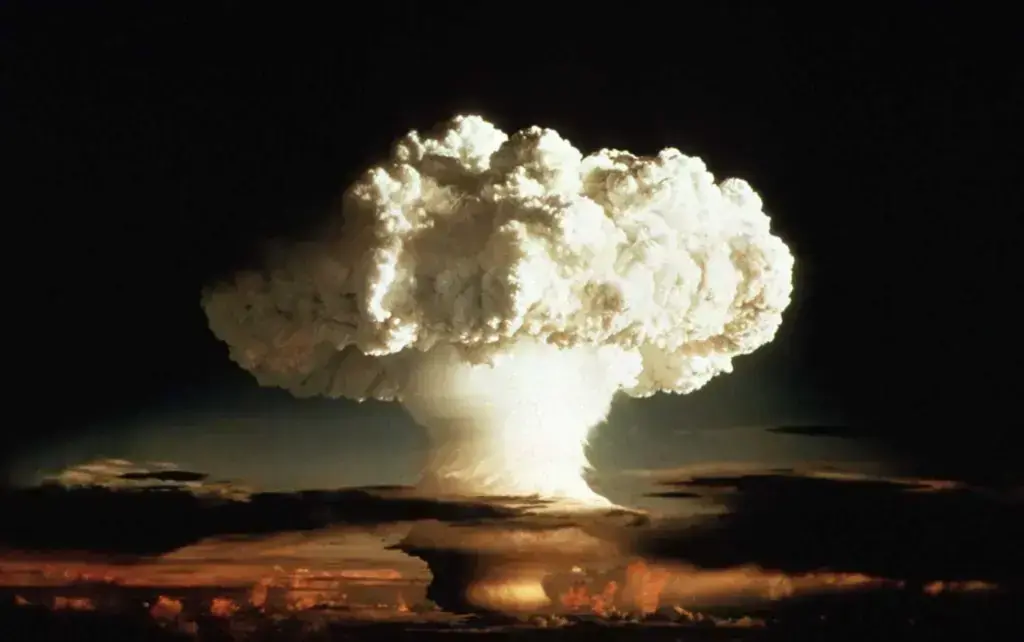
The image shows a nuclear explosion in the shape of a mushroom cloud, with a large plume of smoke and fire rising over a dark landscape. Photo: Mattias Forsgren/file photo.
The image shows a nuclear explosion in the shape of a mushroom cloud, with a large plume of smoke and fire rising over a dark landscape. Photo: Mattias Forsgren/file photo.
By Mattias Forsgren – Jul 17, 2026
“If you can defeat a strategic enemy not using any US troops you’re at the acme of professionalism.” – General Keith Kellogg
The Hypothesis
Assuming there is some logic behind the US’s actions on all fronts, and that there is an overarching strategy, what would it be? A dark but, in my view, plausible hypothesis:
The American strategy now is to Ukrainify Europe, so that when Ukrainian men run out, they can be replenished with Europeans. For this to work, unemployment and desperation must increase in Europe, and some form of attack from Russia must be provoked or fabricated.
Behind this hypothesis lies a more specific strategic calculation. In nuclear confrontations, as in chess, the ultimate objective is often not to fight a full-scale war but to place the opponent in zugzwang — a situation in chess where every available move leads to a worse position, and ultimately to check mate. In his analysis “From U.S. Horizontal Escalation to Russian Escalation Dominance,” Ola Tunander describes how the United States achieved a form of escalation dominance during the late Cold War through its superiority in attack submarines. By threatening the Soviet ballistic-missile submarine force, Washington undermined the reliability of Moscow’s second-strike capability. The central problem for Soviet leaders was the maintenance of a credible Mutual Assured Destruction. Once that credibility was placed in doubt, the logic of MAD began to unravel and restraint was forced.
I think that is why, from the perspective of top Western military strategists, the collapse of the Soviet Union and the dissolution of the Warsaw Pact constituted a genuine military victory. The political class mostly interpreted 1991 as the end of an ideological struggle and the beginning of partnership. Those who saw it as a military triumph never abandoned the assumption that the victor retains the right to dictate terms. Putin’s restoration of Russian sovereignty has therefore been experienced as a violation of that privilege. The determination to force a clearer acknowledgement of defeat has deep roots here.
The aim is to place Russia in zugzwang, where all possible actions worsens the situation, and then to raise the pressure until Moscow yields. The US can no longer threaten Russia’s nuclear forces the way it did in the 1980s. Back then the Soviets were largely unable to detect the much quieter American attack submarines. This acoustic superiority allowed US boats to hunt down Soviet ballistic-missile submarines and turn them into “sitting ducks.” That meant the Soviet second-strike capability — the ability to retaliate after a US first strike — was no longer secure. If one side can realistically destroy the other’s nuclear forces before they can be launched, the logic of mutually assured destruction (MAD) starts to break down: the weaker side can no longer be certain of being able to retaliate, and the stronger side gains what strategists call escalatory dominance.
Today the relationship has reversed. Russia has caught up on the submarine front and has developed and deployed hypersonic missiles — including the Avangard, Tsirkon, Kinzhal and Oreshnik — that travel at extreme speeds and can manoeuvre in flight, rendering them extremely difficult for current US and NATO defences to intercept. In the same analysis (From U.S. Horizontal Escalation to Russian Escalation Dominance), Ola Tunander shows that this capability has transferred escalatory dominance to the Russian side. The United States can no longer assume it holds the upper hand on the higher rungs of the escalation ladder; any move that risks vertical escalation now carries greater uncertainty for Washington than for Moscow.
That is why a new strategy has been developed to achieve the long-standing goal of inflicting a strategic defeat on Russia. Because the United States can no longer risk climbing the escalation ladder itself Washington instead transfers the confrontation, with a degree of plausible deniability, onto a proxy: a nuclear-armed or nuclear-sharing Europe driven into acute desperation. Such desperation could arise after Russian hypersonic missiles have destroyed key European arms factories, after tens of thousands of European soldiers have been killed in Ukraine, and after Russian forces are approaching Kiev or even the Polish border.
At that point Europe itself becomes the party with the strongest immediate incentive to escalate, while the United States retains both distance and deniability. Yet Europe lacks the conventional military resources to mount any decisive escalation of its own, and will not possess them for the foreseeable future. Assessments from NATO officials and European intelligence services indicate that serious conventional readiness against Russia is unlikely before the early-to-mid 2030s; critical shortfalls in ammunition, air defence, armour, logistics and intelligence systems remain structural. In such a position of conventional impotence, nuclear weapons risk appearing as the only available “quick fix.” We already hear the mantra that Putin’s nuclear threats are a “bluff” — a framing that lowers the psychological barrier to escalating the confrontation with Russia to the point where Moscow feels compelled to use nuclear weapons in order to restore the credibility of its deterrent.
This logic is consistent with what Tunander has shown about the historical reality of the U.S. “nuclear umbrella.” The umbrella didn’t mean that the United States was prepared to strike Russian territory to save its NATO allies and thereby risk the destruction of American cities. U.S. tactical nuclear weapons were planned for use inside Europe, against forces on European soil, precisely to keep any nuclear exchange geographically limited. Today, with no Warsaw Pact left as a convenient target set and with U.S. escalation dominance gone, the umbrella has effectively ceased to exist. In a serious confrontation the United States would have every incentive to delegate both the fighting and the nuclear risk to the Europeans.
The strategy aims to place Russia in a position where the only alternatives are strategic retreat or the destruction of Europe as a proxy — a destruction that would come at the price of the damage European nuclear weapons would inflict on Russian territory and forces, while the American homeland remains a sanctuary. It would be a form of checkmate – one could reasonably expect Russia to back down under such immense pressure. Yet the method multiplies the risk for nuclear war by misstake. It also places Russia in a severe dilemma. Sergey Karaganov, honorary chairman of Russia’s Council on Foreign and Defense Policy, has for several years openly advocated for a limited nuclear strike against European targets — precisely in order to restore the fear of nuclear weapons among European elites and populations, and thereby force them to abandon their support for the war against Russia. But any limited nuclear strike against Europe would itself lower the threshold for European nuclear use against Russia, or risk triggering an immediate counter-strike. Russia would therefore face a choice with no optimal outcome: either tolerate the gradual construction of a desperate, nuclear-armed European front, or act early and thereby risk the very escalation it seeks to prevent — but against an opponent that is still somewhat less potent than it would become if Russia refrained from striking. The hope of reversing the trend without triggering a full-scale European war is thus weighed against the risk of confronting a far more dangerous adversary later.
The American calculation appears to be that this dilemma can be exploited. By gradually raising the level of pressure and threat — keeping Russia inside the zone of zugzwang without crossing into open strategic nuclear exchange — the United States hopes to force Moscow to back down rather than accept the costs of a wider war. The more Europe is positioned as a disposable nuclear front, the sharper the dilemma becomes. The objective may be to compel the acknowledgement of defeat that many in the West still believe was owed after 1991. The practical effect is to place the entire European continent — and Russian decision-making — on a hair-trigger.
What follows is an examination of the motivation behind this very dangerous (and psychopathic) strategy and of the economic, political and military steps that appear designed to create precisely these conditions.
The Motive: Imperial Overreach
What would drive a power to contemplate such a radical abandonment and betrayal of its own allies? The answer is an order that can no longer reproduce itself on the old terms and whose managers know the consequences of failure.
This is not a ‘Grand Design’ drawn up in a smoke-filled room by a handful of conspirators. Rather, it is the emergent result of following the path of least resistance within a compromised power network. As the Epstein files have demonstrated, a sociological milieu can maintain its secrets not through formal conspiracy, but through shared vulnerability and mutual self-interest. When careers, assets, and legal liabilities are all bound to the same system, the rational choice for each actor is to protect that system at all costs. The result is indistinguishable from a master plan, but far more difficult to refute.
For decades the Western core has lived off financialization and the systematic offshoring of production. Industrial capacity was relocated to low-wage countries while the metropolitan economies shifted toward rent extraction, asset inflation, and the recycling of global savings through the dollar system. The near-collapse of 2008 exposed how close this structure had come to the abyss. As Michael Hudson has shown in Killing the Host, the banks were rescued while the underlying debt overhead was left intact. Zero interest rates and successive rounds of Quantitative Easing did not restore productive capacity; they inflated still larger bubbles in stocks, bonds, and real estate. The Covid years repeated the pattern on a greater scale. The structural problems remain unresolved. What has been constructed is a more leveraged and fragile system.
Simultaneously the old instruments of external control have begun to fail. The classic Economic Hit Man model of debt, privatization, and political compliance no longer works against states that possess alternatives. Sanctions that were supposed to reduce Russia’s economy to “tatters” and turn the ruble into “rubble” achieved neither. Iran has likewise endured. China’s technological advance across the majority of critical domains has erased the assumption of permanent Western superiority. African and other Global South actors increasingly turn toward new partners. The long-standing capacity to keep weaker regions in permanent underdevelopment is slipping.
At the same time, the people at the top know they have blood on their hands — and that a real collapse of the system could finally bring them to account. Chinese Foreign Ministry spokespeople have stated the point with shocking directness. In August 2022 Zhao Lijian publicly circulated a meme that effectively accused the United States of having carried out the 9/11 attacks as a false-flag operation—an act of the highest criminal magnitude whose purpose was to mobilize domestic and international support for the series of wars and war crimes that followed.

Chinese Foreign Ministry spokesman Wang Wenbin has likewise called for the international community to examine U.S. war crimes and hold those responsible to account, adding that justice may be delayed but will not be denied. The criminal record is extensive: fabricated atrocity stories used to manufacture consent for war (the Kuwait incubator testimony engineered by Hill & Knowlton, the Viagra-rape claims against Libya, the weapons-of-mass-destruction dossier on Iraq), a long series of regime-change operations, and formal legal mechanisms such as the American Service-Members’ Protection Act—popularly known as the Hague Invasion Act—designed to shield U.S. and allied personnel from the International Criminal Court. Under the principles established at Nuremberg, the planning and initiation of aggressive war constituted the supreme international crime. An elite that has operated for decades with near-total impunity understands what a genuine systemic collapse could mean for its own security. The fight for hegemony is existential for those who run the system. When no safer options remain, they will use any measure that still has even a slight chance of success.
Cannibalising the Vassals
Europe’s security has long been expensive for the United States. For decades the two formed a single imperial apex: the historical core of the system remained culturally and institutionally European, while the military muscle and the financial command structure were progressively concentrated in the United States. For decades America played the part of the stronger partner that still deferred to European civilisation. The recent spectacle of NATO Secretary General Mark Rutte calling Trump “Daddy” shows how far that relationship has shifted — and in which direction the deference now flows.
That arrangement is now breaking down. More nationalist, less Europe-romanticising forces have taken control in Washington. The continent is no longer treated as a co-equal partner at the summit of the Rules Based Order, but as a resource to be drawn from: economically drained, politically subordinated, and militarily prepared as the theatre in which the costs of imperial decline will be paid.
The US has invested heavily in ramping up its domestic energy production in order to survive the impending disruption — or total collapse — of energy exports from the Persian Gulf. They prepared for the current conflict they provoked, in line with the strategy outlined in the military-industrial think tank Brookings Institution’s 2009 document Which Path to Persia?. At the same time as they pretend to seek a resolution, they continually take new steps to escalate it, not least by using Israel as a tool.
Europe is now dependent on American energy. Whether through a full-scale war in the Gulf or through a prolonged closure of the Strait of Hormuz (and potentially the Red Sea as well), the effect for Europe would be the same. When the crisis deepens, the Americans will be in a position to say: “Sorry boys, but we need all the energy for ourselves now.” The resulting energy shock would accelerate the Ukrainification of Europe — and likely of Japan, the Philippines and South Korea as well — turning them into more desperate and controllable frontline assets against Russia’s eastern flank and against China.
One doesn’t need to be a genius to understand what the blowing up of Nord Stream has to do with this. Biden explicitly said they would blow up the pipeline if Russia attacked Ukraine, and Blinken and Nuland openly celebrated when it was done. Sweden, Denmark and Germany classified their investigations, citing national security and the confidentiality of preliminary inquiries. The practical effect was that the results never had to be shared with Russia — or any other interested party.
The United States has spent years doing precisely what a series of its own most experienced geostrategic observers warned would produce a Russian military intervention in Ukraine. In 2008, then-ambassador to Moscow William Burns (later CIA director) sent a cable whose subject line read “Nyet Means Nyet.” He wrote that Ukrainian entry into NATO was “the brightest of all redlines for the Russian elite (not just Putin)” and added that Russia was particularly worried the strong divisions inside Ukraine over NATO membership “could lead to a major split, involving violence or at worst, civil war. In that eventuality, Russia would have to decide whether to intervene – a decision Russia does not want to have to face.” A decade earlier George Kennan, the architect of containment, told the New York Times that NATO expansion was “the most fateful error of American policy in the entire post-cold-war era” and “the beginning of a new cold war.” Stephen Cohen and John Mearsheimer issued the same warning for years: push Ukraine toward NATO and the West would force Russia into a military response. The warnings were clear, repeated, and ignored. The policies continued.
Why European Elites Behave Against Their National Interests
Almost all analysts in the alternative media are left bewildered by the spectacle of European politicians acting as if their countries have no self-interest. Russia is not merely a conventional military superpower — ranked second only to the United States in independent assessments such as the Global Firepower Index, and repeatedly described by NATO’s own Supreme Allied Commander, General Christopher Cavoli, as retaining formidable multi-domain capabilities largely unaffected by the war in Ukraine. It is also a nuclear power of the first order. Europe’s long-term security and economic survival depend on access to Russian energy and raw materials; this is something German industrialists and a number of more sober politicians have long understood. That Europe’s current leadership appears incapable of recognising this elementary reality is what continues to astonish observers outside the mainstream.
According to veteran war reporter Patrik Baab, both European and Ukrainian elites need the ongoing conflict to safeguard their own political survival and ambitions. Western European leaders who steered their countries into the war and its financial consequences cannot admit failure without losing power, and therefore escalate further. Some German elites, he adds, are also driven by a lingering desire for revenge over historical defeats such as Stalingrad. This is certainly an important part of the explanation. Yet it is difficult to believe that such self-destructive behaviour is not also the result of conscious American manipulation of European politics. The case for systematic U.S. influence over European decision-making is stronger than most polite discourse is prepared to acknowledge.
Colonel Lawrence Wilkerson (former Chief of Staff to Colin Powell) describes how the United States systematically engineered European political obedience and NATO expansion through orchestrated influence operations. After the Cold War, Washington decided that every European country — regardless of size, democratic credentials or popular will — should join NATO. For holdouts that preferred neutrality or whose populations opposed membership, the U.S. ran campaigns modelled on “color revolutions.” These involved packages of NGOs, quasi-governmental organizations, official agencies and high-profile visits by American senators and representatives, deliberately backing pro-NATO political minorities (“tyrannies of the minority”) rather than majority opinion. This successfully pulled countries such as Montenegro and Albania into the alliance.
Wilkerson adds that the CIA, USAID and related instruments were used to shape post-Cold War Europe itself — training and elevating compliant leaders while discarding those who did not fit the desired profile. He recalls how they continuously identified and selected the politicians “we need,” marking others off the list. The country teams and ambassadors on the ground carried out this work, sometimes guided by the State Department, sometimes by the CIA.
This pattern of influence is not new. As Colonel L. Fletcher Prouty – who for years coordinated military support for CIA clandestine operations – explained regarding the Military Assistance Program in his book The Secret Team:
“The important thing about the Military Assistance Program is that it brought with it some new definitions of the role and responsibility of the armed forces of the nation. In the first instance, these definitions seemed quite correct and served to make the Military Assistance Program more meaningful to Americans. However, as the years passed and the MAP work became routine, and as these earlier doctrines became part of the ‘military language’ for both countries involved—the United States and the host country—they began to produce subtle changes in the role of the U.S. military. This led to a very sophisticated form of direct intervention in the internal affairs of the forty host countries, and in some cases, it resulted directly in the separation of that nation’s armed forces from its political control through practices that will be explained. In this sense the elaborate statements of mission of the mutual security programs are a refined cover story. The military assistance program becomes the means by which the [Secret Team] may, whenever it finds or suspects ‘communist-inspired subversive insurgency,’ increase its role in the armed forces and political organizations of the host country until the trouble becomes an outbreak of open hostility. Thus the ‘fireman’ becomes the man who sets fires rather than the one who puts them out.”
By “Secret Team” Prouty meant the informal network of senior CIA officers, military special operations personnel, and their allies in the executive branch and private sector that operated with limited oversight and used official programs such as military assistance as instruments of covert intervention. What he described for the Third World in the Cold War era has clear parallels in the post-Cold War European theater: the progressive integration of national armed forces into NATO structures, the continuous flow of military assistance and training, and the gradual separation of those forces from purely national political control – all under the cover of mutual security and “deterrence.”
Brutal methods were used to keep politicians that Washington did not favor from power. From the Gladio stay-behind networks that embedded clandestine structures inside both NATO and neutral countries and, committed acts of terrorism that helped keep any real left or sovereign influence in check, through the unresolved or suspiciously timed killings of figures such as Aldo Moro, Olof Palme and Alfred Herrhausen—leaders who threatened the existing Atlantic order or sought more independent economic and security paths—the pattern is one of selective pressure and removal. Added to this are the confirmed NSA surveillance of Angela Merkel and other European leaders, and the quieter but persistent shaping of personnel through massive propaganda programs, and elite socialization programs such as the World Economic Forum’s Young Global Leaders, which have placed Atlanticist-aligned figures in key ministries, central banks and EU institutions across the continent. When these instruments are viewed together with the long record of U.S. opposition to genuine European neutrality the picture that emerges is a sustained effort to ensure that European political elites remain structurally obedient to Washington even when that demonstrably harms the material interests of their own populations.
The same pattern that prepared Ukraine for total mobilization is now being applied to Europe, only on a larger scale and with greater subtlety. In Ukraine the process was compressed: the destruction of industry in the Donbas, the severing of energy and trade links with Russia, the systematic impoverishment of large parts of the population, and the cultivation of a permanent state of existential threat. Parallel to the material devastation ran a comprehensive information and political purge. Opposition parties that favored any form of normalization with Russia were suspended and later banned. Russian-language media were restricted or eliminated. The population was sealed off from the adversary’s own narrative. Russians were systematically dehumanized so that the idea of negotiating with them, or even recognizing their humanity, became politically toxic.
Europe is being subjected to a slower but structurally identical treatment. The destruction of Nord Stream, the forced decoupling from Russian energy and raw materials, the resulting deindustrialization (most visible in Germany’s chemical and automotive sectors), soaring energy prices, and the steady erosion of real wages are producing the same material conditions: rising unemployment, declining living standards, and a growing sense that the future has been cancelled. At the same time a massive propaganda campaign has rendered Russia and Russians non-human. Tabloid front pages (as documented in analyses of Swedish Expressen headlines) present a continuous stream of demonization. Russian athletes, including disabled competitors, Russian cultural figures, even Russian cats at exhibitions, have been subjected to collective punishment. Russian state media have been banned across the European Union so that citizens cannot hear the other side present its own case. Political parties or voices that call for negotiation or normalization are marginalized, investigated, or treated as security threats — the same logic that led Ukraine to ban eleven opposition parties in the first weeks of the Russian invasion.
Those who challenge the narrative face concrete professional and personal consequences. Swiss intelligence veteran and analyst Jacques Baud, living in Brussels, was placed under EU sanctions in December 2025: his assets frozen and his travel restricted, without trial, for the crime of offering analyses that contradicted the official line. In Sweden, the international-relations scholar Frida Stranne was subjected to a sustained campaign of vilification that rendered her nearly untouchable in media and policy circles. In Norway, professor Glenn Diesen has faced years of systematic smears, media campaigns labelling him a Russian propagandist, pressure on his university to dismiss him, and repeated attempts to cancel his public appearances. The message is unambiguous: deviation from the approved framing is not a legitimate difference of opinion but a form of disloyalty.
Once enough Europeans experience the same combination of economic despair, information isolation, and manufactured external threat that Ukrainians faced, the political threshold for sending European men into the meat grinder will fall dramatically.
Nuclear War via Proxy
Furthermore, this influence over European decision-making can be used to construct precisely the situation outlined earlier: a nuclear-armed Europe that can be positioned as the disposable front in a confrontation with Russia, while the United States retains both geographic distance and a measure of plausible deniability.
In the extreme version of this logic, European states — whether through American nuclear bombs that European pilots are trained to deliver under NATO’s nuclear-sharing arrangements, or through some form of national or shared European capability — become the parties that actually cross the nuclear threshold. A strike launched from Nordic or German territory toward St. Petersburg or Moscow would almost certainly trigger a Russian response against the countries that launched it. It would not, however, automatically compel Russia to strike the American homeland, since that would risk the mutual annihilation of what remains of industrial civilisation, including Russia itself.
The calculation, therefore, is that Russia can be forced into a strategic retreat — or into a limited nuclear exchange confined to Europe — without the United States having to own the initiating threat. This would amount to the clearer acknowledgement of defeat that many in the Western security establishment still believe was owed after 1991. Only after that, the reasoning goes, could the United States turn its full attention to the larger contest with China.
Whether such a controlled outcome is actually achievable once the nuclear threshold is crossed is another question. The practical effect of the strategy, however, is to place the European continent on a hair-trigger while the American homeland remains, for the moment, the protected sanctuary.
Professor Ola Tunanders paints a somewhat similar scenario in his article How will the Ukraine War end?:
Scenario C: “That the war continues with missile strikes that trigger an attack with nuclear weapons. The Russian conventionally armed Avangard and Oreshnik missiles will perhaps destroy European military bases and partly civilian infrastructure. The British and French may feel compelled to respond with the use of nuclear weapons. Russia will then also respond with nuclear weapons. British and American military structure in Europe will largely be destroyed. Hundreds of thousands of people will be dying. The Russian losses will also be large, while the U.S., like China, will seek to avoid entering the war. There will be a U.S.-European split and NATO may collapse. Military targets and infrastructure, not least in the UK, will be destroyed. Norway will be better off, but it depends on where the wind is coming from.”
If one goes back and studies the Americans’ plans for nuclear war during the Cold War, this is not beyond the realm of the conceivable. It only depends on which forces hold power in the US, and I definitely think it looks like they are moving toward an increasingly extreme regime. American prosperity depends on being able to extract surplus value from the rest of the world. The dollar as reserve currency, technological superiority, brilliant propaganda, and the military have been the tools used to maintain the system. These tools are now losing their functionality, not least because of BRICS – yet they must maintain the system if they want to avoid economic and political collapse. The war is existential for all parties.
The Escalation Ladder
Could the Americans be setting the stage for such an outcome? A lot of things that don’t appear to make sense do seem to add up if you suppose that is indeed the case.
So, the answer appears to be yes. What we are witnessing is not a series of disconnected improvisations, but a carefully paced escalation ladder whose every “red line” has been moved forward once it became clear that Russia would not respond with the all-out retaliation previously invoked as the reason for restraint.
In the opening months of the war, Western leaders spoke only of humanitarian aid and limited defensive equipment. Biden himself declared in March 2022 that providing fighter jets — let alone American pilots or crews — would mean “World War III.” That line was crossed. F-16s were delivered. Long-range Western systems (ATACMS, Storm Shadow and their equivalents) are now routinely fired from Ukrainian territory deep into Russia. Ukrainian drones have struck airbases housing nuclear-capable strategic bombers thousands of kilometers from the front, an operation of such logistical sophistication that claims of Western intelligence and technical support are difficult to dismiss. British military-intelligence networks have been documented planning and training covert Ukrainian partisan and sabotage units for attacks on Russian targets. Missiles and drones that land on Polish or Romanian soil are, as a first reflex, attributed to Russia — regardless of later technical findings. The destruction of Nord Stream was immediately framed as a Russian act. Parallel to this kinetic escalation runs a systematic cultural and sporting quarantine of everything Russian, completing the psychological preparation by rendering the adversary an absolute other.
Each step was once declared unthinkable. Each step, once taken, became the new baseline. The political effect is cumulative: the European public and its leadership have been conditioned to accept as normal what would have been regarded as direct involvement only a few years earlier.
Further rungs on the ladder are already visible. Open discussion of European troops on Ukrainian soil — framed as a post-ceasefire “reassurance force” — continues within the Coalition of the Willing, despite Russian statements that such forces would be treated as legitimate targets. Massive rearmament programmes, openly justified by the need to be ready for high-intensity conflict with Russia within a few years, create their own strategic logic: they give Moscow a rational incentive to strike European arms factories and logistics hubs preventively. A successful Russian strike of that kind would, in turn, supply European governments with the domestic political capital required to crush remaining opposition and accelerate direct involvement. On the Russian side, voices calling for limited nuclear use against European targets in order to instil fear are no longer confined to the fringe.
This is the operational environment in which the United States can manage escalation. The costs — conventional attrition and, if the ladder continues, limited nuclear exchange — fall on the European theatre. The American homeland remains the protected sanctuary. The same logic that once calculated “acceptable losses” of hundreds of millions in a European nuclear exchange during the Cold War now finds its contemporary expression in the calibrated risks of proxy escalation.
The Ukrainification of Europe is the stepwise transformation of the continent into the principal battlefield of a conflict whose strategic purpose is to exhaust two of America’s rivals while preserving the core of American power.
Europe itself is opening the door to nuclear weapons in ways that would have been politically unthinkable only a few years ago. Ukrainian leaders, including President Zelenskyy, have repeatedly framed the choice as binary: either NATO membership with credible security guarantees or the restoration of a nuclear capability. Public opinion inside Ukraine has shifted accordingly; polls now show substantial support for nuclear weapons as a preferable alternative to uncertain Western commitments. In Germany the taboo has cracked. Generals, former foreign ministers and leading politicians have openly discussed the need for German tactical nuclear weapons or a European deterrent independent of the United States. While the government still rejects a national bomb, talks with France on “forward deterrence” — including possible temporary deployment of French nuclear-capable aircraft on allied soil — are under way. In Sweden the Defence Minister has stated that nuclear weapons could be accepted on Swedish territory in wartime, and the government has confirmed early discussions with France and Britain about nuclear cooperation.
The Defence Cooperation Agreements signed by Sweden and Finland with the United States deliberately leave the door open: they contain no explicit peacetime ban that would prevent the introduction of American nuclear weapons under crisis or wartime conditions. Sweden has already participated in NATO’s Steadfast Noon nuclear exercise. Across the continent the conversation has moved from absolute rejection to contingency planning. The practical effect is to prepare European territory, European political consent and European delivery systems for a nuclear role — precisely the role required if the United States intends to confine any limited nuclear exchange to the European theatre and spare the American homeland from nuclear Armageddon for the time being.
This reading gains further weight from the fact that Under Secretary of Defense for Policy Elbridge Colby is currently overseeing a classified nuclear strategy review that deliberately shifts emphasis toward shorter-range tactical nuclear weapons for regional conflicts with Russia or China. Rather than relying primarily on the threat of massive strategic retaliation, the review aims to expand the president’s “option space” with more credible, lower-yield systems that could be used against specific military targets without automatically triggering all-out nuclear war. Officials familiar with the work describe it as strengthening extended deterrence and escalation management under the nuclear shadow—precisely the kind of calibrated, theater-level capability that would make proxy nuclear signaling via European soil more plausible while still preserving the American homeland as a sanctuary.
Defining victory
In this light, the old Cold War calculations about “winning” a nuclear exchange take on renewed and chilling relevance. Those 1970s-era assessments, famously captured in the U.S. Air Force statement that America could lose two hundred million people and still field a surviving population larger than at the time of the Civil War were a cold, calculated assessments made to ensure that the ruling elite and core institutions of power could survive, even if vast numbers of ordinary people did not.
The real metric of victory was the survival of command structures, succession protocols, hardened leadership bunkers, airborne command posts, and enough industrial and financial seed stock (currency reserves, key personnel cadres) to keep a functioning American state apparatus on top of the global system.
Continuity of Government (COG) programs like Mount Weather, Raven Rock, the Greenbrier Congressional bunker, mobile command convoys, and pre-positioned successor support teams built to safeguard the presidency, the National Command Authority, the Federal Reserve’s ability to reissue currency, and the chain of command that allows the extraction of value to continue under post-apocalyptic conditions. The same logic that tolerated “acceptable losses” on a civilizational scale in the 1970s and 1980s now finds its echo in the calibrated risks of European proxy escalation.
If Nordic, German or any other European soil becomes the launchpad for strikes that draw Russian retaliation, the continental United States, shielded by distance and the doctrine of Mutually Assured Destruction (MAD), preserves its hold on power, its energy dominance, and its position to dictate terms to a shattered Europe and a bloodied Russia.
The same forces that invested in American domestic energy independence, severed Europe’s direct energy lifeline to Russia, and maintained the option of proxy nuclear escalation understand that true strategic defeat for America would be the loss of its ability to set the terms of global extraction. A limited nuclear exchange confined largely to European and Russian soil, followed by American-led reconstruction on fire-sale terms, fits the pattern.
Once Europe and Russia have exhausted each other in conventional attrition or a limited nuclear exchange, leaving the continent shattered, its industries available for pennies on the dollar, and its remaining populations desperate, the United States would finally be free to pivot decisively against its only true peer competitor: China.
American military strategists have long argued that the real existential threat is not Moscow but Beijing. Official doctrine increasingly reflects this: the 2026 National Defense Strategy prioritizes homeland defense and deterring China in the Indo-Pacific.
A bloodied Russia cannot effectively support China; and the United States, having extracted surplus value from the European collapse, hope to be able to confront Beijing from a position of relative strength, whether through economic strangulation, or a carefully calibrated Pacific conflict that again seeks to keep the American homeland as a sanctuary. The same logic that once calculated acceptable losses in a European nuclear exchange now underpins planning for the Indo-Pacific: victory is defined not by the survival of populations or even of formal allies, but by the continued ability of the American system to set the terms of global extraction against its principal rival.
Cui Bono?
Most people see only madness in the actions of America under neoconservative rule, but as Michael Parenti taught us:
“To say that George Bush’s policys isn’t working is a senseless comment. It’s not a politically defined comment. You have to ask: Working for whom? Cui bono?
When you think that those who rule you, who rule the wealth, who control the markets, and the labour, and the resources of society, and set the wages, and control the media market – when you think they are stupid, you are being stupid. You got that? OK!
If you know that and you don’t know anything else you know more than if you know everything else but you don’t know that. When the rulers appear to be blundering into disaster, ask cui bono!”
In the end, the most powerful motive behind this entire strategy may be the simplest and most personal. The networks that have driven the post-Cold War order know that a genuine systemic collapse would not merely end their geopolitical dominance — it would expose them. The accumulated record of illegal wars, false pretexts, economic predation, and the deliberate sacrifice of allies would become impossible to bury. Chinese officials have already begun to name these crimes in public; others will follow if the protective machinery of the system fails.
For those who have lived for decades above the law, the Ukrainification of Europe and the calculated risk of nuclear escalation are acts of self-preservation. Better to drive the continent into desperation and force a confrontation that keeps the system on life support than to face the day when the music stops and the accounts are finally opened.
The strategy may therefore be less about securing a lasting American hegemony than about postponing the moment when justice finally catches up with those who have treated the world as their private casino.
(Substack)