By Richard Medhurst – Oct 29, 2021
Criminalizing journalism: The United States puts Assange’s mental health on trial at the High Court, while offering worthless assurances that cannot be trusted.
This week at the High Court in London, US lawyers appealed against a UK judge’s decision in January not to extradite Australian journalist and WikiLeaks founder Julian Assange. Baraitser blocked the extradition on grounds it would be oppressive to his health, and that US prison conditions are too inhumane. Accredited journalist Richard Medhurst reports:
Some background information first: Assange’s extradition battle with the United States continued at the appeal hearing on October 27-28 at the High Court in London. The first day was largely the prosecution’s, with half an hour at the end for the defense. The second day was given to the defense to expand on its responses to the prosecution’s arguments. Equally, the US’ prosecutors were also given a brief moment at the end to counter.
The High Court judges overseeing the hearing were Lord Justice Holroyde and Lord Chief Justice Lord Burnett. Holroyde ruled in the United States’ favor on August 11th, allowing them to appeal on all five grounds, including Assange’s health. Burnett previously presided over Lauri Love’s case, blocking his extradition to the United States.
The judges issued no immediate ruling, but said they had been given “a lot to think about”. It’s expected to be weeks or months before they reach a decision.
I attended the hearing remotely and reported live on Twitter. You may read the Day 1 thread and Day 2 thread, to see the minute-by-minute developments.
I also made full video reports for Day 1 and Day 2.
Assange lawyers: “This is a miserable attempt to tarnish the reputation of a distinguished neuro-psychiatrist”
Appealing on five grounds, the two main topics of the High Court appeal dealt with Assange’s health, and diplomatic assurances that he wouldn’t be placed in oppressive prison conditions in the US.
The United States lawyers attempted to downplay the severity of Assange’s mental illness, arguing that he was not at high risk of suicide. The prosecutors argued that he did not meet the criteria for his extradition to be oppressive, and that the judge did not apply the test correctly.
The case now hinges on whether the United States can prove that Assange is not too sick to be extradited, and that the judge erred in her ruling. To do this they have attacked the medical evidence she cited in her report and the medical experts themselves.
Prof. Michael Kopelman is the key medical expert for Assange’s defense. In his first psychiatric evaluation, Kopelman concealed the identities of Assange’s partner Stella Moris and their children, out of concern for their privacy and safety.
This was after revelations that Assange was being spied on in the Ecuadorian embassy. His lawyers told the High Court that Moris even moved to a different address for more protection.
Assange's lawyers refer to the CIA's plots against him: "They were taking counsel's notes and photocopying them. They were seeking DNA from the nappies of one of Stella Moris' children. There was even even talk of poisoning or kidnapping Julian #Assange"
— Richard Medhurst (@richimedhurst) October 28, 2021
It’s against this backdrop of surveillance, attempting to steal DNA, and even contemplating to kill Assange, that Kopelman chose not to disclose the relationship with Moris’, and their children.
Outside the High Court, Assange’s partner Stella Moris recalled:
.@StellaMoris1 earlier:"His lawyers had been targeted by name, his Spanish lawyer's office was broken into, his lawyers’ notes seized and copied, our eldest son's DNA was instructed to be stolen. My mother was followed, I was followed— Julian was spied on in every single detail." pic.twitter.com/E8EYRu3KWY
— Richard Medhurst (@richimedhurst) October 28, 2021
The judge deemed this inappropriate, but “an understandable human response to Ms. Morris’s predicament”. She preferred Kopelman’s evidence, as he had spent the most time with Assange, and his reports were more detailed.
RELATED CONTENT: The Assange Persecution is Western Savagery at its Most Transparent
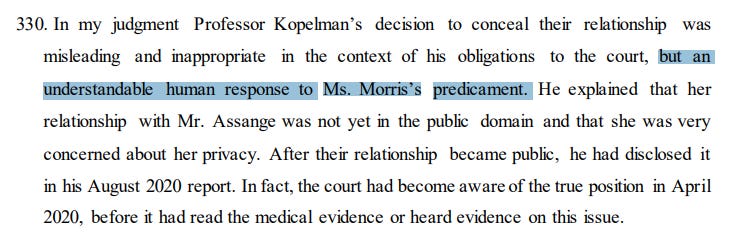
Despite this point having little to do with medical science or psychiatry, the prosecution have used it to try and discredit all of Kopelman’s medical evidence. They say the judge should have given it little or no weight. They accuse Kopelman of misleading the court, and failing in his duty as an impartial, expert witness.
Assange’s lawyer Fitzgerald called it a “miserable attempt to tarnish the reputation of a distinguished neuro-psychiatrist”.
The United States’ lawyers are basically trying to sink the entire case, on a technicality that has nothing to do with psychiatry. In fact, Kopelman is such a renowned neuropsychiatrist that even the US’ lead prosecutor, James Lewis, had solicited his services in another case— an irony which Kopelman highlighted in court.
The notion that Kopelman “concealed” anything from the court is incorrect.
Kopelman issued two psychiatric reports on Assange: the first in December 2019, the second in August 2020. By the second report, Kopelman had disclosed the relationship. Either way, both his reports were submitted before the court had heard any medical testimony.
Solicitor Gareth Peirce writes that in December 2019, Prof. Kopelman sought advice on “whether the identification of Ms Moris as Mr Assange’s partner could be deferred but the report nevertheless served, without detriment to or qualifications of its conclusions or their basis.” [….] “I indicated to Professor Kopelman that in the circumstances, I believed that would be appropriate.”
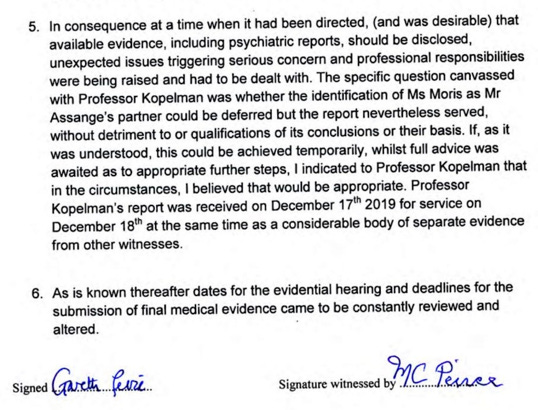
This further proves that there was no ill-intent to conceal information from the court on the part of Kopelman, nor did he do so in “cahoots” with Moris and Assange, Fitzgerald argues.
Fitzgerald points out how the prosecution’s lawyers “make a great hullabaloo” that Assange had had two children in the embassy. But not one of the other psychiatrists [besides Kopelman] wrote about this in their reports. Assange had voluntarily told Dr. Nigel Blackwood (one of the prosecution’s medical experts) that he had had two children with Stella Moris.
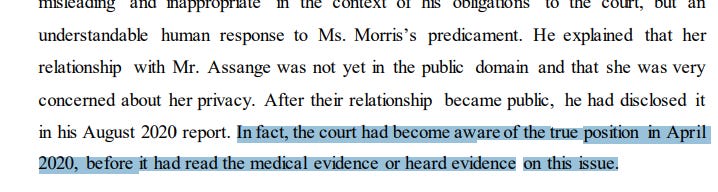
Fitzgerald: “If [Kopelman] did this on legal advice, and the court isn’t misled, but gets the full picture— it isn’t unreasonable for the judge to say ‘this was an understandable human response’.” She also says, the court knew already in April 2020 before even hearing medical evidence.
Prosecutors accuse Assange’s defense of taking a “crystal ball-type approach”
Section 91 of the Extradition Act bars extradition if “the condition is that the physical or mental condition of the person is such that it would be unjust or oppressive to extradite him.”
Baraitser blocked Assange’s extradition on these grounds.
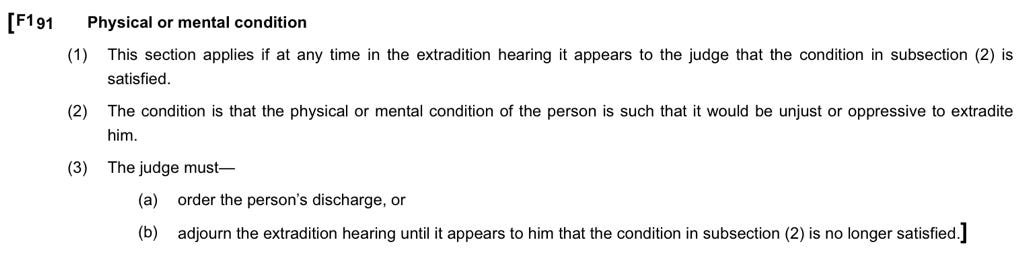
Lewis argues that the judge was looking into the future, instead of considering Assange’s health as it currently stands: “One has to be careful of not going into this crystal ball-type of approach.” He adds “You have to take his mental health as it stands at the moment”.
On the judge’s approach to Section 91: “She was wrong to approach the question on whether Assange’s mental condition is such that it would be oppressive to extradite him, based on a prediction of the future and uncertain events.”
Lewis maintains that it’s “the wrong approach” and “had she applied this section correctly she would have decided the question differently and arrived at a different conclusion”.
An eerie image: Assange is seen via video, sitting in a blue room in Belmarsh prison, looking pale and sick, as the prosecution can be heard in the background arguing to the court about his mental state, painting him as a malingerer. He is then escorted out the room by a guard.
— Richard Medhurst (@richimedhurst) October 27, 2021
Assange’s defense countered by saying: “If the predictive thing is: he’ll commit suicide no matter the steps taken – that satisfies the test, even if there are protections in place”.
Fitzgerald adds: the decision not to extradite must consider that if the person’s state is such, “that no matter the conditions, that they would take their life”, then this makes the extradition oppressive. One must consider Assange’s condition potentially deteriorating in the future.
Fitzgerald maintained that in regards to Section 91, Parliament never intended to place “artificial limits on how far one can look down the line”. Whether Assange is put into oppressive conditions the moment he lands or two years down the line— the extradition is oppressive either way.
Fitzgerald argued that Parliament added Section 91 specifically to protect the mentally and physically disordered, because one can’t just assume that the requesting state [the United States] will protect Assange. In fact, “the judge goes a step further”, he says, and makes it very clear: extradition would worsen Assange’s health and drive him to take his own life.
Prosecutors: “No one ever extradited from the United Kingdom to America has ever committed suicide”
Responding to this argument, Fitzgerald explained that it’s precisely because of protections from the English courts that people like Gary McKinnon and Lauri Love were not placed in such danger.
The prosecutors claim Assange is only moderately depressed, able to control the urge to commit suicide, and therefore fit to be extradited. This approach, however, fails to consider the person who makes plans to take their own life, driven not by impulse, but nevertheless by their mental disorder—which includes Assange, his lawyers argue.
All psychiatrists who evaluated Assange determined he suffers from depression and is at risk of suicide, just to varying degrees. In fact, Kopelman does say that Assange lacks the capacity to resist the impulse to commit suicide. The prosecution, however, sought again to discredit his expertise, saying that he was the only doctor out of five who found this, and that his evidence relied too much on the “self-reporting” of Assange—apparently unaware that this is a common practice in psychiatry.
Lewis essentially accused Assange of being a malingerer; of using the risk of suicide to avoid extradition: “If he’s clever enough, he can get around that [extradition]. It then becomes a trump card which cannot be dealt with by the requesting state, no matter if the prevention matters are a hundreds times better than in England.”
This “carries with it the risk of rewarding fugitives for their flight.”
High risk of suicide
The prosecution pointed to Prof. Seena Fazel’s assessment from 2020 that Assange is not at high risk of suicide, when compared to other prisoners. Fazel argues: When I refer to high risk, it’s an elevated risk compared to prisoners of similar age and gender.
In the High Court, Assange’s lawyers responded that in the United States there are people jailed for a “joint of marijuana”. Therefore, Fazel’s notion that Assange would have a lower risk of suicide compared to other prisoners in the US v in the UK, is inaccurate, because the US has “a prison population seven times higher”.
Refuting the Asperger’s diagnosis
Assange was diagnosed with Autism Spectrum Disorder (ASD), which in combination with depression, is said to increase the risk of suicide, according to the testimony of the medical experts. The prosecution sought to discredit the ASD diagnosis, on the grounds that only one out of five doctors diagnosed Assange as autistic. This was Dr. Quinton Deeley, a leading expert in the field.
Fitzgerald: “Everyone accepted that [Deeley] is an expert on ASD. Fazel and Blackwood agreed, and Kopelman referred the matter to him. That’s why Deeley carried out the test. When asked, Fazel said ‘I’m not an expert’.”
Fitzgerald continues: “So when the prosecution say Assange’s ASD diagnosis was from a ‘lone’ person— he [Deeley] is an expert! He’s the expert people look to in this matter.”
Blackwood said Assange showed no traits of autism. In addition, Fazel and Kopelman found Assange to possess “autistic-like traits”.
If ASD, in combination with depression, raises the risk of suicide (on which blocking the extradition is contingent), then by discrediting the ASD diagnosis, this would allow the prosecution to minimize the risk of suicide, and argue in favor of extraditing Assange.
James Lewis, the lead prosecutor (who is not a doctor) argued that Assange cannot be suffering from serious mental illness because he once requested “milk and oranges”. (He actually said this). Lewis also points to Assange reading the British Medical Journal, as an indication that he might possibly be faking his illness: “One can’t necessarily read into that, but it is a factor” he said.
After dealing with health matters in the first half of Day 2, Mark Summers takes over from Edward Fitzgerald to argue against the diplomatic assurances offered by the United States.
Diplomatic Assurances
The district judge found American prison conditions to be too harsh and likely lead to Assange taking his own life.
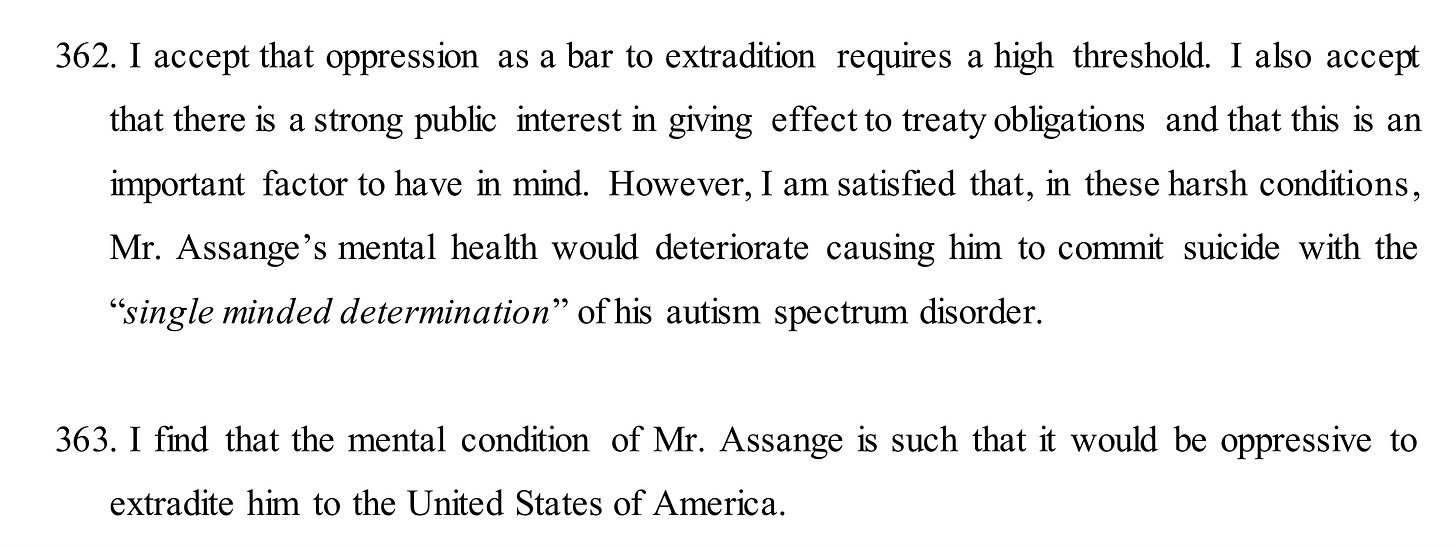
To satisfy these concerns, the US recently offered not to place Assange under some of the most horrific prison conditions: Special Administrative Measures (SAMs), and not to send the WikiLeaks founder to one of America’s worst prisons: ADX Florence.
It is very likely Assange will be sent to ADX Florence, which former warden Robert Hood described as “worse than death”.
Additionally, the US claims Assange can serve out any potential sentence in Australia.
Lewis argues that “Kopelman’s evidence and the judge’s findings were contingent on those factors” and predicated on the imposition of SAMs and ADX Florence. Given these diplomatic assurances, “it cannot now be said that it’s oppressive to extradite Mr. Assange. The judge would’ve decided the question differently under Section 91.”
So why didn’t the US offer up these assurances before? Especially when its lawyers claim it’s permissible to do so at any stage in the process? Because the United States lost its extradition battle in January, and is now trying to rerun the case differently, claiming there won’t be any SAMs or ADX. But this is not true.
Not only are SAMs and ADX practically guaranteed for Assange, but the United States explicitly stated in court that it reserves the right to place him in either if he “threatens” national security—which means they will, as the entire indictment is built on the same false premise.
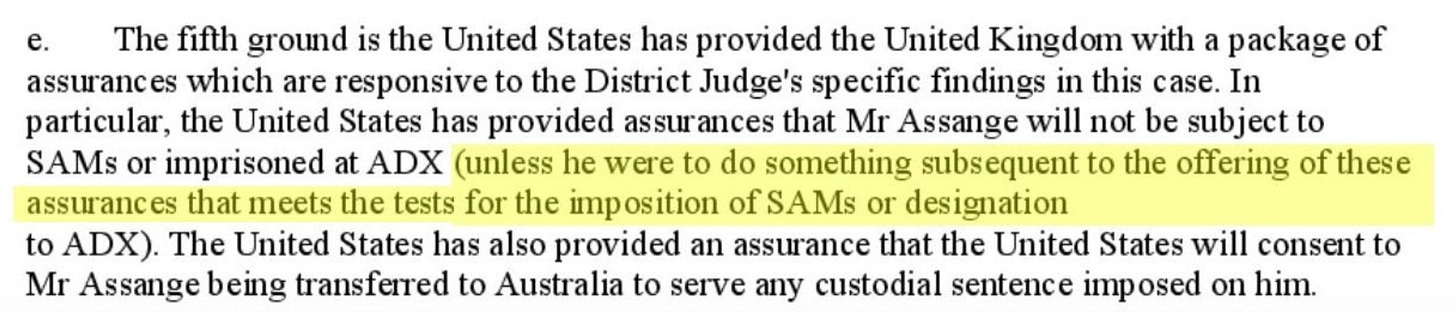
During the extradition hearing in September 2020, the US made clear that SAMs are a possibility for Assange, and went to great lengths to portray them as “okay”. On Thursday, Lewis told the High Court that SAMs are not that bad because Assange would be afforded luxuries such as: playing crochet, poetry, or ‘self-recreation’ (whatever that means).
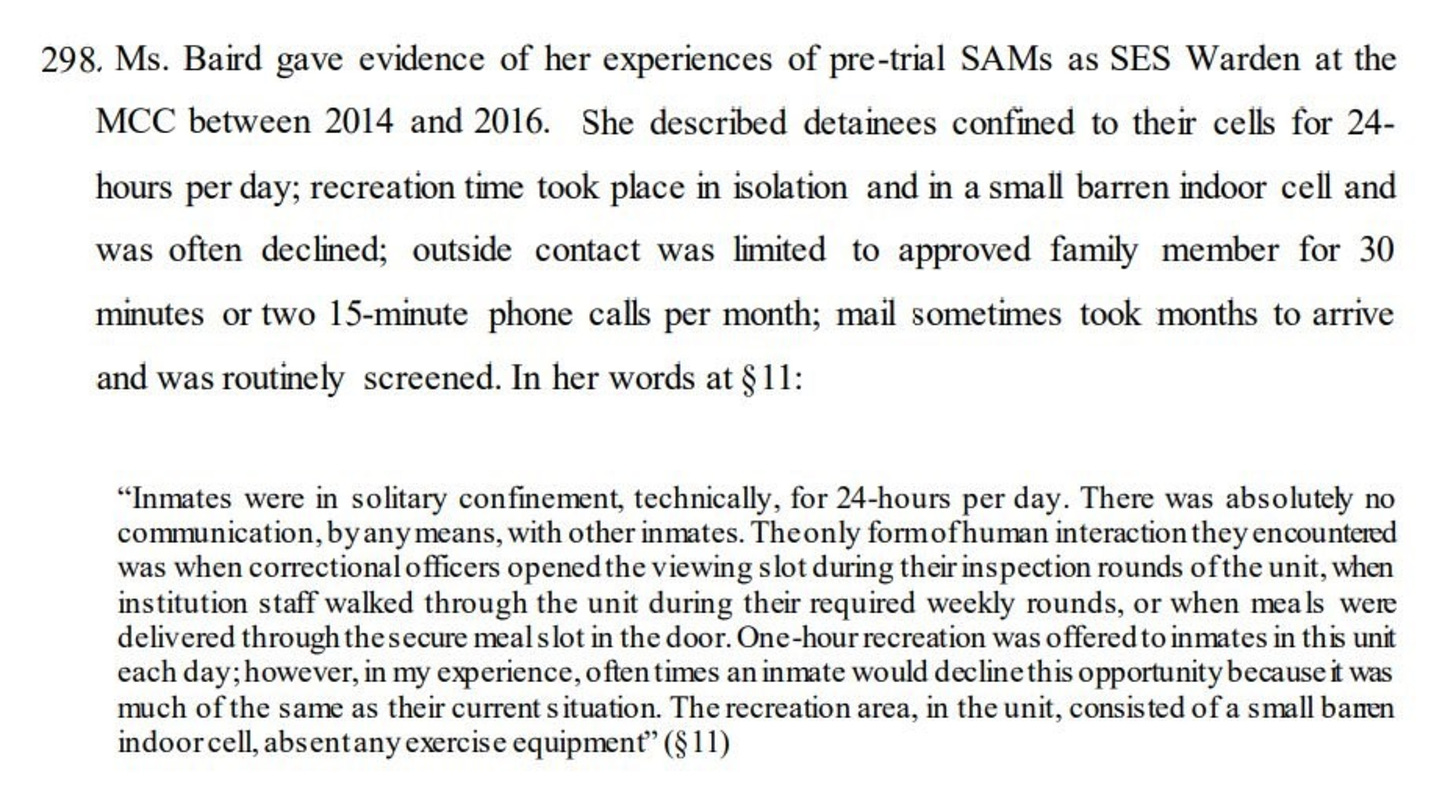
The reality is that under SAMs, Assange would be placed in isolation 24-hours per day. The only human interaction he would have is when the guards come to inspect the cell or give him food through the door slot. His conversations with his lawyers would be monitored and recorded.
Assange’s lawyers pointed to testimony by Maureen Baird, former warden at Metropolitan Correctional Centre (MCC), who testified at Assange’s extradition hearing, countering all the United States’ arguments about SAMs. She also said there hadn’t been a single suicide at MCC in 13 years, until Jeffrey Epstein in 2019.
Even if Assange could avoid SAMs (extremely unlikely), he would still be put in administrative segregation (ad seg). Ad seg is essentially “SAMs, but without restrictions on communication”, as his lawyer Mark Summers put it. The US claims inmates can communicate with each other “seemingly through the plumbing”.
Summers: "You can proceed entirely confidently, that in the event of surrender to the USA, Julian #Assange will enter into administrative segregation (ad seg) at Alexandria for years"
— Richard Medhurst (@richimedhurst) October 28, 2021
Judge: why years?
S: that's how long it will take before a trial can even happen
— Richard Medhurst (@richimedhurst) October 28, 2021
How can anyone trust Assange won’t be put under SAMs the moment he sets foot in the US, when that decision is up to the agency whose crimes he exposed, and had discussed plans to potentially kill him?
Assange could be placed under SAMs at the discretion of the Central Intelligence Agency (CIA)—the same intelligence agency that was contemplating, if not plotting, to potentially kidnap, poison, render or assassinate Assange, his lawyer Summers explained to the judges.
It’s at this point that we saw the Yahoo! News investigation brought up in court for the first time, where 30 US officials confirmed discussions at the CIA, around maybe kidnapping or poisoning Assange. This confirmed what we already knew from the former employees of UC Global, contracted by the CIA to spy on Assange in the Ecuadorian embassy. I heard their anonymous witness testimony in court at the Old Bailey, while I sat next to former Ecuadorian consul Fidel Narvaez, who knew of this only too well.
Summers adds that this was even confirmed by former CIA director Mike Pompeo.
If not ADX, then where?
Even if Assange could somehow avoid ADX, the United States has a large selection of other hell-holes they could send him to, designed to isolate him—isolation which would drive him to suicide, as doctors and Judge Baraitser warned.
Summers tells the High Court: “Even if ADX Colorado is off the table, Assange would be sent to a Communications Management Unit (CMU). […] It’s a prison within a prison; an experiment in social isolation. Correspondence is limited to one 6-page-letter a week to one recipient.”
S: Even if ADX Colorado is off the table, Assange would be sent to a Communications Management Unit (CMU), according to Lewis, Kromberg…
S: It's a prison within a prison; an experiment in social isolation. Correspondence is limited to one 6-page-letter a week to 1 recipient.
— Richard Medhurst (@richimedhurst) October 28, 2021
Drone whistleblower Daniel Hale, convicted in July, is currently in a CMU.
Alternatively, Assange could be sent to a Special Housing Unit (SHU) “designed to isolate prisoners from each other and the outside world”, Summers explains to the judges.
The way the United States has worded these “assurances” is very clever too. They bind the prosecutors to consent, but not the US Department of Justice— meaning they’re worthless. The DoJ can simply say it never made such promises.
Assange’s lawyers cited previous cases of people extradited to the US expecting to receive medical or psychiatric placement, only to find themselves sent to ADX or denied medical care:
-The Spanish court made Mendoza’s extradition to the US conditional on prisoner transfer back to Spain to serve any sentence. Mendoza applied and then the DoJ refused on the basis: we, the DoJ, never promised we would grant it.
-Abu Hamza was sent to ADX after being promised a transfer to an appropriate medical facility by the US.
-Haroon Aswat’s extradition was contingent on assurances of psychiatric placement & treatment. Upon arrival to the US, he was not hospitalized.
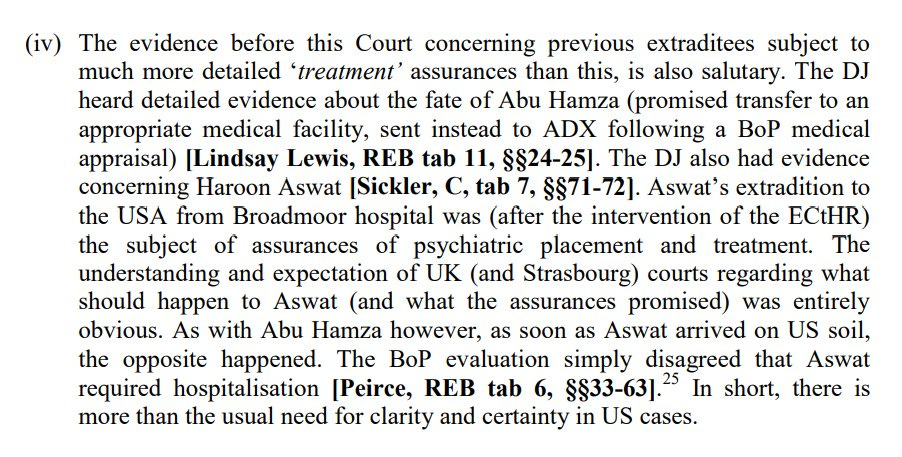
Responding to the cases highlighted by the defense, Lewis said: the US never promised not to send Abu Hamza to ADX, only that he might not be sent there. Therefore, this wasn’t a breach of assurances. Lewis went on to insist that Assange is being given diplomatic assurances, which are “solemn undertakings given out at the highest order” and that “these are not dished out like smarties”.
He added: “[Mr. Assange] is not going to spend his life subject to SAMs in the ADX. In addition, he knows he will get required medical care. Because the United States have never broken a diplomatic assurance, ever.”
US prosecutors: “Assange knows if convicted he can serve his sentence in Australia. Now he has hope to look forward to that.”
Lewis said Assange “now knows he’s not going to go to SAMs and ADX. That must reduce the suicidal ideology.” Lewis even called prison in Australia something that Assange could “look forward to”— as if being imprisoned in one’s home country is something every journalist dreams of.
Australia, for its part, has not even indicated it would take Assange at all, never mind in ten years— which is how long this process could take.
Even in the event Assange is acquitted in the United States, he risks facing jail time as a result of the political persecution against him.
Summers told the High Court: “Even in the event of acquittal in the US, what witnesses said, is that even if Assange is acquitted, what Gordon Kromberg can do is summon him before a grand jury, incarcerate him for civil contempt, and place him in a Special Housing Unit.”
Assistant US Attorney Kromberg has done this in the past, namely with Chelsea Manning. After Obama commuted her sentence, she was thrown back into jail by Kromberg for refusing to testify against Assange.
RELATED CONTENT: Assange Supporters Rally in London, as US Prepares new Extradition Attempt
Absent from all this is any discussion about free speech, freedom of the press or first amendment rights. The United States has put Julian Assange’s mental health on trial, while the war criminals escaped out the back.
While January’s outcome was positive, we are now seeing why Baraitser’s ruling was insufficient and problematic: it still criminalizes journalism, and now the whole trial has become about Assange’s health, and worthless assurances from the US.
The United States is pretending that Assange is in good health, after wearing him down for a decade. I saw Assange briefly: he wore a white shirt, black tie, sat with his elbows on the table and one hand over his face. He did not look well.
An eerie image: Assange is seen via video, sitting in a blue room in Belmarsh prison, looking pale and sick, as the prosecution can be heard in the background arguing to the court about his mental state, painting him as a malingerer. He is then escorted out the room by a guard.
— Richard Medhurst (@richimedhurst) October 27, 2021
As he winces in pain, lawyers are arguing over whether he is at moderate or high risk of suicide— but why is he suicidal in the first place? Who has been persecuting him for ten years for publishing materials in the public interest? Who said he must choose between being imprisoned in Australia or America, as he sits in an English prison? None of these options are acceptable.
British courts should not be complicit in extra-territorializing US law, and sending an Australian journalist to his death in a foreign country, which he owes nothing. Assange won his case in January. He is guilty of no crime. If this is really about justice, he must be set free immediately.
Richard Medhurst is a Syrian-British journalist covering US politics, international affairs and the Middle East.
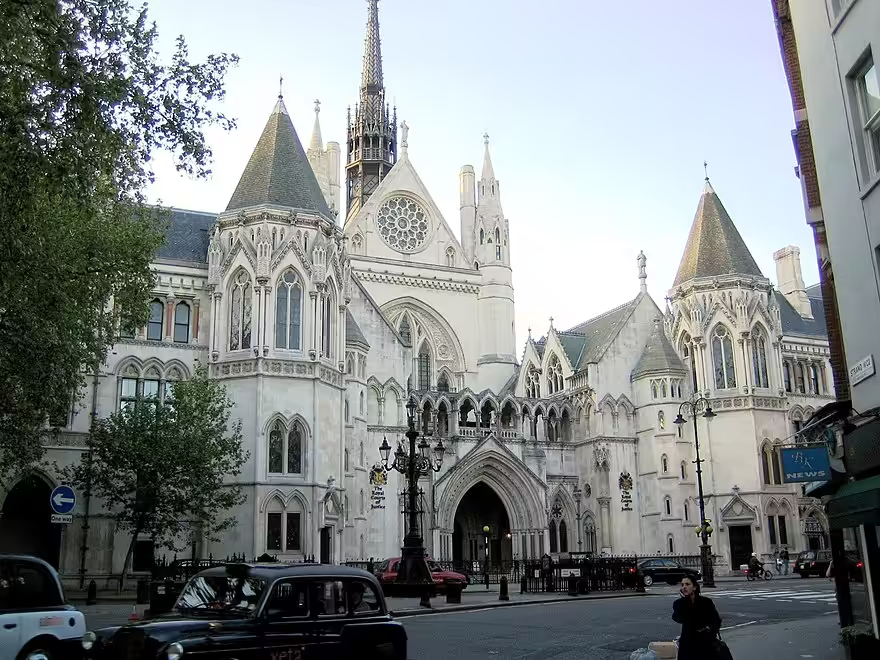
Featured image: The Royal Courts of Justice, London, where the Assange-US extradition appeal unfolded.