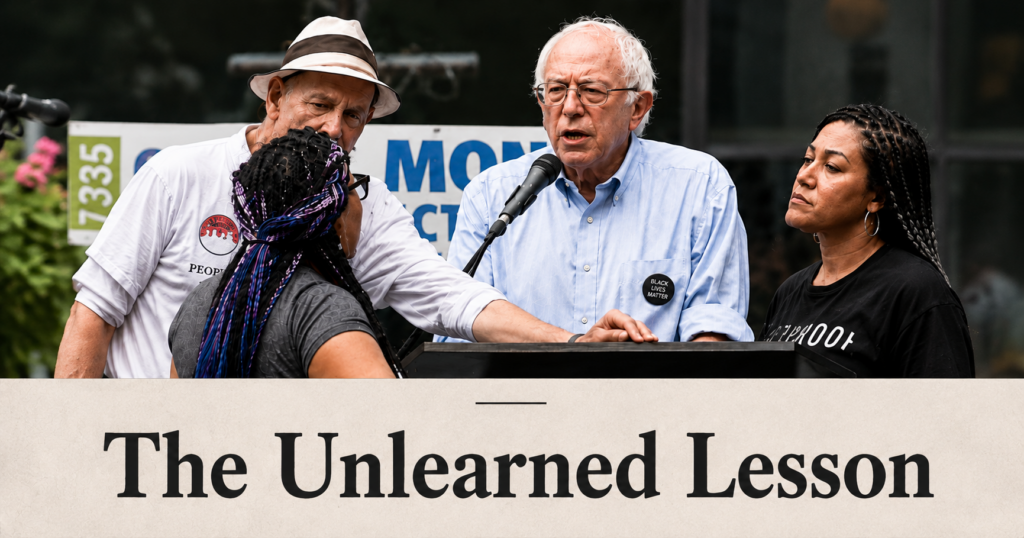
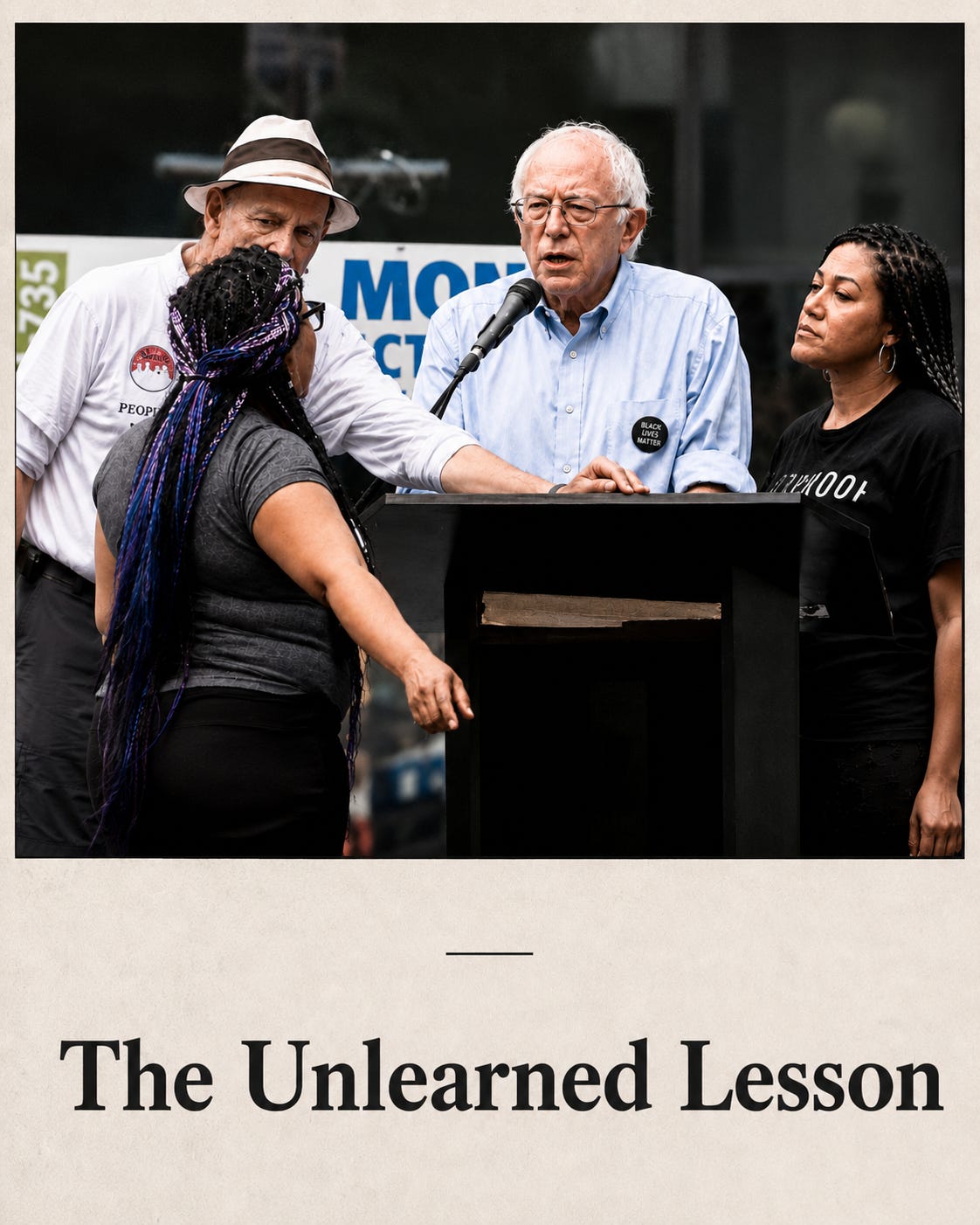
Activists Marissa Janae Johnson, left, and Mara Jacqeline Willaford interrupt Sanders in Seattle. Photo: Brandon Wall/Twitter.
Activists Marissa Janae Johnson, left, and Mara Jacqeline Willaford interrupt Sanders in Seattle. Photo: Brandon Wall/Twitter.
By Tony Chamas – Aug 18, 2026
A Theory of the Two Lefts
This essay serves as the fourth and final essay in my Genealogy of Wokeism series. But you don’t need to read those essays first before reading this one. For those who want a rigorous, historically grounded definition of what wokeism is, I would direct them to Part 1 of this series. It is highly influenced by (and a complement to) American sociologist Musa al-Gharbi’s book We Have Never Been Woke, which is by far the most detailed and empirically grounded study of wokeism that exists to date. After deconstructing the history of wokeism from the past to the present, I conclude with this final piece on what to do about it.
This final installment is directed not so much at “woke people” themselves, but at what I believe is a more politically consequential group: those who already see through woke politics and have nonetheless decided to live with it. To this crowd of people who may consider themselves “neither woke nor anti-woke,” I pose the following challenge: if wokeism is truly a fringe phenomenon driven by an overrepresented minority, then a question immediately follows: why does the left not simply reject it? If it truly is so insignificant, then why do leftists, including many self-proclaimed “class-first” leftists, continue to accommodate the dogmas of woke people and allow them to define the cultural politics that have become associated with “the left”? As I will show, the Bernie Sanders campaigns of 2016 and 2020 exposed an underlying civil war within the left, which has had grave consequences that much of the left still has not learned from. There has always been a divide between woke leftists and class-first leftists who find the woke stuff annoying, embarrassing, and who quietly roll their eyes at the pronoun rituals and the cancel culture performance, who prefer to focus on economics while treating the cultural absurdities as a self-limiting nuisance. I argue that wokeism’s greatest structural asset is not its popular appeal; it is the tolerance it receives from people who know better yet choose, for reasons of social comfort or strategic calculation, to do nothing about it. This essay argues that this tolerance is not a neutral position. It is, in effect, the condition that keeps wokeism alive, allowing it to continue derailing any serious left political project interested in large scale structural change.
Memory-holing Wokeism
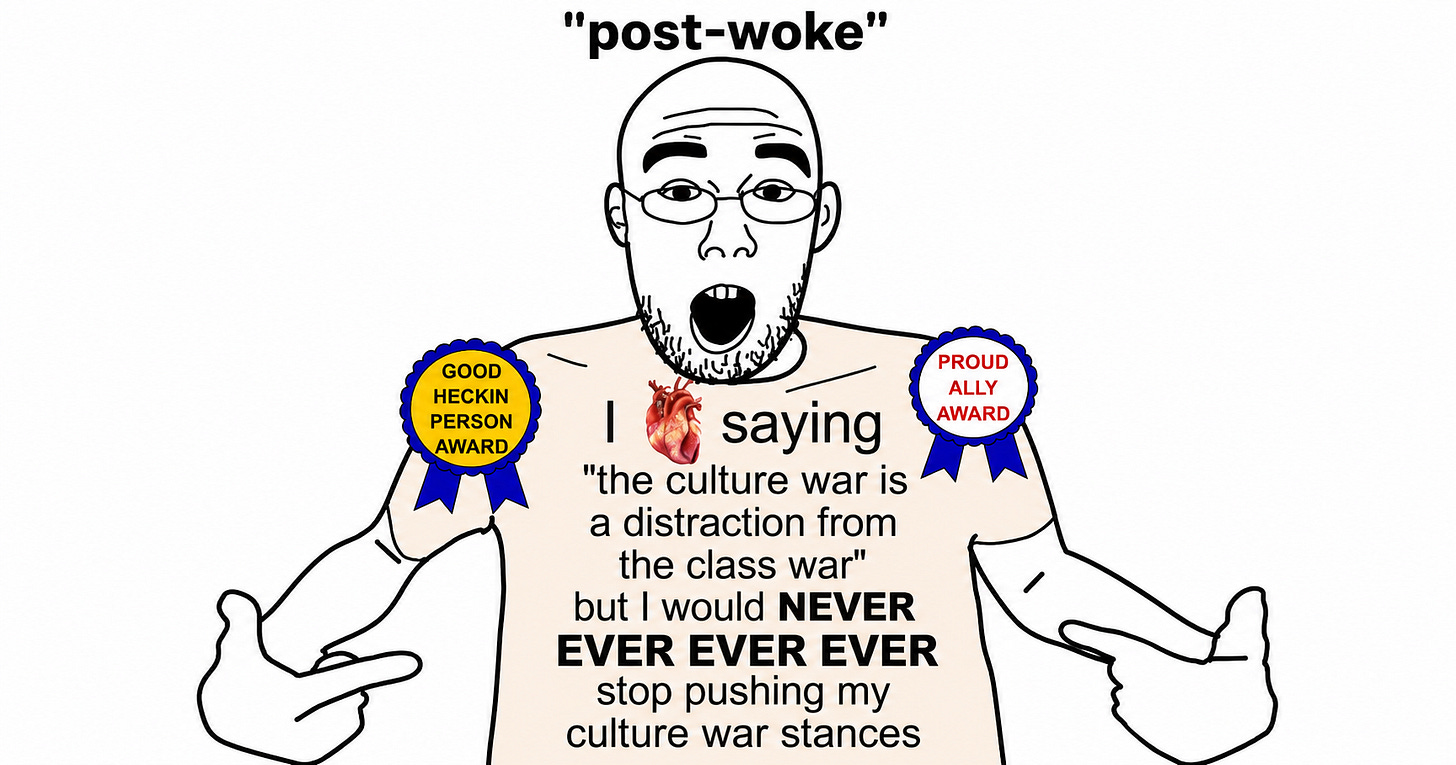
Whenever people take a surface look at what I have written and said about wokeism (without really reading), they often assume that I take the standard class-first lefty conclusion that “the culture war is a distraction, and that we must just focus on class and economics.” But that is not my argument. The “culture war is a distraction” framing is a very limited narrative that stops people short of grasping the full scope of the problem.
The “post-woke” left approach to wokeism is captured in a familiar narrative that is increasingly standard among class-first leftists that sounds reasonable on its face. Consider a statement from Graham Platner, at the time a left-leaning Senate candidate in Maine: “I just have no patience for getting dragged into, frankly, culture war issues that are being invented by the people that don’t want us talking about raising their taxes. That’s why it exists.”1 The posture is recognizable. It is the standard agnostic response to the culture war among class-first leftists: the culture war is a manufactured distraction, conjured by billionaires and the right to keep ordinary people from focusing on economic questions. This would be a strong narrative for the left if it were true. The problem is that it simply does not reflect reality. What that narrative gets correct is that the right does benefit from keeping the culture-war terrain active, and concentrated wealth does have an interest in keeping workers divided. These are real phenomena.
What this narrative gets profoundly wrong is the order of cause and effect. Action precedes reaction. The culture war was not invented by the people who oppose woke politics. It was generated by the same symbolic-capitalist overproduction this series has documented from the beginning, and the right-wing anti-woke industrial complex was an entirely predictable response to it. To act as if the right fabricated the culture war from nothing is to pretend that the woke left did not exist, or that the decade of language policing, institutional capture, and consciousness politics that preceded the conservative backlash was simply not a real phenomenon. This version of events may be convenient for those who want to distance themselves from the woke tendency without examining their relationship to it. It does not fool anyone who watched what actually happened.
The evidence against this account is not difficult to find. Was it right-wing billionaires who pressured institutions to adopt gender-neutral language, substituting terms like “birthing persons” for mothers in official government communications? Was it right-wing media that structured certain public-sector hiring processes to advantage applicants who identified as women or people of color? Was the left’s embrace of open borders, accompanied by slogans like “no human is illegal,” merely a conservative fabrication? These were left-generated political developments. The right reacted to them, cynically and effectively. But the raw material was real, and asking people to disbelieve what they observed between 2015 and 2022 is not a political argument. It is an insult to their memory.
The correct formulation is the inverse of what the class-first agnostic typically offers. It is not that right-wing propaganda creates an image of the left that does not correspond to anything real. It is that the woke left’s attempts to impose a cultural revolution, on a public that did not invite one, are what supply right-wing propaganda with its most effective material. The left’s most embarrassing representatives are the right’s most effective recruiters. Class-first leftists who genuinely want to demonstrate that the left is more than its woke faction have one option: stop treating the woke tendency as an unfortunate footnote and start disciplining it. The reason most have not done so is not strategic calculation. It is a failure of nerve.
The truth is that “the culture war is a distraction” narrative is itself a distraction, specifically from the fact that it was the left’s own symbolic-capitalist class that generated the culture war in the first place, and that many of the people now insisting we ignore it were content to tolerate it, and in many cases enable it, right up until it became politically costly. The pivot from cultural maximalism to economic agnosticism is not a principled intellectual development. It is a retreat made under conditions of losing. The narrative functions not to redirect attention toward economics but to shut down scrutiny of the left’s own recent history. It works only on people who have already decided not to think about it; to anyone who remembers what the left was doing between 2014 and 2020, it reads as precisely what it is.
There is a meaningful distinction between rejecting woke politics as wrong and simply declining to engage with it as if it does not exist. The second is a fundamentally different intellectual posture, and a substantially less honest one. When faced with a concrete cultural question, the agnostic politician freezes, because silence is not a philosophy. It is an evasion, and a costly one: accepting the woke frame by default while pretending not to engage with it at all. The agnostic approach of casually disavowing woke or laughing off as well-meaning but “went a bit too far” (as AOC did in a recent interview where she said “woke” was “a little crazy”) is a convenient way of distancing oneself from it without actually confronting it or holding the people who pushed it (and still push it) accountable.
Culture War as Class War
While the culture war is a distraction insofar as it does not bring real progress in material terms, and changing minds does not necessarily change things, the culture war is not entirely divorced from the economic war. For the economic war to be overturned and won by a pro-working class force, it would require a political movement that is not actively hostile and at odds with the working class it seeks to galvanize. Understood structurally, the culture war is downstream of elite overproduction: a form of class conflict in which PMC symbolic capitalists, who use oppressed minorities as human shields for their own class advancement, contest institutional terrain against the fraction of concentrated wealth whose dominance they nominally challenge. But the contemporary left is precisely such a hostile force, which is why the culture war is not merely a distraction; it is a hindrance to the economic project. The way to deal with it is not just to say that it does not matter and that we should stop thinking about it.
The more important point, however, is that the left’s cultural failures are not solely failures of strategy or optics. Some woke positions on cultural questions are substantively wrong, not merely politically inconvenient, and a serious left should be willing to say so. The Nordic countries, which built the most successful social democratic institutions in the modern world, have in several cases arrived at conclusions about cultural-political questions that contradict the dominant positions of the Anglo-American woke left on the merits. Denmark’s Social Democratic Party, governing from the left on economic policy, has imposed some of the most restrictive immigration controls in Western Europe, not as political triangulation but as a policy response to the labor-market and social-cohesion concerns of its actual working-class constituency. Several Nordic countries, following systematic review of the clinical evidence, have rolled back the routine prescription of puberty blockers for youth gender dysphoria, concluding that the evidence base does not support the intervention at the scale it was being administered.2 These are not concessions to the right. They are examples of a mature social democratic politics willing to follow evidence and constituent interest even when doing so conflicts with the ideological commitments of its symbolic-capitalist professional strata. The contrast with the Anglo-American woke left, which treats any deviation from the dominant progressive position on immigration or trans medicine as a form of moral betrayal, is instructive. The goal is not to win by holding whatever positions are most culturally palatable. The goal should be to have the correct ideas, the ideas that actually improve people’s lives, and to build movements serious and disciplined enough to implement them.
Recognizing the failures of woke politics is a necessary starting point, but it is not sufficient. Being post-woke, in the sense of declining to engage with the cultural politics of the prior cycle, is not the same thing as rejecting the woke mode of politics as the organizational and strategic threat it actually represents. The first posture, treating wokeism as something that will fade on its own if ignored or gently discouraged, underestimates the structural dynamics that sustain it. Some on the left object that fighting wokeism is itself just another culture war, and that anti-wokeism is merely wokeism inverted. Applied to right-wing media, which has no stake in class politics, the charge is largely fair. Applied to the left it collapses, because the two sides do not have the same interest in the outcome. The right loses nothing by leaving the woke tendency intact, since an opponent that easy to caricature is an asset to it. The left is the only side with a material stake in defeating wokeism, which is why treating opposition to it as a distraction from class politics gets the relationship exactly backwards. Anyone who genuinely believes in the left’s stated goals, whether economic justice, reduced poverty, better healthcare, or effective climate policy, should be the most forcefully anti-woke, precisely because the woke tendency has demonstrably driven those goals backward. The woke left did not merely fail to advance working-class interests. It actively alienated the working-class constituencies without whose support no anti-establishment politics can succeed.
No amount of redirecting to economic issues works when the thing being redirected away from is visible, immediate, and real.
And it is real. It is not merely an online phenomenon or a product of right-wing media amplification. The pronoun rituals, privilege-checking procedures, and representation performances that characterize many DSA meetings and, as was visible at the NDP convention, mainstream party conferences,3 are genuine organizational realities that real people must conform to or fight against in order to participate in left-wing political spaces. Many people conform out of politeness rather than conviction, and complain about it behind closed doors. What is perpetually baffling is the number of people on the left who insist these things no longer exist, or are so marginal as to be irrelevant, when they are demonstrably present and operative. The fact that these tendencies are driven by a loud minority is not a reason to dismiss them. It is the most compelling reason to reject wokeism and stop capitulating to the expectations of woke people.
The deep and largely unspoken division between the cultural left and the class-first left was exposed most dramatically during the 2016 and 2020 Democratic primaries, and specifically in the two Bernie Sanders campaigns. Those elections revealed that there are different lefts operating under the same banner, with genuinely conflicting priorities, and that many who appear to be on the same side are not aligned on anything that matters politically. The lessons produced by those campaigns have still not been learned.
The Lesson of Bernie Sanders 2016–2020
Everything this essay has argued in the abstract, the Sanders campaigns of 2016 and 2020 proved empirically. They functioned as a litmus test for the American left, and the results were unambiguous. What those campaigns exposed was the depth of the division between two fundamentally incompatible political formations operating under the same banner: a genuine class-first left committed to socioeconomic transformation, universal public goods, and the material interests of working people, and a synthetic woke left, rooted in the professional-managerial class and the symbolic-capitalist aspirant strata described in Part 1, whose actual priorities are cultural sensibility, identity-based recognition, and the preservation of the institutional terrain on which their careers depend. These are not two wings of the same movement. They are structurally opposed projects, and the Sanders campaigns proved it by forcing the contradiction into the open.
Above all, the Sanders experience demonstrates that the woke left, and specifically this PMC faction, is the primary internal obstacle preventing the left from winning. It was not the Republican Party that stopped Bernie Sanders. It was not Fox News. It was the Democratic establishment and its woke-adjacent professional class: the staffers, the activist organizations, the media professionals, the NGO operatives, and the symbolic-capitalist intelligentsia who could not tolerate a politics that did not center their cultural priorities. Sanders had the policies, the cross-class appeal, and the grassroots energy to capture the Democratic Party and advance a genuine social democratic agenda. What he did not have was the willingness to destroy the internal opposition that stood in his way. Unlike Donald Trump, who ruthlessly dismantled his Republican primary opponents in 2015 and 2016, humiliated the party establishment, and forced the entire apparatus to conform to him, Sanders chose accommodation. While Clinton supporters attacked him and his base as “Bernie Bros” and framed the choice between a woman candidate and a class-first candidate as inherently sexist, Sanders pulled his punches, deferred to the unity imperative, and tried to coexist with forces whose structural interest was his defeat.
The Day Sanders Stood Still
There was one event in particular that many of us probably remember, which I believe was a symbolically defining moment for the nascent class-first left in America. It was the day in which the Bernie Sanders movement marked its total capitulation and submission to the woke minority, allowing the left to become totally captured by the woke, which had already culturally captured the more centrist/establishment liberal left. On August 8, 2015, Bernie Sanders arrived at Westlake Park in Seattle to address a Social Security rally. He was drawing crowds that had surprised even his own campaign staff, and his candidacy had demonstrated an early cross-class reach the Democratic establishment had not anticipated. Before he could speak, two Black Lives Matter activists rushed the stage and seized the microphone. One of them told the crowd, which had begun to boo the disruption, that they were “white supremacist liberals.” She spoke for several minutes. Sanders and his people stood to the side, visibly too weak-willed to assert control of their own event. Organizers eventually ended the rally, and Sanders left without delivering his speech.
The incident was not primarily notable for what the protesters said. It was notable for what Sanders did not do. The Sanders team did not have the balls to simply kick them out. They feared the potential backlash of woke outcries over “kicking out a black woman” from their event. But backlash from whom, and at what cost? No sane person looking at that spectacle would have thought that the two BLM activists weren’t obviously in the wrong. As a result of the inability to stand up to this nonsense, Sanders was not able to defend his platform or the audience that had shown up to hear him. He stood aside, and then he ceded it. The image was widely circulated and understood by those watching as exactly what it was: a signal that this movement would accommodate disruption rather than confront it, that the symbolic-politics faction could command the attention of the working-class left simply by invoking the right moral vocabulary loudly enough.
That signal set the trajectory for everything that followed.
It is almost hard to believe today that Bernie Sanders, prior to running in the Democratic primary, was not a Democratic politician. He had been an independent his entire political career, serving as mayor of Burlington and then in the House and Senate without affiliating with either major party. He did not register as a Democrat until 2015. His reasoning was explicit: he had drawn the lesson from Ralph Nader’s 2000 campaign that third-party runs in the American electoral system produce nothing except the spoiler effect. The Democratic primary was not his natural home. It was the only viable vehicle for a social-democratic agenda in a system structurally hostile to independent candidacies. That outsider status was not incidental to his appeal. It was the source of it. The 2016 Sanders campaign was remarkable in ways the left has since worked hard to forget. Sanders was not simply appealing to Brooklyn socialists, campus activists, or the already-converted professional-progressive base. His campaign was genuinely cross-class in its reach precisely because it was not primarily framed through the idioms of identity politics. He spoke in a class-first language about wages, inequality, healthcare, Wall Street, trade, corruption, and the domination of political life by concentrated wealth. The results bore this out. Sanders won or performed strongly in states that were not liberal enclaves, across the industrial Midwest and the rural interior, while making the race against Hillary Clinton far more competitive than the political class had expected. The 2016 campaign demonstrated that class-first language could reach voters the left had been told were unreachable.
This is also why the so-called “Bernie-to-Trump” phenomenon, however overstated in some versions, was real enough to matter politically. Some voters who supported Sanders in the primary subsequently voted for Trump in the general, which made no sense if you understood politics through the symbolic coordinates of liberal progressivism. It made perfect sense if you understood that many of those voters were not looking for “left” or “right” in the professional-managerial sense. They were looking for someone who seemed to be against the system, against the donor class, against trade deals that hollowed out their communities, against a political order that treated them as disposable. Sanders could reach that voter because, at his best, he was addressing the same material anxiety through a different vocabulary.
These voters did not become far-right. They moved away from the left. The distinction matters because the standard left response to the Bernie-to-Trump phenomenon is to characterize it as radicalization, framing the departure as a rightward conversion when the more accurate account is that the left lost these people rather than the right capturing them. A politics that alienates people it already had is a different problem from a politics facing a new ideological adversary, and it requires a different diagnosis. The right did not conjure these voters. The left drove them out.
His 2019 Fox News town hall illustrated this directly. Sanders appeared before an audience that had been told for years that he was a dangerous radical, and received sustained applause when he made the case for Medicare for All. The audience was not applauding because they had suddenly become socialists. They were responding to a material argument framed in universal terms, about healthcare costs, medical bankruptcy, and the insurance industry’s grip on the political system, rather than as a boutique moral performance for the already-enlightened. That moment contained within it the entire blueprint for a cross-partisan working-class politics: frame material demands in terms that speak to shared conditions rather than to the symbolic hierarchies of progressive respectability, and the audience is there. The opening was real. What happened next was its squandering.
The electoral arithmetic of 2016 and 2020 tells this story precisely. In 2016, Sanders lost California to Clinton, a state generally perceived as the most progressive in the country. He lost it to a Southern Democrat with deep regional ties and every structural advantage of name recognition and establishment support. Yet he won Michigan, Wisconsin, West Virginia, Indiana, Oklahoma, and Kansas. When the 2020 campaign set about analyzing the 2016 loss, the diagnosis it arrived at was that Sanders had failed to appeal to minority voters and women sufficiently, that losing California was evidence of a coalition problem. This was almost certainly the wrong lesson. What the 2016 numbers showed was not a coalition failure but a class strength: his weakness was with the educated, socially liberal, PMC-adjacent vote that California concentrated. That was not a deficiency to be corrected by adopting identity politics messaging. It was a sign of what made his politics distinct.
What drove the 2020 shift was not only the changed political environment but the changed composition of the campaign itself. The 2016 operation had been run largely by professional strategists whose primary brief was winning votes. The 2020 operation brought in a substantially different kind of staff: people who were themselves committed leftists rather than professional electoral strategists, many of them radicalized by Trump and what followed. It was this staff that persuaded the campaign the 2016 loss had been a minority-outreach failure. A neutral analyst looking at the same data might have reached the opposite conclusion. A staff whose politics were shaped by identity frameworks was structurally unlikely to.
The 2020 results confirmed what the misdiagnosis predicted. The campaign softened its class edges, leaned into representation and coalition politics, and attempted to appeal to the Warren voter and the Buttigieg voter on their own terrain. It won California. And it lost Michigan, Wisconsin, and most of the Midwest to Joe Biden. What the geographic shift makes unmistakable is that his support moved in exactly the wrong direction for general-election viability: away from the states that decide federal elections and toward the states that were already reliably Democratic. That is precisely backwards for a movement that claimed working-class politics as its reason for existing. He should have focused on what separated him from the rest, not on what united him with them.
The claim that Sanders won California in 2020 because the identity pivot worked does not survive scrutiny. He won California not because his appeal to identity groups succeeded, but because the centrist and progressive opposition that had consolidated behind Clinton in 2016 was divided in 2020 among Buttigieg, Warren, Harris, and Biden. Clinton had swallowed up the entire socially liberal, fiscally moderate vote in 2016. In 2020, that vote was split. California, moreover, is not a left-wing state in the class sense; it is a progressive state in the PMC sense. Winning it proved nothing about electability in a general election. If Sanders were ever to demonstrate electability against a Republican, the evidence would have to come from swing states and the Midwest, which is exactly where his 2016 campaign had shown real strength and his 2020 campaign forfeited it. There was nothing strategically better about the 2020 campaign. He lost by a wider margin overall. The only result of the pivot was gaining more woke support at the cost of his swing-state appeal. Trying to capitulate to woke progressives rather than challenge and defeat them, as Trump did to his Republican opposition, ultimately set social democratic class politics backward, and we are still suffering from it today. There was a path. A class-first left could have said: we are not the cultural left, not the HR department, not the NGO class, not the people yelling at you online about your language and your privilege. We are on the side of better wages, healthcare, unions, family stability, public goods, and national economic populism. That was the offer Sanders was best positioned to make. It was not the offer his 2020 campaign ultimately delivered.
On immigration, the capitulation was especially revealing. Previously in 2015, when Ezra Klein pressed Sanders on open borders, Sanders dismissed the idea as a “Koch brothers proposal,”4 arguing that it would expand the labor pool and suppress wages. That was not a right-wing aberration. It was historically normal labor politics. The political terrain shifted dramatically after Donald Trump descended the escalator at Trump Tower in June 2015 and made mass immigration the organizing theme of his campaign. In 2018, at close to the peak of the Trump derangement cycle, the writer Angela Nagle published a piece in a left-wing magazine5 making the straightforward labor-left case against open borders, citing not right-wing theory but the historical position of figures like A. Philip Randolph and arguing that cheap imported labor suppresses wages. This was not a fringe position. It was, for most of the history of the American labor movement, the default one. For that piece, Nagle was doxxed, harassed, and effectively erased from serious consideration on the left. That is what you got, in 2018, for holding a position that Bernie Sanders himself had held for most of his career. That is how far this stuff went. A labor movement that takes wages seriously cannot treat immigration purely as a moral question of humanitarian openness while ignoring the employer interest in an expanded labor supply. But after Trump, positions that had once been ordinary within the labor left became suspect if they sounded even remotely like something a Trump voter might say. This is how the woke tendency disciplines the left into impotence: not through argument, but through association. It does not ask, “Is this true?” It asks, “Could this be associated with the right?”
In 2020, Sanders tried to play on the woke left’s terms, and it didn’t work whatsoever. The most telling case was South Carolina. Biden crushed Sanders among Black voters by approximately four to one, according to exit polling.6 Sanders, who had moved his campaign substantially toward the language of identity and coalition management, did not produce the Black working-class breakthrough the strategy was supposed to deliver. The Black voter in South Carolina was not the Black activist in a graduate seminar. Many wanted the candidate they associated with stability, familiarity, and the Obama legacy, not the candidate whose campaign vocabulary had been shaped by progressive professionals who believed they understood Black political interests better than Black voters themselves.
The consolidation behind Biden was not organic. Barack Obama played a well-documented coordinating role in pressuring other candidates to drop out and endorse Biden,7 and a concerted effort among Black Democrats and Black PMC figures to campaign heavily in the South spread the narrative that Bernie was too white. Prominent figures in Black media and popular culture, who had initially shown interest in Sanders, fell in line behind establishment Democrats. This pattern repeated from 2016, when the same dynamics played out on behalf of Clinton. It was documented. Few lessons were learned.
The professional-class theory of representation is false, and South Carolina proved it empirically. The left persistently confuses demographic categories with ideological blocs, then acts shocked when ordinary people inside those categories do not vote the way university activists expect. The Black working class is not the same as the Black PMC. The Latino working class is not the same as the Latino activist class. First-world feminist activists and girlboss corporate careerists don’t represent all women. Gay voters are not the same as queer-theory academics. This confusion is not a purely intellectual error. It is a structurally motivated one: the professional-class operatives who shape left strategy benefit from treating themselves as the authentic voice of the communities they claim to represent. They are not. They are the professional apparatus that sits between those communities and genuine political representation.
There is an objection to all of this that deserves to be taken seriously. Some analysts have argued that Sanders performed as well as he did in 2016 not because of any groundswell for socialism but because a great deal of his support was driven by animosity toward Hillary Clinton. The evidence offered is that Sanders, who had been an independent before he entered the Democratic primary, brought large numbers of people into the party who had never been Democrats and who registered specifically in order to vote for him. This cannot be the whole explanation for his support. But there is a rational kernel in it, and that kernel supports my argument rather than undermining it.
Political support is very often driven more by what people oppose than by what they support. The appeal of Donald Trump was in large part a reaction: a hatred of the Democrats, a sense of betrayal by them, and a contempt for what Chris Hedges called the liberal class. Most of the people who voted for him had no firm expectation that he would deliver on his promises. What they knew was that he was against the people they disliked, which made him the lesser evil. The same logic runs in the other direction. A great deal of Democratic support in the post-Trump era, across the Clinton, Biden, and Harris campaigns alike, has been driven by hatred of Trump rather than by enthusiasm for Democrats. People frequently vote on the basis of what they want to stop.
So the fact that a portion of Sanders’s 2016 support was anti-Clinton is not a weakness of that campaign. It is how political coalitions actually assemble, and it points to the opposite of the conclusion progressives drew in 2020. They had internalized the accusation that criticizing Clinton was sexist, and advised him toward a softer, rainbow-coalition posture in which he competed on his opponents’ terms rather than his own. The correct lesson was to intensify the 2016 approach, not to abandon it: to go after the Democratic establishment harder and more explicitly, and for the leftists campaigning for him to mark the distinction between themselves and the left they were opposing rather than dissolving it into left unity. He softened instead. He lost his grit, a great many people noticed, and the map of states he won and lost in 2020 reflects it.
This bears directly on the objection that will be raised against the argument of this essay: that a class-first left which confronts the woke tendency openly will alienate minorities and drive left-wing people away. That objection counts only the people already inside the left’s imagined constituencies and ignores everyone outside them. A class-first left that was openly and vehemently antagonistic toward the synthetic PMC liberal left would attract people precisely because of that antagonism, including a great many who currently vote for nobody at all. A large percentage of people do not vote in most elections, and many of them despise both sides. If you believe left-wing candidates win by first converting everyone to leftist principles, you have misunderstood how politics works.
The Left’s Civil War
The 2016 and 2020 democratic primaries were two revealing instances that exposed the underlying civil war within the left, which leftists tried to forget about later. Perhaps the most concentrated single illustration of where the PMC-left had arrived by 2020 was the endorsement choices of Angela Davis and Judith Butler. These are self-described communists, people who have built entire careers on critiquing capitalism and its cultural apparatus, who chose to support Kamala Harris over Bernie Sanders in the primary.8 Their stated rationale amounted to the claim that a woman president was a prerequisite for social democracy, that the symbolic representation question had to be answered before the material one could be addressed. The fact that two of the most prominent intellectuals on the far left could not bring themselves to support the most left-wing candidate in the race, in part because he was too old and too white, is a testament to what the PMC-left’s actual priorities were beneath their radical posturing. Nor is this simply a case of late-career accommodation to liberalism. Davis had already demonstrated the priority of symbolic ideology over material outcomes much earlier. In the 1970s, she vehemently opposed the Wages for Housework movement, which proposed compensating women directly for domestic labor, in effect a basic income that would have expanded women’s economic independence from both husbands and employers. Davis rejected this on the grounds that it would “entrench gender roles” and “send women back to the kitchen,” preferring the communist prescription of collectivized childcare and mass female workforce participation, which she argued would expand the proletariat and accelerate the conditions for revolution. Whatever the merits of the Wages for Housework proposal, Davis’s rejection of it was not a materialist argument. It was an ideological one: it prioritized the symbolic meaning of women’s labor over the concrete economic independence of actual women. The fact that Angela Davis endorsed Kamala Harris, a former prosecutor with one of the most hawkish incarceration policies in California, tells us a lot about why we shouldn’t take someone seriously just because they say they care about class. One of the most infamous “communist” icons in the United States, a lifelong advocate of prison abolition, endorsed a top prosecutor over the man who had the most left-wing economic agenda says a lot.
During the 2020 Democratic primary, I observed that self-described progressives consistently preferred Warren or Buttigieg over Sanders, offering rationalizations about Sanders being too old, too white, or insufficiently electable. When the field narrowed to a contest between Sanders and Biden, the same people migrated to Biden on electability grounds, despite the fact that their previously preferred candidates had no credible path to a general election and Sanders had demonstrated actual crossover appeal. The rationalizations shifted with the field; the conclusion remained constant. What presented itself, on the surface, as principled concern about identity and representation was, structurally, a class preference. These were people whose political priorities aligned with the professional-managerial strata, and Sanders, whatever his policies, was not the candidate for them.
Sanders repeatedly held back. He refrained from going hard after Warren when she functioned as his most dangerous ideological competitor. Warren declined to exit the race until the last possible moment, functioning as a vote-splitter long after any plausible path to the nomination had closed for her. She was waiting, as subsequent events suggested, for a position in the Biden administration, which, in the end, she was never offered. A candidate presenting herself as the ideologically aligned alternative to Sanders held in the race specifically to prevent the more serious progressive from winning. The left largely declined to state this with the clarity it deserved. Sanders declined to campaign against Biden on the terms that would have distinguished them most sharply, because the entire logic of “left unity” had trained the left to believe that the real enemy was always the right, never the Democratic establishment that blocks every material reform the left claims to care about. Anyone with eyes could see that the biggest obstacle to Bernie Sanders, and to universal healthcare, a jobs guarantee, and the whole suite of social-democratic policies, was the Democrats, not Trump. “Unite against the right” sounds like solidarity. In practice, it functions as a permanent injunction against fighting the forces immediately in front of you.
Sanders further compromised himself by accepting a position in the Biden administration, hoping to exert leverage from within a coalition that had no structural interest in his agenda. Perhaps he shifted some things at the margins. It was not enough for the working class to register, and it was more than enough for them to associate him with the administration’s failures. The most consequential of those failures was the border. Immigration, particularly illegal border crossings, increased rapidly under Biden. Sanders himself has since acknowledged that the border was the Biden administration’s single biggest catastrophic failure.9 He did not say so while he was part of that administration. He said it after.
Furthermore, the premises of the identity narrative have been disproven by the last three elections. Biden, who was portrayed as the least progressive on racial issues, won more Black voters than Kamala Harris did, by a wide margin. It was under Kamala Harris that Black voters shifted significantly toward the Republican Party.10 No one chose Kamala Harris as the Democratic nominee through a primary process. That Biden outperformed Harris among the very constituency the identity framework treats as its core electoral base is decisive evidence that the professional-class theory of representation does not hold, and that electoral outcomes are not determined by identity symbolism in the one-dimensional way the woke left has insisted.
In effect, Sanders had tolerated a faction that ensured his movement could never become the serious working-class political force it claimed to be. This is not a verdict on Sanders himself, whose policy commitments remain far superior to most of what the Democratic Party has offered. It is a verdict on the strategic logic of accommodation. When a working-class political project tolerates, even if it does not emulate, the woke tendency within its coalition, it enables that tendency to dominate the movement’s public face, alienates the people who most need to be convinced, and ultimately loses to the people more willing to perform the correct symbolic politics without delivering any of the economic substance. A campaign can be led by someone who personally does not believe in the latest progressive orthodoxy, but if that campaign is staffed, narrated, disciplined, and morally policed by people who do, the campaign will eventually be shaped by them. The figurehead may be old-school. The machine will not be.
A Theory of the Two Lefts
The unlearned lesson of the two Bernie Sanders campaigns is that they exposed the reality that there are two lefts within the broader camp that proudly claims, “the left”: a class-first left that prioritizes bread-and-butter economic issues, and a cultural left that prioritizes radical social change. The latter is the faction that tends to be the most associated with “wokeness” as it prioritizes first-world cultural problems and tends to be driven by the professional managerial class or PMC aspirants.
The left describes its own divisions almost entirely in doctrinal terms. Social democrats, anarchists, Marxists of every hyphenated variety, Maoists, and left communists all understand themselves to be separated by questions of theory and strategy, and the sectarian energy devoted to policing those borders is considerable. What these categories conspicuously fail to do is predict anything. On paper there are a dozen lefts. In practice there are two, and the line between them runs not through doctrine but through the class formation of the people who hold it.
The most misleading of the doctrinal axes, and the one that does the most work in hiding the real divide, is the spectrum running from moderate to radical. There are moderate ends and radical ends of both the cultural left and the class-first left. Thinking about the left only in terms of radical against moderate obscures the fact that cultural radicals on the far left often have more in common with moderate cultural leftists than they do with radical class-first leftists, let alone moderate ones. What I want to debunk is the idea that people who call themselves communists or socialists are necessarily more committed to class politics. You would think they would be. Whether they are is revealed by their actions and their priorities. They may say they are one thing and in practice get heated, even narcissistic, about small differences and small disagreements over culture, and they will seem radical by rejecting reforms and dismissing them as insignificant when for the working class those reforms are often very significant.
All of these differences get obfuscated, because the real conflict is between the people who prioritize cultural revolution and cultural radicalism and the people who prioritize economic transformation. Material transformation, in other words, against consciousness transformation. The class-first left is the one that serves people where they are.
None of this fits everyone neatly, and I acknowledge as much. There are exceptions to the rule, and people do not always fall into these boxes. You can find cultural radicals who are in fact working class: someone who is trans or LGBT may have a particular concern with those cultural issues in a way that most people in their cohort do not. But most of the time the people who put cultural radicalism before anything else are PMC people, because they can afford to be perpetual losers, leading with cultural radicalism ahead of class and never moderating their positions strategically. If they had a serious concern with actually winning rather than just complaining, they would be doing something different in order to prevent the current trajectory. They can afford to advocate radical positions with no actual possibility of succeeding because they sit in a more comfortable position; if anything they use that radicalism to establish a brand. They also love the identity material, because it gives them a competitive edge in a highly competitive symbolic-capitalist job market, especially in academia, which is a good part of what representation is about, and it doubles as a shield from criticism. It is not that cultural issues cannot matter to the working class. It is that their prioritization among the PMC has far more to do with careerism and the incentives running through the symbolic-capitalist industries, art, media, entertainment, and academia, than with the fact that they are first-world problems, all of which I have described at length across this series.
So the question is never who is more radical on the surface. It is the priorities people put forward and the actions, not just the words, that they take to advance them. If someone claims radicalism on culture and class and yet shows no willingness to adapt in order to reach masses of people and build a political project capable of working, their radicalism is a posture rather than a politics. Usually what they expect instead is a form of cultural consciousness-raising, because they think everything is politically impossible now and all they can do is raise consciousness. That is the surest sign of a woke PMC cultural leftist.
The sociological groundwork for this is not new: what a symbolic capitalist is, and how that stratum came to hold the cultural authority it now holds, is the argument of Parts 1 and 2, which this section presupposes rather than restates. Part 1 also drew the distinction that does the most work for the present point, between the liberal variety of wokeism and the left variety. Neither camp is uniformly woke. A great many mainstream progressives are not, and a great many socialists and communists are not.
There are of course many left-wingers who do not fall neatly into either camp, and a good number who want to have their cake and eat it too, claiming class and cultural radicalism at once. Even so, there is a relatively easy way to tell a woke cultural leftist from a class-first leftist. Class-first leftists concentrate on what people have in common: universalist principles, and the issues that help the greatest number of people. Cultural leftists concentrate on what sets people apart, on the minoritarian questions of race and gender that matter most to them as individuals. The class-first leftist meets people where they are. The cultural leftist tends to regard himself as a member of an enlightened priestly class whose role is to enlighten the backward masses.
That difference in emphasis follows directly from a symbolic-capitalist, university-educated socialization. Cultural capital and a demonstrated commitment to cultural radicalism function as a badge of distinction, a way of separating oneself from other people, rather than as a contribution to a political project capable of reaching them. It shows in how these people act and in how reliably self-defeating their strategies are: leftism becomes a personal brand and an in-group rather than something that might actually succeed. This is why, as I argued in Part 1, wokeism turns out to be anti-political in practice. It opts for change through consciousness because it will not accept the common majority as it is. What it wants is for that majority to bend to the minority, to adopt minoritarian views and lifestyles rather than simply tolerate their coexistence.
This is why I resist the habit of treating wokeism as a liberal problem that the real left does not have. The claim comes in two forms, both evasive: either wokeism belongs to liberals and has been misattributed to socialists, or the woke are not the true left at all and can therefore be disowned without further examination. Each move defends the label instead of inspecting the behavior, and the behavior is the only thing that can settle the question. What someone calls themselves is not evidence. How radical they say they are is not evidence. What they do and what they prioritize are. I set out that test at length in Anti-Social Socialists, and the short version is that a serious politics judges itself by measurable movement toward a concrete goal, while a performative one judges itself by how radical it looks to other radicals.
What a left tendency treats as grounds for excommunication tells you what it is actually for.
A clarification is necessary here, because the argument is easily mistaken for one I am not making. Nothing in this account holds that coming from the professional-managerial class disqualifies a person from class politics, or that class origin settles political priority. Plenty of symbolic capitalists are class-first, and the clearest illustration sits in the campaigns already discussed. The 2016 Sanders operation was run largely by professional strategists and media people, which is to say by symbolic capitalists, and it produced the most substantively class-first campaign in modern American politics. What changed by 2020 was not the class composition of the staff. It was what the staff understood itself to be there to do. Socialization shapes political inclination; it does not determine it. The symbolic capitalist appears in this argument to explain why cultural priorities are so common in one particular stratum, not as a standpoint epistemology in which an occupation issues a politics automatically.
There is one more reason for insisting on this particular line rather than the one now being offered by liberals. As the woke tendency has weakened, the critique of it has been picked up by centrist Democrats and their counterparts abroad, who are drawing the division where it suits them: between sensible moderates on one side and a far left treated as a single undifferentiated bloc of extremists on the other. That framing does not correct wokeism. It offers an occasion to bury socialism alongside it, and to file anti-Zionism under the same heading of embarrassing radicalism. I have no interest in that project, and the distinction I am drawing is not a route into it. Much of the documentary work that has made the woke record impossible to deny has come from writers in that camp, and Jamie Paul, whose Memory-Hole Archive series on Substack is a very useful empirical record documenting what went down during the peak woke era, is someone whose position on class I do not share. Crediting the record is not the same as adopting the frame. The division that explains the last decade is not moderate against radical. It is cultural against class-first.
The Left Unity Trap
One of the major things that prevents class-first leftists from reckoning with the contradictions between these two lefts is what might be called the left unity trap: the injunction, enforced through social and organizational pressure, to maintain solidarity with everyone who identifies as left-wing regardless of their organizational behavior or the compatibility of their politics with any viable working-class program. The result is a left that cannot discipline itself, cannot establish its own organizational authority, and cannot distinguish between the serious working-class politics it claims to advance and the status competition that actually drives a significant portion of its activist base.
One basis for so-called “left unity” that masks the conflict between these “two-lefts” is the notion of shared enemies. Two people who both despise Trump will assume they occupy the same side when the only thing established is that they dislike the same man. But they don’t always hate him for the same reason. I was always part of the class-first left who thought that Trump was a massive conman who wasn’t going to do anything to help ordinary people. What I detest most about the Trump presidency is his wars, incompetence, corporate handouts, the anti-labor policies of the Republican Party more broadly, and the fact that he cut Medicare and Medicaid. Yet left-wing media tends to critique Trump most of all for the things that ordinary people care the least about: his cutting of DEI, non-politically correct antics, his reactionary rhetoric, and most of all: his immigration policy, which is carelessly handled, yet still closer to the median voter’s position(and to Obama and Clinton’s policies) than many cultural leftists like to admit.
The Hard Truth Most “Old Leftists” Don’t Want To Admit
Another reason why the class-first left fails to combat the influence of the woke cultural-left is that a lot of them are genuinely stuck in a 20th-century romantic image of what the left is (the legacy of the labor movement, the civil rights movement, the socialist movement, with its moderate and radical communist wings, etc.) when that is not what the modern left is anymore. These types of “class-first” leftists who identify more with “the old left” (or even the old New Left) often become part of the left for reasons that are completely different from the motives that drive woke people to embrace “leftism.” As a result, they remain indifferent to the culture wars that woke people fight with conservatives. Furthermore, because they think they are both part of this thing called “the left,” they often take the side of the woke leftist over the conservative by disposition, regardless of whether they thought about the issue at all. They place more blame on the reactionary for reacting to the excesses of the cultural radicalism, rather than the woke leftist for pushing it in the first place. But if they dare to challenge the woke leftist for burning the left to the ground with their culturally extreme first-world priorities, then they will face the same wrath that all of the figures who have been publicly “canceled” by the left have faced. Much of this all looks ridiculous to ordinary people outside of the progressive bubble, yet the “voices of the left” are still scared to meet the people where they are and against the woke minority. This is because these voices are career leftists, whose careers are built on a certain brand, and are especially prone to the threat of cancellation, which causes them to never challenge a wide range of thought taboos that prevent them from thinking about cultural matters, which I discussed in my essay on the incentives that driveleft-liberal conformism.
If you are a classical social democrat, a Marxist, a communist, a modern democratic socialist, or a leftist of any sort who prioritizes class and economic goals, then you should come to terms with the fact that this is not what the actually existing left is, even if that’s what you want it to be. You can define the left however narrowly you want; you can pick and choose which people you think are “real leftists” and which people are just “liberals,” but for your average median voter, these distinctions mean nothing. The reality is that the average person associates “the left” with a mixture of cultural radicalism, economic populism, and the various tendencies often associated with wokeism, regardless of whether they support it or not. And the important thing is that this image of the left is not a product of mere propaganda, but of the reality of what the existing left has become. That is not what the left has to be, as the class-first left does in fact exist, but it has been subordinated to the broader PMC cultural left. At the end of the day, both are subordinated to liberal progressives, like the Democratic Party, who can perpetually get away with neglecting the working class while paying lip service to activist rhetoric during primaries.
How Pseudo-Radicalism Masks the Divide Between the Two Lefts
Another overlooked problem that often blinds many class-first leftists to the reality of the two lefts is the phenomenon of pseudo-radicalism. This is a more subtle, ambiguous phenomenon that obfuscates the clear divergence in real commitments between cultural radicals and leftists committed to economic issues of civilizational importance. The cultural left does not announce itself as liberalism. It speaks in the vocabulary of revolution, liberation, and emancipation, and that vocabulary is what allows class-first socialists to read it as a “comrade” rather than a temporary ally with divergent interests. When somebody denounces empire, celebrates armed resistance abroad, and decorates their politics with Black Panther iconography, the reasonable inference is that you are dealing with someone to your left. The inference is usually wrong, because radical aesthetics and radical commitments are not the same thing, and the first is far cheaper to acquire.
The distinction between the two lefts often gets blurred because many cultural radicals pay lip service to class and throw it into their “intersectionality” equation that prioritizes race and gender in actual practice. There are people who call themselves “socialists” or “communists” who might LARP about reading Karl Marx, but in practice are more committed to cultural revolution than to mobilizing the working class against the power of global capital. The façade of their radicalism is revealed whenever they dogpile any sane person on the left who is any more socially conservative than a liberal after 2014, yet they will corral around the Democrats, or some pinkwashed liberal party every election to strategically vote out the threat of “fascism.” The endorsement choices discussed earlier are the purest form of this. Angela Davis and Judith Butler are not confused twenty-year-olds working their politics out in public; they are two of the most credentialed communist intellectuals alive, and both passed over the most left-wing candidate in the field in favor of Kamala Harris. If the veneer of radicalism holds that far up the left-wing intelligentsia, there is little chance of the class-first left detecting it further down. Due to the confusing mix of genuine radical reformers and radical LARPers within the left-wing activist base, most left-wing “thought leaders” and even left-wing politicians (as seen with Zohran Mamdani, Jeremy Corbyn, and Bernie Sanders’s concessionary pivot in 2020) feel the need to appeal to the demands of both the cultural-left and the class-first left, even though the cultural-radicals are a loud minority. This should be self-evident given that their demands of the cultural-left resonate with far fewer people than the universal economic issues that the class-first left prioritizes, which is why the political right always likes to attack the left on culture wars rather than on economics, because culture has become the left’s most obvious weak point.
In a 2026 conjoint experiment, political scientists David E. Broockman and Joshua L. Kalla presented 6,000 registered voters who had participated in the 2024 general election with hypothetical 2028 presidential candidates assigned different policy positions. Democratic candidates gained their largest electoral returns by moving away from the party’s standard positions on social and cultural questions, especially affirmative action, race-targeted business assistance, school policy on gay and lesbian issues, asylum admissions, and medical transitions for minors; moving toward the middle on economic questions produced no comparable benefit. Republicans showed the reverse, gaining roughly four to six percentage points when they moderated on healthcare, the minimum wage, Social Security, and prescription drugs. Fewer than 10 percent of respondents consistently chose Democratic, Republican, or middle positions across the five issues on which their own views were measured.11 The electorate is cross-pressured in precisely the direction the contemporary left seems least capable of representing: left-leaning on many economic questions and closer to the center or right on several cultural ones.
The tendency of cultural radicalism has been around the left since the 1960s and is documented in detail in historian Christopher Lasch’s work (especially in The Revolt of the Elites, The Agony of the American Left, and The Culture of Narcissism), but it wasn’t until the past few years that it really became especially clear to me that the line between the “real left” and the pseudo-left radicals was very blurry. After October 2023, when being pro-Palestine became the fashionable “current thing” for left-wing activist types, I saw a lot of people who I know weren’t really invested in socialist politics suddenly put on their keffiyehs after they previously had the Ukraine flag or #BlackLivesMatter in their bio. A substantial layer of left-wing social media influencers and “video essayists” with urban middle class/upper middle-class university-educated backgrounds, who had built their audiences largely on cultural issues like feminism, LGBTQ representation, and racial identity politics rather than any serious engagement with class issues, began openly promoting a lot of “radical” stuff regarding “decolonization” that was often not easy to separate from genuine anti-imperialism. “Decolonization” is one of the “radical” things that the cultural leftist types like to LARP about, because it is much easier to cheer on radical movements outside of one’s country (or ones that no longer exist) that they are far removed from than it is to build radical movements with the people in your own country.
You see this often with leftists less than a few years into their “radicalization” phase promoting “leftism 101” reading recommendations, typically with books like Paulo Freire’s Pedagogy of the Oppressed, Frantz Fanon’s The Wretched of the Earth, Angela Davis’s Are Prisons Obsolete?, Judith Butler’s Gender Trouble, Walter Rodney’s How Europe Underdeveloped Africa, Edward Said’s Orientalism, Peter Kropotkin, sometimes Lenin, and various radical thinkers who have very little useful to offer for today’s political context. I even saw some of these cultural leftists (who would have previously clocked any talk about The Israel Lobby as a “Nazi” talking point) posting “introduction to Hamas” books as recommended reading and lots of pro-Hamas messaging in general. This surprised me as a Lebanese Canadian who got into left-wing politics at a very young age through anti-imperialism and figures like Noam Chomsky and Richard Wolff, and politics of democratic socialism that eventually busted onto the scene during the first Bernie Sanders campaign in 2016.
Those familiar with my anti-Zionist positions would know that I don’t blame the Palestinians for militant resistance, as I blame the state of Israel for causing the October 7th attacks to happen. However, my point here about the woke people suddenly becoming interested in Palestine is to use this as one of the many examples of how the pseudo-radicalism of cultural leftists often causes class-first leftists to give them a pass and only identify “liberals” as the problem. If someone on “the radical left” is willing to support a highly problematic right-wing Islamist group like Hamas but isn’t willing to even support a socialist project capable of reaching the working-class in their own countries, then what does this say about the nature of their “radicalism”? The pattern is the point: people with no demonstrated commitment to class politics sometimes latch on to the most maximalist position available on whatever question happens to be fashionable. This appearance of “radicalism” masks their fundamental opposition to the class-first left, which is revealed by their luxury beliefs and first-world problems that they prioritize above material ones.
As I showed in a previous essay, The Myth of the Movement, one way to cut through the illusion of “the left” is to ask what “the movement” actually punishes. How many people on the left have been expelled or driven out of an organization for being insufficiently committed to economic redistribution? They are never about the issues that matter most to most working people. They are about the issues that matter most to the activist rebel priest class: sex, gender, and race. A movement’s real hierarchy of values is legible in what it treats as unforgivable. This is what the sympathetic critics of wokeism miss. Their gentle version of the complaint grants that the underlying concerns are genuine and faults only the messaging. The harder possibility is that the commitment of many PMC leftists is not sincere.
If Wokeism Is So Fringe, Then Why Doesn’t the Left Reject It?
The most common defense for not opposing the woke tendencies on the left that you often hear from the agnostic “neither woke nor anti-woke” crowd is that wokeism is largely an “online” phenomenon, loud and omnipresent on social media but not representative of how most voters actually think or what most people actually care about. This observation is largely correct. It leads, however, to entirely the wrong conclusion. The fact that wokeism is not as popular as its online presence makes it appear is not the strongest argument for tolerating it. It is the strongest argument for confronting it directly and rejecting it. The very gap between wokeism’s online dominance and its genuine popular support is what makes the confrontation both necessary and, ultimately, winnable.
To understand why, it is necessary to distinguish between different kinds of political actors, because they are not all the same and the failure to separate them analytically is one of the central sources of confusion on this question. There are voters. There are activists. There are influencers. There are campaign staffers. There are journalists. There are nonprofit operatives. There are people in university departments, party apparatuses, media operations, and activist networks who do not represent the working class but who have tremendous institutional power over how “the left” is narrated to the public, how its candidates are advised, and how its organizations police their own members. The ordinary voter is not the same as the online leftist with a Substack, a podcast, a graduate degree, and a professional incentive to turn every political question into a status competition over language, identity, and moral hygiene. The average voter is not sitting around deciding whether a socialist campaign has adequately centered the most recent academic innovation in gender theory. The average person is worried about rent, wages, groceries, healthcare, immigration, family stability, and whether the people claiming to represent them seem remotely sane.
This is why the power of wokeism is so consistently misunderstood. Woke politics is not powerful because it commands a mass majority among voters. It is powerful because it occupies strategic positions in the institutions that shape political narrative: universities, media, publishing, nonprofits, party offices, activist organizations, HR departments, NGOs, and campaign communications teams. Its power is not primarily electoral. Its power is narrative, bureaucratic, symbolic, and disciplinary. This is also precisely why the post-woke response fails. The post-woke person says “relax, this stuff is mostly online.” But if it is mostly online, why are politicians so terrified of it? Why do campaign staffers talk this way? Why do left-wing organizations adopt its rituals? Why do people get publicly humiliated for failing to repeat the correct formula on demand? Why did Tim Walz visibly freeze when asked simple questions like “What is a woman?”12 These may seem like silly culture-war traps, and in one sense they are. But they work because they expose something real: that much of the left no longer feels capable of saying obvious things in public without first checking whether some activist faction will accuse it of bigotry. That exposure is damaging not because the questions are important in themselves but because the freezing reveals the disciplinary power that the woke faction exercises over the left’s ability to communicate with ordinary people. Wokeism is a paper tiger that survives only because everyone is too afraid to touch it.
Wokeism As a Paper Tiger
The common arguments deployed by liberals & leftists to justify tolerating wokeism contradict one another in ways that are rarely acknowledged. On one hand, some “class-first” leftists argue that the woke faction must not be challenged publicly because doing so would fracture left unity. On the other, many of the same people insist that wokeism is an overrepresented minority phenomenon, loud online but insignificant in the real world. These arguments contradict each other in a serious way. If wokeism is genuinely insignificant, there is no strategic case for unity with it: unity with something irrelevant is not solidarity; it is a category error. If it is significant enough to warrant unity, then it is significant enough to warrant confrontation.
The most common argument for accommodation is that challenging woke people within left movements is too politically costly. This argument is at least honest, as it admits that capitulating to woke is necessary because of the power woke people still have in gatekeeping the left, rather than pretending it doesn’t exist or isn’t a big deal. Although the power that woke people have over the left is real, it is significantly inflated in the grand scheme of things. In reality, wokeism is a paper tiger that is kept alive by an overrepresented minority of people in symbolic-capitalist spaces (media, academia, art, entertainment, NGOs, political activism, etc.). These people tend to exert a massive influence over left-wing spaces, but have lost much of their influence over the majority of people whom left-wing organizations should appeal to, because their agendas and ways of culturally revolutionizing society from the top down are unpopular. Wokeism has been in visible retreat ever since Trump’s second victory in 2024, when corporations and mainstream media institutions quietly abandoned the gestures that had defined the era: the speech codes, the DEI departments, the token representation, the mandatory language guides, and, after Musk’s purchase of Twitter, the migration of much of the woke commentariat to Bluesky. As it has declined, many leftists have tried to memory-hole the whole thing, to act as though it never happened or was never a big deal, and yet the paradox I have traced in earlier essays, particularly The Next Awokening and Anti-Social Socialists: How the Left Became a Freak Show, is that woke now appears dead everywhere except on the left itself, because left-wing spaces are the last places that will grant the woke PMC rebel-priest class refuge and a platform on which to build social and symbolic capital. Far from making woke a passé topic not worth discussing, this is exactly what makes the present the most critical moment for the left to reject it: the woke minority has lost most of the leverage it once held, and a left that refuses to move on when everyone else already has will never meet people where they are.
Why Accommodating Woke Fails
One of the most common retorts to anti-woke leftists is that “we” should “be careful” when critiquing wokeism, in order not to “alienate” people. But who exactly are these people who are supposedly at risk of being alienated from left-wing politics if woke tendencies are to be rejected or challenged? My retort to this objection is that the left alienates far more people from left-wing politics overall by capitulating to the woke minority than it would by rejecting some of the woke cultural dogmas that have proliferated since 2012 (see the Genealogy of Wokeism Part 1). If we are talking about voters, the woke constituency is not a significant electoral bloc, and it is certainly not one that can be offset by winning over new people who had been previously alienated from left-wing politics. By capitulating to woke dogmas and trying to appease woke ideologues, you lose far more people than you gain. You lose the ordinary people who are either voting for the populist right or not voting at all. By rejecting woke, you are not going to alienate many ordinary voters. You will alienate staffers, activists, and PMC-type operatives. The math is clear. Accommodating woke cripples the left.
A working-class political project that rejected woke disruption publicly would call the bluff in real time: it would reveal that what the woke faction actually cares about is the preservation of its own political terrain, not the material welfare of the groups it invokes. A politics that would abandon universal healthcare and housing cost reduction because the program does not conform to the preferred gender discourse of its PMC leadership is not a politics of liberation. Most people can see this, and the exposure is more achievable than the left’s habitual self-censorship suggests.
The mistake is not merely being woke. The mistake is tolerating woke people as if they are simply one faction within a broad coalition that can be managed through tact and good manners. That is precisely how they win. They enter a movement, often in the language of justice, compassion, inclusion, and marginality, but their practical function is to narrow the movement’s appeal, moralize every disagreement, alienate ordinary people, and transform a politics of the common good into a politics of symbolic status competition disguised as social justice. They do not merely bring bad opinions. They bring an entire style of politics: the pronoun rituals, the point-of-privilege culture, the anxious language policing, the moral blackmail, the obsession with representation over material interest, and the institutional inability to distinguish the working class from the professional-managerial activists who claim to speak on its behalf. Wokeism does not merely backfire on the true believers of woke causes. It has negatively shaped the organizational culture around the left more broadly, impacting what staffers are willing to say in public, setting the terms on which candidates are advised, and ultimately determining what the movement looks and sounds like to people encountering it for the first time.
What Is to Be Done?
Given the highly different priorities of the woke cultural left and the class-first left, the premise that something called “left unity” is a coherent or desirable strategic goal is itself the error. For the class-first left, maintaining solidarity with a woke faction that actively sabotages class politics is not a tactical compromise. It is surrender rationalized as principle. A left that refuses to challenge the woke tendency from within will find itself permanently held hostage to it. The class-first left’s primary obstacle is not the right. It is the left-wing establishment: the synthetic left, the race-first left, the cultural left. These are people who invoke class intermittently, but do so in the most self-defeating terms available. The lesson the Sanders campaigns should have produced is straightforward: the biggest enemy of a class-first left is the existing left. A class-first politics that treats the woke faction as a manageable annoyance, rather than as the primary organizational obstacle to its own emergence, is a politics that has already accepted defeat. Leftists who want to see a movement for class politics in their lifetime (what Adolph Reed Jr. called “socialism for grown-ups”) must have the courage to stand up to the woke activists. The Woke-HR left must be stripped of the privileged position of dominance that the left gives in order for a viable socialist or social democratic agenda to have any real room to flourish.
All of this might seem like tiresome old news, yet the class-first left still hasn’t taken the lesson to its logical conclusion, if they have even internalized it at all. The underlying logic here is straightforward enough to state plainly. You cannot work with the beehive on the beehive’s terms. You can manage around it, signal that you are not opposed to it, and pursue a different agenda while avoiding direct confrontation. What you cannot do is build a serious political project inside it without eventually being attacked by it. The only productive relationship is one in which the woke tendency subordinates itself to a broader populist coalition organized around more important priorities. If the woke people abandon socialist organizations because they are insufficiently pro trans, support limits on migration, and no longer do pronoun and privilege-checking bullshit, then so be it. They can find a new home in the Green Parties that they used to dominate prior to the great awakening (described in part 1). The left unity illusion prevents the class-first left from doing what needs to be done to reclaim dominance over the left that it has lost.
The Correct Answer to “Throwing Minorities Under the Bus”
The standard objection to class-first leftism and any of the things I am proposing is that it “throws minorities under the bus.” It means: are you going to deprioritize first-world PMC concerns in favor of kitchen-table issues that affect the actual working majority? The honest answer is yes, and that answer requires no apology. The kitchen-table issues, healthcare, wages, housing, working conditions, are the issues that most materially affect minority working-class people, who constitute the overwhelming majority of the minority populations the woke left claims to champion. A program that delivers universal healthcare benefits a working-class Black family in Detroit enormously more than any DEI initiative. A policy that substantially reduces housing costs in American cities benefits minority renters more than any land acknowledgment or pronoun mandate.
The standard objection to this framing is that the left need not choose, that class politics and cultural politics can simply coexist. This misunderstands the structural problem. The conflict is not primarily one of attention or bandwidth. The deeper issue, as this series has documented, is that many woke cultural positions are not merely unpopular but substantively wrong. They will be exposed as such whenever they are interrogated directly, whether by political opponents, by evidence, or by ordinary people who encounter them and find them disconnected from reality. A left-wing political program that bundles popular material demands with ridiculous, unserious demands is shooting itself in the foot. For instance, the recent DSA program still commits to a complete freedom of movement policy, which is essentially a euphemism for open borders, and folds the medicalization of gender dysphoria, including hormone treatment and gender-affirming surgery, into its Medicare for All proposal, with the fuller platform calling for trans minors to access that care without parental consent.13 That the DSA still feels the need to package these highly unpopular positions, which arguably are not even good policies from a left-wing standpoint, alongside its genuinely popular economic demands is clear evidence that it remains beholden to the priorities of the cultural left. It hands the right a standing refutation every time it is asked to defend those positions publicly.
There is a further dimension to this that needs stating plainly. For all the urgency that progressive activists bring to questions of gay rights, transgender rights, and women’s rights, the basic fact is that most of these battles, as far as the existing capitalist system is capable of resolving them, have already been won. The United States legalized gay marriage before countries like Israel even considered it. Women now earn 58 percent of all bachelor’s degrees and 62 percent of all master’s degrees, and outperform men at every level of education from primary school through graduate programs.14 The remaining structural barriers women face, the impossibility of balancing caregiving with full-time employment, delayed childbearing, the growing difficulty of finding a stable partner, are not problems that any existing feminist framework has shown any capacity to address, because they are consequences of the political economy itself rather than of residual patriarchal attitudes. A sensible response to this situation is not to keep pushing the cultural frontier further and further into territory that alienates the very people whose support is needed. It is to consolidate the substantial gains that have been made and to defend them. The quickest way to lose those gains is to overstep: to push an ideological agenda into schools, children’s media, and public institutions that the majority of the population did not ask for and does not support. This wave of anti-trans sentiment that has swept Western politics did not emerge from nowhere. For a considerable period, most people were perfectly willing to live and let live. What changed was not a spontaneous eruption of bigotry but a reaction to a concerted institutional push that most ordinary people, including many who consider themselves socially liberal, experienced as an imposition. Any left that is serious about its own future should be defending the rights it has won, not gambling them on an escalation that is producing precisely the backlash it claims to oppose.
When a class-first leftist faces this accusation, the correct response is not defensiveness. It is to reverse the question. If the people leveling the charge would genuinely prefer to see the left lose to right-wing populism rather than relinquish their maximalist cultural positions, they are implicitly conceding that they do not care about the working-class majority, a majority that includes the very minorities they invoke. The minorities who face the most acute material conditions stand to gain most from pro-working-class economic policy. The PMC operatives who trade on their minority identities to legitimize their own agendas, and advance their own career trajectories within professional and activist institutions, are not the same as the working-class minority. That conflation is not an accident; it is the mechanism by which professional-class interests are laundered as progressive solidarity. Do not cower to that pressure. The correct response is to go on the offensive.
If you factor in the reality of cause and effect, some of the arguments that woke people use to gaslight leftists into capitulating to their nonsense can be flipped on their head and turned against them. When woke people accuse so-called “class reductionist” leftists of throwing minorities under the bus, what they are really asking is whether you are willing to throw them, the woke social climbers, off the bus. The woke left losing to right-wing populism is what is actually making conditions worse for the minorities they claim to represent. They are the ones who end up throwing working-class minorities under, and they do it while speaking in their name.
Don’t Give Them an Inch
Consider what the presence of woke activists inside left spaces actually does to the people most needed for a working-class politics. The rituals described above, the constant policing of vocabulary, the implied accusation that every instinct the ordinary person has is suspect until it has been purified by the correct theoretical framework: these are not minor aesthetic complaints. They are structural barriers that keep ordinary people out of left spaces, working-class men in particular, who read the atmosphere immediately and do not feel welcome in it. The left cannot function as a big tent for the working majority while simultaneously operating as a seminar in progressive etiquette. As long as the woke tendency is treated as one faction among many rather than as an organizational problem to be solved, the tent will keep shrinking.
A separate and equally serious problem operates inside these spaces rather than at their threshold. Many people already participating in left-wing organizations are not true believers in woke ideology. They sit through the rituals, mouth the approved vocabulary, and avoid raising objections because the social costs of visible dissent are immediate and real: loss of organizational standing, exclusion from professional networks, the reputational damage that follows from being tagged as regressive by a vocal minority with significant institutional leverage. Their compliance is not agreement; it is the management of fear.
The problem is not that most people secretly love wokeism. The problem is that many people privately dislike it and publicly tolerate it. A politics willing to say what most people already think, without first calibrating itself against the likelihood of activist disapproval, does not need to convince the majority of anything new. It only needs to give the majority permission to acknowledge what it already believes.
This means the argument cannot be “stop talking about woke.” The argument has to be: defeat it. Expel it from the commanding heights of the left. Break its moral authority. Make it costly to bring woke organizational culture into a serious political project. Make it clear, through consistent practice rather than rhetorical gesture, that this is not the politics of the working class, not the politics of social democracy, not the politics of a movement that intends to win. This does not require making wokeism the primary obsession of the left, and the right’s error is to do exactly that, turning the culture war into an end in itself rather than a barrier to be cleared. The task is to clear the barrier efficiently and return to the politics that actually matters: wages, housing, healthcare, labor power, and the reconstruction of a working majority capable of contesting the institutional dominance of concentrated wealth.
The strategy of simply ignoring the woke tendency, of treating it as a manageable nuisance, of waiting for it to exhaust itself without being actively confronted, is itself a form of woke thinking. Wokeism is, at its core, a politics of consciousness: the belief that if enough people think the right things, if enough people are awakened to correct ideas, reality will conform. The agnostic post-woke strategy performs its own version of this logic: if we decline to acknowledge the problem, if we refuse to give it oxygen, it will cease to exist. That is not strategy. That is magical thinking in the passive mode, the belief that you can manifest a post-woke politics into being by refusing to look at what currently stands in the way. It is not the kind of thing that will go away if we merely pretend it does not exist. The voters do not need convincing. They have already moved on. The problem is not out there in the electorate. The problem is inside the organizations, the campaign staffs, the media ecosystems, and the activist networks that are supposed to be building something serious. That is where it needs to be confronted.
The choice is not between confronting wokeism and doing real politics. The choice is between confronting it now, on your own terms, or being confronted by its consequences later, on theirs. Most people are already waiting for someone to make that choice. They are simply waiting for someone to say it first.
Nothing to See Here Folks: Turning a Blind Eye
There is another and distinct failure mode, and in some ways it is the most revealing: the active dismissal of extreme woke positions as fringe inventions that serious people do not actually hold. The tendency is familiar. “Open borders, that is a crazy far-left idea, no one actually believes that.” Except the DSA has a freedom of movement position in its platform, which is functionally an open borders stance.15 “Family abolition, who on the left actually advocates that?” Except there is a real and documented current within communist, socialist-feminist, queer-theory, and radical-left traditions that treats the family not merely as something to reform but as an institution to abolish or transcend. This is not a right-wing hallucination. These are real positions, held by real people, published in real journals, advocated in real organizations. What post-woke people mistake for a mole is a much larger cancer that has grown far past the point of being marginal.
K-12 Radicalism and Gender-Race Education Revolution
A pinnacle example of wokeism being pushed on people who then rejected it is the attempt to revolutionize K-12 education. The writer Jamie Paul documented this excellently in his article on K-12 radicalism. Through the peak years a concerted effort ran across American primary and secondary education to remake the classroom along progressive ideological lines, recasting ordinary instruction as a vehicle for racial consciousness-raising and, increasingly, for a gender ideology that taught children their sex was a matter of self-declaration. This was not the work of a few stray teachers acting on their own. It came through curricula, district policy, and state guidance, and it routinely came at the expense of the basic academic mission, as the pursuit of racial equity was used to justify lowering standards and scrapping selective admissions.
None of this was hidden. Anyone who was paying attention during those years watched it happen in real time. What Jamie Paul has done, in his Memory-Hole Archive series, is assemble the documentary record of it, case by case and with the primary sources attached, which makes it difficult for the progressives who now claim it never happened, or that they were never really part of it, to keep pretending.16 Paul is no reactionary; he is a self-described queer writer who came up through progressive politics. Readers who want to see the specifics, rather than take my word for the pattern, should read him. The point here is the general one: the agenda was organized, it was institutional, and it was imposed on the people least able to refuse it.
The Gender Wars Were Waged by the Wokes, and Rejected by the Right
If there is a single front on which the post-woke left most wants to declare the culture war imaginary, it is this one. The convenient line is that the alarm over gender was manufactured by the right, a distraction with no real content behind it. The opposite is true. Over the past decade a concerted campaign worked to redefine the most basic categories of human life, sex and woman among them. This campaign was pushed from above by the progressive professional class until it reached the level of law: executive action extending self-identification into single-sex spaces, and a proposed Equality Act, which Democrats passed through the House almost without a single Republican vote, that would have written gender identity into the legal meaning of sex throughout federal statute. This was not a fantasy of Fox News. It was the program of the institutions the left controls.
And it was felt. Ordinary people, very many of them parents, saw what was being taught to their children and what was being demanded of their own speech, and they rejected it, which is a large part of why parents have drifted toward the Republicans. Here again the point does not stand or fall on any single anecdote, and here again Jamie Paul has done the documentary work, in an essay in the same series devoted to the sex and gender front, for anyone still inclined to deny that the campaign was real.17
On my own podcast, 1Dime Radio, I ran into this directly. A few years ago, I was hearing right-wing commentators claim that trans activists actually wanted children to be able to transition without parental consent, and as early as possible. I dismissed this. I said on air that no one clearly believed that, because it seemed too extreme for any serious person to advocate. When I expressed that view, I received a flood of comments from pro-trans advocates arguing the exact opposite: that puberty blockers and early medical intervention were essential to prevent suicide in trans youth, and that access should be as early and as unrestricted as possible. There is also a practical argument many activists make, though they do not always lead with it: transitioning earlier allows a person to present more convincingly as the opposite sex, because puberty has not yet produced its physical effects. Once I actually examined what the activist positions were, rather than assuming they matched what a reasonable person would hold, I found they were substantially more extreme than I had assumed.
None of this constitutes an argument against trans people or against their basic legal rights as adults. Respecting people’s rights does not require agreeing with their ideology. The specific concern here is narrower and, frankly, harder to dismiss: the application of puberty-blocking and hormonal protocols to minors on the basis of a clinical rationale that the evidence has since substantially undermined.
The centerpiece of that rationale was the claim that puberty blockers prevent suicide in gender-dysphoric youth, and that withholding them constitutes a medical emergency. Multiple systematic reviews have since found no significant effect of puberty suppression on suicide rates.18 The claim that blockers are a suicide-prevention measure of demonstrated efficacy is no longer scientifically defensible in the way activists have presented it. What remains is a protocol that delays puberty, with permanent physiological consequences for bone density, fertility, and neurological development, on the basis of presenting preferences that the evidence suggests are transient in a substantial proportion of adolescent cases. This is a public health question of the same type as the over-prescription of SSRIs, the aggressive medicalization of childhood attention disorders, or the pharmaceutical management of normal adolescent distress: a pattern in which a social problem is converted into a medical intervention that benefits pharmaceutical manufacturers and clinical providers, at potentially significant long-term cost to the patient. The left used to understand this dynamic and critique it. It has become ideologically costly to do so on this particular subject. That is itself an illustration of everything this essay has argued.
The point of all this is not to settle trans policy in an essay about class politics. The point is that there are positions people actually hold on the activist left, real positions with real institutional backing and real policy consequences, that post-woke people routinely dismiss as right-wing inventions. Once you realize these positions are real, and that they carry genuine political costs for any left that tolerates them, the correct response is to reject them clearly. Post-woke people avoid doing so because looking forces exactly that rejection, and the rejection carries real social risks. But the courage to look, and to say what you find, is precisely what the post-woke left has so far refused to summon.
Why Ignoring Culture War Enables Wokeism
Woke ideology functions as ideology in the classical sense: it rationalizes contradictions and legitimizes a worldview that serves the material interests of its holders. It tells the professional-managerial class that its cultural preferences are social justice, that its institutional advancement is a victory for the oppressed, and that the working people who resist its cultural program are simply too backwards to recognize their own interests. Every leftist who goes along with this framework to avoid social friction lends it exactly the legitimacy it needs to keep reproducing itself. The personal cost of compliance is low and immediate; the political cost is the entire class-first project, accumulated across a thousand organizational capitulations.
Not giving them an inch means not legitimizing their premises. This is simpler in practice than it sounds. Critiquing a bad idea when it originates from the left is not right-wing provocation. It is the minimum condition for intellectual honesty. A left that cannot criticize its own bad ideas from within has outsourced its self-correction mechanism to the right, and the right will use it. Every woke position that goes unchallenged inside the left becomes a gift to the right’s most effective political operators, who will run it on loop until it has done the maximum possible damage to every constituency the left claims to represent.
“No War but Class War” is a Lazy Cop-Out
Woke people gravitate to culture. That is their natural terrain, for the structural reasons this series has traced from the beginning. By retreating away from culture and focusing only on class, the class-first left does not neutralize the woke tendency. It leaves the woke people totally in control of the cultural narratives and discourses that come to define The Left™. The problem in the first place is that many people who enter left-wing politics come from the symbolic-capitalist strata of the PMC: they gravitate toward cultural issues, they hold woke positions on those issues, and they have every sociological incentive to maintain them. Due to their power in symbolic production, they shape the narratives. So when the class-first left abandons cultural terrain and speaks only about class, it cedes the ground, literally, to the people generating the problem. If class politics is ever going to win, it requires preventing the woke tendency from continuously derailing every left-wing project with its symbolic demands, and that will not happen unless the woke tendency is challenged directly. To go beyond woke, you have to be against woke. The left’s response to the culture war should not be to have no position on it. It should be to figure out what is actually true, and what policy is actually good for most people.
If your political position sounds completely insane to the average person, the answer is not to improve the messaging or produce better propaganda. The question to ask is why it sounds that way. And maybe the answer is simple: maybe we were wrong. If you do not think seriously about cultural issues or automatically dismiss any critique someone on the left has of progressivism, then you end up not understanding the problems people have with your side. Just like right-wing Fox News watchers have a very distorted idea of what socialism is, leftists often have a very poor understanding of what people on the other side actually think, and fight with straw-man arguments. Leftists get told all the time that everyone on the right wants to “erase trans people,” stop all immigration, and make women into second-class citizens. They critique a straw-man bogeyman version of their opponents because they don’t want to deal with their actual, more reasonable criticisms.
The important takeaway here is that you can’t move beyond wokeism merely by turning a blind eye to it or passively disavowing in a way that pretends it is no longer a real problem. Truly being “post-woke” requires more than simply refusing to participate in woke discourses. It requires actually questioning the premises and ideological narratives that compel people to abide by it. This is not a demand to spend all of one’s time denouncing woke. It’s not to make opposing wokeism your entire personality and being a mirror anti-woke social justice warrior. The demand is narrower and more fundamental: to reject the thought taboos that wokeism has installed across the left, and to stop allowing those taboos to prevent people from thinking clearly about issues the left is currently not permitted to challenge.
What Discourse Is For
A natural objection arises at this point, one that any honest account of the premises of this series must address directly. If my theory of wokeism, articulated in the first two parts of the Genealogy of Wokeism series, posits that consciousness divorced from material reality does not drive political change, that what people think is largely downstream of what they materially experience, and that the woke mode of trying to change politics by first changing minds is a structural failure, then what, precisely, is the purpose of writing these essays? Is this not exactly the kind of discourse voodoo, the belief that changing the way people talk about things directly changes how things are done, that this series has spent its prior installments critiquing?
The answer requires a distinction that the woke mode of politics consistently collapses. There is a fundamental difference between discourse as propaganda and discourse as illumination. Discourse as propaganda assumes that if enough people can be persuaded to adopt the correct ideas, political change will follow: that the barrier between the existing order and the desired one is a problem of insufficient consciousness in the general population, to be resolved by the right intellectual vanguard saying the right things loudly enough and to enough people. This is precisely the woke epistemology this series has traced from evangelical revivalism through its secular descendants, and it fails for the same reason across all its iterations: it mistakes the direction of causation, assumes that changed ideas produce changed conditions, and builds a political practice on a fantasy of discourse as politically efficacious in itself.
Discourse as illumination operates on different premises. It does not assume that everyone who reads it will be converted to a shared worldview, or that such a conversion is the precondition for political progress. It assumes, more modestly, that illuminating and understanding the problem is a first step in trying to figure out what is to be done, and that clear thinking about real conditions, including real disagreements and real structural constraints, is a more useful starting point for political action than manufactured consensus around a set of correct ideas.
While leftists will often deny this by moving the goal post as to what counts as “left,” it is known that the left has had a much greater institutional presence in academia, art, and alternative media than it has with the working class on the ground. This is evidenced by how far culture and discourse have shifted to “the left” since 2010, despite the fact that this cultural dominance has not produced any political or economic gains for the working class majority. If anything, the cultural dominance of the left has coincided with the left’s electoral decline and the inability to stop the sustained erosion of the welfare-state gains that an earlier, more materially grounded left had actually built. The power to shape cultural discourse has not, in any of these cases, translated into the power to shape material conditions. That failure is not incidental. It is precisely what a politics organized around changing minds rather than changing conditions produces.
Not only does wokeism prioritize the wrong goals, the greatest irony is that it fails even at achieving those goals. It actually makes the things it is supposed to care about worse. Racism, misogyny, and anti-trans sentiments have arguably all gotten worse since the last Great Awokening. Woke obsessions with identity politics and “decentering” white male heteronormativity have contributed to the rise of white identity tribalism on the right and the emergence of the anti-feminist industrial complex (the “manosphere”). The inability of the left to address the symptoms beneath this reaction, aside from calling it fascism and attacking the lowest hanging fruit in the “manosphere,” has only made things worse. This is the final irony of consciousness politics: it does not merely fail to solve the problems it claims to address. It generates their opposites.
Conclusion: The Class War is Inseparable from The Culture War
There is a reason this series has been called a genealogy. To trace where wokeism came from is to show that it was made by an identifiable stratum of people with a set of structural incentives that drive their tendencies, under identifiable conditions, serving identifiable interests, and what was made can be unmade. Wokeism is not a permanent feature of the left. It is a paper tiger held upright by institutional inertia, professional incentive, and the silence of people who know better. But a genealogy can only carry you to the present. These essays can show how the thing was built; they cannot tear it down. That remains the work of a left that has finally decided which class it actually serves. The culture war was never a distraction from the class war; it is the class war, waged through symbols rather than strikes.
That is why wokeism should be firmly rejected, not ignored. The woke people should not be appeased. They must play ball, or not at all. Fear not offending them, because the left as a whole is better off without them. Wokeism is in decline and stays alive only because it continues to hide behind what passes for “the left.” The only reason why the woke minority still makes the left capitulate to their bullshit at the expense of the working majority is because of all the agnostic leftists scared of being “anti-woke” who turn a blind eye to it. When you stop abiding by their bullshit, when you stop taking their moral façade seriously, and when you stop letting them speak for the left and every oppressed minority, they lose their power over you. They ruin everything they touch.
Most people have already moved on from woke, yet the left hasn’t. It continues to fail to regain significant national-level political success despite all structural conditions that would favor left-wing politics (economic decline, the disappointment of right-wing populism, the failure of imperialist wars, etc.). Every structural condition for a left-wing renaissance is in place and the opposite is happening, which is why the word itself now has to be redefined rather than merely defended. The left in its original sense meant the fight for a more equal society, and that fight by its nature prioritizes economics and collective forms of organization over individual expression and identitarianism. The global mood has turned hard against the excesses of cultural progressivism while the appetite for economic populism keeps growing amid the concentration of oligarchic power and the decay of democratic institutions, which means the constituency for a culturally moderate (dare I say moderately conservative) left-wing politics already exists. It is up to those leftists who treat structural economic reform as the priority to step up and stop letting a loud cultural minority run their side and make a mockery of their ideas. Yet wokeism lives on in the left and continues to make most normal people not want to touch leftism with a ten-foot pole. They are repulsed by the voices of the left and those who operate in left-wing politics that choose to enable it by downplaying it or turning a blind eye to it, allowing the loud woke minority to dominate all of the left’s cultural narratives.
The liberal-centrist parties have already moved on and adapted to the rest of society quite easily, even though they were championing all this woke bullshit just a couple of years ago. They quietly dropped most of the woke rituals, stopped going on with the woke narratives, and have pushed many of the woke activist types out of their organizations. If the organized left does the same, the wokes will go from an overrepresented minority to a fringe minority. They will instead be isolated in smaller and smaller echo chambers, in which they will cannibalize themselves rather than bring the entire left down with them.
If you enjoyed this essay and found much of it compelling, you will probably love my upcoming book titled Post-Left Theory: Beyond Marxism, Anarchism and Vibes featuring David McKerracher of Theory Underground, coming out very soon. See our recent talk about it on my podcast 1Dime Radio!
Footnotes/Works Cited
[1] Graham Platner, interview on Death, Sex, and Money (Slate podcast), reported in “Controversial Dem Candidate Graham Platner Says Anti-Trans Attacks Are ‘Invented Culture-War Scare,’” Them / Yahoo News, March 9, 2026. See also “An Invented Culture War Scare: Platner Defends Trans Kids With New Ad,” Washington Current, March 10, 2026.
[2] On the rollback of puberty blocker prescriptions for youth gender dysphoria across Nordic countries, see the findings of the UK’s independent Cass Review (2024), which recommended against routine use of puberty blockers for children and adolescents experiencing gender incongruence. Sweden’s National Board of Health and Welfare reached similar conclusions in 2022, restricting the practice outside of research settings, as did Denmark’s Odense University Hospital in 2023. On Denmark’s Social Democratic Party immigration restrictions, see the party’s 2019 manifesto and subsequent legislative record under Prime Minister Mette Frederiksen.
[3] 2026 NDP Leadership Convention, Winnipeg, March 2026. Video of the equity-card and “point of privilege” exchanges went viral across social media. See “Non-binary NDP Convention Chair’s Past Activism Draws New Attention after Viral Clip,” Western Standard, March 31, 2026; “Viral Videos from NDP Convention Show the Party Has Stooped to a New Low,” Todayville, April 3, 2026.
[4] Bernie Sanders, interview with Ezra Klein, Vox, July 28, 2015. Video excerpt: “Bernie Sanders: ‘Open Borders? That’s a Koch Brothers Proposal,’” Vox YouTube channel, July 29, 2015,
[5] Angela Nagle, “The Left Case Against Open Borders,” American Affairs 2, no. 4 (Winter 2018), https://americanaffairsjournal.org/2018/11/the-left-case-against-open-borders/.
[6] NBC News Exit Poll, South Carolina Democratic Primary, February 29, 2020. Biden received 61 percent of Black voters; Sanders received approximately 16 percent. See Jane C. Timm and Patrick J. Egan, “South Carolina Exit Polls: Black and Moderate Voters Fuel Biden to Victory,” NBC News, February 29, 2020. The Washington Post exit poll characterized the margin as “about four to one.”
[7] On Obama’s role in the pre-Super Tuesday consolidation, see Alexander Burns, Jonathan Martin, and Katie Glueck, “How Biden United the Democrats behind Him in 72 Hours,” New York Times, March 4, 2020.
[8] Davis did not endorse Sanders during the 2020 primary, despite his being the most left-wing candidate in the field. She later endorsed the Biden-Harris ticket, expressing excitement over Harris’s vice presidential nomination and calling it “more palatable.” See Reuters interview, August 2020, and “Angela Davis Calls for Support to Biden-Harris Ticket,” Workers’ Voice, August 17, 2020. In 2024, Davis endorsed Harris for president, stating, “I am still a communist… there is no question about who progressive people and people who identify with radical change will vote for.” See “Angela Davis: Electing Harris Will Open Space for More Radical Struggles,” People’s World, September 23, 2024.
[9] Bernie Sanders, appearance on The Tim Dillon Show, October 2025: “Trump did a better job. I don’t like Trump, you know, but we should have a secure border, and it ain’t that hard to do. Biden didn’t do it.” See also Sanders on ABC’s This Week with Jon Karl, March 23, 2025: “Yes, should have done much better. No argument.”
[10] 2024 National Exit Poll (Edison Research / National Election Pool). Biden won approximately 87 percent of Black voters in 2020; Harris won approximately 78 percent in 2024, a shift of roughly 9 percentage points. See CNN, “2024 Presidential Election Exit Poll Results and Analysis,” November 2024.
[11] David E. Broockman and Joshua L. Kalla, “Should Moving to the Middle Win Candidates Votes? It Depends Where Voters Are” (working paper, March 11, 2026), 14–17, esp. fig. 3 and appendix table A4.
[12] House Oversight Committee hearing on sanctuary jurisdictions, June 12, 2025, Washington, DC. When asked “What is a woman?” by Rep. Nancy Mace (R-SC), Governor Tim Walz replied, “I’m not sure I understand the question here. What do you want me to say?” See “Gov. Tim Walz Blasted by GOP Rep When Asked ‘What Is a Woman?,’” Fox News, June 13, 2025.
[13] Democratic Socialists of America, Workers Deserve More! (2025–2026 program), planks on Freedom of Movement and healthcare. The freedom of movement plank calls to “allow workers to freely migrate between countries to seek employment without restrictive immigration controls,” and the healthcare plank guarantees “complete access to reproductive and gender-affirming care.” The fuller DSA Political Platform specifies coverage for hormone replacement therapy and gender-affirming surgeries and calls to “allow trans minors to access gender affirming care without parental consent.” On the unpopularity of the latter, a 2025 survey found that only 22 percent of Americans supported requiring health insurance to cover gender transition-related medical care. See also note 15 below on the DSA immigration plank.
[14] Pew Research Center, “U.S. Women Are Outpacing Men in College Completion, Including in Every Major Racial and Ethnic Group,” November 18, 2024. As of 2024, 47 percent of women aged 25 to 34 hold a bachelor’s degree or higher, compared with 37 percent of men. Women earn 58 percent of all bachelor’s degrees and 62 percent of all master’s degrees. See also National Center for Education Statistics (NCES), Digest of Education Statistics, 2023, Tables 322.20 and 323.20; and Richard V. Reeves, Of Boys and Men: Why the Modern Male Is Struggling, Why It Matters, and What to Do about It (Washington, DC: Brookings Institution Press, 2022).
[15] Democratic Socialists of America, Political Platform, section on Immigration and Migrant Justice. The DSA platform calls for allowing workers to freely migrate, demilitarizing the U.S. border, ending all immigrant detention and deportations, and providing immediate amnesty for all immigrants. See also DSA Wikipedia entry and “Ten Arguments for Open Borders, the Abolition of ICE, and an Internationalist Labor Movement,” Democratic Left / DSA Socialist Forum, Fall 2019.
[16] Jamie Paul, “Memory-Hole Archive: K-12 Radicalism,” American Dreaming, October 7, 2025, https://americandreaming.substack.com/p/memory-hole-archive-k-12-radicalism. Part V of Paul’s Memory-Hole Archive series, which compiles the documented record with primary sources; the full series is available at https://americandreaming.substack.com/t/memory-hole.
[17] Jamie Paul, “Memory-Hole Archive: Sex and (Trans)Gender Wars,” American Dreaming, December 22, 2025, https://americandreaming.substack.com/p/memory-hole-archive-sex-and-transgender. Part VIII of Paul’s Memory-Hole Archive series, which compiles the documented record with primary sources; the full series is available at https://americandreaming.substack.com/t/memory-hole.
[18] Hilary Cass, Independent Review of Gender Identity Services for Children and Young People: Final Report (London: NHS England, April 2024). The University of York systematic reviews commissioned by the Cass Review, particularly Taylor et al. (2024), found no clear effect of puberty suppression or hormone treatment on suicidality in gender-dysphoric youth. The Review concluded: “the evidence does not adequately support the claim that gender affirming treatment reduces suicide risk.”
(Substack)