By Bryce Greene – Oct 23, 2020
Bolivia’s Movement Towards Socialism (MAS) party won a decisive victory in the country’s presidential elections on Sunday, with its candidate Luis Arce apparently winning by a large enough margin to avoid a runoff, likely achieving an absolute majority. The leading opposing candidate, neoliberal Carlos Mesa, and the right-wing unelected President Jeanine Áñez congratulated Arce on his victory.
Some in US corporate media, however, failed to describe what was really going on in the country.

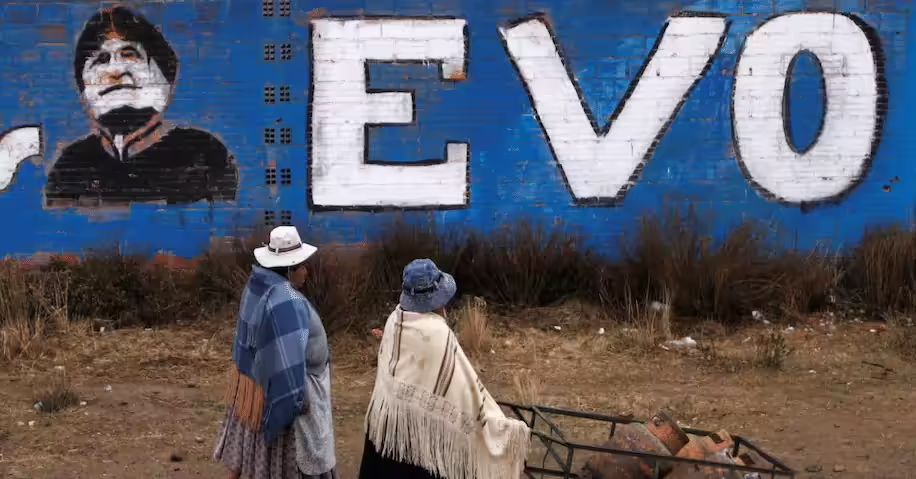
When the Wall Street Journal (10/19/20) reported on the MAS victory, for example, it kept to the usual line (FAIR.org, 11/11/19, 11/18/20) about the previously elected president from MAS, Evo Morales, having been “driven from power” in November 2019 after “an election that observers said was marred by irregularities”—avoiding referring directly to Morales’ military overthrow as a “coup.” Instead, the Journal wrote that “Bolivians rose up against Mr. Morales” after he “had grown increasingly authoritarian” and already “ruled” for 14 years.
First off, to say that Morales “ruled” in his country is about as accurate as saying that Barack Obama “ruled” the United States from 2009–17. Until Morales’ ouster, Bolivia was (and hopefully will again be) a functioning democracy. Trying to paint democratically elected leaders as dictatorial autocrats is a time-honored US tradition going back at least as far as Jacobo Árbenz in Guatemala, removed in a CIA-backed invasion in 1954.
RELATED CONTENT: Media Coverage Of Bolivia’s Elections: Who Got It Right, Who Didn’t
The “irregularities” mentioned are a reference to an analysis by the Organization of American States (OAS), an institution that gets 60% of its budget from the United States. Its analysis, released immediately after the election, expressed “deep concern” about a “hard-to-explain change in the trend of the preliminary results.” Their analysis was immediately challenged by the Center for Economic and Policy Research (CEPR), a progressive DC-based think tank, which noted that the OAS provided “absolutely no evidence—no statistics, numbers or facts of any kind”—to support its conclusions. (See CounterSpin, 7/31/20.) The study was later fully debunked, as reported by both the Washington Post (2/27/20), which wrote that “the OAS’s statistical analysis and conclusions would appear deeply flawed,” and the New York Times(6/7/20), which came to similar conclusions (FAIR.org, 3/5/20, 7/8/20). The Wall Street Journal neglected to mention any of this in its reporting.
To say that “Bolivians rose up” against Morales is true only in the narrow technical sense that the coup leaders that forced the president’s removal were from Bolivia. In fact, the situation was far more complicated. After a month-long delay in the vote count, the OAS statement and right-wing protests against the president, military leaders forced Morales to step down from office and flee the country. Morales eventually took refuge in Argentina, barred from returning to Bolivia due to terrorism charges that Human Rights Watch describes as “politically motivated.”
Jeanine Áñez, a member of a far-right party that won just 4% during elections, declared herself the interim president, violently repressing those who protested the move (FAIR.org, 12/13/19). The US State Department supported Áñez’s ascension. At the time, the Wall Street Journal (11/11/19) described these incidents as “a democratic breakout.”
Áñez then began to sell off public resources and take out massive international loans on behalf of the nation. Over the next year, her government delayed elections three times(FAIR.org, 8/6/20) until an unprecedented general strike forced the government to agree to an election. Despite all of this, the Journal and other outlets described the coup regime benignly as a “caretaker government.”

The Associated Press (10/18/20) ran a story reprinted by the Washington Post (10/18/20) that had many of the same omissions as the Wall Street Journalpiece, describing the coup against Morales as a “resignation” followed by a “self-exile,” and ignoring US support.
The New York Times (10/19/20) published a piece that was more sympathetic to Morales and his party, but still contained several critical omissions. The Times cited MAS’s popular support as well as its success in reducing Bolivia’s poverty. Their piece cited Morales describing his ouster and the violence that followed as a
“coup,” and did not dispute it.
However, in describing his departure from the country, the Times neglected to mention that Morales was under threat of arrest. After reading that Morales merely “fled the country,” a reader may assume that it was more voluntary than it was. The Times also failed to mention the election’s repeated delays and the general strike that finally brought it into existence.

The Washington Post (10/18/20) did a better job capturing the situation, describing how the right wing “drove the left from power” last year. They wrote that Morales’ supporters called it a coup, but placed “coup” in quotation marks and linked to a Post piece (11/11/19) headlined “After Morales Resignation, a Question for Bolivia: Was This the Democratic Will or a Coup?” The Post’s post-election piece reported on the many delays as well as the US support for Áñez.
The next day, the Post (10/20/20) published a piece that said “Bolivia’s democracy…has delivered Morales’s movement back to power,” and noted positively that “Arce’s victory adds to the sense of momentum behind socialist or left-leaning politics elsewhere in the region.”
It may seem surprising that so much reporting on Bolivia still ignores facts that are critical to understanding the situation there, but US media have a long history of reporting on Latin America that does more to please the State Department than to inform readers.