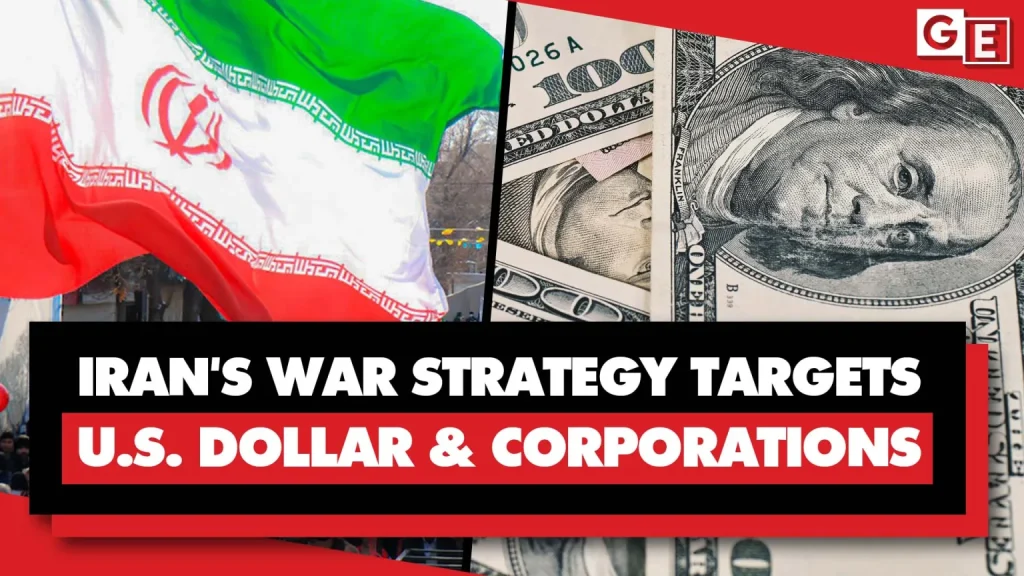
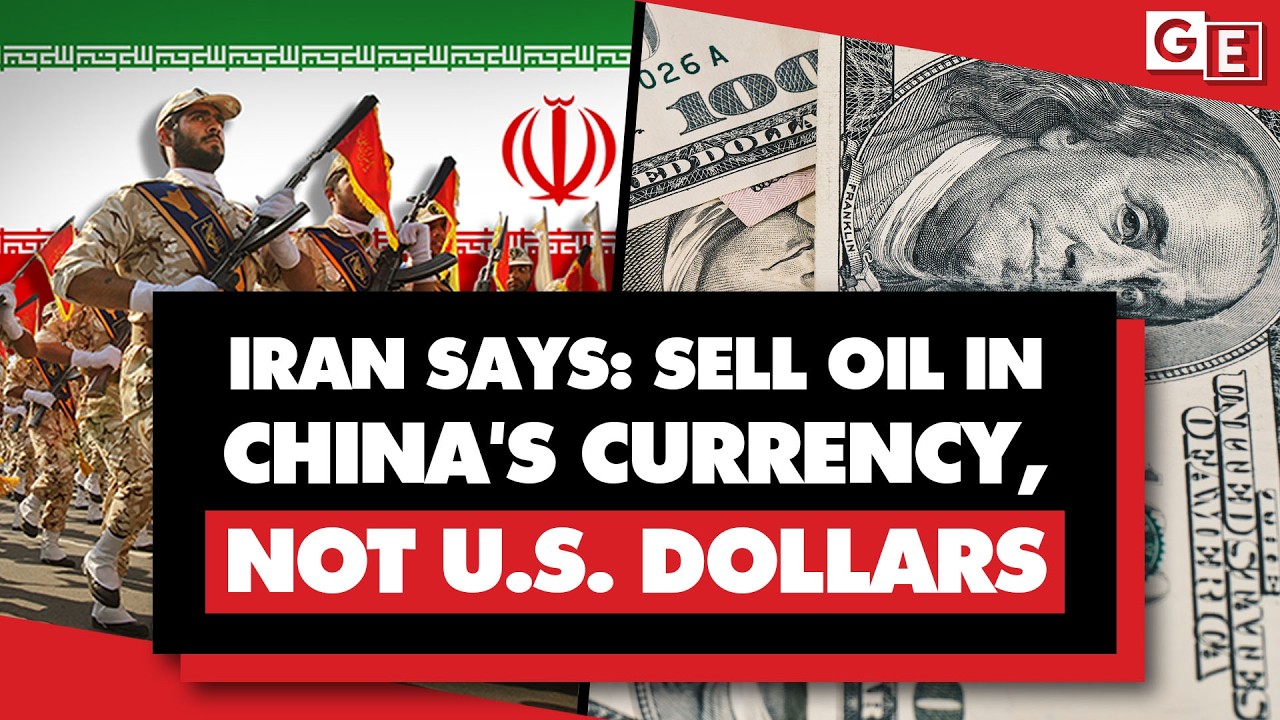
A visual composition featuring the flag of Iran on one side and US currency on the other side, and text saying that Iran's war strategy targets the US dollar and corporations. Photo: Geopolitical Economy Report.
A visual composition featuring the flag of Iran on one side and US currency on the other side, and text saying that Iran's war strategy targets the US dollar and corporations. Photo: Geopolitical Economy Report.
By Ben Norton – Mar 17, 2026
In response to Trump’s war of aggression, Iran is using asymmetric tactics, targeting US corporations and dollar dominance, challenging the petrodollar system, demanding oil sales in Chinese yuan.
Iran has responded to the war of aggression that the United States and Israel launched against it on February 28 by using unconventional tactics.
As the US and Israel systematically assassinate Iranian officials and bomb schools, hospitals, and residential areas, Tehran has defended its sovereignty by engaging in a campaign of asymmetric economic warfare, not only hitting US military bases in West Asia, but also targeting major US corporations, and even challenging dollar dominance.
After closing the Strait of Hormuz, the most important oil transit chokepoint on Earth, Iran has disrupted global energy markets and directly confronted the petrodollar system, demanding that ships that want to pass through the strait must sell their oil in China’s currency, the renminbi (also known as yuan), not dollars.
In this way, Iran has demonstrated that it is possible for a medium-sized country in the Global South to resist the US empire.
Iran’s asymmetric warfare
The United States has the most powerful military on Earth. It spends approximately $1 trillion on its armed forces every year, whereas Iran’s defense budget is less than $10 billion — that is, just 1% of that of the US.

Given the clear disparity in conventional military force, Iran recognized that it needed to engage in asymmetric warfare.
Iranian military strategists identified the weak points of the US empire, and they have cleverly targeted these vulnerabilities.
Immediately after the Donald Trump administration started this war of aggression, Iran retaliated, hitting the roughly two dozen US military bases hosted by the neighboring countries of West Asia.
Tehran also struck a major CIA station located inside the US embassy in Saudi Arabia, as well as crucial radar systems and several US Air Force refueling planes.
Iran is allowed to respond to the US-Israeli aggression, according to international law. Article 51 of the UN Charter guarantees the right of a state to self-defense.

Largest oil supply crisis in history
This was only the beginning of Iran’s strategy of asymmetric warfare, nevertheless.
In response to the US-Israeli war of aggression, Tehran closed the Strait of Hormuz, which the US government’s Energy Information Administration (EIA) has described as “the world’s most important oil transit chokepoint.”
Before this war, roughly 20% of the oil traded in the global market passed through this narrow strait on a daily basis.
Since the Trump administration launched this war of choice, traffic has ground to a halt.

A spokesperson for Iran’s Islamic Revolutionary Guard Corps (IRGC) said they will not allow “a liter of oil” to pass through the strait, until the US and Israel end their war of aggression.
“You will not be able to artificially lower the price of oil. Expect oil at $200 per barrel,” the spokesperson said, according to Al Jazeera.
“The price of oil depends on regional security, and you are the main source of insecurity in the region,” the IRGC added.
This US-Israeli war has created what the International Energy Agency (EIA) describes as “the largest supply disruption in the history of the global oil market.”
The price of oil has skyrocketed from just around $60 per barrel in January 2026 to well over $100.

Iran challenges petrodollar system, demanding oil payments in Chinese yuan
However, while Iran has shut down the Strait of Hormuz, it made an important exception.
Tehran has said that Chinese tankers are allowed to pass through the oil transit chokepoint, unimpeded.
This has led to some ships claiming to have commercial links to China, even if it is not always true.
Moreover, an Iranian government official told CNN that tankers can have permission to travel through the Strait of Hormuz if they agree to sell oil in China’s currency, the renminbi (or yuan), not US dollars.

This is what CNN reported on March 14 (emphasis added):
“Iran is considering allowing a limited number of oil tankers to pass through the Strait of Hormuz, provided that the oil cargo is traded in Chinese yuan, a senior Iranian official tells CNN.”
This is an extremely important geopolitical development. It is a direct challenge to the global dominance of the US dollar.
The dollar is the most powerful weapon that the US empire has — much more powerful than its military.
The fact that the dollar is the global reserve currency, and that the US is the only country with the ability to print it, gives it what is known as an “exorbitant privilege.”
The US can run gargantuan deficits with the rest of the world — chronic current account deficits of more than $1 trillion per year — sucking in the goods and services produced by foreign workers, and it does not face the currency depreciation and inflationary pressures that other countries would suffer from, because there is artificial demand for the dollar, given its reserve currency status.

This exorbitant privilege also helps the US keep borrowing costs relatively low, as the dollars it sends abroad to pay for imports are often recycled by foreign investors into US Treasury securities and corporate bonds, thereby reducing yields and interest rates for both the public and private sectors.
Foreign investors similarly use these excess dollars to help inflate enormous bubbles in the US stock market, further enriching wealthy shareholders. (Around 90% of the stocks held by US investors are owned by the richest 10% of the population.)
One of the pillars of dollar dominance is the petrodollar system. Since the US made a historic agreement with top oil producer Saudi Arabia in 1974, the vast majority of global crude has been sold in dollars.
In other words, soon after US President Richard Nixon de-linked the dollar from gold in 1971, the gold standard was replaced with a de facto oil standard.
Almost all countries on Earth have to import oil, and this means that they need access to dollars to do so. And because oil is the most important global commodity, most other commodity markets are also priced in dollars.
This ensures an artificial global demand that strengthens the dollar, granting the US its exorbitant privilege.
Dedollarization
The United States has taken advantage of its “exorbitant privilege” to weaponize the dollar system, through the use of illegal unilateral sanctions.
The US has imposed unilateral sanctions on one-third of all countries on Earth, including 60% of low-income nations.
This increasing weaponization of the global reserve currency has incentivized more and more countries to seek financial alternatives.
In response to Washington’s illegal sanctions, Tehran has pushed for dedollarization for years.
China purchases the vast majority of Iran’s oil exports, and the BBC reported back in 2012 that Beijing has been paying in yuan.
Iran was admitted into BRICS in 2024, and it has advocated for a new currency for international trade. (Although some other BRICS members, namely India and the UAE, lean pro-Western and have opposed such efforts.)
Western sanctions have also motivated Russia, which is consistently among the world’s top three oil producers, to push for dedollarization.
About 20% of the global oil trade was done in other currencies, as of 2023. This was a marked shift compared to recent years, but it meant that 80% was still conducted in dollars.
Iran is now forthrightly confronting this system, using its geopolitical leverage over the Strait of Hormuz and the global oil trade to challenge the petrodollar.
Fears of global economic crisis
The Western financial press has warned that this war that the US and Israel started in West Asia could unleash a “global economic crisis.”
This is because oil is the most important commodity on Earth. Every country relies heavily on petroleum, and practically everything in a modern economy depends on it. The trucks, ships, and planes that are used to transport food and other goods use a lot of oil.
Therefore, as the cost of crude goes up and up, the prices of other products will rise as well, fueling inflation.
The Persian Gulf region is likewise a significant producer of fertilizers and the chemicals used in fertilizers, meaning this US-Israeli war of aggression could cause a global food crisis as well.
All of this was totally avoidable and unnecessary. But Donald Trump has defended his decision to start this war of choice. The US president insisted on his website Truth Social that the oil price shock is “a very small price to pay.”

Rising gasoline prices and inflation just a few months before the November midterm election are really going to hurt Trump and the Republican Party.
This is why Trump is so worried, and so desperate to find a way to forcibly open the Strait of Hormuz.
Trump sent 2,500 more Marines and three more warships to West Asia, the New York Times reported on March 13. This was in addition to the more than 50,000 US troops already in the region.
Trump has also threatened multiple countries and demanded that they send their own warships to the Persian Gulf, to try to force open the strait. They have quietly declined, however, as they are afraid of getting further involved in the war.
Asymmetric economic warfare: Iran targets major US corporations in West Asia
US Treasury Secretary Scott Bessent boasted that the Trump administration’s “maximum pressure” campaign of economic warfare against Iran aimed to “collapse” the country’s economy by cutting off oil exports, denying it hard currency, and fueling inflation.
Bessent even took credit for the extremely violent protests and riots that destabilized Iran in the weeks leading up the US-Israeli war of aggression.
Tehran has sought revenge for all of this by engaging in its own kind of guerrilla economic warfare, thereby giving the US empire a taste of its own medicine.
After hitting US military bases in West Asia and closing down the Strait of Hormuz, the Iranian military announced that it will target the offices of major US corporations in the region.
Iran’s Islamic Revolutionary Guard Corps (IRGC) published a warning with the addresses of these corporate offices, Drop Site News reported.
“We warn the American regime to evacuate all American industries in the region,” the IRGC said.

Among the corporations on the list were Lockheed Martin and Boeing, which are top Pentagon contractors and key parts of the military-industrial complex.
Also named were Silicon Valley Big Tech monopolies, like Microsoft, Oracle, and Amazon.
Furthermore, the IRGC mentioned US oil corporations like ExxonMobil, and financial firms such as Citigroup, KKR, and Bain & Company.
New Supreme Leader Mojtaba Khamenei spells out Iran’s strategy to expel the US empire
The Iranian government has been quite clear about its goal: it wants to push the US empire out of West Asia.
This was spelled out by the new supreme leader of Iran, Mojtaba Khamenei.
Mojtaba Khamenei is the son of the previous supreme leader, Ali Khamenei, who was killed by the US and Israel on the first day that they launched this war of aggression, February 28.
In a speech on March 13, Mojtaba Khamenei said, “I advise the leaders of regional countries to shut down those [US] bases as soon as possible, for they must surely have realized by now that the US’s claims of ensuring security and peace have been nothing but lies.”
“Shutting down US bases in the region will enable those governments to strengthen their ties with their own people, who are generally dissatisfied with the humiliating behavior associated with those bases,” he added.
It is not just US military bases that Iran is targeting, but also what Khamenei called “financial bases.”
He noted that, “for years, the enemy has been establishing military & financial bases in some of these countries to secure its dominance over the region.”
This was apparently a reference to the offices of major US corporations, which were told to evacuate by the IRGC.
“In any case, we will obtain compensation from the enemy,” Khamenei said. “If they refuse, we will take it from their assets to the extent we deem appropriate. If that wasn’t possible, we will destroy an equivalent amount of their assets.”

The supreme leader likewise vowed that his country will take “revenge” for the more than 175 children and teachers who were killed in a US military double-tap strike on a girls’ elementary school in the city of Minab in southern Iran on February 28.
Khamenei similarly promised to get revenge for his family members that died at the hands of Washington and Tel Aviv.
In his March 13 speech, Mojtaba Khamenei noted that, in addition to his father, the US and Israel killed his wife, his sister and her child, and the husband of another sister.
In order to seek revenge, Tehran will use all of the tools at its disposal, Khamenei insisted.
“The leverage of closing the Strait of Hormuz must definitely continue to be employed,” he declared.
“Studies have been conducted regarding opening other fronts where the enemy has minimal experience and where it would be highly vulnerable,” he added. “Should the war continue, activation of such fronts will be carried out based on certain interests.”
Khamenei did not identify what those “other fronts” are specifically, because Iran does not want to lose the element of surprise.
https://OrinocoTribune.com/irgc-destroys-55-enemy-targets-in-70th-wave-of-operation-true-promise-4/
Nevertheless, it is quite clear that one potential front would be Yemen.
The northern part of Yemen, where the majority of the population lives, is governed by Ansarallah, also known as the Houthi movement.
Ansarallah is an indigenous Yemeni resistance group that is allied with Iran and strongly supports the Palestinian people in their struggle against Israeli settler-colonialism and genocide.
Drop Site News reported that Ansarallah is prepared to join a “coordinated campaign of military operations” with Iran, if Tehran deems it necessary.

The Ansarallah-led government in northern Yemen would likely seek to halt oil traffic in the Red Sea.
Given the closure of the Strait of Hormuz, Saudi Arabia has rerouted some of its oil exports via pipeline to its western Yanbu port on the Red Sea.
Yemen has the ability to shut down another important chokepoint, the Bab al-Mandab Strait, where close to 10% of global seaborne-traded oil transits every day.

This is not just hypothetical. Starting in late 2023, Ansarallah used its leverage to threaten to attack ships in the Red Sea, declaring that it would only stop when the US and Israel ended their genocide in Gaza.
In 2025, the Trump administration launched another war against Yemen, in an attempt to forcibly open the Red Sea.
In May 2025, the US was forced to sign a ceasefire with the Ansarallah-led government in nothern Yemen.
Yemen is the poorest country in West Asia. However, it was able to use unconventional tactics to fight the US empire, which boasts the most powerful military force on Earth and a $1 trillion annual budget.
What all of this demonstrates is that Iran and Yemen have mastered the art of asymmetric warfare, borrowing the tactics of Global South anti-colonial movements in the 20th century, to successfully resist the aggressive US empire.

Benjamin Norton is the founder and editor of the independent news website Multipolarista, where he does original reporting in both English and Spanish. Benjamin has reported from numerous countries, including Venezuela, Nicaragua, Bolivia, Ecuador, Honduras, Colombia, and more. His journalistic work has been published in dozens of media outlets, and he has done interviews on Sky News, Al Jazeera, Democracy Now, El Financiero Bloomberg, Al Mayadeen teleSUR, RT, TRT World, CGTN, Press TV, HispanTV, Sin Censura, and various TV channels in Mexico, Nicaragua, Venezuela, Ecuador, and Bolivia. Benjamin writes a regular column for Al Mayadeen (in English and Spanish). He was formerly a reporter with the investigative journalism website The Grayzone, and previously produced the political podcast and video show Moderate Rebels. His personal website is BenNorton.com, and he tweets at @BenjaminNorton.