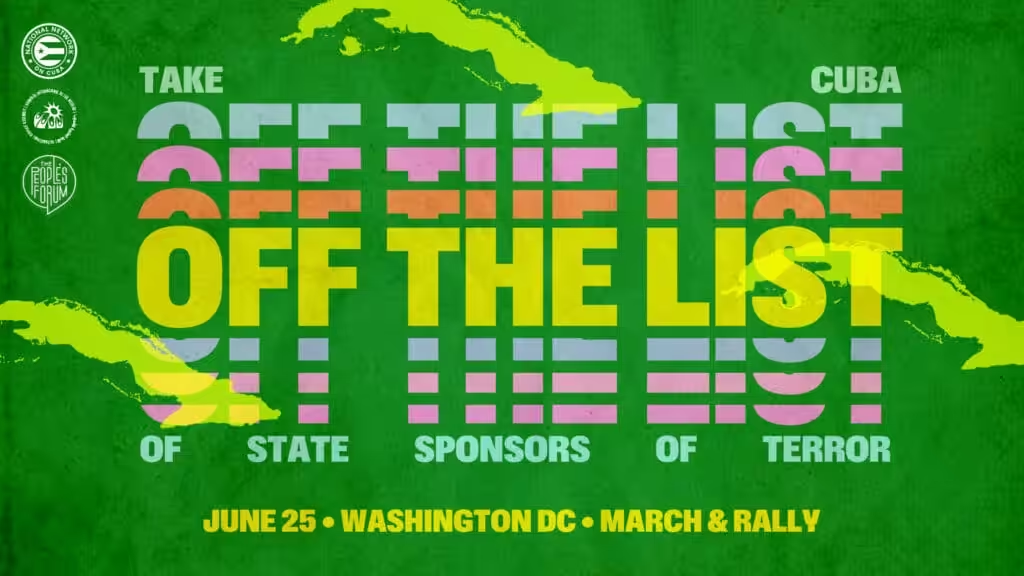
A The People's Forum banner showing a map of cuba and the date for a rally in Washington DC, with the cation "Take Cuba off the list of State Sponsors of Terror." Photo: The People's Forum/File photo.
A The People's Forum banner showing a map of cuba and the date for a rally in Washington DC, with the cation "Take Cuba off the list of State Sponsors of Terror." Photo: The People's Forum/File photo.
By Calla Mairead Walsh – Jun 28, 2023
On Tuesday, May 23rd, the State Department reported that Cuba — along with Iran, Syria, the Democratic People’s Republic of Korea, and Venezuela — are not “not cooperating fully” in the United States’ supposed fight against terrorism. The Biden administration officially designates Cuba as a “State Sponsor of Terrorism” (SSOT), as well as Iran, Syria, and the DPRK.
Literally 0% of Americans view Cuba as a serious threat, and the Biden administration has provided no evidence of Cuba supporting terrorism in any way. Cuban and American officials even met earlier this month in Havana to discuss cooperating on anti-terrorism measures. So why is Biden keeping Cuba on the “State Sponsors of Terrorism” list?
Sixty-four years after the triumph of the Cuban Revolution, the United States is still waging an economic and media war against Cuba. The administrations of Trump and now Biden have weaponized the “State Sponsors of Terrorism” list to isolate Cuba internationally and justify continuing the genocidal American blockade.
The impact of being labeled a “State Sponsor of Terror”
It goes without saying that the United States is the biggest “State Sponsor of Terrorism” in the world. The US is the only country with over 800 foreign military bases and spends more on its military than 144 countries combined. The US has launched 251 foreign military interventions since 1991. A report recently published by Brown University shows that the post-9/11 wars the US waged in Iraq, Afghanistan, Syria, Yemen, and Pakistan killed at least 4.5 million and displaced 38 to 60 million people. But the word “terrorist” is almost never applied to the US government. The term is highly politicized and subjective in the United States, used to demonize internal and external enemies and justify waging war on them, be it by bombs or blockades.
Designating Cuba as “terrorist” exacerbates the already devastating impacts of the American blockade, which has stolen an estimated $144.4 billion from the Cuban economy from the early 1960s to 2020, according to the United Nations. The United Nations Economic Commission for Latin America and the Caribbean (ECLAC) determined that US sanctions on Cuba “constitute the most severe and prolonged system of unilateral coercive measures ever applied against any country.”
On top of the blockade, Cuba’s “terrorist” designation restricts American foreign assistance, exports of dual-use items, and loans from the World Bank. It has also prevented Cuban Americans from transferring money to family in Cuba, stopped faith-based groups from shipping humanitarian supplies, and inhibited American universities from working with Cuban academics and institutions. Non-US citizens who have traveled to Cuba, a supposedly “terrorist” country, also have restrictions on visas to enter or visit the United States.
Despite being a list created and maintained only by the United States, because of its enormous power over the global financial system, the designation inhibits the ability of Cuba — and the other countries listed — to trade normally with the rest of the world. Banks don’t want to risk giving loans to a country labeled as “terrorist” by the hegemonic United States. The United States has sued foreign companies and banks for hundreds of millions of dollars for violating American sanctions on Cuba, and many major international banks no longer provide services to Cuba for fear of retaliation. The blockade as a whole is extraterritorial and thus violates international law.
The history of Cuba’s “terrorist” designation and US terrorism against Cuba
President Ronald Reagan first added Cuba to the terror list in 1982, citing Cuba’s support for national liberation movements across the world, such as giving military aid to Angola to defeat a US-backed invasion by the South African apartheid regime. Meanwhile, the United States was backing violent terrorism to sabotage the Cuban Revolution.
As Cuba expert Professor William LeoGrande said, Cuba’s “terrorist” designation “is ironic because in the 1960s, the CIA sponsored assassinations attempts, sabotage, and paramilitary raids against Cuba—what today would be called state-sponsored terrorism — and CIA-trained Cuban exiles continued such attacks for the next several decades.”
Luis Posada Carriles, the mastermind behind many of these US-backed terrorist attacks — including the bombing of Cubana Flight 455 in 1976 and a series of hotel bombings in 1997 — died peacefully in Florida in 2018, protected by the US government and lionized by the right-wing Cuban-American community in Miami. But Cuba, according to the State Department, was the real terrorist.
During President Barack Obama’s second term, he pursued a policy of “rapprochement” with Cuba, restoring diplomatic relations and lifting some travel and trade restrictions. The Obama administration removed Cuba from the terror list, saying, “we will continue to have differences with the Cuban government, but our concerns over a wide range of Cuba’s policies and actions fall outside the criteria that is relevant to whether to rescind Cuba’s designation as a State Sponsor of Terrorism.”
Obama’s “friendly” policy was still aimed at regime change through a new set of tactics, and he continued funding covert operations and “democracy promotion” programs aimed at undermining the Cuban Revolution. Nevertheless, rapprochement had positive effects for the Cuban and American people, especially renewed travel and people-to-people exchanges between the two countries. All of this was undone by Donald Trump.
Trump tightened the blockade and added an additional 243 sanctions on Cuba. Then, just four days after the January 6th insurrection, Trump and his neoconservative Secretary of State Mike Pompeo redesignated Cuba as a “State Sponsor of Terrorism.” They made this last-minute move in bitter spite of Cuba, but also to create a political obstacle for President Biden, who would be pressured from different sides to keep or remove Cuba’s “terrorist” designation.
Biden and Trump’s hawkish Cuba policy
Many Cubans and Americans alike hoped Biden would re-normalize US-Cuba relations as he promised during his campaign, when he said he would “promptly reverse the failed Trump policies that have inflicted harm on the Cuban people and done nothing to advance democracy and human rights.” But Biden has changed little. He slightly eased some Trump-era restrictions in May 2022 but has also renewed his predecessor’s harshest measures. As a result, Cuba — also impacted by the pandemic and the war in Ukraine — is experiencing its worst economic crisis and fuel shortages in decades.
The economic crisis in Cuba is fueling a political crisis for Biden at the border, as more Cubans than ever are leaving for the United States to escape the crushing impacts of sanctions. A group of Democratic lawmakers is urging Biden to lift Trump-era sanctions on Cuba and Venezuela to slow the surge of migration, but Biden has not moved a finger. Instead, he follows the line of conservative Cuban-American lawmakers on Cuba policy, especially Chairman of the Senate Foreign Relations Committee, Democratic Senator Bob Menendez of New Jersey, who Biden needs to push his appointments through the confirmation process.
Menendez, who is currently under investigation for corruption, lambasted his fellow Democrats’ push against Trump-era sanctions and claimed that the Cuban and Venezuelan governments — not US policy — were solely responsible for the economic crises in those countries. The Washington Post reported that “Privately, senior Biden officials have conceded that picking a fight with [Menendez] is not worth whatever benefit might come from relaxing sanctions on [Cuba and Venezuela], even if it would fulfill a campaign promise Biden made to restore President Barack Obama’s policies toward Cuba.”
Despite Biden claiming to care about “human rights” and “supporting the Cuban people,” he is not changing his internationally condemned policy — which violates Cuba’s sovereignty and human rights — because doing so is not politically expedient.
Activists who support normalizing US-Cuba relations have concentrated on pressuring Biden to remove Cuba from the terror list because, as Noam Chomsky and Vijay Prashad wrote in Peoples Dispatch, “Biden can remove Cuba from this list with a stroke of his pen. It’s as simple as that” — unlike the blockade, which is a complex amalgamation of hundreds of different laws in the hands of Congress.
Cuban President Describes Today´s Financial Order Unfair, Exclusive
In the State Department’s most recent public remarks on Cuba, they have doubled down on Trump’s policy of keeping Cuba on the list. Earlier this year, far-right Florida Republicans Maria Salazar and Marco Rubio introduced the FORCE Act in the House and Senate, respectively, to codify into law Cuba’s “terrorist” designation so that it could only be removed by Congress, not the President alone.
And not only that. Cuba would have to meet impossible criteria, completely changing their political and economic system to be what the United States defines as “free,” in order for the designation to be lifted. As People’s Dispatch wrote, “Essentially, Salazar is demanding that the Cuban people overthrow their own government and overturn the Cuban political system which has been built by the people and for the people over the last 60 years.”
It could not be more clear that the terror list has nothing to do with preventing actual terrorism; rather, it is about harming enemy states of the US. In March, when Salazar interrogated Secretary of State Antony Blinken about Cuba’s “terrorist” designation, he said that Cuba would have to “meet a very high bar” to be removed from the list and the State Department had no plans to do so.
Earlier this month, Cuban journalist Liz Oliva Fernandez stumped State Department Spokesperson Vedant Patel when she asked him “Why is Cuba on the State Sponsors of Terrorism list if you are trying to work with them to fight against terrorism?” He completely dodged the question, refusing to provide any examples of Cuban terrorism.
Even anti-Cuba mainstream US media has reported that the “terrorist” designation is “bogus.” NBC News wrote, “according to half a dozen interviews with former intelligence analysts and officials who worked on Cuba policy in both Republican and Democratic administrations, the ‘consensus position’ in the US intelligence community has for decades been that the communist-led nation does not sponsor terrorism.”
Larry Wilkerson, chief of staff to then-Secretary of State Colin Powell in the George W. Bush administration said that “‘Cuba is not a state sponsor of terrorism’ was a mantra from the moment I walked into the State Department to the moment I walked out. It’s a fiction that we have created… to reinforce the rationale for the blockade.”
Similarly, Congressman Jim McGovern (Democrat-Massachusetts) and Senator Patrick Leahy (Democrat-Vermont) published an op-ed in The Boston Globe explaining that “[i]t’s an open secret in Washington that Cuba does not belong on the list and that the previous false justification by the Trump administration was politically motivated.”
The #offthelist campaign
The US government does not represent the American people on most issues — especially Cuba. The blockade of Cuba persists against the democratic will of the American people, a majority of whom have consistently opposed the blockade, especially restrictions on trading medicine and food with Cuba.
In the United States, Cuban-Americans, solidarity activists, labor unions, and local governments, have organized resistance to Biden’s designation of Cuba as a “State Sponsor of Terrorism.” Since January 2023, the National Network on Cuba (NNOC), a coalition of over 50 organizations across the US working to end the blockade, has been leading an international campaign to get Cuba #OffTheList.
On June 25th, this movement rallied at the White House — and in other locations around the world — demanding Biden take Cuba off the list, lift all US sanctions, and end US terrorism against Cuba. The NNOC organized these rallies alongside the Canadian Network on Cuba, ANSWER Coalition, CodePink, IFCO/Pastors for Peace, the Alliance for Cuba Engagement and Respect (ACERE), the International People’s Assembly, and over 70 other groups.
The voices of the American people and our progressive movements are clear: we want normalized relations with Cuba. Just in the past couple of years…
• Labor unions and city councils have passed over 80 resolutions supporting an end to the blockade, promoting scientific collaboration with Cuba, and urging that Cuba be removed from the terror list. And, just last week, the Washington, DC Council unanimously voted to pass a Cuba solidarity resolution and sent copies to Biden and key congresspeople urging them to end the blockade. Combined, these resolutions represent well over 50 million Americans.
• The 33 member states of the Community of Latin American and Caribbean States (CELAC) demanded that the United States remove Cuba from the terror list and “reiterated their rejection of the US unilateral lists and certifications that affect Latin American countries.”
• Across the world, there have been monthly rallies and car caravans initiated by Cuban-Americans calling to end the blockade, take Cuba off the list, and build Puentes de Amor (bridges of love) between the American and Cuban people.
• Over 100 Democratic House members urged Biden to remove Cuba from the SSOT list and normalize US-Cuba relations. Their open letter was signed by big names like Appropriations Subcommittee on Foreign Operations Chair Barbara Lee of California, Rules Committee Chair James McGovern of Massachusetts, and Foreign Affairs Committee Chair Gregory Meeks of New York.
• Nearly 9,000 Cuban and American business owners sent a letter to Biden demanding he lift Trump-era sanctions and deliver on promises to help Cuba’s private sector, with the main demand being to take Cuba off the terror list.
• Over 10,000 people and 100 progressive advocacy groups signed an open letter organized by CodePink urging Biden to reverse Trump’s terrorism designation for Cuba and to reinstate Obama-era policy with the island.
• Hundreds of US lawyers wrote to Biden urging him to take Cuba off the list.
• We are rallied at the White House — and around the world — to tell Biden that Cuba is not a terrorist state, and the American people won’t stand for US terrorism against Cuba.
Calla Walsh serves on the MAPA Board of Directors. She is an anti-imperialist organizer and writer. She is co-chair of the National Network on Cuba, a coalition of 50+ organizations across the United States working to end the US war on Cuba.
(Mass Peace Action Massachusetts)
BLA