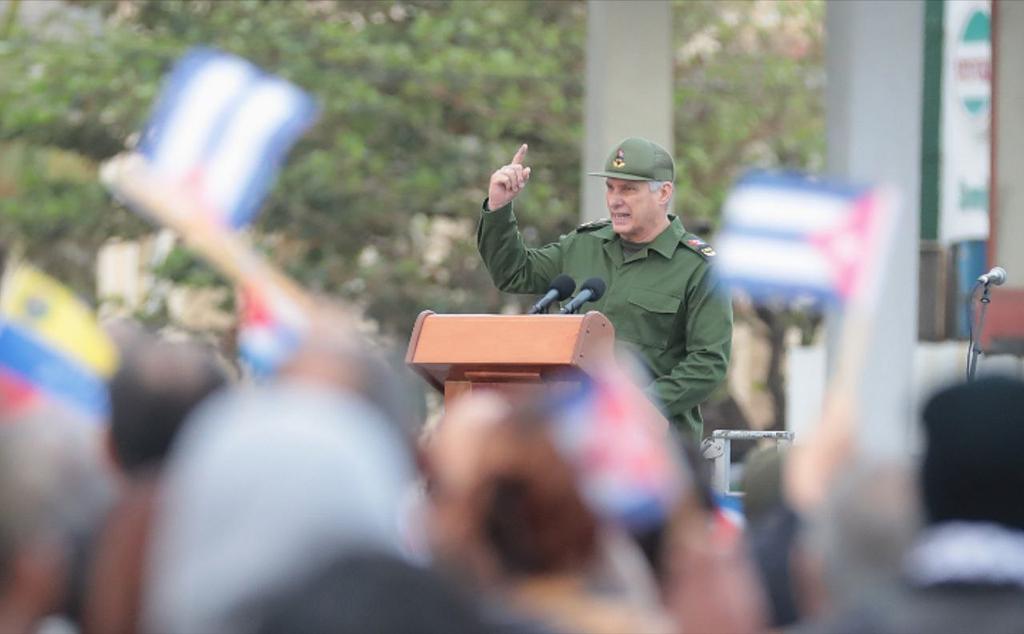
Cuban President Miguel Díaz-Canel speaks at the tribute ceremony for the 32 Cuban combatants killed in the January 3 US military attack on Venezuela, held at the Anti-Imperialist Tribune in Havana on January 16, 2025. Photo: Presidency of Cuba.
Cuban President Miguel Díaz-Canel speaks at the tribute ceremony for the 32 Cuban combatants killed in the January 3 US military attack on Venezuela, held at the Anti-Imperialist Tribune in Havana on January 16, 2025. Photo: Presidency of Cuba.
Cuban President Miguel Díaz-Canel stated that Cuba remains willing to engage in dialogue with the United States, provided it takes place on the basis of sovereign equality and mutual respect. He made these statements during the tribute ceremony for the 32 Cuban combatants killed in the January 3 US military attack on Venezuela, held at the Anti-Imperialist Tribune in Havana on Friday, January 16.
In his remarks, the Cuban president underscored that there is no possibility of reaching an understanding under conditions of pressure, threats, or political impositions. This has been Cuba’s position for over six decades of bilateral relations with the US, marked by diplomatic tensions due to imperialist hostility and the blockade.
President Díaz-Canel emphasized that Cuba will not accept negotiations based on blackmail or preconditions, reaffirming the country’s willingness to move toward a more stable bilateral relationship with the United States, provided that the principles of national sovereignty and non-interference in internal affairs are respected.
“Dialogue is possible, but it must take place between sovereign states on an equal footing,” he said.
🇨🇺| Presidente @DiazCanelB
“Nuestros bravos combatientes, con armas convencionales y sin más chalecos que su moral y su lealtad al compromiso con la misión que cumplían, pelearon hasta morir y golpearon a sus adversarios”.#HonorYGloria pic.twitter.com/DZv8uCehf2
— Presidencia Cuba 🇨🇺 (@PresidenciaCuba) January 16, 2026
Díaz-Canel: “Imperialism made us anti-imperialists”
Miguel Díaz-Canel stated that the anti-imperialist character of the Cuban people is not based on theoretical slogans or artificial ideological constructs, but on a historical experience marked by aggression, interventionism, and external pressure policies.
At the Anti-Imperialist Tribune in Havana, the president stressed that Cuba’s anti-imperialist stance is the direct result of decades of confrontation with hostile policies promoted by Washington, and is part of the historical memory of national resistance.
He highlighted that the Cuban people have built their political awareness through concrete experiences that include the economic blockade, covert operations, military aggressions, and attempts at international isolation.
“Imperialism made us anti-imperialists,” he said, underscoring that the defense of national sovereignty has been a constant for Cuba from the 19th-century wars of independence to the present day.
He added that each historical stage has reinforced the Cuban people’s sense of collective resistance and the need for unity in the face of external pressures.
The president also emphasized that defending Venezuela is part of defending Latin American dignity and sovereignty.
Cuba Honors 32 Martyrs in the US Military Attack on Venezuela
He reiterated that the 32 martyrs “defended not only Venezuelan sovereignty but also regional peace and Cuba’s honor,” calling their sacrifice an expression of Cuban internationalism.
The president noted that Cuba has actively promoted the declaration of Latin America and the Caribbean as a Zone of Peace, approved at the CELAC Summit held in Havana in 2014, highlighting the country’s historical commitment to diplomatic solutions to international conflicts.
However, he clarified that this peaceful vocation does not imply renouncing the legitimate right to self-defense. “Peace does not mean weakness,” he said, reaffirming that Cuba will respond firmly to any external aggression.
During the event, Díaz-Canel also referred to the current international context, marked by geopolitical tensions and armed conflicts, stating that national unity constitutes the country’s main shield against external pressures.
He concluded his remarks by reiterating that Cuba remains open to diplomatic dialogue with the United States. However, he warned that Cuba will not accept any condition that would entail renouncing its political project, its sovereignty, or its independence.
(Telesur)
Translation: Orinoco Tribune
OT/SC/SF