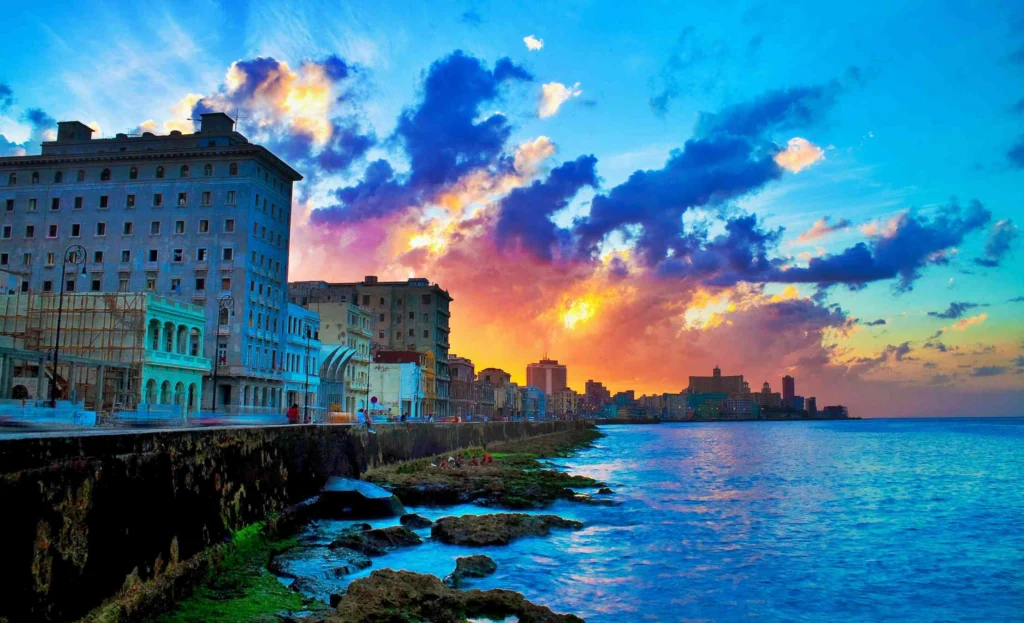
The famous Malecón seawall and coastal skyline at sunset in Havana, Cuba. Photo: teleSUR/File photo.
The famous Malecón seawall and coastal skyline at sunset in Havana, Cuba. Photo: teleSUR/File photo.
The Cuban government is implementing a package of economic transformations that allows for the expansion of the private sector, amid a crisis exacerbated by the United States blockade.
Cuba’s Council of State published Decree-Law 128 this Thursday, which authorizes foreign companies to hire employees directly, eliminating the need for state agencies that previously acted as intermediaries in local hiring. Furthermore, it allows these companies to open bank accounts abroad without prior authorization from the Central Bank of Cuba, requiring only notification within seven days and an audit of transactions.
The measures, published in the Official Gazette, are part of the 176 economic and social reforms approved by the government in June. During the press conference, Deputy Prime Minister and Minister of Foreign Trade, Óscar Pérez-Oliva, indicated that these reforms could have a short-term impact on the economy, although their true effect is difficult to calculate due to the undeniable external pressure.
Under the new legal framework, both joint ventures and companies with 100% foreign capital will be able to pay bonuses or gratuities to their employees in foreign currency. Furthermore, import and export permits are being simplified through a digital process.
Pérez-Oliva emphasized that the reforms are on the right track, citing partnerships between private businesses and foreign capital, as well as direct foreign trade, as key drivers. However, he clarified that they do not depend solely on domestic regulations, as pressure on international carriers increases costs, referring to the U.S. blockade.
El Secretario de Estado es un mitómano patológico. Argumenta que entidades "sostienen y financian el aparato represivo del régimen" cuando varias de ellas solo prestan servicios al sector privado. El bloqueo no distingue, es genocida, es un castigo colectivo. #CubaVencerá pic.twitter.com/aOZTnKRq8A
— Oscar Pérez-Oliva Fraga (@polivaoscar) August 21, 2026
The text reads, “The Secretary of State is a pathological mythomaniac. He argues that entities “sustain and finance the repressive apparatus of the regime” when several of them only provide services to the private sector. The blockade does not distinguish, it is genocidal, it is collective punishmen”
In the area of property ownership, Decree-Law 130, which relaxes and updates land rights, came into effect this Thursday. Previously, Decree-Law 133 allowed the formation of private companies with more than 100 employees and the participation of Cubans abroad in the business ecosystem. This is in addition to the recent authorization to establish retail chains announced last week.
The reform package also boosts the tourism sector, allowing the creation of private travel agencies, from micro-enterprises to large corporations. For ecotourism, investments will be enabled in priority conservation areas and heritage sites such as Viñales, Trinidad, and the Zapata Swamp.
Cuba Announces New Relaxations for the Transfer, Import, and Sale of Vehicles
A reduced tax rate of 25% will be established for profits, along with the elimination of customs duties on imported equipment and tax exemptions if profits are reinvested. Juan José Álvarez, legal director of the Ministry of Tourism, noted that a number of factors within the tourism sector have now converged to substantially expand this possibility.
These transformations aim to liberalize and decentralize the Cuban economy in the context of a severe economic situation that has persisted for six years, exacerbated since January by the U.S. oil blockade and additional sanctions aimed at achieving political and economic changes on the island.
(teleSUR)