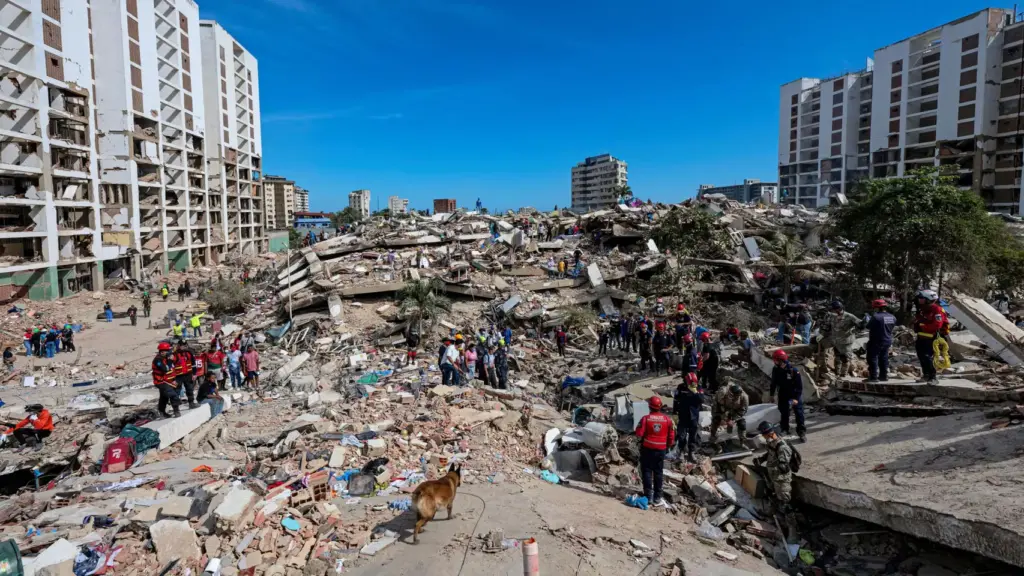
Rescue team over a collapsed building in La Guaira state, Venezuela. Photo: RTVE.
Rescue team over a collapsed building in La Guaira state, Venezuela. Photo: RTVE.
By William Serafino – Jul 1, 2026
The devastating earthquakes in Venezuela have introduced a new factor of complexity into a Washington-Caracas relationship that was already a labyrinth since January 3, 2026, a fateful date for Venezuela from every point of view.
Before the earthquakes, the bilateral pact erected on pillars of consensual stability and mining-energy plunder had consolidated a new status quo, not without dilemmas for both parties, but both Miraflores and White House appeared to be largely absorbing the political and reputational costs of the unprecedented shift.
Washington was internally instrumentalizing the political-military success of January 3 (mainly for internal electoral purposes) and, from there, managing internal criticisms from Republican sectors for whom this objective ultimately contributed to strengthening Delcy Rodríguez’s administration. On the other hand, the Venezuelan government proposed a new “political moment” characterized by pragmatism, with changes in legislations, the structure of the State, and government administration to find new sources of re-legitimation, betting everything on the promise of an upward economic turn associated with the asymmetric normalization of relations with the US.
But on the day when it was least expected, the earth shook violently, also cracking the equation of the pact. With the earthquakes, new factors entered the public agenda: urgency for reconstruction, a dangerous mix of social dissatisfaction, increased pressures on the country’s economic/fiscal dynamics in a context of severe income restrictions, and dramatically revealed vulnerabilities.
From now on, in my opinion, a new dynamic begins. Starting from the premise that there is a mutual dependency (first tactical, then strategic) between Washington and Caracas, the relationship will have to manage paradoxes and obstacles that are difficult to assimilate.
For Washington, it will not be so easy to continue on the path embarked upon since January 3. The approach of issuing licenses to ease sanctions, while simultaneously protecting the punitive architecture that underpins them, has suffered structural damage. Reconstruction places the urgency of releasing funds and lifting restrictions at the center of the national political discussion, which contradicts Trump’s calculation of illegally managing the oil industry and confiscating its revenues, vital for a country exhausted, impoverished, and stunned by earthquakes.
Trump faces a scenario where he must decide between terrible options: dismantling the blockade to mitigate national criticism and losing political and economic influence, or resisting the modification of his objectives (energy plundering) and exposing himself to fierce opposition within Venezuela. The narrative that Venezuelans are dancing in the streets will not serve to address the new scenario; in fact, insisting on that path considerably affects the real estate Caligula.
For Caracas, the situation is precarious. It will not be able to continue walking the path designed after the US military aggression of January 3. Delcy Rodríguez’s government has a wide window of opportunity to strengthen its claim for the lifting of sanctions, but insisting too strongly and generating irritation in the Trump administration could undermine its own current position of power, which is largely dependent on Washington. Regarding reconstruction, the political challenge is even greater. If the plans present a significant deficit in effectiveness and efficiency, and foster a climate of widespread dissatisfaction, it will become evident that the asymmetric normalization of relations with the US has little material and social reach, generating uncomfortable scrutiny over whether alignment with Washington is truly functional to the needs of the Venezuelan society. The notion of exchanging sovereignty for stability and economic opportunities as constitutive elements of the pact is also gravely wounded.
In my view, the situation is profoundly delicate and both parties are recalculating their moves. The US government could risk adventurous calculations to expand the current perimeter of dominance over Venezuela, using the façade of humanitarian aid to expand military presence and strengthen control mechanisms. We are talking about a US administration focused on hard power and the use of power policies, so this projection is not far-fetched. The US has obtained a firm control over Venezuelan oil and will seek to preserve it, using force if necessary. January 3 represents the immediate and clearest precedent of Washington’s imperialist actions, and it cannot be forgotten.
The limits of the Washington-Caracas pact are being tested every hour, with Miraflores perhaps calculating how far it can push the Trump administration without losing its support to achieve even greater relief from sanctions, and White House, very likely, mapping post-disaster weaknesses to assess a broader neocolonization effort. For a vulnerable Venezuela, going through a critical juncture from a historical and geopolitical perspective, the fundamental issue lies in whether the political elites have the real capacity to generate deep consensus not only to undertake an efficient reconstruction but also to execute it with sovereignty and autonomy, even if it implies more sacrifice from those of us who are inside, standing and trying to see a future of our own among the rubble.
Translation: Orinoco Tribune
OT/SC/DZ

William Serafino in a Venezuelan political scientist, graduate of the Central University of Venezuela (UCV). Researcher, writer, and analyst specializing in geopolitics. Winner of Venezuela's Simón Bolívar National Journalism Prize, Research category (2019).