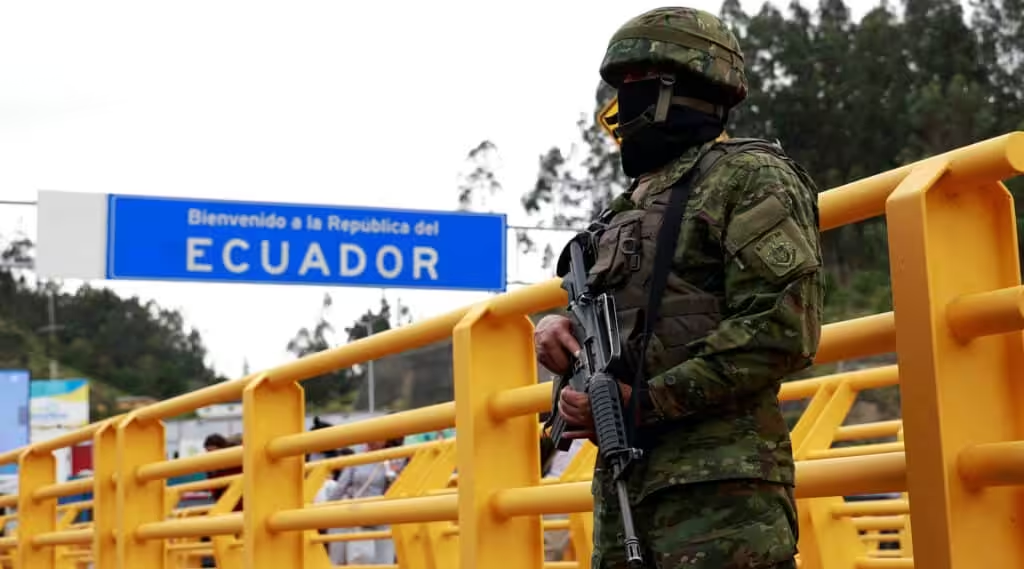
Ecuadorian heavily armed soldier patrolling a border checkpoint near a sign reading “welcome to the Republic of Ecuador.” Photo: Karen Toro/Reuters/file photo.
Ecuadorian heavily armed soldier patrolling a border checkpoint near a sign reading “welcome to the Republic of Ecuador.” Photo: Karen Toro/Reuters/file photo.
By Francisco Dominguez – Feb 23, 2025
Ecuador’s presidential election on February 9, 2025, resulted in a technical tie between the two leading candidates: Daniel Noboa, the wealthiest individual in Ecuador and the incumbent president, and Luisa González, the candidate of the Citizen Revolution movement, founded by former president Rafael Correa. With a voter turnout of 83%, Noboa secured 44.16% of the vote, while González garnered 43.98%. The only other candidate of significance was Leonidas Iza of the Pachakutik indigenous movement, who received 5.3%. The remaining 13 candidates combined for just 6.6% of the vote. Since no candidate achieved a decisive majority, a run-off election between Noboa and González is scheduled for April 13, 2025.
During the campaign, Daniel Noboa, desperate to secure a first-round victory, violated numerous electoral norms. His government reportedly spent over US$12 million on publicity firms to disseminate misleadingly positive information about his administration and negative propaganda against Luisa González, who, as in the 2023 election, faced death threats. Noboa’s campaign also relied on thousands of unidentified online trolls to amplify his messaging. In a particularly controversial move, he militarized the country’s ports and closed its borders on the eve of the election. Additionally, he bypassed constitutional protocol by refusing to appoint his official vice-president, Verónica Abad, as acting president while he campaigned. Instead, he illegally appointed unelected individuals to the role.
Ecuador’s mainstream media heavily promoted a pro-Noboa and anti-González narrative, predicting a landslide victory for Noboa in the first round. Three polling companies were authorized by the electoral authority to conduct exit polls. However, one firm, Estrategas, released a fraudulent poll claiming Noboa had 50.12% of the vote compared to González’s 42.21%. It was later revealed that this poll was conducted by an obscure individual named Diego Tello, whose background and affiliations remain unclear.
Noboa’s presidency has had devastating consequences for Ecuador. His policies have exacerbated labour insecurity, commercial liberalization, and financial deregulation, driving the country’s public debt to 67% of GDP, up from 38% in 2016. Financial deregulation in a dollarized economy has facilitated massive capital flight and speculative investments, while also enabling money laundering and illicit activities tied to the drug trade.
By December 2024, over 5 million Ecuadorians (out of a population of 13 million) were living below the poverty line, and 58% of the economically active population worked in the informal sector without registered employment. Noboa raised the VAT from 12% to 15% to fund his controversial law-and-order policies, further straining household incomes. Despite temporarily stabilizing electricity supply ahead of the election, his administration failed to address the root causes of the energy crisis, which had plunged the country into prolonged blackouts and rationing.
Ecuador’s economic growth in 2024 was a meagre 0.3%, reflecting the depth of the crisis. Meanwhile, Noboa, a member of Ecuador’s wealthiest family with an estimated fortune of US$1.3 billion, has remained insulated from the hardships faced by ordinary citizens.
The energy crisis, caused by drought, underinvestment in hydroelectric and thermoelectric infrastructure, and government neglect, led to widespread blackouts lasting up to 14 hours and severe rationing. This sparked mass discontent and further damaged the economy.
Perhaps the most alarming aspect of Ecuador’s crisis is the surge in violent crime. In 2024, the country recorded an average of one homicide every 75 minutes. Since 2020, 16 prison massacres have occurred, the latest in November 2024 claiming 15 lives. Homicides increased by 245% between 2020 and 2022, and by 75% in the first half of 2023 compared to the same period in 2022. The murder rate for children and adolescents rose by 640% between 2019 and 2023, reaching a historic high of 40 murders per 100,000 inhabitants in 2024, the most violent in the country’s history.
A particularly shocking incident was the murder of four children—Ismael, Josué, Saúl, and Steven—by a military patrol in a crime with clear racist undertones. Authorities initially attempted to cover up the incident, a stark contrast to Ecuador under Rafael Correa’s presidency when it was one of Latin America’s safest countries.
Noboa’s response to the escalating violence, which is closely linked to drug traffickers using Ecuador as a transit route, has been to replicate Colombia’s failed “war on drugs” model. He declared a state of emergency for three months, labelling drug cartels and their armed gangs as “non-state belligerent forces” and framing the situation as an “internal armed conflict.”
Since Lenin Moreno’s betrayal of the Citizen Revolution, Ecuador has transformed from one of Latin America’s safest countries into a major transit hub for Colombian cocaine trafficking to Europe. This shift has brought rampant corruption, criminal control over prisons, and legislation that facilitates money laundering. A recent study implicated Ecuador’s financial system in laundering US$3.5 billion in illegal assets, alongside an unrelenting wave of criminal violence.
The Correista vote was fractured in 2017 when Lenin Moreno, the Citizen Revolution’s presidential candidate, betrayed the movement. Guillermo Lasso, the right-wing candidate, won majorities in the Sierra and Amazonas provinces, areas that had previously supported Rafael Correa in 2013. This division deepened after Moreno embraced IMF-inspired neoliberal austerity measures during the pandemic, benefiting multinational corporations and powerful economic groups at the expense of the middle and working classes. Moreno’s government also unleashed brutal repression against mass protests, including an indigenous uprising in October 2019 that resulted in at least 8 deaths, 1,340 injuries, and nearly 1,200 arrests.
In 2013, Rafael Correa won 23 of Ecuador’s 24 provinces. By 2017, Moreno secured only 13 provinces, with Lasso winning the remaining 11, primarily in the Sierra and Amazon regions. This trend continued in the 2021 election, when CIA-supported candidate Yaku Pérez of Pachakutik won 13, mainly in the Sierra and Amazonas provinces in the first round, most of which went to Lasso in the second round. A similar pattern emerged in the 2023 election, with Luisa González winning 14 provinces, Noboa securing 6, and Christian Zurita (who replaced the assassinated Fernando Villavicencio) winning 4. Pérez’s support collapsed from nearly 20% in 2021 to less than 4% in 2023.
In the table below we can see the Citizen Revolution electoral strength under Rafael Correa presidency and the steady electoral improvement since their defeat in 2021:
| Citizen Revolution Electoral Performance (2006–2017 and 2021–2024 in percentages) | |||||||
| Year | 2006 | 2009 | 2013 | 2017 | 2021 | 2023 | 2024 |
| 1st Round | 22.84 | 51.99 | 57.17 | 39.16 | 32.72 | 33.61 | 44.00 |
| 2nd Round | 56.67 | —- | —- | 51.16 | 47.64 | 48.17 | —– |
Although the Citizen Revolution lost the presidency in 2021, its political defeat began with Lenin Moreno’s betrayal. Moreno, who served as Correa’s vice-president from 2006 to 2013, was elected president in 2017 with the support of Citizen Revolution voters. However, within a year, he launched a vicious campaign against Correa and his allies, using lawfare to ban Correa from running for office and persecuting Citizen Revolution leaders. Correa’s foreign minister, Ricardo Patiño, for ‘instigation and terrorism,” forcing him to seek asylum in Mexico in 2019. Many other national Citizen Revolution leaders such as Paola Pabón, Virgilio Hernández and Christian González, who, charged with “rebellion” for opposing Moreno’s repression and neoliberal policies, were forced into exile to avoid imprisonment, while Correa himself sought asylum in Belgium.
Moreno also dismantled key institutions, withdrawing Ecuador from UNASUR and ALBA, shutting down Telesur, recognizing Venezuelan opposition leader Juan Guaidó, and allowing the U.S. to establish a military presence in the Galápagos Islands. His appalling mismanagement of the COVID-19 pandemic and the arrest of Julian Assange at the Ecuadorian embassy in London further tarnished his legacy. Correa said that to have allowed the British police to enter Ecuador’s embassy in London to arrest Assange was “one of the biggest betrayals in Latin America’s history.” By the end of his presidency in 2021, Ecuador was in ruins, with Moreno’s approval rating at just 5%.
Despite these challenges, the Citizen Revolution has maintained a strong parliamentary presence. In the 2009 National Assembly elections, it became the largest party with 59 out of 124 seats, increasing to 100 out of 137 in 2013. Although its representation declined to 74 seats in 2017, it remained the largest bloc. After enduring persecution under Moreno, the movement still secured 49 seats in 2021, 52 in 2023, and 67 in 2025.
The technical tie between Noboa and González, each with around 44% of the vote, highlights the decline of traditional parties. Pachakutik’s performance, though modest, could be decisive in the run-off. The April 2025 election presents a promising opportunity for the Citizen Revolution to return to power and revive the progressive policies of the Correa era.
However, Ecuador’s oligarchy, through Moreno, Lasso, and now Noboa, violating legal and constitutional norms and plunging the country into economic and social chaos, has systematically reversed the gains of the Correa years. In the two months leading up to the run-off, the oligarchy may resort to extreme measures to retain power, including potential electoral interference and violence.
Noboa, who expected a first-round victory, has already begun questioning the election’s legitimacy, alleging fraud without evidence. International observers from the Organization of American States, the European Union, and Ecuador’s National Electoral Council have confirmed the transparency and reliability of the results.
The democratic process faces significant threats, particularly given Noboa’s militarization of the country and the potential for U.S. interference. The U.S. Southern Command has sought to establish a military base in the Galápagos, raising concerns about external influence in the election, which, under Trump, is likely to intensify.
On February 19, 2025, President Noboa put forth a proposal for the deployment of foreign troops to Ecuador, intending for them to collaborate with the national army and police in the fight against what he termed ‘criminal bands.’ He did not clarify the origins of these foreign troops, raising significant concerns. Currently, the only foreign military presence permitted in Ecuador is that of the United States, which operates under a special agreement established by former President Guillermo Lasso during his administration from 2021 to 2023.
Noboa has been advocating for a constitutional amendment to allow the establishment of foreign military bases, a move that not only contravenes the existing constitution but also represents a blatant infringement on national sovereignty. His apparent commitment to further militarizing Ecuador suggests that the upcoming second round of elections may occur with the Executive branch overseeing both national and international military forces.
Since the adoption of Ecuador’s 2008 Constitution, the oligarchy has sought to dismantle its progressive provisions and destroy Correismo as a political force which, if successful, would end Ecuador’s democracy. This effort has been supported particularly by US imperialism, which has exploited Ecuador’s resources and undermined its democracy.
The global solidarity movement must remain vigilant, demanding respect for electoral laws, an end to militarization, ceasing the use of lawfare against opponents and the lifting of the state of emergency. The people of Ecuador must be allowed to vote freely, without the heavy-handed tactics that have characterized the governments of Moreno, Lasso, and Noboa.
FD/OT

Francisco Dominguez, a former refugee from Chile in the UK, is head of the Centre for Brazilian and Latin American Studies at Middlesex University, London, United Kingdom. He is also secretary of the Venezuela Solidarity Campaign in the UK.