By Dave Lindorff
After days of breathless reporting in the US media about public and military support for Venezuelan President Nicolás Maduro collapsing, and about an April 30 coup by presidential poseur Juan Guaidó, we now know the truth: The whole thing was a fraud, staged at the instigation of Washington in hopes that the Venezuelan people and rank-and-file troops would fall for the trick and think an actual coup was underway.
We also know, from an excellent May 2 report by Michael Fox in the Nation magazine, that the US mainstream media and its reporters in country were promoting that dangerous fraud.
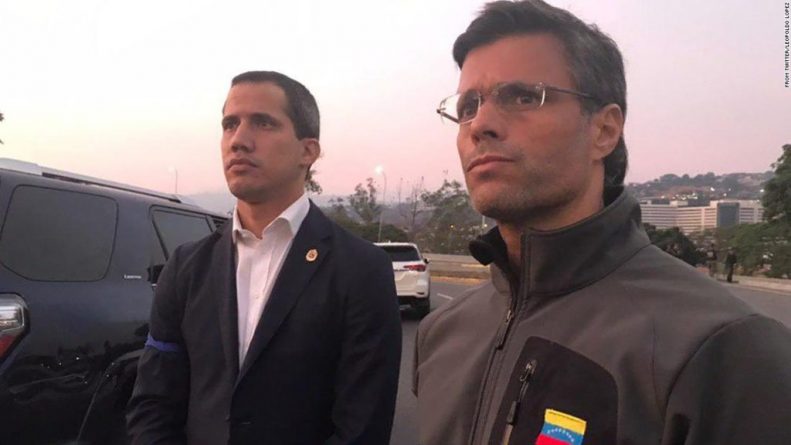
Take CNN. In its reporting on the “uprising” announced by Guaidó on Tuesday, April 30, it ran a video from social media depicting Guaidó, accompanied by opposition leader Leopoldo López, along with some armed men in uniform, said to be military defectors, standing behind them. The video claimed they were on the La Carlota military airfield in eastern Caracas, which Guaidó said had been “liberated.” According to CNN, he was addressing “thousands of supporters” on the scene, urging the rest of the Venezuelan military to join the coup and oust the “usurper” Maduro.
RELATED CONTENT: The Shipwreck of Leopoldo López Opens the Way for the Military Option
But as Michael Fox and other observers noted, CNN didn’t show those “thousands” of supporters—because there were none. Nor did the cable network explain in its report that Guaidó and Lopez were not actually at the airbase, but rather were standing on a highway overpass outside the base—which was, in fact, never in rebel hands at all.
Guaidó and his “deserting” soldiers quickly left the scene as government troops headed their way, with López later that day holing up in the Chilean and eventually the Spanish embassy, seeking asylum for himself and his family, and with some two dozen soldiers who had deserted in support of Guaidó asking for asylum in the Brazilian embassy.
There are two possibilities here: Either CNN’s US-based editors were lied to by their reporters in Caracas, or they were well aware that their story of the takeover of a military airfield, along with reports of thousands of protesters on the scene in support of Guaidó, was a hoax. It’s not hard to imagine the latter being the truth, because CNN earlier was caught fraudulently reporting that Venezuelan troops had set aid trucks stopped at the Columbian border afire, when in fact the fires had been started by anti-Maduro protesters. Though this truth was proven by other reports and video, CNN never corrected its false story in that case, nor did it discipline its on-the-scene reporters.
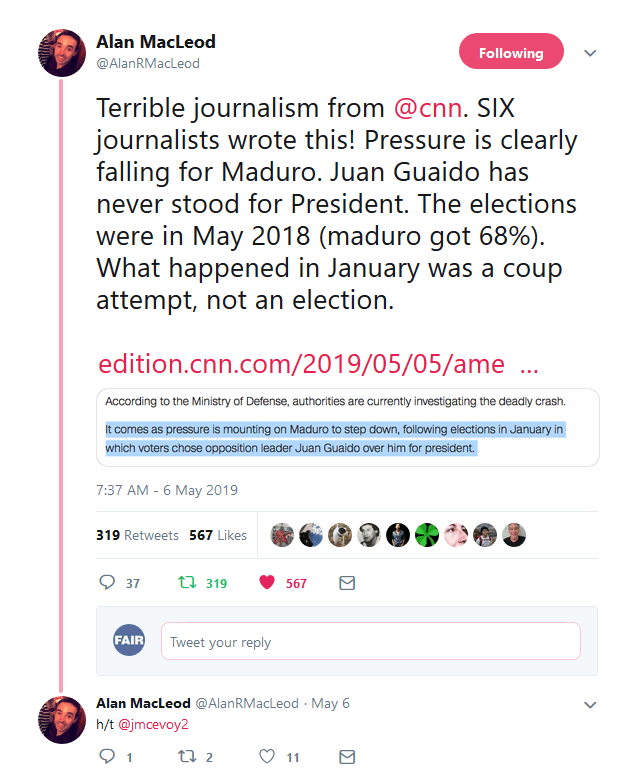
CNN’s standards of accuracy were further discredited by its May 5 claim that pressure is mounting on Maduro to step down, following elections in January in which voters chose opposition leader Juan Guaidó over him for president.
Six reporters were credited for the story that contained this line, which has almost as many errors: Guaidó was not even a candidate in the May 2018 (not January 2019) presidential elections; Maduro won that race with 68 percent of the vote, a credible total given the opposition’s boycott of the balloting. Guaidó was chosen not by voters but by the National Assembly—which has been suspended by the Venezuelan Supreme Court—and ultimately by the Trump administration. As for “pressure…mounting on Maduro,” that seems like a dubious reading indeed of the post-coup attempt political terrain.
After much social media ridicule, CNN corrected the line, keeping in the bit about mounting pressure, but acknowledging that Guaidó “declared himself interim president.”
The New York Times hasn’t done any better. On the day of the fake coup, the Times reported, in an unusual unbylined article (at the end there was a note saying only that reporting was contributed by Isayen Herrera, Nicholas Casey, Anatoly Kurmanaev, Ana Vanessa Herrero, Rick Gladstone and Katie Rogers) headed “Venezuela Crisis: Guaidó Calls for Uprising as Clashes Erupt”:
“Today, brave soldiers, brave patriots, brave men attached to the Constitution have followed our call,” Mr. Guaidó said in a video posted on social media, speaking from Generalissimo Francisco de Miranda Air Base, a military airport in Caracas known as La Carlota.
The “newspaper of record” either made no effort to check its reporters’ “facts,” or went along deliberately with the charade that Washington’s hand-picked “legitimate president” Guaidó was actually speaking from a “liberated” military airfield, when he was really only standing on a highway overpass outside the airfield, which itself was never even contested, remaining in government hands throughout the day.
To compound the journalistic felony, the Times ran a Reuters wire photo showing Guaidó speaking to a street full of supporters, purportedly taken that day, but clearly not depicting where he had made his call for a coup, when he had only the camera to address, though incautious readers might well have assumed that is what the photo showed.
Did editors at the Times’ home office in New York double-check on the reporters’ claims before running their incendiary report of the capture of a government military airbase? Why didn’t one of the paper’s many reporters and photographers in Caracas high-tail it to the La Carlota base to get a firsthand report and video of the first victory in this so-called coup attempt?
In another linked story published the same day, this time authored by Nicholas Casey, the Times again reported falsely, writing:
It was the boldest move yet by Juan Guaidó, Venezuela’s opposition leader: At sunrise, he stood flanked by soldiers at an air force base in the heart of the capital, saying rebellion was at hand.
Clearly Casey was either making it up or, more likely, had been too lazy to go (or to dispatch one of his colleagues to go) to the airport to confirm the veracity of Guaidó’s “bold” claim. But this is not just fraudulent reporting, it is dangerous and incendiary propaganda. Its publication could have, and perhaps did, lead hundreds of coup backers to rush to the airport, where they were met by the Venezuelan military, with a number of protesters reportedly being injured in the ensuing confrontation.
Casey, in his article, writes that “by the end of the day,” it was clear that Guaidó had failed to precipitate a successful coup, but he doesn’t say what had been clear much earlier that day: that the airport had never been captured at all, and that Guaidó had not spoken from a liberated airfield, but from a bridge outside the airfield. In fact, Casey must have known, or should have by day’s end, and well before the Times’ deadline, that his earlier report on Guaidó’s call-to-arms had been based on fake information. Instead, he was still pretending his story was fact-based, and presented as if he had been witness to the events he was reporting on. Even though his article notes that “by day’s end, news spread of another blow to the opposition: Leopoldo López, the political prisoner who heads Mr. Guaidó’s party, had fled into the Chilean Embassy, along with his wife, Lilian Tintori,” he continued with the fiction that an airbase had been captured and that the military was falling apart, writing:
The events also cast a harsh new light into the division within the armed forces, which puts Venezuela in a precarious position as the country’s political crisis deepens. While the highest ranks of the military dig into their support for Mr. Maduro’s government, many rank-and-file soldiers appear willing to defy their commanders and come to the aid of the opposition.
In fact, far from “many” soldiers deserting, it may have been no more than 25 men in uniform who defected in support of Guaidó, and they, as was well known by the time Casey filed his article, had sought asylum in the Brazilian embassy, a devastating sign of his failed call-to-arms, a reality which Casey didn’t bother to mention in his article. (Sitting at home on the evening of April 30 and reading reports in publications like Telesur English and Al Jazeera, I was able to learn about this and about Lopez’s seeking asylum with his family in the Spanish embassy, so surely Times factcheckers should have also been able to get that information challenging Casey’s reporting.)
Interestingly, Casey did quote the Maduro administration as stating late Tuesday night in a public TV broadcast that the La Carlota airport had never been threatened or taken over by defecting soldiers. Instead of verifying it as fact, all Casey did was cite Maduro’s denial, hinting that maybe it had not actually been “liberated.”
The Casey article, still available online, contains a correction at the end, dated May 1:
Because of an editing error, an earlier version of this article misidentified the CNN program on which Mr. Pompeo made his remarks about plans for Mr. Maduro to fly to Cuba. It was The Situation Room With Wolf Blitzer, not State of the Union.
But as of this story’s May 7 posting date, no correction has yet been made by the Times concerning the article’s fundamental and far more serious errors of reporting, such as there had been “a predawn takeover of a military base in the heart of the capital,” or that Guaidó had made his video appeal for a rebellion from that “liberated” airbase.
How does any self-respecting news organization allow such abysmally inaccurate reporting to remain this long online uncorrected? The only possible answer is that Casey, and the other in-country reporters who were said to have contributed to his bylined piece (Isayen Herrera, Ana Vanessa Herrero, Anatoly Kurmanaev and Katie Rogers), were giving the New York Times exactly the propaganda piece that they and the coup plotters in Washington wanted.