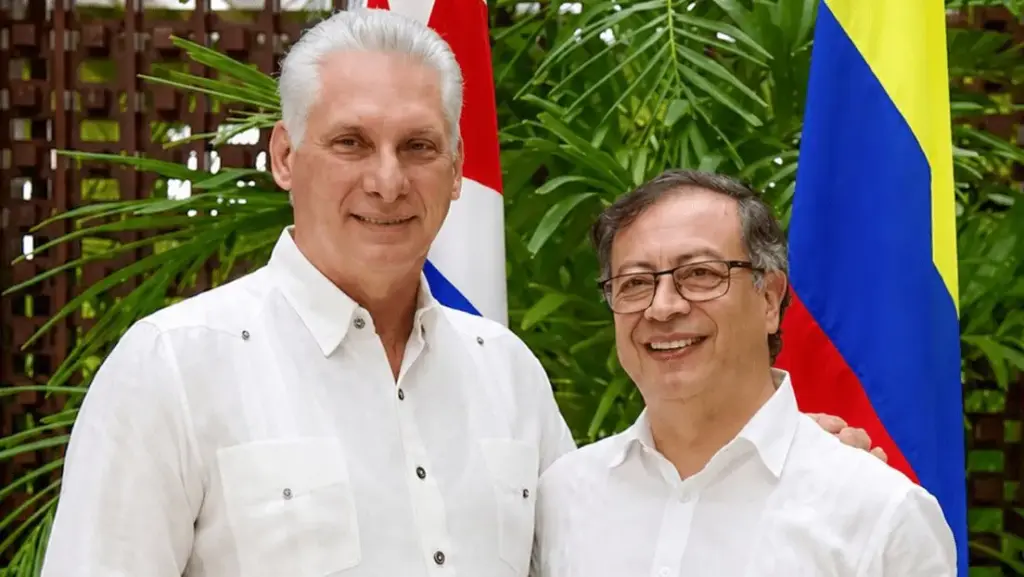
Colombian President Gustavo Petro (right) with his Cuban counterpart, Miguel Díaz-Canel, in Havana, Cuba, July 31, 2026. Photo: radiocaribe.icrt.cu.
Colombian President Gustavo Petro (right) with his Cuban counterpart, Miguel Díaz-Canel, in Havana, Cuba, July 31, 2026. Photo: radiocaribe.icrt.cu.
The outgoing president of Colombia, Gustavo Petro, made a trip to Cuba on Friday, his last trip abroad before his term ends and he hands over the presidency to far-right Abelardo de la Espriella, who will take office on August 7 in Cali. This was confirmed on Thursday, July 30, by sources from the Presidency of Colombia, which added that he will remain in Cuba until Saturday.
Previously, Petro received the credentials of the new ambassador of Palestine in Colombia, Suad Ahmad Hasan Sobeh, marking a political position clearly opposed to De la Espriella, who has expressed his full support for Israel.
Petro’s last foreign trip as president is to Cuba and not to the United States
In Cuba, the outgoing Colombian president was received by his Cuban counterpart, Miguel Díaz-Canel.
Petro’s trip just a few days after the far-right President-Elect De la Espriella announced that he will suspend diplomatic relations with both Cuba and Nicaragua, claiming that his government will not maintain “any ties with tyrannies.”
Petro’s decision to choose Havana as his destination instead of the United States, where he was scheduled to participate in OAS and UN conferences, is due to last-minute changes in the international agenda.
On social media, the president explained that the absence of the president of Congo at a United Nations conference motivated his decision. “The President of Congo could not attend, and therefore, by protocol, the level of the conference was reduced, and I therefore suspended my trip to the US,” he wrote.
In light of this cancellation, Petro announced that his new destination would be Havana. “I replaced it with a place that I consider vital for national sovereignty and the fight for life in the Caribbean: Cuba under attack,” he noted.
According to reports in the press, the Colombian president will travel to Cuba to convey his support and solidarity with the nation, amid the intensification of the US blockade, the fuel blockade, and the threats from the US to overthrow the Cuban government by force.
The visit takes on special significance in a context of bilateral diplomatic tension. The historical relationship between the two countries hangs by a thread amid the imminent arrival to power of Abelardo de la Espriella, who has already announced that he will close the Colombian Embassy in Cuba.
Cuba called this decision an “act of subordination to the US policy of aggression … which has no justification whatsoever and does not serve Colombian national interests either.”
Without directly mentioning his successor, Petro warned that this eventual break in relations will isolate Colombia and lead it to belong to the “small circle of friends of genocide, as humanity is against the holocaust in Gaza.”
This will be the third time Petro visits Cuba as head of state. The two previous trips were in June 2023, when he participated in the closing of the third cycle of talks with the ELN, and in September of the same year, to attend the Summit of Heads of State and Government of the G77 + China Group.
Although Petro chose Cuba as the his destination abroad before his presidency ends, he has been criticized by some analysts for contradictions in his policies towards the island. Despite the fact that Colombia is among the top eight oil producers in the continent—including United States and Canada—President Petro has been criticized for not translating his rhetoric defending the independence of Cuba into real actions, such as delivering urgently needed oil to the island asphyxiated by the tightening of US blockade.
Venezuela, on the contrary, was among the few countries in the continent that rejected until the last minute the US blockade of Cuba, and for the last two decades delivered oil to the island until December 2025, when the US began piracy operations, hijacking oil tankers on their way to Cuba.
Despite this reality, many progressive analysts in the region question Venezuela for currently not delivering oil to Cuba, without considering that the US invasion of Venezuela on January 3 to kidnap President Nicolás Maduro was in part a response to Venezuela’s relations with Cuba.
Petro welcomes new Palestinian ambassador to Colombia
On Thursday, the Colombian president formalized the arrival of the new diplomatic representative of Palestine, amid a shift announced in the country’s foreign policy.
In a ceremonial event, President Gustavo Petro received the credentials of the new ambassador of the State of Palestine to Colombia, Suad Ahmad Hasan Sobeh, just ten days before the end of his term.
🇨🇴 En la @Casa_Narino, el Presidente @PetroGustavo recibió a 3️⃣ nuevos embajadores en Colombia, quienes presentaron sus cartas credenciales ante el Jefe de Estado:
1️⃣. Suad Ahmad Hasan Sobeh, embajadora del Estado de Palestina. 🇵🇸 pic.twitter.com/P1BQ28YFmg
— Presidencia Colombia 🇨🇴 (@infopresidencia) July 29, 2026
On the same day, Petro also accredited the new ambassador of Turkey, Emir Salim Yüksel, and the ambassador of Venezuela, Ramón Maniglia Ferreira. The presidency officially confirmed the three appointments.
This diplomatic gesture comes at a crucial moment for Colombia’s foreign relations, as President-Elect Abelardo de la Espriella had announced the reestablishment of relations with Israel as soon as he takes office on August 7.
As if that were not enough, he confirmed the relocation of the Colombian embassy from Tel Aviv to Jerusalem, marking a shift from Petro’s stance.
Petro severed relations with Israel in May 2024, in direct response to the Israeli military offensive in Gaza and the occupied territories, and also ordered the opening of a Colombian embassy in the Palestinian city of Ramallah, although that mission never became operational.
De la Espriella, on the other hand, has already announced the definitive suspension of that project. Gustavo Petro has declared that during his administration he sought to support the Palestinian community and advance the two-state solution, which will completely change with the arrival of De la Espriella.
Translation: Orinoco Tribune with Orinoco Tribune content
OT/SC/JRE