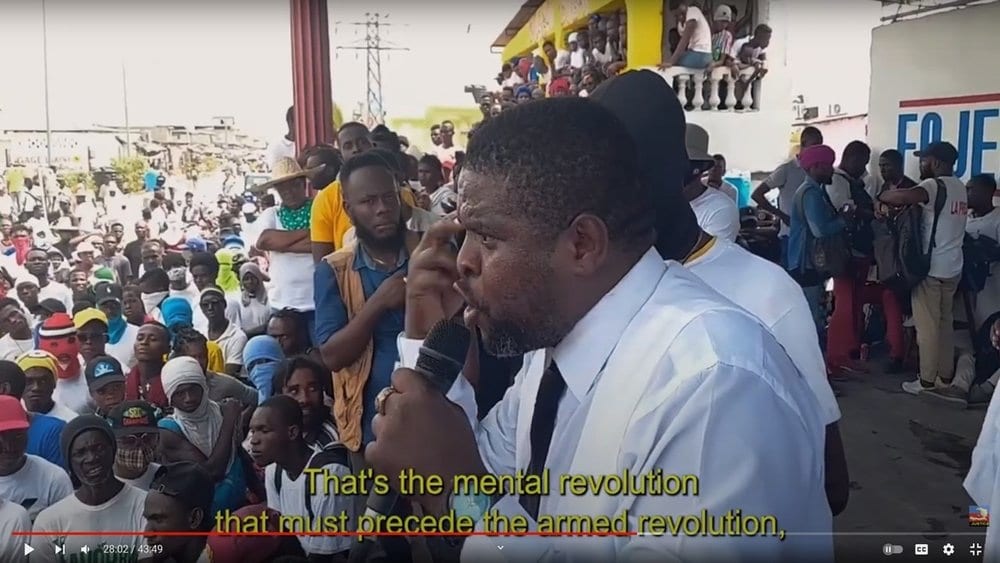
Caption: G9 Family and Allies leader Jimmy Cherizier speaks at a rally demanding an end to the Western puppet government of Haiti. Video source: Another Vision: Inside Haiti's Uprising | Episode 3: A Burgeoning Revolution, 28:02.
Caption: G9 Family and Allies leader Jimmy Cherizier speaks at a rally demanding an end to the Western puppet government of Haiti. Video source: Another Vision: Inside Haiti's Uprising | Episode 3: A Burgeoning Revolution, 28:02.
By Peter Biesterfeld – Mar 23, 2023
Note: This is part two of Peter Biesterfeld’s series for The Canada Files: “A Case for Anti-war and Anti-imperialist Journalism.” It focuses on how Canada’s mainstream media is failing Canadians with its foreign policy coverage.
What follows is a critical examination of the reliability of Canada’s Fourth Estate, also known as Canada’s mainstream media. With examples torn from the headlines, the aim is to shine some light on Canadian foreign affairs reporting and to learn from its failures in order to serve the public’s right to know more reliably in future.
War porn
“Ukrainian soldier Volodymyr Tereshchenko wants to ensure any Russian he confronts regrets it.” – Chris Brown, foreign correspondent CBC News Jan 23, 2023
The journalism of Canadian political reporters covering wars and international affairs can be as jingoistic as Canada’s foreign policy, which remains firmly in lockstep with the US and NATO.
What amounts to war porn from embedded reporters like Brown reads like weapons advertising for the military industrial complex inserted into heroic anti-Russia narratives that feature and promote Canada’s billions in military assistance to Ukraine.
On the one-year anniversary of Russia’s special military operation (SMO) in Ukraine, the Canadian mainstream press continues to beat the drums for war and cheer for a Ukrainian victory.
In a February 24, 2023, Associated Press story headlined “Ukraine leader Volodymyr Zelenskyy pushes for victory on war anniversary,” the Toronto Star reminded readers where the battle lines are:
“Western nations are supporting Ukraine militarily, financially and politically. But China, India and countries in the global south have proven ambivalent about Western arguments that Ukraine is the front line of a fight for freedom and democracy.”
China’s anniversary position statement on the war reads like a generic road map to peace and includes all the traditional milestones and imperatives: cease fire, resumption of peace talks, dropping sanctions, and a resolution to the humanitarian crises. The Canadian establishment press is mostly dismissive of the Ministry of Foreign Affairs of the People’s Republic of China that published the non-specific but constructive one-pager.
CBC News Feb 23, 2023: “China’s positions throw doubt on whether its 12-point proposal has any hope of going ahead — or whether China can be seen as an honest broker.”
The Toronto Star describes some of China’s suggestions for peace in a Feb. 24 Associated Press piece titled “What is China’s peace proposal for Ukraine War?” But the story focus, like much of the reporting in the NATO-aligned press, is on China’s “no limits” relationship with Russia and whether China can be trusted: “China has offered contradictory statements regarding its stance. It says Russia was provoked into taking action by NATO’s eastward expansion, but has also claimed neutrality on the war.”
Far from giving credence to China’s peace “offer” the Star article quotes a belligerent US Secretary of State Anthony Blinken several times: “Publicly, they present themselves as a country striving for peace in Ukraine, but privately we’ve seen already over these past months the provision of non-lethal assistance that does go directly to aiding and abetting Russia’s war effort.” The State Department provides no evidence for the claim.
Not referenced in the mainstream press is a companion document China’s foreign affairs ministry published alongside its position statement, titled “US Hegemony and Its Perils.” From the table of contents:
I. Political Hegemony—Throwing Its Weight Around
II. Military Hegemony—Wanton Use of Force
III. Economic Hegemony—Looting and Exploitation
IV. Technological Hegemony—Monopoly and Suppression
Independent commentators and analysts like Alexander Mercouris of independent news outlet the Duran, and the Grayzone’s Aaron Maté are much closer to serving the public’s right to know by providing historical context and significantly more in-depth analysis of what a Ukraine peace deal might look like from a Chinese perspective. Long-form reportage, debates and discussions with subject matter specialists are features in progressive press coverage that mainstream news consumers are often denied in global affairs reporting.
In a Substack article about how Zelensky went from “pro-peace candidate to no peace president,” Maté cites David Arakhamia, Zelensky’s house leader in the Ukrainian parliament: “By early 2021, Zelensky believed that negotiations wouldn’t work and that Ukraine would need to retake the Donetsk and Luhansk regions ‘either through a political or military path’. The Kremlin disengaged (from talks).”
In a digital world of media abundance news consumers who don’t trust mainstream journalism can readily find independent news channels, alternatives to the mainstream media, which tend to have a particular worldview.
Many observers of the news industry don’t see this as a good thing. Chris Hedges says on his Substack: “The advent of digital media and the compartmentalizing of the public into antagonistic demographics has destroyed the traditional model of commercial journalism.”
In today’s climate of discomposure around “fake news”, whose news can be trusted? MSM, or the alternative press? Whose journalism is more reliable? Corporate or independent news coverage?
Depends on who you ask. Most industry insiders agree with Hedges.
Where are MSM on the decline of Canadian journalism?
“Our sense of skeptical inquiry needs to inform everything we do in journalism. It is a key quality in our quest to trust the news.” —Jeffrey Dvorkin, Trusting The News in a Digital Age: Towards a “New” News Literacy (2021).
In a Massey College livestream in January 2022 long-time CBC broadcaster Michael Enright is in conversation with journalist-academic Jeffrey Dvorkin:
“This is my deeply held view…” Enright leans into the microphone. “…the Internet has destroyed journalism.”
The two elder statesmen of Canadian broadcast journalism are discussing the decline of the fourth estate in the information age. The occasion is the book launch of Dvorkin’s latest: Trusting The News in a Digital Age: Towards a “New” News Literacy (2021). The compact but instructive 155-page primer is aimed at students of journalism and media studies, but anybody interested in journalism should read it. “How to use critical thinking to discern real news from fake news,” reads the blurb on the cover.
Enright and Dvorkin are lamenting how social network services like Google, Facebook, Twitter and YouTube have replaced newspapers, radio and television as destinations for vital advertising dollars in an already underfunded and “hollowed out” Canadian news sector.
Many media observers agree with Enright and Dvorkin that there is a crisis in Canadian journalism and that the wild west of social media is at least partly responsible.
Once managing editor and chief journalist for CBC Radio (1991-97), Dvorkin writes in Trusting the News: “As they look around in their media landscapes, many people have decided that the traditional media can no longer function as a gatekeeper when the Internet has removed the gatekeeping function of traditional news organizations. Information is no longer penned up but is running loose everywhere!”
Dvorkin wants legacy news organizations to return to their role as gatekeepers. He argues in his book that the digital democratization of the public square inevitably brings with it “deliberate attempts to convey wrong information that need reliable journalism to help news consumers identify what can be trusted.”
Dvorkin writes, “journalists place a great deal of value on skepticism” and reminds his readers of best practices for verifying a story by asking: Where did you get this story? Who are your sources? Do you have more than one source? Can these sources be trusted? How do you know this to be true?
Dvorkin scoffs at pundit tables stacked with “clashing opinions” for entertainment rather than news value. “Opinion journalism can be found everywhere, and it seems to be replacing evidence-based reporting,” writes Dvorkin. “It’s a lot cheaper than having a reporter out in the field covering a story that requires complexity and nuance and an expense account from the newsroom.”
Ontario’s public broadcaster TVO televised a debate of “clashing opinions” early on in the Ukraine war. Steve Paikin on The Agenda (Mar 21/22) asked four academics around the table, “Did NATO provoke Russia?” The resulting discussion, though squarely set-up to clash, was more useful than Dvorkin might expect. Sides of the argument not typically explored on commercial news programs were put forward and argued, such as the eight-year civil war in the Donbass as the precursor to Russia’s SMO.
Enright and Dvorkin are not the only observers of the Canadian news landscape who blame the “informational cacophony” of social media for at least some of the decline in mainstream media journalism.
In The End of the CBC? (2020) David Taras and Christopher Waddell point to the “attention economy” and “the corrosive effects of media abundance” as the main threats to CBC’s brand identity as a news organization of note, and ultimately as a threat to the public broadcaster’s existence.
Taras, media scholar at Northwestern University and Waddell, former senior program producer for CBC The National, now a journalism professor at Carleton University, point out that “news is the lifeblood of public broadcasting” and that the Canadian public broadcaster is chronically too underfunded to adequately meet its nation-building mandate. When “trying to do everything and be all things to all audiences,” ask Waddell and Taras, how can CBC be expected to produce consistently high-quality and reliable news programming from coast to coast to coast?
“Despite injection of $675m to CBC over five years announced by Trudeau in 2016 and the extensive handwringing about fake news and its undermining of an informed citizenry, CBC management has been cutting the money allocated to the news, declining in each successive budget from 2017-18 and 2018-19.” —Taras and Waddell, The End of the CBC?
The authors report that news programming on Canadian commercial networks has also suffered a decline as a result of cuts. “Too many news organizations promote opinions and ignore expertise; have few, if any, specialist reporters; crave sensational stories at the expense of accountability reporting; and do little if any digging or investigative work.”
In The End of the CBC?, Waddell and Taras propose the public broadcaster become exclusively a news and current affairs organization, “dedicated to producing, high quality, dependable, and fair news and analysis. The CBC needs to do investigative journalism, produce the accountability news that holds people and institutions responsible, and do the essential work of democracy.”
“The most trusted brands”
“One of the reasons why I think people have gone from reading mainstream newspapers to the Internet is because they realize they’re being lied to.” —Robert Fisk
Reuters Institute for the Study of Journalism, in the introduction to its 2022 Digital News Report, proclaims: “the connection between journalism and the public may be fraying; there is a declining interest in news, and there is a rise in news avoidance.”
Reuters reports that only 42 per cent of Canadians trust “most news, most of the time”. That is down from 58 per cent four years ago and it is the lowest score ever.
For the annual survey Reuters interviewed 92,000 news consumers in 46 different global markets. In the Canadian market, Reuters measured the interactions of English and French speaking news consumers with news organizations from “a list of the most trusted brands”.
The 2021 list in descending order of trustworthiness with English speaking news consumers: CTV News; local or regional newspaper; Global News; CBC News; BBC News; Globe and Mail; City News; CNN; The New York Times; National Post; CP24; Toronto Star; MSN News; Yahoo News; Fox News.
Trusted brand scores for French speaking audiences, from most to least trusted: ICI Radio-Canada Info/ICI RDI; La Presse; TVA Nouvelles/LCN; La Presse Canadienne; Le Devoir; Regional or local newspaper; L’actualité; Journal de Montréal ou Québec; TV5; CTV News; Noovo info; Métro; MSN Actualités; 24 Heures; Narcity.com.
Independent news organizations were not included in Reuters’ data collection. There are no measurements available of Canadians’ engagement with alternative news content in the 2022 report. The number of subscriptions to independent news channels globally confirms that a substantial number of news consumers are getting their news from non-traditional sources. Reuters reports that 77 percent of Canadians access news online, but not exclusively from the “most trusted brands.” According to the report, 40 percent of Canadians get their news on Facebook.
Journalism Fails – A Compendium: Haitian struggles for freedom misrepresented
The background and deep context news consumers require to fully understand what is going on in the world and Canada’s role in it are frequently left out of mainstream reporting.
Case in point is establishment news media’s ongoing whitewash of Canada’s role in Haiti.
This 2004 CBC headline is still posted on cbcnews.ca: – Aristide leaves office, flees Haiti – the article goes on to say, “Jean-Bertrand Aristide resigned as president of Haiti and left the country Sunday, bowing to pressure from rebels who said they would not storm the capital if he left.”
CTV’s update almost 20 years later in a 2021 story: “Reelected in 2000, he (Aristide) was ousted four years later in a rebellion led by opponents with ties to the elite and the old Duvalierist regime.”
Both accounts leave unreported Canada’s Machiavellian role in the ousting of democratically elected Haitian president Jean-Bertrand Aristide.
This l’Actualité banner headline (03/15/03) contradicts the English press: “Haiti placed in trusteeship by the UN?—Aristide must be overthrown. And it is not the Haitian opposition that is calling for it, but a collection of countries brought together at the initiative of Canada!”
Yves Engler reported that a Liberal insider in Jean Chretien’s government had leaked to l’Actualité reporter Michel Vastel details of a meeting of Canadian, French, and US government officials, along with representatives from the Organization of American States (OAS) who came together to strategize over regime change in Haiti. No Haitian representative was invited to the secret gathering designated ‘The Ottawa Initiative on Haiti’ where “Aristide must go” was the theme and a “Kosovo-model” UN trusteeship over Haiti was on the table.
Vastel’s 2003 story remains posted on l’Actualité’s news site and additional information on the Ottawa Initiative released to online news outlet The Breach can be found in the public record. Still, establishment journalists continue to ignore the story, and Canadians who get their news from the most trusted brands remain no wiser about the true role Canada played and continues to play in Haiti’s affairs, acting in concert with US interests and the Organization of American States (OAS).
At the time of this writing Haitian society is spiraling into chaos. Street demonstrations against foreign interventions in Haitian affairs have turned into a virtual insurrection. Protesters carrying symbolic coffins emblazoned with the flags of Canada, France and the US make for dramatic front-page imagery, but receive no meaningful editorial scrutiny in the mainstream Canadian press.
Allan Woods, Montreal-based staff reporter for the Star puts forward a version of the current state of affairs in Haiti in a March 18 story: “The July 2021 assassination of President Jovenel Moïse set off a wave of insecurity that has inundated the island nation. Powerful gangs have been battling for control of the country and the Haitian National Police, lacking personnel and equipment, have been powerless to uphold the law.”
A December 2021 CBC subheadline reads, “Some Haitians say de facto control by foreign ambassadors, local allies brought hunger and gang rule.” CBC Latin Affairs specialist Evan Dyer acknowledges foreign intervention and a corrupt ruling class as root causes of a perpetual humanitarian crisis in Haiti.
Quoting Haitian activist Monique Clesca, a member of the Commission for a Haitian Solution to the Crisis, Dyer reports that the embassies “push a supposed stability that is filled with corruption and impunity. We are where we are because of the support of the Core Group, led by the United States, and Canada also plays a prominent role.”
As with much of Canadian reporting on Haiti, Dyer’s story leaves out any meaningful explanation of Canada’s “prominent role” in Haiti’s “supposed stability.” Canada’s record as perpetual foreign intervenor, regime change backer, and supporter of corrupt Haitian leaderships is blurred out.
A December 3, 2022 Toronto Star op-ed titled “Don’t believe the media hype: Canada is no friend of Haiti” is an uncommon example of historical context on Haiti making its way into the mainstream. Academics Karine Coen-Sanchez, a first-generation Haitian and PhD candidate at the University of Ottawa, and Kevin Edmonds, assistant professor in Caribbean studies at the University of Toronto, write:
“The dangerous lack of context in reporting on Haiti is positioning Canada as a saviour, when there is instead a complex history of self-serving, condescending, and imperialist actions that have neutralized popular political movements, undermined the capacity of the state, and supported a kleptocratic and gang-affiliated PTHK party (Parti Haïtien Tèt Kale).”
One distinguishing feature of mainstream reporting from “troubled parts” of the world in general, including Haiti coverage, is that, with notable exceptions, too few establishment reporters spend significant time with grassroots communities for a comprehensive street level perspective of events.
Independent news outlets Haïti Liberté and Uncaptured Media present a more nuanced narrative on Haiti’s present-day troubles than the mainstream press. With correspondents seeking out voices from behind the barricades, from deep inside impoverished neighbourhoods, what emerges are layered accounts about gangs and violence and desperate lives that are not as homogenous as the establishment press make them out to be.
In a January 31, 2023, Associated Press story headlined “In Haiti gangs take control as democracy withers,” Megan Janetsky and Pierre Richard Luxama point to Jimmy Cherizier, Port-au-Prince community leader and former cop, as the principal violent force inciting the gang wars:
“Internationally, he’s known as Haiti’s most powerful and feared gang leader, sanctioned by the United Nations for ‘serious human rights abuses,’ and the man behind a fuel blockade that brought the Caribbean nation to its knees late last year.”
Evan Dyer reporting for the CBC: “Gang leaders like Cherizier are no longer content merely to provide muscle and coerce votes for Haiti’s rulers; he now has aspirations of ruling Haiti himself.” Dyer’s assertion betrays his remoteness from actual events but manages with one careless claim to erase the revolutionary aspirations of ordinary Haitians.
Kim Ives and Uncaptured Media journalist Dan Cohen’s documentary Another Vision: Inside Haiti’s Uprising (2022) is a must-watch resource available on YouTube that ‘tells the story of Jimmy “Barbecue” Cherizier and the Revolutionary Forces of the G9 Family and Allies, the armed neighborhood federation in the crosshairs of the U.S. empire.
Cherizier formally introduced his anti-violence G9 coalition in a 2020 YouTube video:
“The G9 and allies is a group of young men and women who have united to say there will never be again be kidnapping in Wharf Jeremy, there will never be robberies, hijacking of people’s rice trucks or rapes. We in the ghetto have never benefitted from anything. G9 family and its allies is an organization of nationalists focused on the country and the ghettoes who united to dismantle a number of vagabonds and gangs that politicians use to harm the ghettoes each time they seek to take power.”
According to Ives and Cohen’s documentary, Cherizier is the first populist leader since Aristide who has managed “to shine a light on the pain of the abandoned underclass.”
The nearly three hours of documentary journalism, is part gritty verité that doesn’t look away, and part media analysis that “dissects western media’s disinformation offensive” against Cherizier. Another Vision is a powerful re-education experience, if all you’ve been exposed to is mainstream coverage of Haitian “gang wars.”
Canadian mainstream journalism around Haitian affairs relies heavily on official narratives provided by western government officials, human rights organizations and think tanks.
In November 2017, when still an officer with Haitian National Police (HNP), Cherizier took part in a UN supervised police operation to round up criminals in the Grand Ravine neighbourhood of Port au Prince. The operation went wrong, a gun battle ensued, two cops and nine civilians were killed including suspected gang members. According to Cohen, “The portrayal of this event became the opening salvo in an information war against Cherizier.”
Haiti’s National Human Rights Defense Network (RNDDH) issued a report that civilians had been summarily executed by police during the raid. An Intercept article relying on RNDDH claims called the operation a massacre. According to Cherizier, there were no summary executions by the police, people were caught in crossfire between police and gang members. “These falsehoods were fabricated by RNDDH to pressure the police so they could find an issue to bring against the government at the time.” In the film Cohen explains how the RNDDH report panicked police leadership who turned on Cherizier and accused him of conducting a rogue operation. He was fired after 14 years on the force.
When citing think tanks or sources connected to human rights organizations, the establishment press typically does not report that many such groups, including RNDDH, are funded by the National Endowment for Democracy (NED). The NED is a known propaganda arm of the US government that carries out destabilization campaigns in foreign countries. In the documentary Cohen quotes Allen Weinstein, NED co-founder under Ronald Reagan: “A lot of what we do today was done 25 years ago covertly by the CIA.”
RNDDH has a history of political machinations on behalf of its foreign sponsors including, under a previous incarnation (National Coalition for Haitian Rights [NCHR]), running a disinformation campaign in the lead up to the 2004 coup against Bertrand Aristide.
The opening of the documentary unpacks the history of the Caribbean Nation’s struggle from slavery to independence: “Today Haiti is a neocolony of the US, France and Canada… …Gang violence is a continuation of the 200-year class struggle against exploitation and oppression.”
But the power in Ives and Cohen’s documentary is not in the narration, it’s in the images of the squalor and the sounds of determined defiance. Cherizier tours the film crew through some of the most desperate corners of his lower Delma neighbourhood.
Narrator:
“Children play near sewage-soaked canals, cleaning them is an endless task…mountains of stinking garbage line the streets and alley ways festering for months on end without collection. Many burn around the clock, picked over by beggars and dogs. But in Cherizier’s lower Delma the situation is different.”
The documentary shows the results of Cherizier’s attempts to unite armed groups against criminal gangs and kidnappers. The former National Haiti Police officer amplifies to the camera “underlying issues that give rise to crime, poverty and inequality and a bourgeoisie that pays and arms criminals to do its dirty work.”
Cherizier:
“This is part of Delma 5,6,8 Another Vision. Another Vision means the state doesn’t do anything for us in this place. If we relied on the state or the government our neighbourhood would never be clean.”
Cherizier explains how funds raised from people in the Haitian diaspora, who once lived in lower Delma neighbourhoods, are used to buy street cleaning equipment. He points to a small pickup truck. “With this vehicle we go by people’s houses every Monday Wednesday and Friday to collect their garbage.” In addition to street cleaning G9 provides low-cost water for residents, youth recreation activities and community enrichment programs from cooking hot meals to dance classes and concerts.
Narrator:
“On June 17, 2021, Haitian National Police’s company for the maintenance of order supported by irregulars from the armed groups from Bellaire, Ruelle Maillard and TireMasse (rival neighbourhoods) attacked Delma 4 and 6 (Cherizier’s neighbourhoods). Over the span of a few hours they burned and bulldozed over 60 houses and at least one school. Witnesses told us 20 people died in the attack.”
Cherizier leads Cohen on a tour of the damage:
“What you see there was done by policemen. With armed groups from Ruelle Maillart, Belair, and Rue Tiremasse. They were using the policemen to bulldoze and destroy these houses. You’ll never see a human rights group talk about the massacre in Delmas 6. You’ll never hear human rights groups talk about people in Delmas 6 who were killed. You’ll never hear human rights groups talk about Delma 6 people made homeless.”
When challenged by Cohen, RNDDH director Pierre Esperance claims his organization is too strapped for resources “to report everything.”
The documentary effectively debunks massacre and rape allegations against Cherizier, but doesn’t hold back on showcasing the revolutionary fervour of the movement he started.
Cherizier acknowledges that the criminal gangs opposing him are victims of the system just like he is:
“Who is our enemy? It’s not those armed guys from Ruelle Maillart who are our real enemies. It’s not the armed guys in Belair Rue Tiremasse and Grand Ravine who are my enemies. We have a society where 5 per cent of the population control 85 per cent of the country’s wealth. We have 60 per cent of individuals who are under 35 years old. 70 per cent of our people are jobless. That’s the reality of the country. Today I dare to attack the system. That’s why those guys want to destroy me. We want a revolution to redistribute the country’s wealth for all Haitians to have something.”
An animated female supporter concurs:
“We have to claim what is rightfully ours. When I say rightfully, I mean the right to healthcare, education and housing. We have a right to all those things to live like human beings. The same way people in Petionville live, the same way people in the upper Delmas live. We have to go to school too. They’re not any more intelligent than us, but why are they always marginalizing us. Today we say another Haiti is possible. Today we say about this system, it’s time to become conscious. We must become conscious to see the state people are living in. Come to Cite de Soleil to see how we live.”
In a Haïti Liberté report Kim Ives recently speculated on renewed fighting between downtown Port-au-Prince neighborhoods, after months of relative peace:
“Some analysts question whether the confrontations now raging haven’t been engineered to provide a pretext for Washington and Ottawa to launch their third foreign military occupation of Haiti in the past three decades.”
Indeed, on the eve of president Joe Biden’s Ottawa visit Allan Woods wonders in the Star whether “Canada will agree to lead an international security force to bring order to the country by reinforcing Haiti’s understaffed and ill-equipped national police.”
The Canadian establishment press has abandoned accountability journalism when it comes to reporting on Haiti. Challenges to government decisions for military intervention in Haiti and questions to Canadian policy makers to account for a history of interference in Haitian affairs continue to go unexplored in Canadian news coverage and analyses.
Canadian news consumers who exclusively read, watch and listen to mainstream news remain underinformed about the dishonourable history of Canada’s interference in Haiti.
Bolivarian Aspirations
There is a significant historical dimension to Canadian press coverage of Central and South American affairs.
Boiled down: socialism, in any form, has never sat well in the backyards of the hyper-capitalist and anti-communist duality of the US and Canada.
Mainstream Venezuela coverage since the late Hugo Chavez was first elected president in 1999, is an unsettling example of how most of the corporate news media are cheating Canadians out of public interest reporting and their right to know. The right to know something about the complex and politically volatile history of the region and to know the facts about what the Canadian government is up to in the hemisphere and why.
This Toronto Star headline from August 16, 2011 captures the dominant theme of Canada-Latin America relations over the years: “Canada backs profits not human rights, in Honduras.”
Whether it’s Stephen Harper’s Conservative government supporting coup-installed President Porfirio Pepe Lobo of Honduras, or Liberal deputy prime minister Chrystia Freeland presiding over the Lima Group to push for regime change and sanctions in Venezuela, Canada’s foreign policy in the region is firmly aligned with US interests. Likewise, Canadian media coverage echoes much of what the American press reports on Venezuela, Bolivia and the rest of Latin America.
Alan MacLeod’s Dec. 9, 2019 Grayzone article on Venezuela coverage states: “The corporate media has dutifully ignored the US role in the country’s economic woes, laying the blame squarely at the feet of (president) Maduro, omitting crucial political context on Venezuela’s economic crisis while keeping up a constant flow of content presenting the country as a socialist hellhole.”
The Canadian mainstream press underreports the devastating effects of sanctions on Venezuela. A study by prominent economists Jeffrey Sachs and Mark Weisbrot that links economic sanctions imposed on Venezuela to an estimated 40,000 deaths goes widely unreported.
Parallels between present-day Venezuela and Chile under Salvador Allende in the 1970s are unavoidable.
According to unclassified documents, President Richard Nixon had ordered the CIA to “make the economy scream” under sanctions in Chile to prevent Allende from implementing his political vision while leading a socialist government.
In Canada, when Allende took office in 1970, the Trudeau government of the day fell in line with the US and suspended all aid to Chile immediately. Canadian banks pulled out of Chile. In 1972, Ottawa voted to cut off all money from the International Monetary Fund to the Chilean government.
A September 5, 1970 Toronto Star headline: “Salvador Allende Gossen, Marxist president-elect of Chile, has sworn to impose socialism on the South American nation by nationalizing all large enterprises and expropriating almost all farm land.” Although the headline sounds like a warning siren for insecure Chilean capitalists, some reporting of the day included media criticism of the biased coverage of what went on in Chile.
Managing editor of the United Church Observer, James Taylor, wrote an opinion piece in the Star Sept.12, 1973 titled, “The Chilean experiment: We’re getting a distorted view.” Taylor writes that without permanent foreign correspondents in Chile, Canadian newspapers depended on American news sources: “The Canadian reader has become a victim of US paranoia about socialism.”
Excerpts from Taylor’s 50-year-old op-ed will be eerily familiar to regime change watchers today:
“Yesterday’s coup that ended in Allende’s suicide was preceded by a transportation strike that brought the country to the verge of civil war. The implication was that this was a revolt against the president by the very people who elected him, the working classes. But it was not a truckers strike, it was a truck owners strike. Instead of being a revolt by the masses it turns out to be a sabotage action by the members of the former privileged classes, those who benefitted at the expense of the poor under the previous conservative governments.”
In the aftermath of the coup, 3,000 leftists were murdered, tens of thousands tortured and hundreds of thousands Chileans were driven from the country.
Taylor cites a 1972 Rutgers University media analysis study that concludes: “The American public has been fed a steady diet of homogenized information which is uniformly prejudiced against the government of President Salvador Allende.”
According to Taylor, the study’s author Dr. John C. Pollock contends “that US media treat Chile as a battleground between Marxism and democracy, that they portrayed Allende as a puppet on a Communist string who was juggling Chile’s economy in chaos for the sake of Socialist ideals, while they ignore the disruptive influence of US monetary and trade pressures and the destructive actions of Chile’s right wing groups.”
Independent Socialist magazine Monthly Review says: “In Venezuela today, as in Chile in the 1970s, U.S. intervention relies on an ongoing counterrevolutionary effort, with elites using the revolutionary potential of the masses to frighten the middle class.”
Bolivarian aspirations and social successes achieved by Latin states such as Venezuela’s Chavista socialist revolution, and Evo Morales’ sweeping social reforms in Bolivia go mostly unreported in the Canadian press. Instead, the headlines are dominated by Canada’s overt regime change initiatives while the coverage cheers on the Trudeau government’s support for unelected anti-socialist leaders like Peru’s “president” Dina Boluarte and Venezuelan opposition member Juan Guaido.
Independent news outlets Kawsachun News, Consortium News, Venezuelananalysis, and Ben Norton’s Geopolitical Economy Report are some of the more reliable antidotes to distorted establishment press reporting on Latin America.
Douma and beyond
Canadian foreign affairs reporting on events in the Middle East is as unreliable as the journalism coming out of Ukraine and Latin America. A deplorable case in point is mainstream coverage of the 10-year-long dirty war on Syria. Canada’s involvement, as reported by The Canada Files, includes air strikes, support for jihadists and close military collaboration with US and allied forces.
Uncritical reporting by mainstream news outlets, that claimed the government of Syria launched chemical attacks on its own people in 2018, was the impetus for retaliatory bombing of Syria by the US and its allies.
“Allegations of a chemical weapons attack by Syria’s government spark international demands for investigation.” Johnathan Gatehouse’s report for The National is still available on CBC’s news site:
“Hague-based Organisation for the Prohibition of Chemical Weapons (OPCW) concluded that reactive chlorine gas was used against civilians in the Damascus suburb of Douma on April 7, 2018. At least 43 people died in that attack and more than 500 others were poisoned.”… “The Assad regime’s culpability in horrific chemical weapons attacks is undeniable,” Morgan Ortagus, a State Department spokesperson, said yesterday.
The Grayzone’s Aaron Maté, Jonathan Steele for Counterpunch, and other independents like Eva Bartlett and Vanessa Beeley reporting from the ground in Syria, have done considerable digging on the chemical weapons allegations and found reports of Assad poisoning his own people to be without evidence.
“OPCW inspectors found no evidence to support allegations of a Syrian government chemical weapons attack in the city of Douma in April 2018. But their findings were suppressed, and the team was sidelined,” reports Maté. Testifying before an Arria-Formula Meeting of the United Nations Security Council in 2021 Maté confirmed that “the actual inspectors who went to Douma did not reach the conclusion that was put out by the OPCW.” Maté says he based his UN testimony and his reporting on leaks received from two OPCW inspectors of the Douma Fact-Finding Mission who alleged that scientific evidence was suppressed.
The Toronto Star still has posted on its news site the Canadian Press story of then Foreign Affairs Minister Chrystia Freeland asserting “it is clear to Canada” that the Assad government is responsible for a suspected chemical-weapons attack in Syria that left more than 40 people dead and 500 injured.
“Evidence” for claims that the Syrian army had used chemical weapons on civilians in Douma, was a video provided by the White Helmets, the much-lauded and supposed humanitarian defense group who worked exclusively in areas held by armed insurgents and rebels. The video, which has received a great deal of critical scrutiny from independent reporters, is of a frenzied scene inside of a hospital immediately after nearby shell fire. Adults and children covered in dust are carried in with a lot of commotion and hosed down with water by the rescuers.
The late Robert Fisk, reporting for the Independent at the time, visited the hospital where the White Helmets recorded their video. Fisk interviewed one of the doctors who works there, Dr Rahaibani:
“All the doctors know what happened. There was a lot of shelling [by government forces] and aircraft were always over Douma at night – but on this night, there was wind and huge dust clouds began to come into the basements and cellars where people lived. People began to arrive here suffering from hypoxia, oxygen loss. Then someone at the door, a ‘White Helmet’, shouted ‘Gas!’, and a panic began. People started throwing water over each other. Yes, the video was filmed here, it is genuine, but what you see are people suffering from hypoxia – not gas poisoning.”
Canadian independent journalist Eva Bartlett reported from Damascus:
“One week later, the night before Organisation for the Prohibition of Chemical Weapons inspectors were due to visit Douma (at the request of the Syrian government), the US, France and the UK launched 103 missiles at Syria. They carried out this attack without waiting for any evidence at all, much less a full investigation by the OPCW. Indeed, the immediate attribution of guilt to the Syrian government, alongside the promptness of the retaliation, suggests at least foreknowledge of the ‘attack’, if not outright responsibility for it.”
Even libertarian think tank CATO Institute calls media coverage of the Douma chemical weapons attack “a disgrace”. It notes: “Nowhere is the lack of media skepticism about government propaganda more evident than in the coverage of allegations that Assad’s regime has used chemical weapons against civilians.”
A year after the alleged chemical attacks CBC posted a Thompson Reuters report that partially rolls back the initial allegations. This March 2019 headline states: “Under the OPCW’s mandate, it did not have authority to assign blame for April 2018 attack.”
But the rest of the CBC article maintains the debunked claim. “Inspectors have concluded that a ‘toxic chemical’ containing chlorine was used in an attack last April in the Syrian town of Douma, at the time held by rebels but besieged by pro-government forces, the global chemical weapons agency said on Friday.”
The Syrian-Arab News Agency published a timeline of the so-called ‘chemical file’ on February 2: “The US and a number of the Western states are continuing to use the Organization for the Prohibition of Chemical Weapons (OPCW) as a weapon in the war waged against Syria, and a tool to exert political pressure to serve the agendas of these states in Syria and to justify their attack on it.”
Mainstream news organizations have not reported the claims of dissenting OPCW inspectors, nor the eye witness accounts of people in the White Helmets video which contradicts the chemical attack narrative.
In the meantime, Toronto Star, Globe and Mail, Global News, CTV still have posted on their sites the Reuters and Associated Press wire stories as they first appeared, claiming that Syrian president Assad waged chemical warfare on Syrian civilians, justifying allied retaliatory bombing.
What continues to undermine the reliability of international affairs journalism is the willingness of reporters working in the legacy press to simply report government statements as facts, without demanding evidence for the claims and assertions of official sources.
The question about whose journalism to trust, the alternative press or the corporate media, becomes meaningless if the standard for reliability is that the reporter gets the facts straight. If a journalist can answer all of Jeff Dvorkin’s questions in their reporting, “Where did you get this story? Who are your sources? Can these sources be trusted? And “How do you know this to be true?”, does it really matter whether the reporter works in the mainstream or in the alternative press?
Recommendations laid out in The End of the CBC? for the public broadcaster need critical attention from corporate news outlets as well: “To do investigative journalism, produce the accountability news that holds people and institutions responsible, and do the essential work of democracy.”
Peter Biesterfeld is a freelance writer, independent documentary maker and educator based in Toronto. He writes and makes films about social justice and mediawatch issues. He has written for NOW magazine, Common Ground, The Dominion and Videomaker.