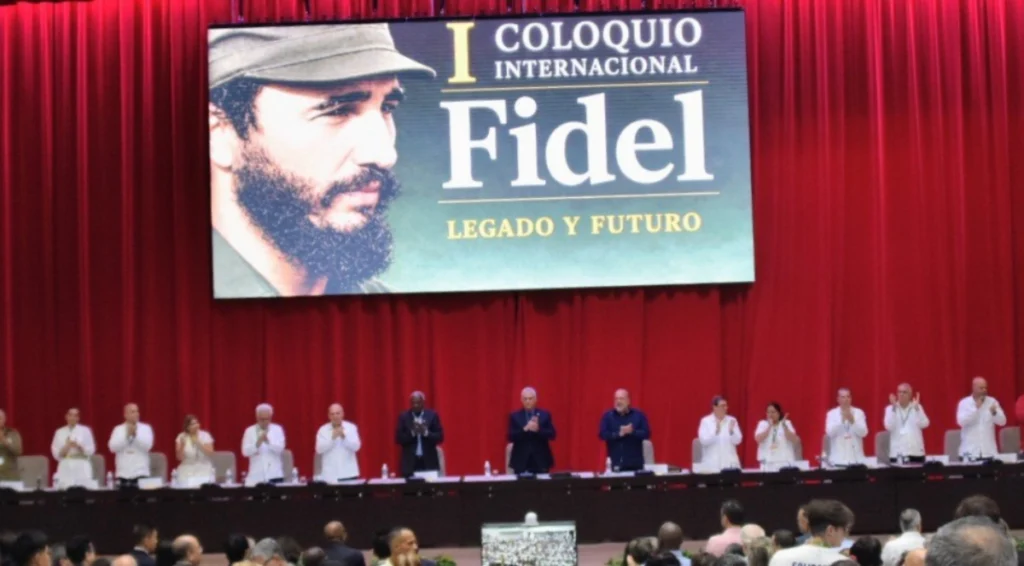
The inauguration of the First International Colloquium: Fidel, Legacy and Future, at the Palace of Conventions in Havana, Cuba, August 10, 2026. Photo: X/@AsambleaCuba.
The inauguration of the First International Colloquium: Fidel, Legacy and Future, at the Palace of Conventions in Havana, Cuba, August 10, 2026. Photo: X/@AsambleaCuba.
The president of Cuba, Miguel Díaz-Canel, inaugurated the First International Colloquium: Fidel, Legacy and Future, at the Palace of Conventions in Havana, with the attendance of 1,500 delegates, including 1,000 international delegates from 63 countries, and a strong youth representation.
The event opened on Monday, August 10 and will run until Thursday, August 13, which marks the 100th anniversary of the birth of Fidel Castro Ruz. It is a broad space for political, academic, and social exchange around the thought of the historical leader of the Cuban Revolution and its relevance to current challenges.
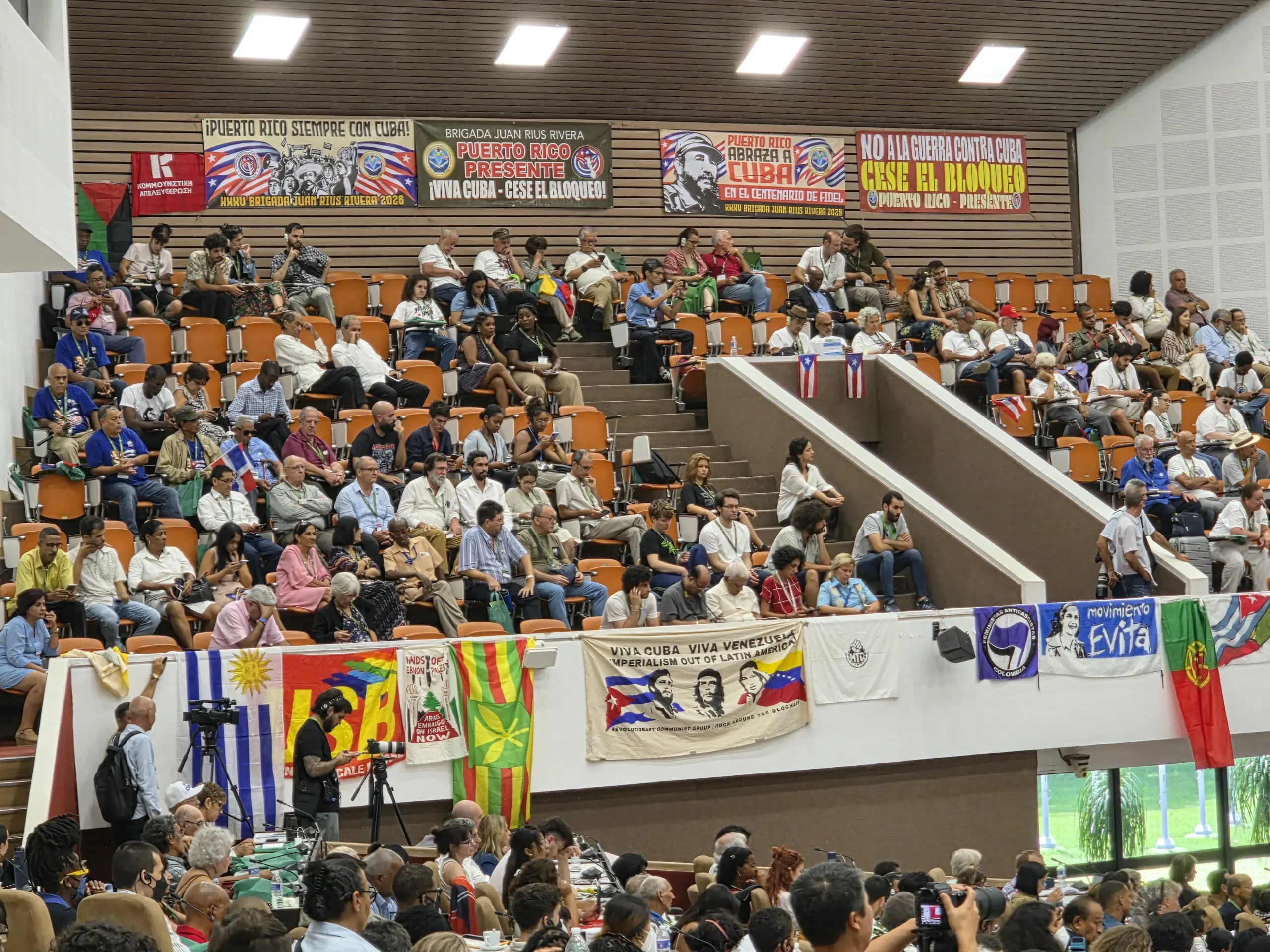
The program includes a formal meeting of the Fidel Castro Ruz Chairs and a symposium dedicated to the Cuban Revolution. In addition, there will be sectoral forums for the youth, parliamentarians, women, artists, creators, and intellectuals committed to popular sovereignty.
Among the topics on the agenda, the influence of Cuban thought on internationalist diplomacy, the self-determination of peoples, and the defense of national sovereignty may be highlighted.
Similarly, collective responses to issues such as socioeconomic inequality, climate change, and threats to peace will be analyzed.
Message from the Chinese president
China was present at the inaugural event, where Liu Haixing, head of the International Department of the Central Committee of the Communist Party of China, conveyed a message from the general secretary of the Central Committee of the CPC and president of the People’s Republic of China, Xi Jinping.
The Chinese president highlighted Fidel Castro’s dedication to Cuba and its people and the significance of his struggle for independence and sovereignty.
Xi Jinping spoke about the contribution of the Cuban leader to strengthening the relations between China and Cuba and reiterated China’s support for the Cuban people and the Cuban Revolution in the current context.
Colloquium in three axes
The colloquium is a tribute to the birth centenary of the leader of the Cuban Revolution, and at the same time acts as a space for reflection on the relevance of his thought.
The colloquium revolves around three axes: the milestone of celebrating one hundred years of a life dedicated to the defense of just causes and strategic thinking; the act of calling upon delegations that challenge blockades, disinformation campaigns, and pressures; and the challenge of safeguarding and transforming the Revolution against economic warfare and suffocation, assuming the legacy of resistance.
Social indices under siege
One of the central themes discussed at the inaugural event was the social indices that Cuba has been able to sustain despite the US blockade. Cuba has more than nine doctors per thousand inhabitants, the highest rate in the continent; a life expectancy of 77.7 years–one of the ten highest in the continent, and the complete eradication of illiteracy in 1961, after a campaign that mobilized 250,000 volunteers.
In this context, the delegates referred to what Fidel Castro said at the UN General Assembly in 1960: “Let the philosophy of plunder disappear, and the philosophy of war will have disappeared! Let the colonies disappear, let the exploitation of countries by monopolies disappear, and then humanity will have reached a true stage of progress!”
Homeland is Humanity
“Homeland is Humanity” is the slogan with which Cuba installed international solidarity as a state policy. In this regard, the delegates made reference to two initial milestones: the creation of the Comprehensive Health Program for Central America and the Caribbean in 1988, and the founding of the Latin American School of Medicine (ELAM) in 1999.
Since then, Cuba sent more than 600,000 healthcare professionals sent to 165 countries, as well as launched the Operation Miracle, with more than three million eye surgeries aimed at restoring vision to people from the poorest sectors of society.
Cuba’s promotion of institutions and global programs such as PetroCaribe, ALBA, the literacy program “Yes, I Can,” and the Henry Reeve Medical Contingent, nominated for the Nobel Peace Prize, was also emphasized.
Regarding Fidel’s work, the delegates noted that “he did not leave recipes, but a method born from praxis.”
The human cost of the US blockade
The delegates also discussed the “human cost” of the blockade that is aimed at suffocating the daily life of the Cuban people in areas of extreme sensitivity.
The figures highlight 1,400 MW of electrical capacity paralyzed due to lack of fuel, causing blackouts of more than 20 hours; 98,000 surgeries pending—of which 12,000 are for children—due to lack of resources and power in operating rooms, and 34,000 pregnant women without access to prenatal ultrasounds.
In addition, there are 67,000 unvaccinated infants and 118,200 oncology patients, both adults and children, who lack adequate treatments due to the blockade on access to technology and materials, such as Cobalt-60.
Translation: Orinoco Tribune
OT/SC/SH