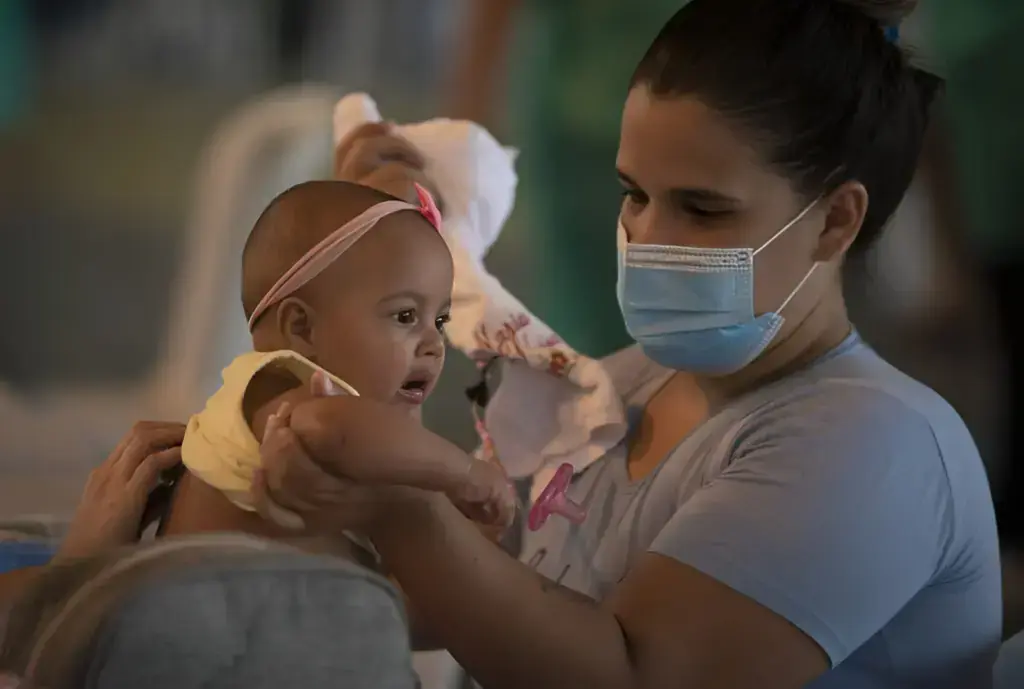
A Brazilian woman holds a child. Photo: Anadolu Agency.
A Brazilian woman holds a child. Photo: Anadolu Agency.
Latin America and the Caribbean is facing an unprecedented demographic situation, with declining fertility, population aging, the transformation of family structures and complex international migration all occurring against a backdrop of persistent inequalities and weakening social mobility and cohesion, associated with gaps in institutional quality and ineffective governance, according to a new report by the Economic Commission for Latin America and the Caribbean (ECLAC).
According to the report “Impacts of Demographic Change in Latin America and the Caribbean: Public Policy Challenges and Options,” presented at the 6th session of the Regional Conference on Population and Development in Montevideo, Uruguay, the total fertility rate, which reached the replacement level in 2015, stood at 1.8 children per woman in 2024, making it the lowest rate in the world.
However, the study adds that the adolescent fertility rate remains high, with 50 births per 1,000 girls aged 15 to 19, reflecting educational gaps and socioeconomic or territorial inequalities that keep the population in a situation of greater poverty.
The data indicates that the decline in birth rates will, in turn, reduce the school-age population to about 38.3 million by 2050, which will require a renewed approach to educational planning aimed at improving the quality and equity of educational systems, as well as teacher training. Moreover, it will be important to advance toward lifelong learning models that include older adults.
Regarding population aging, research estimates that by 2050, people aged 60 and over will represent a quarter of the total population in the region, with around 182 million people.
A parallel process known as the “aging of aging” is also in effect, wherein the population aged 80 and over is experiencing even more accelerated growth than the rest of the age group. “This, together with a preponderance of women and higher levels of dependency in this group, increases demand with regard to pensions, health, care and specialized support services,” the report notes.
The report further indicates that the demographic dividend—the stage when the working-age population is greater than the dependent population—will conclude in 2028, which will bring the challenge of promoting women’s participation in workplaces on equal terms, substantially increasing labor productivity, and reconfiguring the foundations of economic development to compensate for the new age structure.
Another interesting aspect is related to family structures, which have undergone a profound reconfiguration. For example, between 2000 and 2024, the average household size decreased from 4.3 to 3.3 people.
While the dominant two-parent model is losing relative weight, single-person households have almost doubled, and single-parent households—mainly headed by women—have increased significantly.
According to the report, this dynamic is conditioned by the level of income, as smaller and single-person households predominate in the wealthiest quintiles.
ECLAC also notes that urbanization has become a “consolidated trend,” as by 2026, the urban population reached almost 82% of the total, while international migration flows have increased and become more complex.
Moreover, “although regional net migration is negative, intraregional migration has grown exponentially, driven primarily by flows of Venezuelan citizens,” the report commented.
According to the study, these migration flows have a key positive demographic impact on the destination countries with older age structures, as the arrival of younger populations can temporarily moderate population ageing and increase births.
How the Global Food Economy Is Killing Children: The Twenty-Eighth Newsletter (2026)
In the words of the executive secretary of ECLAC, José Manuel Salazar-Xirinachs, this scenario is occurring in a context of persistent inequalities and weakening of mobility and social cohesion associated with gaps in institutional quality and poor governance.
He added that the demographic transformation is redefining the key conditions for development, planning, and education, as well as the sustainability of social protection, health, and care systems.
In this regard, he emphasized that “efforts must be made to develop public policies that respond to the new demographic realities of Latin America and the Caribbean and can address the challenges involved in building more productive, inclusive and sustainable societies, leaving no one behind.”
(Sputnik)
Translation: Orinoco Tribune
OT/SC/CD