Venezuela, with the largest oil reserves on the planet, is again Washington’s favorite target amidst its geopolitical struggle to claim hegemony over the capitalist system.
By Carlos Fazio – April 25, 2020
As we face the so-called “epidemic of the century,” the US has decided to use war diplomacy to escalate its unconventional, asymmetric war against Venezuela. With a series of successive actions intended to spread shock and awe in the “enemy” ranks, on March 26 the Trump administration activated the miserable plan designed by Secretary of State Mike Pompeo and his special representative for Venezuela, Elliott Abrams.
Its ultimate goal is to bring about “regime change” in the country that has the largest proven oil reserves in the world.
That day, in what seems to mark a new point of no return under the legal prong of the coup (lawfare), US attorney general William Barr announced criminal charges of narco-terrorism, cocaine trafficking, money laundering and corruption against the constitutional and legitimate president of Venezuela, Nicolás Maduro.
He also charged a dozen senior civilian and military officials as well as leaders of the Bolivarian Revolution – and even a couple of generals fugitive from Venezuelan justice – under the grotesque argument of “having participated in a criminal association” alleged to involve an ”extremely violent terrorist organization” – the extinct Revolutionary Armed Forces of Colombia, FARC – as well as “conspiring” to use the sale of drugs as a “weapon” against the United States.
On March 31, in another inadmissible act of interference – which violates international law and the principles of the United Nations, including non-intervention, the self-determination of peoples and a prohibition on the threat or use of force in international relations—Pompeo and Abrams published their “plan” euphemistically called “Democratic Transition Framework for Venezuela” (whose sole purpose is the overthrow of Maduro), which was followed on April 1 by Donald Trump’s announcement of the launching of a new anti-drug naval military operation in Caribbean and Pacific waters.
Trump, who appeared in the Oval Office flanked by Defense Secretary Mike Esper and hi Chief of Staff, General Mark Milley, said anti-drug maritime operations will be directed against what he called a “growing threat” from “drug traffickers and terrorists” who seek to “take advantage” of the crisis caused by the coronavirus pandemic to introduce drugs to the United States and harm its citizens.
In turn, Secretary Esper identified Venezuela as a particular threat, accusing the “illegitimate Maduro regime” of using the profits of drug trafficking to stay in power. That is consistent with the covert efforts reported by Venezuelan Foreign Minister Jorge Arreaza in mid-March. He said that amidst a new phase of unilateral US aggression against his country, the Pentagon and the head of the Southern Command, Craig Faller were contemplating a “naval blockade” on Venezuela, an action recognized by the UN as “use of force.” This measure could be escalated with coercive actions under the umbrella of the Organization of American States (OAS), via the Inter-American Treaty of Reciprocal Assistance (Rio Treaty), two relics of the Cold War still being used by Washington.
Pino Arlacchi and the hoaxes of the CIA and the Pentagon
In this new phase of the US hybrid war against the Bolivarian Revolution in Venezuela one should remember that on April 15, 2019, during a question and answer session at the University of Texas, Secretary of State Mike Pompeo said to laughter and applause: “I was director of the CIA. We lied, we cheated, we stole. We even had training courses.” (Although the official transcript by the State Department does not include those words, they were recorded on video.)
Pompeo’s confession came to confirm what is public and notorious and is recorded in hundreds of official documents and literature on the CIA from the past 60 years. But it is still alarming that the chief of American diplomacy should refer to himself as a liar and a thief.
This is even more true at a time when communication experts from the Pentagon and the CIA have launched a new stage of their unconventional war against Venezuela. It is designed around psychological warfare, covert propaganda, and indirect messages through the media (radio, television, written press, Internet), seeking to control and manipulate so-called public opinion by distorting information (toxic news).
In this regard, the charges levied by Attorney General William Barr against President Maduro, the Minister of Defense, Vladimir Padrino López, the President of the Supreme Court of Justice, Maikel Moreno, the Minister of the Interior, Néstor Reverol, and the President of the National Constituent Assembly Diosdado Cabello, among others, of conducting a “narcoterrorist conspiracy” with the FARC to flood the US with cocaine, does not pass the smell test. The theory of a “narco-state” in Venezuela is pure fiction and the US agencies know it.
After learning of this unusual wrongdoing, former UN Deputy Secretary Pino Arlacchi, former executive director of the world organization’s Anti-Drug Program (UNODC), wrote on his Facebook account: “The drug trafficking charge against @ Nicolás Maduro is political garbage. In 40 years of anti-drug experience and as the UN Deputy Secretary, I never ran into #Venezuela; it was always far from the circuits: the US, leading consumer; Colombia [leading] producer.
Later, in an article published by Telesur, Arlacchi said that upon learning the news of the drug trafficking charges against Maduro and members of his government, he was “speechless.” He wrote that he’s seen a lot in the persecution of Venezuela, “but I honestly did not think that the U.S.’s criminal conspiracy would go so far.” And he added: “After stealing $US 5 billion of Venezuela’s financial resources and depositing it in banks in 15 countries, after establishing a blockade of the entire economy of the country through atrocious sanctions with the aim of hitting the civilian population to (unsuccessfully) push them to rebel against their government, and after a couple of failed coup attempts, here is the final shot, an act of despicable defamation.”
After calling this an “episode of asymmetric warfare,” Arlacchi, who served as UNODC executive director from 1997 to 2002, argued that “the maneuver is so over the top,” that he does not think it will have significant consequences at the United Nations or the European Union. “There is no shred of evidence” to support that “slander” which “only exists in the sick fantasy of Trump and his associates.”
He added that it would suffice to consult the two most important sources on the subject: the UNODC 2019 World Drug Report and the latest DEA document, 2019 National Drug Threat Assessment, to verify his assertions. According to the latter, 90% of the cocaine introduced into the US comes from Colombia, 6% from Peru and the rest from unknown origins.
But according to Arlacchi, it is the UN report that provides the most detailed picture, mentioning Mexico, Guatemala and Ecuador as transit points for drugs going to the United States. And the DEA assessment cites the notorious Mexican drug traffickers as the largest suppliers to the US market.
“There is no trace of Venezuela on any page of these two documents. Nor is there in any other mention [of Venezuela] in documents from the anti-crime agencies of the United States over the last 15 years (a topic I am quite familiar with). These do not report any facts that could indirectly lead to the accusations launched against the legitimate president of Venezuela and his government. Therefore, it is just political garbage, which I hope will be treated as such outside the political media system of the United States,” concluded Arlacchi.
A report from the White House Office of National Drug Control Policy published on March 5 indicates that coca leaf crops in Colombia increased by 4,000 hectares to 212,000, while cocaine production grew by 8%, from 879 tons to 951. These figures set historical records.
RELATED CONTENT: Using the Covid-19 Crisis: British and US Military Massing off Venezuelan Coast
From the three sources cited and Arlachi’s remarks, it follows that if the US really wanted to fight drug trafficking, the target would be Colombia, not Venezuela. Another target would be the cartels that distribute the drugs in the US, keeping most of the profits and laundering them there.
To complement the foregoing, a recent report by The Washington Office on Latin America (WOLA) said the role attributed to Venezuela in the transnational drug trade is “exaggerated.” According to the US government’s Consolidated Counterdrug Database (CCDB) cited by WOLA, in 2018, 210 metric tons of cocaine passed through Venezuela. During that same period approximately 10 times more cocaine (2,370 metric tons) passed through Colombia and seven times more (1,400 metric tons) through Guatemala.
Speaking to BBC Mundo, WOLA director Geoff Ramsey said the claim that Maduro is deliberately “flooding” the US with cocaine is “absurd.” And like Arlacchi, he referred to the DEA’s own data. According to Ramsey, the US Department of Justice has been under strong pressure by hardliners in the Venezuelan opposition and the Miami exile community to file those charges, following the same script used by George H.W. Bush in Panama in 1989, in the context of the Cold War.
The Trump administration’s regime change policy of using “lawfare” will now focus on law enforcement agencies such as the FBI and DEA, with the support of military units deployed in the Caribbean and the Pacific and so-called “private security contractors.” We should remember that the current US Attorney General, William Barr, was responsible for drafting the legal justification used in 1989 for the invasion of Panama and for the FBI to enter a foreign country without the consent of the host government. Barr was also the one who arranged a pardon for the genocidal Elliott Abrams in the Irangate affair.
About the DEA and the defector Alcalá
When on March 26 Attorney General Barr announced charges against Nicolás Maduro and eleven high-ranking officials (in addition to two military deserters) for participating in a “narcoterrorist conspiracy” and put a price on their heads, he said they were all part of a so-called “Cartel of the Suns.”
By that time, the dirty war machine in the basements of the Pentagon and the CIA had been manufacturing the conspiracy plot, which was intermittently sold – more intensely in 2015 – in the Western corporate media also complicit in what is called “fourth generation warfare.”
Among the Wild West-style wanted posters released by the Department of Justice and the DEA on March 26, with their logos and a caption reading “REWARD OF UP TO $ USD 10,000,000.00,” including photos of those accused of belonging to the Cartel of the Suns, were two former retired generals who are fugitives from Venezuelan justice: Hugo Carvajal Barrios and Cliver Alcalá.
The day before in Caracas, Venezuela’s Vice President for Communications and Information, Jorge Rodríguez, had unveiled a new terrorist plot to selectively assassinate some high-ranking government officials, including President Maduro. This revelation was based on information published by the Colombian press on March 23 about the seizure of a war arsenal consisting of 26 AR-15 assault rifles and other military supplies in the town of La Ciénaga, Barranquilla, which were going to be brought into Venezuela over the border at Paraguachón in the state of Zulia.
In this context, the first to react hours after the announcement by Attorney General Barr in Washington was Cliver Alcalá, a military deserter and fugitive from Venezuelan justice. He was accused on August 31, 2019, along with Julio Borges and former Venezuelan prosecutor Luisa Ortega Díaz, of having participated in a plan to place explosives in the Palace of Justice and headquarters of the National Police and the Directorate of Military Intelligence—actions linked to the coup attempt on April 30th of that year.
During an interview in Barranquilla, Colombia by the Colombian station W Radio, Alcalá confessed to being part of the plot to commit terrorist acts in Venezuela under the advice of US experts, and claimed ownership of the weapons seized in La Ciénaga on March 23rd. He stated that this arsenal had been financed with money provided by Venezuelan lawmaker Juan Guaidó and that the Iván Duque government [of Colombia] was aware of those plans and had facilitated logistics. In the audio, Alcalá literally stated: “The weapons seized in Colombia belong to the Venezuelan people, within the framework of a pact, or an agreement, signed by President Guaidó, Mr. J. J. Rendón, Mr. Vergara and US advisers. For several months I have been working to put together a Venezuela Freedom unit. Mr. Juan Guaidó sent me to the meeting with the North American advisers and I contributed there, together with members of the Venezuelan military (…) to form a military unit.”
In another part of the radio interview Alcalá said: “I am at home, I am not running away, they informed me of the possibility of a false positive.” In other words, he was afraid of being killed. On March 27 he was detained and transferred on a DEA plane to New York.
One day later, from Washington, Reuters published a cable according to which the former head of Venezuela’s military intelligence, Hugo Carvajal, another key figure in the alleged Cartel of the Suns, whose specific whereabouts in Spain, where he had gone into exile, were unknown, was also in the process of surrendering to the US authorities.
Carvajal, the Cartel of the Suns and the obedient press
Along with Cliver Alcalá and Diosdado Cabello, Hugo Carvajal had been part of the hard core of the alleged Cartel of the Suns, according to the plot manufactured by the DEA and the CIA to implicate former President Hugo Chávez and his successor, Nicolás Maduro, in an alleged criminal conspiracy with the Colombian FARC guerrillas to “flood” the United States with cocaine.
This maneuver, which culminated in 2015, was recorded during the first phase of Operation Venezuela Freedom, outlined in the “Report on Venezuela” prepared in 2012 by the US National Director of Intelligence, James R. Clapper. That report emphasized stirring up propaganda around issues such as planned shortages of food and medicine, unusual price hikes, widespread blackouts, and crime and violence as part of a process of political and social decay leading to induced governance problems that could be exploited by criminal gangs, drug traffickers, paramilitary groups, and pranes or thug armies operating from jails.
In this context, and as part of its irregular war to destabilize the new Maduro government, the screenwriters for the US intelligence services were spreading their new invention in the Western media: the Cartel of the Suns.
The first newspaper chosen to unleash the media circus was ABC of Spain. In January 2015 its correspondent in Washington, Emili J. Blasco, began to spread “scoops” based on “sources close” to an open investigation by the District Attorney for the Southern District of New York. “The number two Chavista head of security has deserted and the US accuses him of drug trafficking,” said the headline. The target of the story was the then president of the National Assembly, Diosdado Cabello, accused in this fabrication of being the “leader” of the Cartel of the Suns and “operator” of the Venezuelan “narco-state”. It was aimed at dividing the Chavez movement internally during the transition caused by the death of the leader of the Bolivarian Revolution, Hugo Chávez, in 2013. But several military officers were implicated along with the then governor of Aragua, Tareck Al Aissami.
Without a shred of evidence and based on the dubious testimony of a disaffected bodyguard, Blasco used the handy Cold War formula of “close sources” to cover up leaks by the CIA, the DEA, and the Department of Justice. In constructing his arguments, a couple of times he used a verb that is the enemy of investigative journalism: “speculate.”
On May 19, 2015, as reported in an investigation by Fernando Casado (“The new invention to attack Venezuela: The Cartel of the Suns”, June 1, 2015), a new leak reached the pages of The New York Times: “The US focuses its extensive cocaine investigation on top Venezuelan officials.” While less yellow journalism sounding than the ABC piece, the influential New York newspaper cited the DEA as a source, but there was still no evidence.
Three days later it was The Wall Street Journal that used leaks from DEA agents and federal prosecutors from New York and Miami to reinforce the hoax about the Cartel of the Suns: “Venezuelan officials suspected of turning the country into an international cocaine distribution center.” Like the previous articles, the lack of evidence persisted.
On May 24, Jackson Diehl, one of the star editorialists of The Washington Post, joined in the Anglo-Saxon media buzz. Diehl titled his opinion article “A drug cartel in power in Venezuela” and treated the “information” he published as reliable facts. His source, which he used as evidence, were alleged emails extracted from the computer of FARC leader Raúl Reyes, which even the Colombian Supreme Court of Justice accepted. In other words, there was still no solid evidence.
As usually happens when “rotten meat” gets planted in the media, and in this case, based on the statement of a deserter, Diehl, from the Washington Post, referenced the articles published in ABC and The Wall Street Journal. In other words, press reports based on unverified information were then used as evidence for press reports in order to produce a “news” story, which, by dint of repetition, becomes “true”.
Within this ongoing unconventional asymmetric warfare, the objectives of the Pentagon, CIA and DEA’s psychological operations and toxic disinformation were exposed by General John Kelly, head of the Southern Command, on March 12, 2015 before the Senate Armed Services Committee. Kelly testified that these actions were aimed at sowing chaos and political destabilization in Venezuela, combined with street actions and the calculated use of armed violence. This stage included the guarimbas that left almost fifty dead, selective killings, sabotage of strategic facilities, and paramilitary actions from the Colombia-Venezuela border.
In this sideshow of news disguised war propaganda, on May 20 intrigue over the Cartel of the Suns was revived, this time by the Spanish newspaper El País in a report titled “New light on the mysterious Cartel of the Suns.” But despite its enigmatic headline, it added nothing new and was simply an ode to speculation.
Five days later, Newsweek magazine in Spanish put the face of Diosdado Cabello on its cover under the headline “Most Wanted.” This US publication reprinted an interview with Juan Forero, the Wall Street Journal reporter who had disclosed a “scoop” on the Cartel of the Suns. As Newsweek put it, “What for many had been an open secret was now affirmed by a newspaper with the prestige of The Wall Street Journal.”
The mechanism for planting an idea in the minds of the public, without solid evidence, had worked because of the laundering of that information. Here the original source of the leak, in this case the DEA -and covertly the CIA- was mostly hidden.
However, as Fernando Casado says in the aforementioned investigation, the chain had started with the Spanish newspaper ABC, which reproduced a “scoop” from its correspondent in Washington, Emili J. Blasco, famous for another “exclusive” from 2012 around the illness of President Hugo Chávez. This then became a trending topic that traveled around the world: “Chávez has one year left to live unless he accepts intensive treatment.” Blasco’s sources were “confidential reports prepared by informants with access to Chávez’s medical team, handled by the intelligence services.” Blasco hid the fact that his source was the CIA, because that would have ruined his credibility. But months later, the former editor of ABC, Ángel Espósito, was interviewed by Casado and acknowledged, “ABC has access to information from the CIA. ABC publishes the information from the CIA. ABC does not say ‘ABC believes Chávez has one year left to live.’ ABC published a CIA report from its Washington correspondent. ”
However, ABC and Blasco, author of the commissioned book Bumerán Chávez (Chavez Boomerang), concealed the fact that their source was the CIA, instead presenting the information as their own using ploys such as “confidential reports” handled by “intelligence services”—in other words, anonymous, vague sources that lack journalistic legitimacy.
Three years later, Blasco and ABC returned to their old ways with their “scoop” about the mythical Cartel of the Suns. Only this time, the new editor of the Madrid newspaper, Bieito Rubido, acknowledged that there was a relationship between his paper and the US intelligence services: “What we publish is always true. In this case our sources are very serious ones, from Spanish intelligence services to the CIA and the DEA,” (See Drug Trafficking Charges against Diosdado Cabello ‘more than proven’ says Director of the newspaper ABC,” NTN24, January 27, 2015).
This was all concocted in the dirty war laboratories without a single shred of evidence. There is no record of the seizure of a single package of cocaine in the United States or another part of the hemisphere with such a logo. However, the file created for this cartel of generals and this fiction about a Venezuelan narco-state was soon eclipsed by the Southern Command’s second phase of Operation Venezuela Freedom. This required positioning the media around a “humanitarian crisis” (due to lack of food, medicine, water, and electricity) and an international public opinion campaign arguing that the South American nation was “on the verge of collapse” and about to “implode,” which set the stage for a request for “humanitarian intervention” at the “request” of the UN or the OAS.
The Pentagon’s conspiracy and psychological warfare plan then entered what it called the “terminal phase” for the Venezuelan revolution around July-August 2016. To this end Washington intensified its policy of “siege and suffocation” of the government of Nicolás Maduro. Under the Full Spectrum Dominance approach drawn up by the U.S. military’s Joint Chiefs of Staff in June 2000 (see the document Joint Vision 2020), it stepped up the use of diplomatic, informational, military, economic and financial resources, intelligence and legal tools, and took advantage of large corporations and business lobbyists, political operators of the international Right and their organic intellectuals, non-state actors (NGOs), Catholic Church leaders, and student groups.
The case of Carvajal case and the DEA storyline
After four years in the shadows, that fictitious construct, the Cartel of the Suns re-emerged in Spain after the National Police arrested the former head of Venezuelan military intelligence and counterintelligence services from 2000 to 2011, Hugo Carvajal, on April 12, 2019.
In February of that year, “made in the USA” Deputy Juan Guaidó, who had proclaimed himself “acting president” of Venezuela, faced the umpteenth “D-Day” for the overthrow of Maduro. The center of the action was the Colombian city of Cúcuta and an unsuccessful attempt to bring “humanitarian aid” into Venezuela. On the eve of this February 23rd stunt, Hugo Carvajal, a disciple of Chávez in the military academy, defected, calling on his former comrades to rebel and throwing his support behind the “self-proclaimed president” imposed by the troika of John Bolton, Mike Pompeo, and Elliott Abrams.
Amid feints and invasion preparations and as the Pentagon’s military siege tightened around Venezuela, Carvajal, according to what his wife Angélica Flores told the newspaper El País, fled that March to Madrid with the help of agents from the Spanish National Intelligence Center (CNI), who even went to wait for him at the Barajas airport. In April, on his way to meet with CNI agents and offer information, Carvajal was detained on an extradition request from the United States. His case was heard in the third criminal chamber of Spain’s National Court.
On September 13, 2019, during Carvajal’s appearance before the National Court, the front page headline of the Spanish newspaper El Mundo was: “Hugo Chávez ordered him ‘to flood the US with cocaine from the FARC’.” The sub-headline read: “El Mundo accesses the US DEA secret report on Venezuela.” On the inside pages the newspaper claimed to have had “exclusive” access to the DEA report that the US Department of Justice had submitted to the National Court the previous day.
The “secret report” added nothing new to the plot divulged in 2015 by the mercenary Western press, nor to the compilation published in May 2018 by the US foundation InSight Crime under the title “Venezuela: A Mafia State?” That investigation into organized crime was sponsored by Open Democracy, part of the George Soros organization and in turn linked to the Carlyle Group of the Bush clan. This again confirmed the existence of the Cartel of the Suns, due to the same defects as the journalistic hoaxes mentioned above. It was based on assumptions and beliefs and presented no solid evidence. But it was apparent that it had been drafted to justify, a posteriori, the judicial warfare (lawfare) practices that, with a veneer of legality, had been used by Washington and its allies against the countries it deems enemies.
Carvajal rejected the accusations of the US justice system as false, and his lawyers described Washington’s request as “political persecution.” They stressed that the charges were based on the testimony of a dozen “confessed criminals” who did not know the ex-military man personally. They denounced the “flippant” way the United States linked Carvajal to the Cartel of the Suns, saying they could just as well have accused him of ties “to the Ku Klux Klan or the National Rifle Association.” They requested denial of the extradition request because it failed to comply with the basic, formal and non-informal requirements and principles.
It was obvious that the leak by the US Department of Justice to El Mundo was an effort to put pressure on the justices on the National Court. However, on September 16, the collegial court denied the extradition request on the grounds that the US claim was based “on political motives” and had been created “within the US political strategy towards Venezuela.”
The magistrates highlighted “the lack of a true telling of the acts alleged to have been carried out by the defendant” and argued that the “conduct” that the US authorities imputed to Hugo Carvajal, “undoubtedly refers to the exercise of the military intelligence service.” They also reported that the US Department of Justice had based its claim on crimes of illicit association to engage in drug terrorism and to import controlled cocaine into the United States from a place outside the country, in addition to a crime of use or possession of firearms.
However, the court warned that this request “is only accompanied by the sworn statement of a DEA agent in charge of the investigation” and “it does not specify what specific acts of a criminal nature” Carvajal carried out.
Therefore, the court considered the description of the events “bereft of determinative value,” and pointed out that the DEA agent’s statement “cannot be used in the factual account that is required in order to attribute to Carvajal the crimes for which he is accused.” Furthermore, the court reproached the US for accusations pointing to “open, abstract and unclear conduct in terms of time, place and acts that constituted the crime for which he was charged.”
Hugo Carvajal was released provisionally, prohibited from leaving Spain, and required to appear in court every two weeks. On November 8, the Attorney General appealed the ruling of the National Court, and the Supreme Court authorized extradition to the United States. Several magistrates not only disagreed with that majority decision, they also reported that they were pressured by the legal advisor at the embassy of Spain in Washington, Jorge Carrera Domenech. One of the judges set forth his disagreement in a dissenting opinion, stating that the drug trafficking investigation against Carvajal was “much more the story of a conspiratorial attack” by the U.S. “against one of its enemies than a legal description of specific criminal acts.”
When informed of the situation by a journalist seeking an interview, Carvajal fled and Elliott Abrams said his escape was a “shame” on the government of Spain. After that the issue was off the radar screen of the media circus, until March 26th when Attorney General William Barr revived the case of Hugo Carvajal and the fictitious Cartel of the Suns.
During a U.S. election year, this new offensive by the White House which includes a renewed naval blockade of Venezuela in the Caribbean, seeks to undermine negotiations between the Maduro administration and the opposition parties. And it is occurring in the middle of the Coronavirus pandemic which has plunged the Trump administration into a serious health crisis. Meanwhile, as the fracking industry is in apparent decline and Whiting Petroleum Corporation—which had projects in North Dakota and Colorado—filed for bankruptcy on April 1, becoming the first victim of the crude oil price war, which may claim 50 more companies from the sector in the coming days. This means that Venezuela, with the largest oil reserves on the planet, is again Washington’s favorite target amidst its geopolitical struggle to claim hegemony over the capitalist system.
Carlos Fazio is a Uruguayan-Mexican journalist and writer, with academic affiliations at UNAM and UACM. He is an investigative journalist and collaborator at the daily paper La Jornada of Mexico and the weekly Brecha of Montevideo.
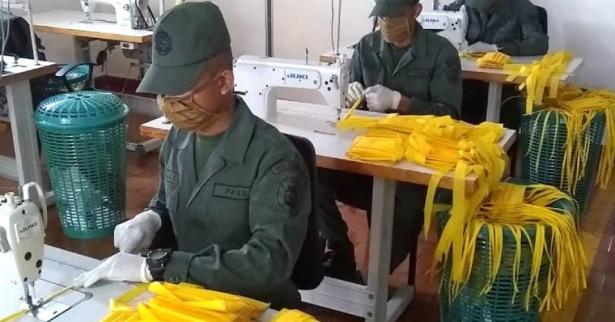
Featured image: Venezuelan soldiers prepare for war… against COVID-19, @Planifica_Fanb