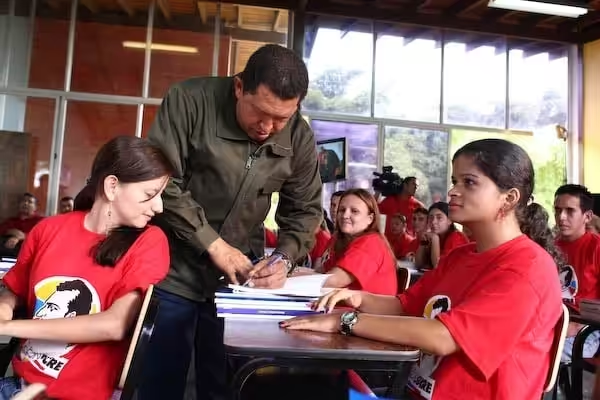
President Hugo Chavez autographing a book for the students of Mission Sucre. File photo.
President Hugo Chavez autographing a book for the students of Mission Sucre. File photo.
By Andreína Chávez Alava – Nov 23, 2022
Venezuelanalysis writer Andreína Chávez writes about the Bolivarian Revolution’s cultural policies, their impact, and present-day versions.
“You are all readers now! Go read to learn about the past, to learn about the present, and to fight for the future.” With these words, President Hugo Chávez used to welcome hundreds of graduates from Venezuela’s literacy program Mission Robinson in the early 2000s. He would then send them off to the world with free books under their arms as soldiers ready for battle.
Chávez’s cultural revolution and its liberating impact on the people could only be described as centuries of progress condensed in a few years, with an entire country being pulled out of the darkness. It is no secret that prior to the Bolivarian Process oil wealth redistribution was skewed toward the elite and everything was privatized or unreachable, even the knowledge that came through education and books.
When Chávez came to power in 1998, he set up to reverse these social injustices. The first, and I would argue most important, step was democratizing education and fomenting love for reading to decolonize our minds, giving true power to the people.
Cuba-Venezuela Comprehensive Cooperation Agreement Turns 22 With Tangible Results
The Venezuelan leader was a voracious reader himself, often reciting his favorite texts during live broadcasts, from poetry to literary classics, revolutionary theory, and the unmissable historical books on Latin America’s emancipation.
Our cultural revolution took off with Mission Robinson in July 2003, when thousands of volunteers took on the task of teaching around 1.5 million people how to read and write using Cuba’s renowned “Yes I Can” learning method. The program’s success was owed to a grassroots-led effort to reach the geographically isolated and historically excluded members of society, such as Indigenous and Afro-descendant groups, urban barrio dwellers, people with disabilities, working-class women, the elderly, and even hundreds of inmates.
The emancipatory project paid off with Venezuela being declared “Territory Free of Illiteracy” by Unesco in October 2005. Chávez went on to launch Mission Robinson II, Mission Ribas, and Mission Sucre for primary, high school, and university education, respectively.
My mom was a Mission Robinson II and Mission Ribas proud graduate. After decades of insurmountable obstacles, she was finally able to pursue an education with free access to books, medical care, eye exams, glasses, and even a scholarship. And classes were within 10-minute walking distance. This is what revolutionizing the system is all about.
I watched her become a woman that spoke with much more confidence, commenting on the political and economic reality around her. She just positively glowed through those years.
Chávez knew that only a nation of readers would spark critical thinking and revolutionary consciousness. That’s why alongside the education programs, there was also a tremendous effort to increase access to books about Venezuela’s history and culture to rescue our indigenous and African roots as well as anti-colonialist struggles, after decades of elite-led efforts to whitewash our identity.
In the span of a few years, popular libraries and bookstores sprung up to trot about towns liberating minds, with millions of titles available for free or at low costs. State-run editorials and Venezuela’s International Book Fair (Filven) were founded as well to revive books and give more Venezuelan authors a platform to publish.
The texts went from Venezuelan independence leader Simón Bolívar to revolutionary theory by Marxist philosopher Ludovico Silva and Cervantes’ epic novel Don Quixote. The purpose was to arm people for the battle of ideas and a cultural transformation amidst a world of misery by capitalist design. In Chávez own words:
“Let us not forget the image described by Victor Hugo, which is tremendously realistic and harsh. He says there is a dark room, poverty, but there is a darker one and that is misery. And I would add another one: hell! We all have to get out of hell, out of the darkness and misery!”
I still remember Chávez saying those words while watching him on television, although at the time I didn’t know he was describing the 1862 French novel Les Misérables. Perhaps this was the moment that inspired him to create “Operation Cosette,” a wonderful project that remains very close to my heart.
When I was sixteen years old, my dad brought home a three-volume edition of Victor Hugo’s haunting story about corrupt systems that prey on the poor. These books were part of the first lot of 500,000 copies distributed for free in 2006.
For years, Les Miserables became my sun and water, adding greatly to my own emancipation process, in which social injustices, past and present, became crystal clear. How could I not recognize the many Jean Valjeans and Fantines around me? I yearned for them to get justice and I cheered for Cosette because compassion saved her from a life of misery.
After democratizing books and education and perhaps closing a perfect circle, in April 2009 Chávez launched the Revolutionary Reading Plan (PRL) which saw the creation of reading groups inside workers’, rural and student organizations, community councils [neighborhood collectives], social production factories, schools, governmental institutions, and more.
The PRL set a higher stage in Venezuela’s cultural revolution: knowledge exchange, reinforcing socialist values, and sharpening minds against media manipulation by dissecting mainstream media articles and images.
“So much poison is injected every day into society, by private media and media campaigns, not just Venezuela but the whole world. We need to inject antidotes and nothing better than the liberation that comes from reading!” explained Chávez at the time.
Almost 15 years later, the Revolutionary Reading Plan, the popular libraries, the free books, and reading circles seem like a thing of the past. Most likely it all faded amidst Venezuela’s economic crisis and deadly US sanctions but these are precisely the times when we need more “antidotes” to combat political apathy and the media’s ruthless warfare.
Where is Venezuela’s cultural revolution today? There are still valuable events organized on a regular basis and some inspiring initiatives by popular organizations, such as communes, but it seems our recent tradition has been preserved more in form than substance.
Take this year’s international book fair and its pretty hallways set up in Caracas’ National Art Gallery, the same place where Chávez launched the Revolutionary Reading Plan back in 2009. This year’s slogan was even aptly chosen: “Reading decolonizes,” but this was no longer a forum for the masses.
So as I went through shelves of pricey books, I wondered if our once flourishing cultural emancipation had been reduced to a yearly fair even if it features wonderful authors like Venezuelan anthropologist Iraida Vargas whose work on communes and socialism is invaluable. It just seems like too narrow a path for the battle of ideas.
With the current imperialist siege against our country that uses media manipulation as one of its main weapons and the resurgence of capitalist logic in the economy, we urgently need more critical thinking and revolutionary consciousness to counterattack. Let’s bring back “Operation Cosette” and multiply it a thousandfold.