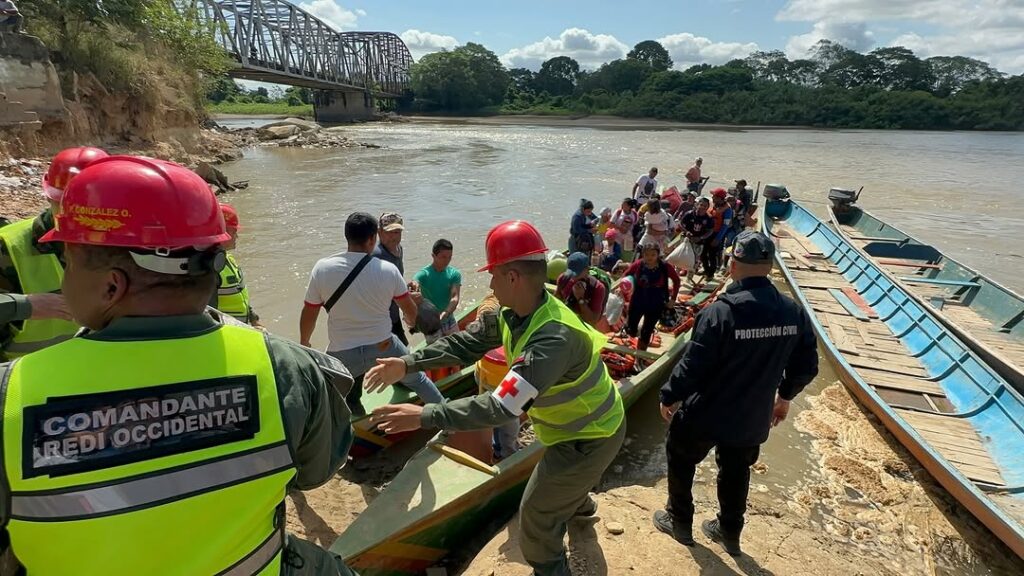
Venezuelan emergency response authorities receiving Colombians displaced due to the armed conflict that erupted in Catatumbo last week. Jesús María Semprún municipality, Zulia state, Venezuela, on Sunday, January 19, 2025. Photo: IG/@madeleintelesur.
Over one thousand Colombians have already passed through the humanitarian corridor established by the Venezuelan government in the border municipality of Jesús María Semprún in Zulia state, fleeing the armed conflict that has kept the Colombian Norte de Santander department in crisis.
Heidi Margarita Beleño, a representative of the Victims of the Colombian Armed Conflict and Displaced Abroad organization, explained this Monday, January 20, that “over one thousand children, women, men, and older adults—victims of violence due to the armed conflict—are being cared for at points established by the Bolivarian National Armed Force (FANB), SAIME [Venezuela’s Administrative Service for Identification, Migration, and Immigration], and the Ministry of Popular Power for Health.”
Beleño highlighted “the solidarity and love of the Venezuelans from the south of Zulia state, whose community spokespeople, from the first moment, have offered their unwavering support,” she said.
President Nicolas Maduro’s instructions were precise, and reception points were established along the humanitarian corridor: at the Rural Command Detachment 11-1 Mi Ranchito, the Ecuador Bridge at Kilometer 16, the Catatumbo Bridge, and the Esmirda de Muñoz School. From there, citizens are transferred to the El Cruce sector to receive proper care and then taken to the Simón Bolívar Task Force headquarters, which is the main shelter located at the Alexis Durán soccer stadium in Casigua El Cubo, Jesús María Semprún municipality.
The representative for the victims of the armed conflict also reported that “there are families who, after crossing the humanitarian corridor, have moved to other municipalities such as Maracaibo, Machiques, and Villa de Rosario, where they have relatives who have been waiting to welcome them subject to prior authorization and review by the authorities.”
The communal councils, Venezuelan state institutions, and the general public are working to provide the displaced with clothing, footwear, household goods, mattresses, and hydration supplies.
Beleño announced that the Colombian Diplomatic Corps would approach the Simón Bolívar Task Force shelter in the next few hours.
On Sunday, during the supervision of humanitarian points by the Venezuelan vice minister for Risk Management and Civil Protection, Admiral Juan Carlos Oti Paituvi, the attention provided to Colombian citizens in terms of medicine, food, transportation, and identity guarantees was supervised. Then, it was reported that 812 Colombians were received at that point, 352 men, 258 women, and 202 children.
To date, no displaced persons have been reported in Táchira state. The Regional Executive is paying attention, especially in the border area, in the Bolívar and García de Hevia municipalities, to assist in case any situation arises in this regard.
Last Thursday, Colombian authorities reported clashes between the National Liberation Army (ELN) and dissidents of the Revolutionary Armed Forces of Colombia (FARC) in the Catatumbo region (in the north of Colombia), leaving at least 30 people dead.
In response, the Colombian Army announced that it would send 300 soldiers to the area where the security crisis has caused the deaths of several peace signatories and civilians. This situation has triggered a humanitarian crisis in the border region with Venezuela, which has been affected for several years by the presence of illegal armed groups and criminal activities related to drug trafficking.