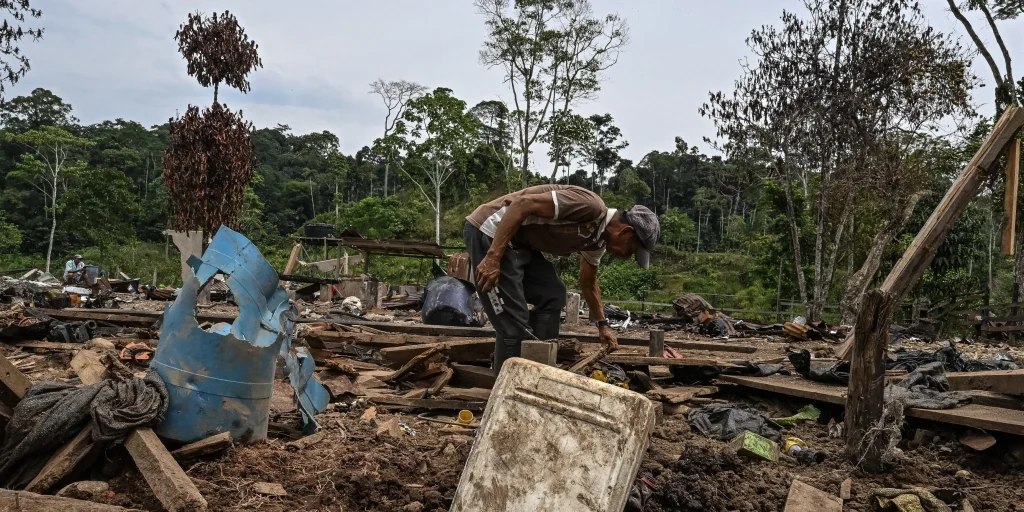
Farmer Jose Pena looks for belongings amid rubble after a bomb dropped by the Ecuadorian army in the Lago Agrio region, Sucumbios province, Ecuador, on the border with Colombia, on March 18, 2026. Photo: Luis Acosta/AFP/Getty Images.

Orinoco Tribune – News and opinion pieces about Venezuela and beyond
From Venezuela and made by Venezuelan Chavistas
Farmer Jose Pena looks for belongings amid rubble after a bomb dropped by the Ecuadorian army in the Lago Agrio region, Sucumbios province, Ecuador, on the border with Colombia, on March 18, 2026. Photo: Luis Acosta/AFP/Getty Images.
By Nick Turse – Mar 23, 2026
With “Operation Total Extermination” and Trump’s threats against Cuba, expect more U.S. military strikes in the region.
As the Trump administration continues to bombard Iran, a top Pentagon official revealed that U.S. wars in the Western Hemisphere are also expanding, unveiling an effort dubbed “Operation Total Extermination.”
Attacks on Latin American drug cartels are “just the beginning” Joseph Humire, the acting assistant secretary of war for homeland defense and Americas security affairs, told members of the House Armed Services Committee last week.
Humire indicated that many more strikes in Latin America are on the horizon. The comments came a day after President Donald Trump again teased American annexation of Cuba. “I do believe I’ll be the honor of — having the honor of taking Cuba,” Trump said last week. “Whether I free it, take it, I think I can do anything I want with it.”
Humire announced that the Department of War supported “bilateral kinetic actions against cartel targets along the Colombia-Ecuador border” — Pentagon-speak for March 3 strikes on unnamed “Designated Terrorist Organizations” previously reported by The Intercept. “The joint effort, named ‘Operation Total Extermination,’ is the start of a military offensive by Ecuador against transnational criminal organizations with the support of the U.S.,” he said.
The U.S.–Ecuadorian campaign has already strayed into Colombia after a farm was bombed or hit by “ricochet effect” on March 3, leaving an unexploded 500-pound bomb lying in Colombia’s border region. In response to a request for comment, U.S. Southern Command referred The Intercept to a statement on X by the Ecuadorian Ministry of Defense confirming the bomb landed in Colombia.
Humire referred to the attacks as “joint land strikes” and said that America was providing Ecuador with “capabilities that they otherwise would not have.” The U.S. has since conducted at least one more strike with Ecuador. “Yes — as @POTUS has said — we are bombing Narco Terrorists on land as well,” self-styled War Secretary Pete Hegseth wrote on X on March 6, announcing the new strike. Days later, in a war powers report announcing the introduction of U.S. armed forces into “hostilities” in that country, the White House informed Congress of “military action taken on March 6, 2026, against the facilities of narco-terrorists affiliated with a designated terrorist organization.”
The attacks in Ecuador are also part of, and an expansion of, Operation Southern Spear: the U.S. military’s illegal campaign of strikes on boats in the Caribbean Sea and Eastern Pacific Ocean. The U.S. has conducted 46 attacks since September 2025, destroying 48 vessels and killing almost 160 civilians. The latest strike, on March 19 in the Pacific, killed two more people and left one survivor. The Trump administration claims its victims are members of at least one of 24 or more cartels and criminal gangs with whom it claims to be at war but refuses to name.
“Rushing to war on one man’s whims is the exact opposite of what the Constitution demands.”
“This Administration is barely paying lip service to the constitutional or international law governing the use of force. But we have these rules for a reason,” said Rebecca Ingber, a former State Department lawyer and now a law professor at Cardozo Law School in New York. “Rushing to war on one man’s whims is the exact opposite of what the Constitution demands.”
Gen. Francis Donovan, the SOUTHCOM commander, told lawmakers last week that “boat strikes are not the answer,” but teased an even larger campaign. “What we’re moving for right now might be an extension of Southern Spear, but really a counter-cartel campaign process that puts total systemic friction across this network,” he told members of the Senate Armed Services Committee. “I believe these kinetic [boat] strikes are just one small part of that.”
Humire could not say how many land strikes were being conducted across almost 20 Latin American and Caribbean nations. “I don’t have an exact number,” he replied to a question. But when asked by Rep. Adam Smith, D-Wash., the ranking member of the House Armed Services Committee, if the War Department would “be moving to a lot more terrestrial strikes,” Humire replied, “Yes, ranking member.”
The Office of the Secretary of War did not respond to a request to clarify how great that increase might be.
Humire said the U.S.–Ecuadorian campaign was “setting the pace for regional, deterrence-focused operations against cartel infrastructure throughout Latin America and the Caribbean.” The word “deterrence” has become a popular Pentagon euphemism for the use of lethal strikes, in contrast to previous efforts to U.S. government efforts to marshal economic, diplomatic, and military means to convince adversaries to abandon a specific course of action. “Deterrence has a signaling effect on narco-terrorists, and raises the risks with their movements,” Humire claimed.

In January, the U.S. attacked Venezuela and abducted the country’s president, Nicolás Maduro. It now rules the country through a puppet regime. Federal prosecutors have reportedly drafted a criminal indictment against Venezuelan Interim President Delcy Rodriguez, threatening her with corruption and money laundering charges if she does not continue to do the bidding of the Trump administration. Trump also recently teased the possibility of making Venezuela the 51st U.S. state.
The Trump administration is reportedly undertaking a regime-change operation in Cuba, attempting to push out President Miguel Díaz-Canel as a requirement for negotiations between the U.S. and that island nation. U.S. officials are said to favor Raúl Guillermo Rodríguez Castro, the grandson of 94-year-old Raúl Castro, the former Cuban president and brother to Fidel, the leader of Cuba from 1959 to 2008. Díaz-Canel referenced U.S. plans to “seize the country” on X late Tuesday and said the U.S. would be met with “impregnable resistance.”
“I am holding Cuba,” Trump said recently, noting his costly regime-change war in the Middle East takes precedence at the moment. “We’re going to do Iran before Cuba.” Trump imposed an oil blockade on Cuba in January, plunging the country into a humanitarian crisis. The island’s national electrical grid has already collapsed three times this month, with one blackout lasting more than 29 hours. U.N. human rights experts have condemned Trump’s fuel blockade on Cuba as “a serious violation of international law and a grave threat to a democratic and equitable international order.”
Trump, who has repeatedly spoken of “taking” Cuba, is the latest in a long line of U.S. presidents who have attempted to overthrow the Cuban government. During the Cold War, the CIA launched the disastrous 1961 Bay of Pigs invasion. The agency also tried to assassinate Fidel Castro at least eight times. The U.S. also conducted a covert campaign of bombing Cuban sugar mills and burning cane fields, among other acts of sabotage.
In the wake of the Bay of Pigs debacle, the Pentagon prepared top-secret plans to pave the way for an attack on the island. In the spring of 1962, the Joint Chiefs of Staff circulated a top-secret memorandum titled “Justification for U.S. Military Intervention in Cuba.” It described numerous false-flag operations that could be employed to justify a U.S. invasion, including a plot to “sink a boatload of Cuban refugees (real or simulated)” and even staging a modern “Remember the Maine” incident by blowing up a U.S. ship in Cuban waters and blaming the incident on Cuba. Other U.S. plans for covert action on the island specifically prioritized attacking Cuba’s electrical grid.
Asked if the Joint Chiefs of Staff were involved in analogous actions today, spokesperson Maj. Annabel Monroe referred The Intercept to Southern Command, who then referred The Intercept to the State Department, which did not respond to a request for comment.
Humire said that the War Department was “currently focused on partner-led deterrence operations,” but would not rule out unilateral U.S. strikes across Latin America. He said that, in addition to Ecuador, the U.S. had forged agreements with 17 partner-nations in the Western Hemisphere, as part of the so-called Americas Counter Cartel Coalition. This international body, formally announced by Trump at his Shield of the Americas summit earlier this month, will focus on “bi-lateral and multi-lateral operations against cartels and terrorist organizations.”
Humire was asked if any of the 18 nations were concerned about issues of sovereignty regarding the U.S. potentially conducting attacks in their countries. “Members of the coalition specifically signed a joint security declaration mentioning that they want this support and most of them all are looking for this,” he replied. But the barebones statement they signed is astonishingly vague and offers little of substance on the subject.
Humire indicated that the U.S. had leveraged gunboat diplomacy in Venezuela to strong-arm Cuba and assist in “gaining compliance from Nicaragua,” as well as “shifting the Caribbean in a favorable direction toward U.S. interests.”
Recent official leaks about the potential U.S. indictment of President Gustavo Petro of Colombia on drug charges — the official reason for Maduro’s kidnapping, and the means reportedly used to keep his successor, Rodriguez, in line — suggest the U.S. may employ that tactic as leverage or an eventual pretext for military action. (Petro has denied ties to drug traffickers.)
“It sounds as if Petro is potentially on the chopping block,” a former defense official, who spoke on the condition of anonymity due to his current employment, told The Intercept. The source said leaks about the potential indictment of Petro, coupled with the U.S.–Ecuadorian attack, which has stirred up tensions along the South American nations’ border, increasingly look like a coordinated campaign to foment “discord” if not conflict. Asked in January about attacking Colombia, Trump responded: “It sounds good to me.”
The U.S. attacks on the Colombia–Ecuador border come as America has recently established a “permanent FBI presence in Ecuador,” joining agents from the U.S. Drug Enforcement Administration and the Department of Homeland Security. Just before the U.S. began attacks on the Ecuador–Colombia border, Donovan traveled to Quito, Ecuador’s capital, to meet with President Daniel Noboa and senior Ecuadorian defense officials.
Last August, Lt. Col. Phillip Vaughn — the commander of an Expeditionary Task Group overseeing Air Force Special Operations in the Caribbean and South America — coordinated meetings to increase “interoperability between U.S. and Ecuadorian forces” to “counter illicit actors operating along Ecuador’s northern border” with Colombia including “operational planning scenarios, execution of close air support procedures,” and “multiple topics on Joint Terminal Attack Controller support,” which relates to targeting and airstrikes.
America’s Western hemisphere blitz is part of what Trump and others have called the “Donroe Doctrine”: a bastardization of the 1823 Monroe Doctrine. While President James Monroe’s policy sought to prevent Europe from colonizing and meddling in the Western Hemisphere, Trump has wielded his variant as a license for America to do exactly that.
The National Security Strategy, released late last year, decrees the “Trump Corollary” to the Monroe Doctrine a “potent restoration of American power and priorities,” rooted in the “readjustment of our global military presence to address urgent threats in our Hemisphere.” Humire defined “America’s immediate security perimeter” as “Alaska to Greenland in the Arctic to the Gulf of America and the Panama Canal and surrounding countries.” Trump has also threatened to annex Greenland (and possibly Iceland), turn Canada into a U.S. state, and conduct military strikes in Mexico. Humire also detailed efforts to strong-arm Panama to cut ties with China to ensure access to the Panamanian-owned canal that he nonetheless called a U.S. “national asset.”
In addition to his wars in the Western hemisphere, Trump has also launched attacks on Iran, Iraq, Nigeria, Somalia, Syria, and Yemen during his second term — most of them sites of U.S. conflicts during the war on terror.
Smith, the House Armed Services Committee ranking member, told Humire that Trump’s wars in the Americas also appeared to be morphing into a new “forever conflict” with no clear goal or “end point.” Asked what “level of achievement” would be necessary to “stop kinetic action,” Humire responded with a wall of words about border security, terrorism, and cartels. When Smith interrupted to clarify if the boat strikes would continue unabated, Humire confusingly replied: “No, correct.”