By Pablo (SOAW)
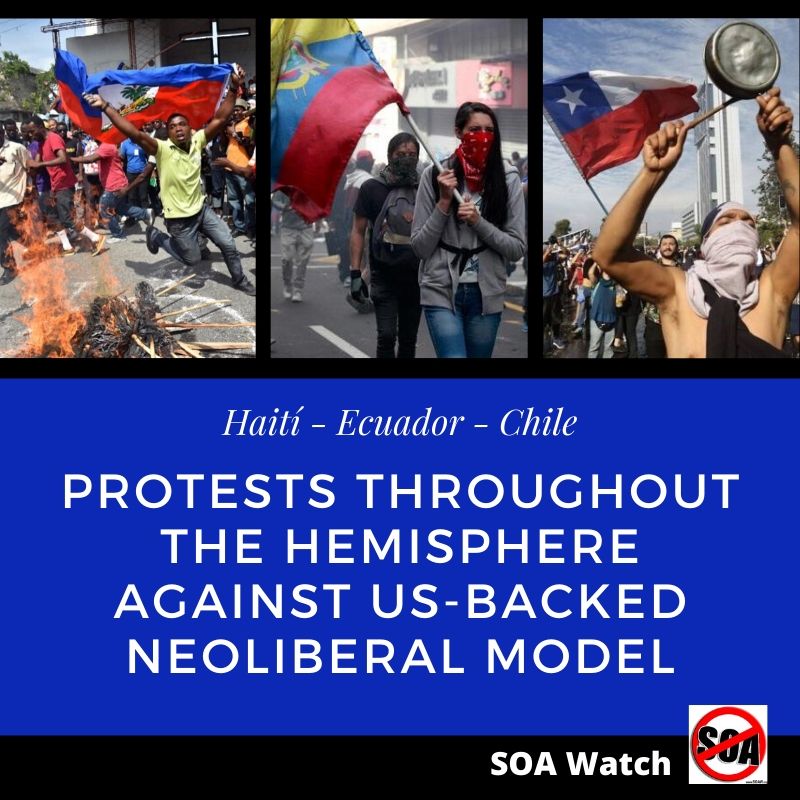
In recent weeks, massive demonstrations have been occurring in Chile against the US-exported neoliberal economic model. The imposition of the neoliberal model in Chile occurred under the Pinochet dictatorship and was designed by the ‘Chicago Boys’, economists trained under Milton Friedman at the University of Chicago. Chile has long been uplifted as a model for the success of neoliberalism, which includes privatization of public services and goods, deregulation, and cuts to public spending in areas such as health and education. However, Chile’s so-called ‘economic miracle’ has come at the cost of the majority of the population, as Chile is the most unequal country of the Organization for Economic Cooperation and Development (OECD) nations.
One of the slogans of the protests in Chile is ‘It’s not 30 pesos, it’s 30 years’ referring to the fact that although the 30 peso increase in metro fare that sparked the current wave of demonstrations has been reversed, what they are protesting is 30 years of neoliberal economic destruction — enshrined in the Constitution, imposed during the Pinochet dictatorship, and evidenced in the continued privatization of public services, including education and pensions as well as policies that benefit the economic elite while cutting public spending. Many demonstrators are demanding a new Constitution that ensures rights for all Chileans.
RELATED CONTENT: Agony and Death of Neoliberalism in Latin America
The demonstrations in Chile follow similar massive demonstrations in Ecuador, where protests were sparked by International Monetary Fund (IMF)-imposed cuts to fuel subsidies, the latest move in a series of neoliberal economic policies. The IMF is the US-dominated international financial institution that imposes neoliberal economic policies on countries in exchange for loans, wreaking havoc throughout the world. Earlier this year, IMF-backed changes to education and healthcare in Honduras also sparked months of massive protests. In Ecuador, after days upon days of demonstrations that paralyzed the country, Indigenous leaders reached an agreement with Ecuador’s government to cancel the IMF austerity package. However, Indigenous organizations have been clear that this is not enough. In a recent letter to the IMF, Ecuadoran Indigenous organizations demanded the IMF ‘stop the pressures to sign letters, treaties, agreements that do not benefit the Ecuadoran people’ and indicated they would return to the streets if policies that benefit powerful economic groups and hurt the majority of the population continue to be imposed.
Massive and ongoing demonstrations have also been taking place in Haiti over the past year, demanding the resignation of US-backed President Jovenel Moïse. The demonstrations, which have been occurring since at least July 2018 and intensified this September and October, also have their roots in US policy. Previously, Haiti had received cheap oil through Venezuela’s Petrocaribe program — which had provided very significant aid to Haiti for years — but this ended under President Moïse, who began towing the line of US policy towards Venezuela, negatively impacting the population. An audit also found that Moïse and other politicians had stolen millions in Petrocaribe assistance funds increasing public outrage. In July 2018, fuel price hikes, yet again as a result of the IMF, sparked demonstrations and since then demonstrators have been demanding Moïse’s resignation. Despite more than a year of mounting protests demanding his resignation, Moïse refuses to step down — it is widely understood that Washington is keeping him in power. As Haitian photographer Georges Harry Rouizer stated in this NACLA article, “Nobody supports Moïse—not the people. He came to power without popular support… But he has the U.S. as his bwa banann (the support that holds up a banana tree), so he stays in power.”
RELATED CONTENT: The Great Hypocrisy of Our Time
The massive demonstrations in all three countries have been met by militarization and brutal repression by state “security” forces. In Haiti, the National Human Rights Defense Network reports that just between September 16-30, 2019, at least 17 people were killed in the state repression of the demonstrations. Demonstrators in Ecuador were also killed by state repression and persecution, including Indigenous leader Segundo Inocencio Tucumbi Vega. Ecuador’s Indigenous federations report that the violence and repression in the context of the protests left 8 people dead, 1340 injured, and 1192 detained. In Chile, President Piñera declared ‘we are at war’ on the protests. This, combined with brutal repression, has led the demonstrators to demand his resignation. While estimates from organizers on the ground are higher, the Chilean state’s National Institute for Human Rights (INDH) reports 20 people have died in the context of the protests and has announced that it will be presenting criminal cases for 5 people it has documented as being killed by the military and other state “security” forces. According to the INDH, 1,233 people have been injured and 3,712 people detained (again real numbers may unfortunately be higher) and there have been numerous cases of sexual violence by state authorities against detainees. Demonstrators have also denounced the use of the metro station’s tunnels as a torture center and other human rights violations by state “security” forces during the repression against the demonstrators.
As the protests and repression continue in Chile, its National Coordinator of Human Rights Organizations writes ‘the impunity for the crimes of yesterday causes the injustices of today’. The US trains and provides assistance to the military and other “security” forces in Haiti, Ecuador, and Chile, which are responsible for the brutal repression against demonstrators. After Colombia, Chile sends the second highest number of “security” forces to be trained at the SOA-WHINSEC.
SOA Watch stands in solidarity with demonstrators throughout the continent who are challenging the US-exported neoliberal economic model and its institutions, such as the IMF, which only lead to inequality, privatization and injustice. It is at moments like these, when this economic model is in crisis, that the US agenda of training and financing security forces throughout the continent is made clear: impose right-wing economic policies that benefit corporations and the elite and result in privatization and cuts to public spending, harming the overwhelming majority of the people. These policies are enforced by US-backed regimes and US-trained and financed “security” forces, who do not think twice about firing live bullets at their own populations — those who are simply demanding the right to determine their own economic models and live with dignity.