
By David Ridley
Taking the top 50 firms in the productive economy into public ownership and subjecting the rest to planning agreements is the only way to counter the power of multinational companies, according to Stuart Holland’s distinct brand of democratic socialism. In this first article for Forging the Weapon, I look at Stuart Holland’s influential 1975 book, The Socialist Challenge, which provided the theoretical basis of the Labour Party’s 1973 Alternative Economic Strategy.
As an adviser to Harold Wilson on European affairs in the 1960s, Holland persuaded French President Charles De Gaulle to give Britain a second chance to join the European Community. When Wilson failed to follow through, he resigned started and studying for a Ph. D in Economics at Oxford University. After graduating from Oxford, Holland then became a Lecturer at Sussex University, where he drafted what became the economic program of the British Labour Party in the 1970s.
After reviewing Holland’s unique theory of the ‘state as entrepreneur’, I look at a recent vision of a UK Green New Deal, highlighting a lack of engagement with the problem of meso-economic power. In the last section, however, Jeremy Corbyn’s latest policy of a publicly owned pharmaceutical company as part of Labour’s ‘Medicines for the Many’ policy is argued to have a distinctly Holland-esque approach to monopoly capitalism.
Democratic socialist governments should not limit themselves to nationalizing economically inefficient companies or sectors subject to ‘market failure’ such as energy, transport and healthcare, but should rather aim public ownership at the ‘commanding heights’ of the economy, taking over profitable firms and growing them through targeted investment and expansion.
This is Stuart Holland’s argument in The Socialist Challenge, a hugely influential book that provided the theoretical foundations for the UK Labour Party’s economic policy in the lead up to the 1974 general election and expressed most clearly Holland’s idea of the ‘state as entrepreneur’.
Holland’s vision of public ownership was a response to the failure of Keynesian economics in the 1960s. Macroeconomic intervention through fiscal and monetary policy had failed, Holland argues in the book, because a new power had emerged in the post-war period not taken into account by Keynes in his General Theory of Employment, Interest and Money.
Multi-national companies made up what Holland called the ‘meso-economic’ layer, which, through their power to control prices and move their operations to the most favourable international markets, scuppered both macro-economic policy and distorted competition in the ‘micro’ economy. Only direct and ‘decisive’ state intervention at the meso-economic level could secure strategic objectives such as national and regional investment in socially useful production.
Only direct and ‘decisive’ state intervention at the meso-economic level could secure strategic objectives such as national and regional investment in socially useful production.
Competitive public ownership would then provide a political-economic foundation for wider planning agreements, as well as for increased worker control within firms through an expanded trade unionism. Alternative plans and industrial democracy can then become the core of a new ‘social contract’ between industry, government and workers based on tripartite sectoral collective bargaining.
Holland’s vision bears directly on the present, when public ownership is once again on the agenda for the Labour Party as part of wide-ranging proposals for a ‘Green New Deal’. However, while the new economics is excellent on dealing with the power of finance, not much, if any, is concerned with the problem of meso-economic power.
International markets are dominated now more than ever by multi-national companies, which wield enormous power over both national governments and local businesses. Aiming public ownership at the least sustainable yet economically profitable meso-economic players would be politically a good place to start for an entrepreneurial state approach to the Green New Deal.
The limits of state capitalism
The core argument of Holland’s book, and of the 1973 Labour Party economic strategy which was based on it, was that Keynesian economic policy had become ineffectual in an age of multi-national corporations.
Keynes in his day turned economic orthodoxy on its head, proposing that instead of rebalancing the economy during a crisis, the state should borrow and spend to stimulate demand. Previously, liberal economic theory imagined the state as a household, in which too much debt was bad, and austerity was sometimes needed to put the national economy back on secure foundations.
However, Keynes realized that if people stopped spending money during a crisis, this would lead to a negative ‘multiplier’ effect, where the businesses that no longer received this custom ended up cutting jobs, which led to further decreases in spending, until the whole system seized up like a machine with no oil.
But the same multiplier effect, Keynes theorized, also applied to investment. If governments stimulated demand through low interest rates, tax cuts and welfare measures, then people would spend more, creating a virtuous circle in which more jobs would be created, more tax could be recouped, and wealth eventually would trickle down through the levels of society.
For Holland, the problem with this argument was not so much the theory—which in a perfectly competitive market would probably work—but the economic reality in which multi-national corporations take these government stimulants with one hand and stick two fingers up at national and local economic and social needs with the other.
Multi-national energy and pharmaceutical companies are happy to take government handouts subsidies, for example. But if governments then demand lower prices or try to recoup some of this expenditure through corporation tax, these monopoly firms will also happily blackmail states with the threat of relocation to a country with a more appealing wage and taxation regime.
RELATED CONTENT: The Russian Revolution Changed the World Forever
Alongside such blackmail, minimal financial reporting requirements and arbitrary accounting practices mean that finding out exactly how much profit a multi-national made in a particular country is incredibly difficult for governments, making fair taxation of profits almost impossible.
As Holland and many other monopoly capitalism theorists have understood, due to their monopolistic position in not just local but international markets, meso-level corporations can set prices to achieve maximum profitability. This runs counter to liberal economic theory, which believes prices to be determined ultimately by what consumers are prepared to pay for products.
If competition does appear within a particular market, monopolists will lower prices for a short time to abolish such competition, raising them again once monopoly is re-established. If production costs rise due to inflation, this cost is generally passed onto the consumer in the form of higher prices. In most cases, rival brands are in fact owned by the same company, with generic alternatives perceived as inferior thanks to massive spends on advertising and marketing.
In effect, it is the meso-economic layer that determines demand through pricing and marketing, not consumer. Collusion, manipulation and bribery are the rule in monopoly capitalism, not competition.
Socialism-by-results
If governments have any chance of influencing the economy in favour of social needs, then they will need to act directly and decisively at the meso level, Holland insists. Rather focusing exclusively on infrastructure and saving ‘lame ducks’ from insolvency, although both still necessary, governments should take immediately into public ownership the top one or two most profitable and efficient firms in each productive industry.
Thanks to their meso-economic power and influence in these key markets, the state then has genuine capacity to direct production to social need, while also gaining access to key information about these markets that can inform realistic price restraint and taxation policies.
Planning agreements for the remaining large firms in each sector then become enforceable, unlike Labour’s 1964 National Plan, which promised to increase investment, expand exports and replace inessential imports.
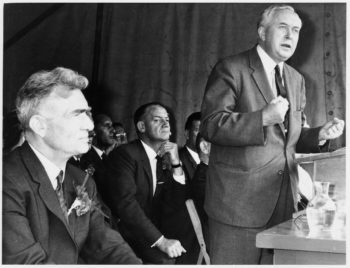
Undermined by a lack of real information and power to influence what happened inside company boardrooms, Harold Wilson’s ambitious attempt to resurrect state intervention was not realized in government. However, with the state leading markets through entrepreneurial public ownership with their access to real information, and under the threat of state aid withdrawal and further public ownership if companies were not to co-operate, Holland maintains that such planning becomes once again feasible.
As part of such planning agreements, Holland suggests that measures to increase worker participation in decision making and corporate planning should be explored. Holland is not so vocal about workers’ control in The Socialist Challenge—preferring instead to concentrate on tripartite bargaining at a national level—but this aspect of Labour’s turn to the left is far more pronounced in the 1973 alternative economic strategy, perhaps thanks to the influence of the Upper Clyde Shipbuilder’s ‘work-in’ on key architect, Tony Benn.
For Holland, wage restraint policies for workers through their trade unions—crucial alongside price leadership through meso-economic public ownership—are only achievable through a new ‘social contract’ between labour, industry and government, negotiated through tripartite bargaining.
Like the National Plan it was designed to support, Labour’s social contract in the 1960s only exacerbated tensions between labour, industry and government, Holland notes, exactly because Labour’s side of the bargain was not followed through thanks to a lack of governmental power to control industry.
A new social contract, Holland maintains, would need to advance significantly on this ‘limited’ and ‘ambiguous’ example in the 1960s and become part of a genuine democratic-socialist transformation, including ‘not only the main features of economic performance in which sustained non-inflationary rate of wage increases will itself depend, but also those wider features of social justice which largely eluded Labour in government’ (p. 306).
While Jean-Jacques Rousseau imagined a social contract within small, face-to-face direct democracies, Holland points out that ‘super-powers and super firms are here to stay’. This means that representation becomes a key issue for what he calls ‘socialism-by-results’. Without industrial democracy—including the power to hire and fire managers in publicly-owned firms—parliamentary socialism is doomed to fail.
Without industrial democracy—including the power to hire and fire managers in publicly-owned firms—parliamentary socialism is doomed to fail.
Holland notes that his distinctly pragmatist program of socialist transformation ‘will not fulfill the aspirations of some socialists to an economy in which private sector capitalism is abolished altogether’ (p. 314). Nevertheless, he insists that his vision of ‘meso-socialism’ has the potential to create a ‘chain reaction’ that would fundamentally and permanently ‘reverse’ the way that economic, social and political power is organized within society.
Although this would be a revolution within a democratic framework—extending and reinforcing democratic processes both at the national and the regional level, and in the enterprise itself—‘no such change can be gradual partial or purely pragmatic’, Holland argues.
‘Flexibility and experiment will be essential in any transformation which enables people to attempt new ways of shaping and running their own lives at work and in society. But a strategy for fundamental change is crucial if change itself is not to become subject to events in favour of the challenged system.’
Tackling meso-economic power today
Interestingly, Holland describes in passing his vision of meso-socialism as a ‘really new deal for working people as a whole’, noting that such a vision can only be achieved by ‘transcending the Roosevelt or Beveridge concept of the Welfare State and adapting government intervention to the changed social and economic climate of our times’.
Today, many on the left are campaigning for a ‘Green New Deal’ to address in a decisive way the threat of irreversible climate change through a fundamental transformation in economic and social relations. However, while the new left is very strong on dealing with the power of finance to both enable and frustrate such transformation, it is not so vocal on the potential for meso-economic power heavily invested in maintaining the status quo to kill such a new deal in its infancy.
Good video explaining the U.S. version of the Green
New Deal (Vox)
British think tank Common Wealth has, for example, recently argued that a ‘transformation of our financial system so it can mobilise and direct the resources and investment needed to drive decarbonisation’ must be ‘at the heart of any radical Green New Deal’.
To deliver a ‘rapid and just transition’ via the ‘largest peacetime mobilization of resources in our history’, four changes to the UK’s financial system are required, according to Common Wealth:
- the reorientation of private financial institutions to serve social needs through new macroprudential rules and binding green fiduciary duties for institutional investors;
- the repurposing of central banking to guide our economies toward rapid transition including the use of new macroprudential tools and credit guidance;
- the creation of a new architecture of international finance that can fund a global just transition;
- and finally, an expansion in the scale and ambition of public finance and fiscal policy including increased public investment and mission-oriented public banking.’
However, when it comes to ‘democratization of ownership and control in the economy’ and ‘breaking from a system dominated by private ownership focused on profit and accumulation and instead extending democratic governance and power into economic life, no mention is made of meso-economic power.
RELATED CONTENT: Campesinos Defending Chavez’s Project: A Conversation with Andres Alayo (Interview)
Even more worryingly, the IPPR’s Luke Murphy says nothing of meso-economic power or multi-national monopolies in his contribution to Common Wealth’s ‘roadmap’, ‘An Industrial Strategy at the Heart of a Green New Deal’.
Claiming that the Conservative Party’s 2017 Industrial Strategy was a ‘good start’, Murphy’s ‘mission-based’ approach to decarbonisation remains squarely within Keynesian boundaries, calling for increased government borrowing and spending to stimulate green investment, and an expansion of the remit of devolved authorities to ensure this investment is focused outside London.
While the ‘international trade union movement’—in particular its idea of a ‘just transition’ in which new jobs are guaranteed in the new green economy—is recognized as ‘essential to ensuring that the journey towards an environmentally sustainable economy is fair and just for all, no suggestions are made as to how workers can repurpose industry towards socially useful ends.
Freelance journalist Ellie Mae O’Hagan addresses the role of trade unions in more detail in her contribution ‘Organised Labour and the Green New Deal’, calling for workers to be themselves involved in designing a just transition to renewable energy.
‘In conjunction with workers in the energy sector,’ O’Hagan writes, ‘trade unions could design a just transition that both lays the groundwork for future green jobs, ensures trade union density increases, and finds good, unionised jobs for those currently employed in the fossil fuel industry.’
Once such a transition is underway, a Green New Deal should back existing Labour Party policy of putting workers on boards, including a third of the board comprising of workers for companies with more than 250 staff members.
This initiative could begin from companies directly affected by the Green New Deal, and then become a template for workplaces across the economy. The workers appearing on these boards must be selected and trained via trade unions, rather than independently of them. This would guard against employers using workers on boards as a PR exercise or to undermine the existing trade union presence, and also ensure the workers in question were backed by their organized colleagues, and therefore less susceptible to pressure.
While important, these proposals fall well short of Holland’s vision of meso-socialism, and again under-estimate the power of multi-national companies to frustrate top-down state intervention. The reality is that today’s labour movement is weak and will provide little bottom-up support to make sure such intervention is followed through at the level of the firm. Now as in the 1970s, state intervention must be decisive and far reaching if it is to be effective.
Medicines for the Many
Meanwhile, Jeremy Corbyn’s surprise announcement of a new policy program, ‘Medicines for the Many’—a ‘radical program of reforms’ to make life-changing drugs available at affordable prices and ‘create a health innovation system that will put public health before private profit’—seems to be drawn right from Holland’s book.
Promising to take on the big pharmaceutical companies which ‘deny life-saving and life-changing medicines to ill patients by charging extortionate prices’, Corbyn announced plans to make public funding for pharmaceutical research conditional on the resulting drugs ‘being priced affordably for all’ and, most importantly, to ‘create a new, publicly-owned generic drugs manufacturer to supply cheaper medicines to our NHS.’
‘We’ll tell the drugs companies that if they want public research funding, then they’ll have to make their drugs affordable for all,’ Corbyn declared at the Labour Party Conference last month. “And we will create a new, publicly-owned generic drugs manufacturer to supply cheaper medicines to our NHS—saving our health service money and saving lives.”
“And we will create a new, publicly-owned generic drugs manufacturer to supply cheaper medicines to our NHS—saving our health service money and saving lives.” —Jeremy Corbyn at the Labour Party Conference
While there is not much detail to be found on this idea at present, in Medicines for the Many policy document Labour that the new public pharma company could, alongside manufacturing generic medicines also enact government Crown Use licences—a legal provision within UK patent law that allows governments to make use of patents without the authorization of patent-holders.
Crown Use licenses have been suggested as a way of breaking the current deadlock surrounding cystic fibrosis drug Orkambi. Vertex’s UK list price for Orkambi is £104,000 for a year’s treatment, but NHS England’s attempts to negotiate a much lower price have hit long-term refusal from the U.S. pharma company.
In a Parliamentary debate triggered by an online petition which reached 118,034 signatures, health minister Seema Kennedy said that unless Vertex “change their approach and behave responsibly”, she would have a “moral obligation” to look at options like Crown Use licenses, a measure that had only been used once before in the UK.
Last year Green Party MSP Alison Johnstone also demanded that Scottish Parliament issue a Crown Use licence for breast cancer treatment Perjeta [pertuzumab]. Just Treatment, who were behind the campaign, pointed to the “significant bargaining power to be gained from initiating a process to challenge high drug prices, even if it will not immediately result in a more affordable version being made available for Scottish patients.”
What all these examples point to is a growing realization on the part of leftists and environmentalists that we will need to take on meso-economic power if we are to enact any progressive policies that seriously challenge the neoliberal status quo. Returning to Labour’s Medicines for the Many policy, this is evidenced by several critiques of monopoly capitalism that make up the background to the public pharma company proposal.
The policy document contains a fascinating discussion of prices, in which it is essentially argued that prices for drugs have nothing at all to do with market-based competition or consumer sovereignty, but rather with whatever big pharma firms can get away with charging as a result of their patent-based meso-economic power.
“Patents provide the owner with market exclusivity so that the patent owner can charge a premium on new medicines, rather than reducing the price to the cost of production or that of competitors,” Labour explains. “Rather than the NHS paying for medicines near the cost of production, as would be the case in a competitive market, the granting of a monopoly allows the industry to keep prices artificially high for the duration of the monopoly.”
Now, in a Marxist monopoly capitalism theory analysis, like the kind mobilized often on this blog, it would be pointed out that all competitive markets tend to monopoly. However, the specific point made here is a good one, and very Holland-esque (or Hollandaise?). In monopolistic markets, prices are determined by producer power, not consumer power. The consumer not only has little power to negotiate, but the purchaser—the NHS—is being actively exploited by the producer. After all, who wouldn’t pay whatever they could afford to save the life of someone they loved?
The NHS is also straightjacketed by a lack of information about the real costs of medicines, so is unable to make concrete arguments about their real prices. Again, in Marxist terms, a commodity’s value is determined by the cost of production—raw materials, labour and technology. Big pharma companies, despite urging for ‘value-based pricing’—i.e. whatever patients are willing to pay—also defend their exorbitant prices by pointing to the huge investment required to develop new drugs.
“The true prices paid for medicines are not publicly available,” Labour notes, “and this contributes to an information asymmetry between governments and the industry that makes it difficult to negotiate fair prices.”
However, aside from many new drugs not actually adding anything of therapeutic value to their predecessors—designed in fact to extend the already lengthy patent periods enjoyed by manufacturers—evidence points to massive inflation of the cost of research and development by firms.
High drug prices are justified as a necessity to recoup the high costs of R&D, but while industry-funded studies put drug development at $2.6 billion per compound this figure is far above the numbers calculated in multiple, independent studies. Even the former boss of GlaxoSmithKline, Andrew Witty, said the industry’s claims are a ‘myth’. Not-for-profit initiatives, in contrast, have been able to develop new compounds for between €100 million and €150 million.

As with all monopolistic, rather than competitive, markets, lack of real innovation is an acute problem for governments, which are now realizing the need for industrial strategies after decades of pretending markets should be left to their own devices. “The current model for researching and developing medicines is driven primarily by potential profits, rather than an ambition to improve public health. Disease areas that are not potential ‘growth markets’ are largely ignored.”
What is encouraging is that Labour realizes that Keynesian ‘nudging’ approaches via fiscal and monetary policy and no-strings-attached subsidies—the kind favoured by the Conservative’s 2017 Industrial Strategy—will not deliver the desired results. Only direct and decisive intervention can direct industry towards social needs.
Reworking the innovation model also means building up pharmaceutical research and manufacturing capacity using alternative ownership models that place the NHS, patients, researchers and public health experts at the centre of decision making.
As Labour rightly points out, this direct intervention will, in theory at least (and with experience in the U.S., with the 1930s New Deal), lead to real improvements in the economy:
Enhancing the public role in health innovation will diversify the economy, create jobs in the life sciences and drug manufacturing industry, and set us on track to truly be an innovation nation.
Interestingly, Labour also makes the same point as Holland in the Q&A at the end of its policy document. “Making the case for an expanded role of the state does not negate the participation of the private sector, but rather redefines its role.” Public ownership in the “commanding heights” of the economy—which is where big pharma exists—is not about socialism per se, but about the state leading industry by example.
It’s true, now is the time for utopian ideas that will break the Thatcherite ‘there is no alternative’ message that has dominated common sense for the last 40 years. However, these utopian ideas must be backed up by concrete strategy to break the meso-economic power that this ideology obscures.
While this will not be socialist enough for some, it is certainly a strategic vision. It’s true, now is the time for utopian ideas that will break the Thatcherite ‘there is no alternative’ message that has dominated common sense for the last 40 years. However, these utopian ideas must be backed up by concrete strategy to break the meso-economic power that this ideology obscures. Labour’s Medicines for the Many policy is a great start and suggests that Hollands work is also well worth revisiting in the current moment.
Source URL: MR Online