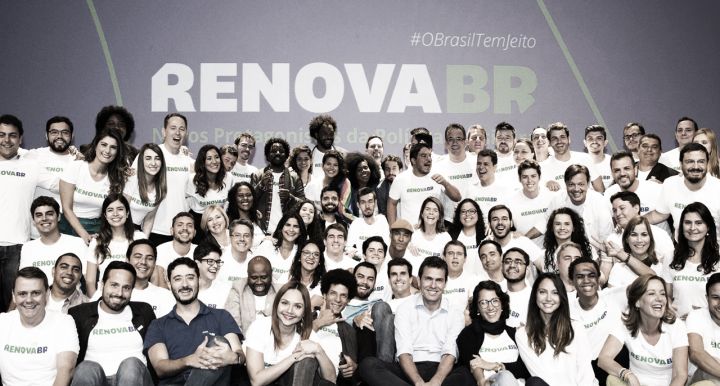
Launched in October 2017, “leadership training and civic engagement initiative” RenovaBR claims to be a response to endemic corruption in politics. Through the “selection and preparation of future leaders”, the neoliberal organisation, backed by a familiar alliance of Wall Street lobbies and Brazilian business elites, seeks to dominate Brazilian political decision making using candidates spread across many different parties.
It is in effect a bid for control of a post-Bolsonaro scenario by the same economic interests which helped bring him to power…
By Rejane Carolina Hoeveler
With the 2020 municipal elections imminent, a debate has resurfaced about organizations like RenovaBR, of which little is known and little has been researched. This article presents only a few fundamental points highlighted in my doctoral thesis, recently defended, with the intention of helping to understand organizations of this type.
The creation of RenovaBR suggests that we are facing what René Dreifuss called a “political-electoral pivot”, initially focused on the 2018 elections; and, as we shall see, with the prospect of consolidating a new level in privatisation of Brazilian politics, disguised in a costume of “renewal”.
Who is Eduardo Mufarej?
Entrepreneur Eduardo Mufarej was a partner at Tarpon Investimentos between 2004 and October 2017, when RenovaBR was officially launched. He also chaired the Board of Directors of the private education conglomerate Somos Educação, controlled by the investment fund since 2015, when Grupo Abril sold all of its shares. Mufarej is also, according to RenovaBR’s own website, a member of the board of the Center for Public Leadership, and the School of Management at Yale University.
It is interesting to note three points about their curriculum: 1. The size of this educational group; 2. the link with BR Investimentos, via Minister Paulo Guedes, (who constantly encourages the privatization of education); and 3. Mufarej was one of those considered for the post of Minister of Education in Bolsonaro’s government when his team was being formed in November 2018, with the explicit support of Paulo Guedes. (1)
Mufarej is typical of a new generation of entrepreneurs in Brazil: (neo) liberal in the economy and liberal in mores, he does not hide his proximity to Partido Novo, but bets on a “broader front”, ostensibly above, and at the same time with a a lot of movement between distinct political parties. One of his tasks is to enlist other entrepreneurs, that is, to politically convince colleagues to deposit their chips (and cheques) into a certain political novelty; in this case, RenovaBR.
In an interview with the newspaper Correio Braziliense, in September 2018, Mufarej was clear about his activist role within the business community when he answered the question “How to overcome the barrier that separates entrepreneurs and society”? (2)
For RenovaBR, Mufarej enlisted, among the most well-known personalities, names such as TV Host Luciano Huck, former president of the Banco Central Armínio Fraga, actress Maitê Proença and volleyball coach Bernardinho. It is interesting to note that, since the movement’s launch, Luciano Huck has been considered as a candidate for the Presidency, and the person advising him for some months was Mufarej’s partner, and Bolsonaro’s Economy Minister, Paulo Guedes.
In the same interview, Mufarej uses the mystique of “entrepreneurship”: “There are 26 million entrepreneurs in Brazil…we are not talking about a group of 300 individuals, there are many entrepreneurs”. Considering practically any self-employed worker as a “entrepreneur”, Mufarej tried to make himself a spokesman for a much broader social base, given the well-known concentration of property in Brazil.
In an interview with IstoÉ Dinheiro, held at the headquarters of RenovaBR – in the Ruth Cardoso center, in Jardins, in São Paulo – Mufarej explained the reason for the creation of RenovaBR with a criticism of public party funding, and gave a mea culpa on a supposed “absence of the private sector in politics”. Making a positive reference to the Fundação Estudar, of billionaire businessman Jorge Paulo Lemann, Mufarej said he agreed with his assessment that entrepreneurs in general should have “more influence in Brazilian politics”.
RELATED CONTENT: Amb. Moncada: Duque and Bolsonaro Represent the Greatest Threat to Venezuela
RenovaBR’s marketing and presentation
“An initiative that was born in civil society, with the objective of preparing new leaders to enter politics. We are not a political party, nor just a movement. We are a leadership training and civic engagement initiative.”
In addition to the description above, the RenovaBR website states that the initiative has 17 “partners”, 49 “teachers”, 483 “donors” and 6,800 “volunteers”. Among the “partners” of Renova BR, we find both companies and other vehicles of private business: GOL, CLP (Center for Public Leadership), Kallas, Kroll (Corporate intelligence firm, the so called “CIA of Wall Street”), Locomotiva Research and strategy, Politize!, pwc, Nonstop, Brazilian Coaching Society, ENGAGE (Learning for results), Communitas, Mindsight (people performance), Printi, Zune Denim, and moip.
There you can see a very interesting network of political and business connections, which deserves a separate analysis.
Among the values RenovaBR claims to defend are: honesty, dialogue and dedication. Among its coordinators are:Eduardo Mufarej, Izabella Mattar, Thomaz Pacheco, Gabriel Azevedo, Fernanda Pedreira, Rodrigo Cobra, Erick Jacques and Pedro Simões.
According to statements by Mufarej, RenovaBR, launched in October 2017 (one year before the elections) opened a selection process to attract “young leaders” in Brazil (there was an age limit of 45 years, and one of the criteria in the selection was whether such leaders already had any social base); to “train them” in various subjects – which according to a report by Nexo Jornal, was carried out by the Public Leadership Center (CLP). After some “tests”, they would become “candidate candidates” for positions to be selected in 2018.
According to my research, candidates received scholarships of R$5,000 to R$8,000 since January 2018; but, in addition to financial assistance and training courses, candidates linked to RenovaBR received resources specifically for “management of social networks and media”, so that, when the electoral campaign started, they would already be known to the public.
The idea of RenovaBR, according to its founder, was inspired by the electoral success of the French movement “En Marche!”, Which elected President Emmanuel Macron and won 64% of the seats in the French parliament.
According to RenovaBR, it trained 133 leaders from January to June 2018. After the end of the first training module, 120 of them were launched by 22 different parties. Alessandro Vieira (REDE) was the senator trained by RenovaBR, and elected in Sergipe. In São Paulo, Tábata Amaral (PDT) and Vinicius Poit (NOVO) were elected federal deputies. Daniel José (NOVO), Heni Ozi Cukier (NOVO), Marina Helou (REDE) and Ricardo Mellão (NOVO) occupy seats in the Legislative Chamber of São Paulo.
In Rio de Janeiro, Marcelo Calero (PPS), Paulo Ganime (NOVO) and Luiz Lima (PSL) were elected to the National Congress, as well as Tiago Mitraud (NOVO) and Lucas Gonzalez (NOVO) of Minas Gerais, and Felipe Rigoni (PSB) of Espírito Santo. Fábio Ostermann (NOVO) was elected to the Legislative Assembly of Rio Grande do Sul. In the North, Joênia Wapichana (REDE) was elected federal deputy in Roraima. In the Northeast, David Maia (DEM) won a seat in the Legislative Chamber of Alagoas.
It is at least curious to see on the RenovaBR website, that among those mentioned on its list of “leaders” – those who completed the course – the names of former Minister of Culture Marcelo Calero, and Fred Luz, director general of Flamengo Football Club.
Reading articles published on the RenovaBR website, we observed an unusual psychological anti-corruption test. RenovaBR used its partnership with S2 Consultoria – a startup specialized in preventing and treating acts of fraud and harassment in organizations – to test “the resistance capacity of 134 leaders when exposed to situations that open space for ethical conflicts”.
RenovaBR’s “rebellious” appeal lies in its claim to refute “ideologies”, “labels” and ideological conflicts, which often appear in the words of its staff. A subtlety of RenovaBR’s discourse is to equate management transparency with fiscal responsibility, thus making it a topic on the moral agenda.
Presented in the New York Times as “fresh faces, fed up with corruption, taking on Brazil’s political old guard”, many of the RenovaBR fellows came from various movements, such as MBL (Movimento Brasil Livre, created in 2014, which organised protests for Dilma Rousseff’s impeachment), and the “Acredito” movement, created in 2017. The latter was classified by Folha de S. Paulo as a “progressive MBL”, and gained a lot of traction in the Brazilian press.
In practice, the Acredito movement merged with RenovaBR, as stated by one of the participants in the round table at the New York headquarters of the Council of the Americas, and all of its staff were integrated with RenovaBR fellows. However, in an article by the newspaper O Estado de São Paulo, Mufarej says that it was not this sector that was successful and boasts of their own electoral achievements (quite modest, if the stated objective was true), admitting that it managed to ride the “Bolsonarista wave”.
RenovaBR’s international connections
At an event held at the headquarters of the Council of the Americas, on May 16, 2018, entitled “Political renewal and new leaders in Brazil” – also recorded and available on the council’s website – RenovaBR leaders, among them the founder, Eduardo Mufarej, presented themselves as representatives of a “new generation of public sector leaders”, highlighting the need for “young and capable professionals in Brazilian politics”.
The Council of the Americas, who sponsored this RenovaBR event, is a business organization that brings together the 200 largest corporations, the vast majority of which are of American origin, which together account for about 80% of all foreign direct investments in Latin America.
It was created in the 1960s by tycoon and philanthropist David Rockefeller, participated in the 1964 coup in Brazil and in 1973 in Chile, supported dictatorships, and in the 1980s it became the main space for negotiating foreign debts in Latin American countries, bringing together among its directors the two major private debt-lending banks, Chase Manhattan Bank and JP Morgan’s First National Bank.
It fulfilled the role of being a pioneering center for the development of neoliberal programs for Latin America, with close connections with the Department of Commerce and the Department of State, having been the main private body that influences the U.S. Congress and the Executive on foreign policy for Latin America.
According to the President and CEO of Council of the Americas, Susan Segal, who opened the event, Eduardo Mufarej contacted her in March, and his proposal was received with great enthusiasm by the Council, which saw RenovaBR and Mufarej as an “excellent alternative”; “To transform [political] dialogue”,”to form new political leaders in Brazil and throughout Latin America”; leaders who are committed to “responsible policy” and to “diversity”; asserting that this should be the “future of politics”, in Segal’s words.
The panel was hosted by AS-COA (acronym for Americas Society / Council of the Americas) not only with RenovaBR, but also the Brazil Foundation (3) and the Brazilian-American Chamber of Commerce. The panel members, in addition to Mufarej, were three RenovaBR scholarship recipients, selected, according to Mufarej, from 4,000 candidates: Carlos Gomes, Felipe Rigoni and Juliana Cardoso.
Under American law, as a tax-exempt organization with permission to lobby, AS-COA cannot explicitly support political parties directly. This makes RenovaBR the perfect choice of partner for Council of the Americas in Brazil.
RenovaBR’s legality questioned in Parliament
As RenovaBR captured business donations and passed them on to potential candidates, it violated electoral legislation.
When this was exposed in the media, RenovaBR was questioned in Parliament. Congressman Jorge Solla (PT-BA) tried to suspend the so-called “Civic Fund for the Renewal of Politics”, asking the then Attorney General of the Republic, Raquel Dodge, for an investigation into RenovaBR. The PT deputy’s argument was that there was “strong evidence that the business group led by large entrepreneurs intends to organize, via a legal entity – a ‘Civic Fund ’, to circumvent the Law”.
According to a report by Istoé, in addition to Mufarej, this group’s coordinators or investors included figures such as publicist Nizan Guanaes, former Central Bank president Arminio Fraga, and businessman Abílio Diniz. According to the article, the group’s intention would be to try to elect 70 to 100 federal deputies at the 2018 elections.
What we have seen so far is that RenovaBR have taken democracy to the letter, as defined by the Austrian economist Joseph Schumpeter: the selection of leaders. It literally prepared a “vestibular” for candidate candidates and captured, among these, legitimate social leaders, who could be progressive or even on the left. With considerable funding from prominent capitalists, and a strategically heterogeneous group, it was able to move between different political parties and set up a mechanism for attracting and training young political leaders on a scale probably unprecedented in Brazil.
We are talking, therefore, about a sophisticated industry for capturing and converting legitimate social and popular leaders – among them many women, blacks, indigenous people, and those from the periphery – who, consciously or naively, become cadres of the liberal right, diluted with multiple party acronyms. Such dilution does not detract from its strength. On the contrary, RenovaBR’s ability to interfere in the political scene is legitimized by claiming to be a patchwork supra-partisanship, whilst functioning as the true “party” – in the extended sense attributed to the term by Antônio Gramsci, Italian communist thinker and activist. The political parties become merely temporary instruments for the RenovaBR project to reach governments and parliaments.
Federal Deputy Chico Alencar (PSOL) summed up the nature of RenovaBR – an organized action by capital that operates to hide characteristics of party organization – as an initiative for the “privatization of politics”.