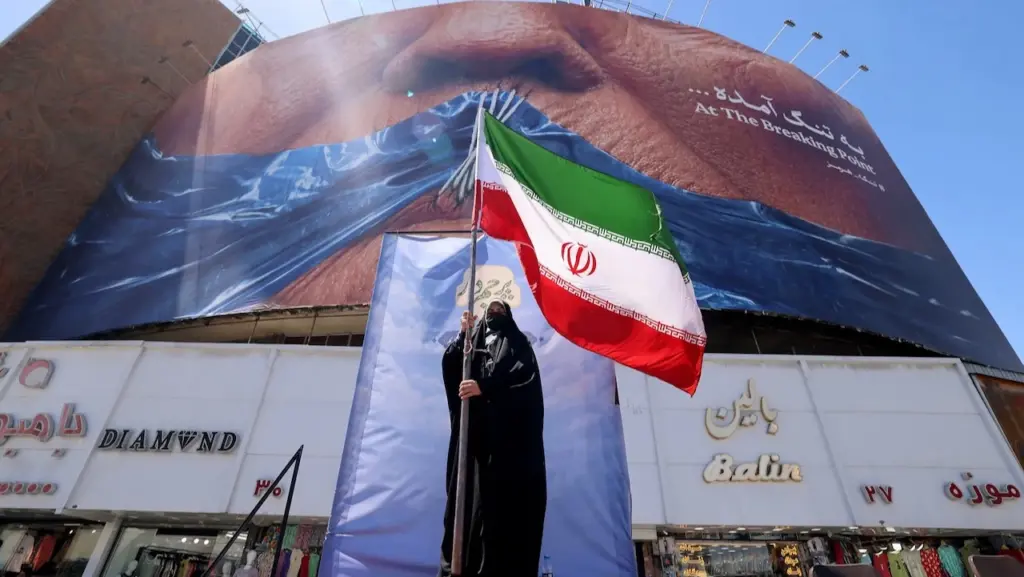
A political rally or demonstration in Iran, featuring a large mural and a person holding the Iranian flag. Photo: Atta Kenare/AFP/Getty Images.
A political rally or demonstration in Iran, featuring a large mural and a person holding the Iranian flag. Photo: Atta Kenare/AFP/Getty Images.
The proposal reportedly has the approval of some EU nations and is part of several initiatives to redraw defense alliances in a post-war Persian Gulf
Saudi Arabia has “floated” the possibility of reaching a “non-aggression pact” between Iran and neighboring states modeled on the 1975 Helsinki Accords, which eased tensions during the Cold War in Europe, the Financial Times(FT) reported on 14 May.
The Saudi-proposed pact for the day after the US-Israeli war on Iran ends reportedly has support from several European capitals, which view it as “the best way to avoid future conflict” and have urged Arab states to support it.
The British daily cites an unnamed Arab diplomat who says that such a pact would be welcomed “by most Arab and Muslim states, as well as by Iran,” although severe concerns remain about Israel’s continued threats to reignite the war regardless of any deal.
Riyadh is reportedly looking to the Helsinki Accords as a possible model, viewing them as a framework that could provide Iran with assurances against future attacks while establishing a broader regional security arrangement.
The Helsinki Accords helped reduce tensions between Eastern and Western Europe in the 1970s, establishing mutual acceptance of Europe’s post-WWII borders and promoting cooperation among nations. The framework aimed not to eliminate conflicts, but to contain them.
Saudi Arabia’s proposal signals growing concerns among Persian Gulf nations that, after the war ends and the substantial US military presence in the region diminishes, they may face a “wounded but more hawkish Iran on their doorstep,” according to FT.
Iran International: Inside the ‘Saudi-Funded’ Network Promoting Regime Change in Iran
Diplomatic sources said the idea is under consideration as part of wider initiatives, including Pakistan-led mediation and a developing defense partnership among Saudi Arabia, Pakistan, Turkiye, and Egypt.
The proposal for a regional non-aggression pact comes as the Persian Gulf seeks to navigate the aftermath of the US-Israeli war of aggression, in which Gulf monarchies directly participated, and the new rules set by Tehran for the Strait of Hormuz.
Earlier this week, Reuters reported that Iraq and Pakistan reached separate agreements with Iran to transport crude oil and liquefied natural gas (LNG) through the waterway under Tehran’s newly imposed controlled-passage system.
Dozens of Chinese-linked vessels also crossed Hormuz over the past 72 hours under the supervision of the Islamic Revolutionary Guard Corps (IRGC) Navy.
“There is no military solution to issues concerning Iran,” Iranian Foreign Minister Abbas Araghchi declared during a BRICS ministerial summit in New Delhi.
“Iran stands firm in the face of threats and does not bow. They have seen and experienced this themselves; they waged a 40-day war against us and saw the outcome. Iran resists pressure,” he stressed, adding that “those who speak to Iran with the language of respect will receive the same in return.”