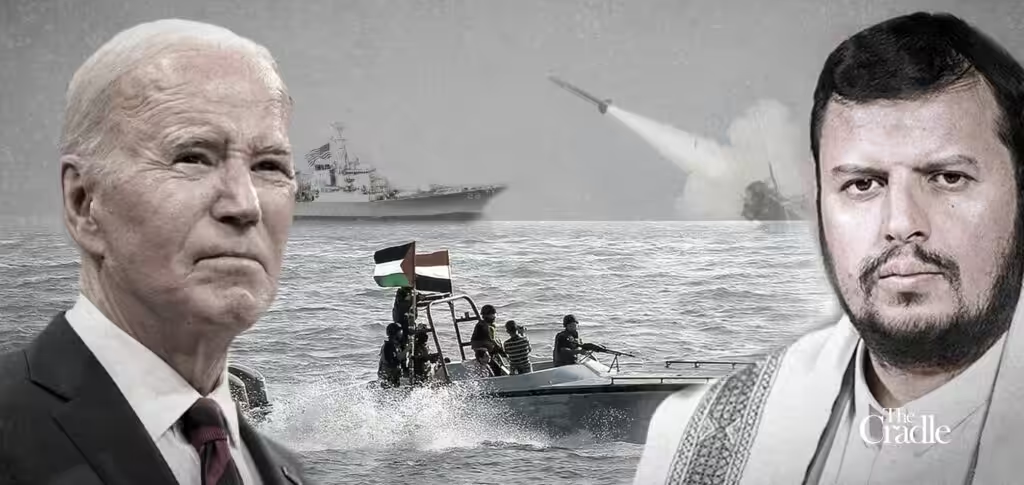
US President Joe Biden (left) and Ansarallah leader Abdel Malik al-Houthi (right), with a container ship and a boat flying Yemeni and Palestinian flags in the background. Photo compilation: The Cradle.
US President Joe Biden (left) and Ansarallah leader Abdel Malik al-Houthi (right), with a container ship and a boat flying Yemeni and Palestinian flags in the background. Photo compilation: The Cradle.
By Khalil Nasrallah – Apr 11, 2024
“We favor a diplomatic solution. We know that there is no military solution.”
– US Special Envoy for Yemen Timothy Lenderking
In a special briefing on 3 April—nearly six months after Yemen launched its far-reaching naval operations to debilitate Israel’s ability to conduct war on Gaza—US Special Envoy for Yemen Timothy Lenderking touted the importance of seeking diplomatic solutions in Yemen instead of the military ones his government has been loudly advocating for months.
Lenderking’s stance contrasted sharply with Washington’s announcement in December 2023 of a multinational coalition against Yemen’s Ansarallah-led forces, aimed at safeguarding international shipping in the Red Sea and effectively protecting Israeli-linked trade from Yemen’s sweeping naval blockade.
But as tensions heighten and regional allies have hesitated to join the US-UK coalition in fear of direct Yemeni retaliatory strikes, the US and its allies have quietly sought to entice Sanaa into negotiations through offers conveyed by Omani and other international mediators who maintain ties with Yemen’s de facto government in Sanaa.
Lenderking’s position may, in fact, reflect an astounding set of private US promises made via intermediaries to Ansarallah behind closed doors—pledges that essentially tick every box on the resistance movement’s wish list.
‘Stop your Gaza support, and we will give you everything’
Informed Yemeni sources reveal to The Cradle that the US offered Sanaa—in exchange for its neutrality in the ongoing Gaza war—“an acknowledgment of its legitimacy.”
This would involve severely reducing the role of the Saudi-backed Presidential Council led by Rashid al-Alimi and accelerating the signing of a roadmap with Riyadh and Abu Dhabi to end the aggression against Yemen.
The sources further reveal that the Americans pledged to immediately release withheld Yemeni public sector salaries from the National Saudi Bank, lift the country’s siege entirely, reopen Sanaa Airport, ease restrictions on the port of Hodeidah, and facilitate a comprehensive prisoner exchange agreement with all involved parties.
In terms of reconstruction, the sources say that Washington “pledged to repair the damages, remove foreign forces from all occupied Yemeni lands and islands, and remove Ansarallah from the State Department’s ‘terrorism list’ – as soon as they stop their attacks in support of Gaza.”
Despite these tempting offers, which have been the subject of negotiations between Sanaa and Riyadh for over two years, the Yemenis remained steadfast. Ansarallah leader Abdel Malik al-Houthi’s consistent position, as reiterated in his speeches, has been to continue operations as long as Israeli aggression against Gaza persists.
Ansarallah’s ‘military negotiation’
From the outset, marked by Israel’s declaration of a state of war following the 7 October Al-Aqsa Flood operation, Sanaa threw its weight behind the Palestinian resistance, launching comprehensive drone and ballistic missile attacks against the southern Israeli-occupied port city of Umm al-Rashrash, known as Eilat.
In response to the Yemeni salvos and interception attempts by US warships, Washington initiated a campaign of threats against Sanaa, which in turn demanded an immediate cessation of aggression against Gaza as a precondition for halting its military operations. Their exact words to the Americans were: “We are not within the circle of those you dictate to.”
Matters only intensified as Ansarallah began deploying previously unused naval strategies—not even utilized against Yemen’s aggressors, Saudi Arabia and the UAE, in nine years of battles—with al-Houthi vowing to obstruct Israeli ships in the Red Sea.
This strategy was actualized days later on 19 November, when Yemeni naval commandos stormed an Israeli-linked vessel, the Galaxy Leader, and its crew, redirecting the ship to Yemeni shores.
This daring naval action prompted the US to pursue dual strategies: the first, involving intimidation and preparation for a naval coalition to support Israel, and the second, encouraging diplomatic engagements through Arab and international mediators to halt Sanaa’s impactful naval operations.
Quds Day Rallies in Yemen Intensify Amid Biden’s Strategic Shift
Sanaa’s leadership not only dismissed these overtures but expanded the naval blockade to include non-Israeli vessels en route to Israeli ports and extended their theater of operations as far as the Indian Ocean—to cut off Israel’s “alternative long route” shipments.
Yemen’s firm refusal to succumb to either enticement or intimidation led the US and the UK to initiate aggressive military operations against the war-torn Persian Gulf state three months ago, aiming to neutralize the Yemeni threat and halt maritime attacks in support of Gaza under the guise of protecting maritime navigation freedom.
As a countermeasure, Sanaa escalated its military response by expanding operations to target not only US and British ships but also introducing advanced weaponry into its arsenal.
This included the sinking of the British cargo ship Rubymar, attacking other vessels, and broadening the theater of operations to the Arabian Sea and the Indian Ocean—a strategic move to ramp up pressure on those executing the brutal war on Gaza.
Yemen’s military checkmate
In light of the current situation, where the US has acknowledged the futility of its military strategy and is clamoring to devise a diplomatic solution, Sanaa has clearly demonstrated its relevance to any and all West Asian geopolitical calculations.
Its stunning achievements of the past six months include Sanaa’s ability to disrupt the Israeli economy by cutting off or lengthening trade routes for Israel’s essential imports. This can be seen most notably in Eilat, where the operational disruption of Israel’s southernmost port has led to significant job cuts by the port’s operating company and paralyzed shipping entirely.
Ansarallah has also thwarted retaliatory measures by the west’s most celebrated naval forces, made a mockery of their ramshackle “coalition,” and created complex challenges for US hegemonic ambitions in the Persian Gulf, both presently and in the long term.
Moreover, Yemen has showcased remarkable political and military maneuverability, demonstrating that a single resolved Arab state can provide the Palestinian resistance with a potent negotiating tool.
Importantly, through its military operations in the region’s waterways, Sanaa has solidified its position within the Axis of Resistance, transforming into one of the most effective forces in the Axis’ Unity of Fronts strategy. All, while drawing British and American naval assets into vulnerable—and unwinnable—positions and successfully hindering Israel’s shipping connections with the world.
A rising regional power
According to al-Houthi’s most recent count, Yemen’s numerous military operations have launched over 520 missiles and drones to target naval assets and areas in southern Israel. Ninety vessels have been targeted to date, with 34 operations conducted only between 4-5 March using 125 ballistic and winged missiles and drones.
In contrast, the US and UK have launched nearly 500 raids since their ill-conceived naval coalition began ops, resulting in the martyrdom of nearly forty Yemenis.
Six months into the war, Yemen continues to demonstrate its strategic capabilities on land, in regional waterways, and even in the world’s oceans. Yemeni officials hint at further military “surprises” still to come, which they may deploy depending on Israeli actions in Gaza and the broader region, as well as the actions of its US enabler, which Sanaa views as the most destructive and destabilizing force for West Asia’s security and stability.