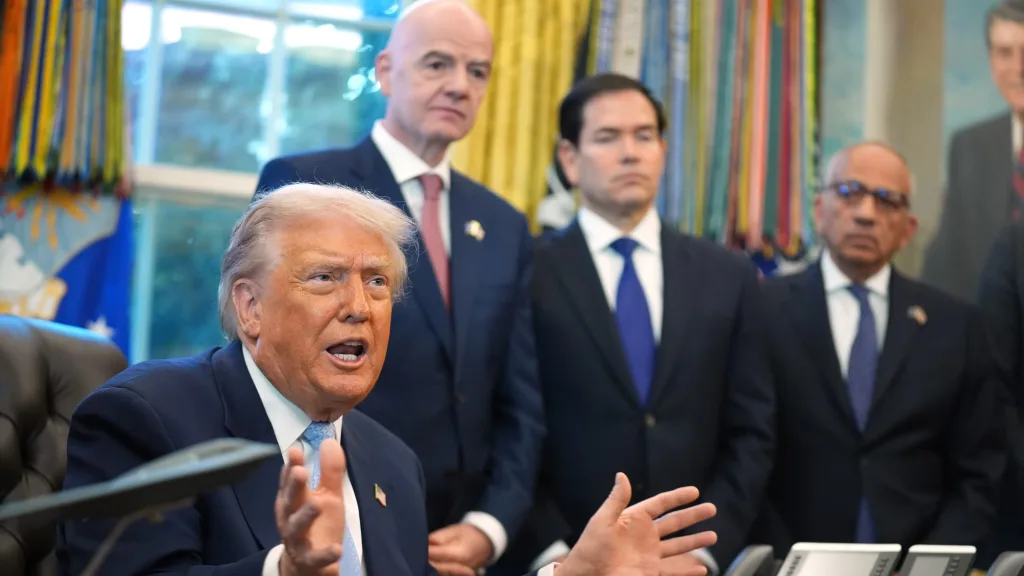
Donald Trump answers questions from reporters during a meeting in the White House Oval Office, Monday, Nov. 17, 2025, as FIFA President Gianni Infantino, Secretary of State Marco Rubio, and FIFA Senior Adviser Carlos Cordeiro listen. Photo: Evan Vucci/AP.
Caracas (OrinocoTribune.com)—On Sunday night, US leader Donald Trump stated that Washington has no new information on the situation with Venezuela but may enter into negotiations with Venezuelan President Nicolás Maduro. He made these remarks at West Palm Beach airport in Florida when asked about the situation.
Hours after the US State Department designated the alleged Cartel de los Soles as a “terrorist organization,” which will take effect on November 24, a reporter asked Trump if the United States might attack “Maduro’s assets or infrastructure inside Venezuela” following the designation. Trump responded, “That [designation] allows us to do it, but we have not said we are going to do it.”
Trump added, “We may have some talks with Maduro, and we will see how they go. They would like to talk.”
🇺🇸🇻🇪 President Trump when asked if there is anything Maduro can do that would allow him to stay with your support?
Analysts consider this new contradictory statement might be part of the US ruler’s psychological warfare, intended to divert attention from real US plans or to sow division among the millions of Venezuelans who support President Maduro.
During a press conference in the White House Oval Office on Monday, Trump reiterated that he might hold talks with Maduro in the future. “He has not treated the United States well… So we will see what happens. At some point, I will talk to him,” Trump said.
Trump repeated unsubstantiated claims of Venezuela being a main player in international narco-trafficking, something discredited by the most respected international agencies, including the United Nations. He also made claims of President Maduro sending convicted criminals to the US, another unsupported allegation aimed at demonizing Venezuelan migrants and increasing xenophobia against those encouraged to move to the US due to illegal US sanctions.
Trump did not specify dates, mechanisms, or actors involved in any potential dialogue. He simply reiterated: “I will talk to anyone, we will see what happens,” a statement that reflects the characteristic ambivalence of his discourse on Venezuela and other recent targets of the US empire.
Although he admitted he did not know “what the possible negotiation is about,” he insisted that it is the Venezuelan authorities who would seek to open diplomatic channels.
Venezuelan authorities have claimed for months that the diplomatic path is the only viable option. Yet, Washington has dismissed any attempt from Caracas to appease US warmongering appetites, and the US military continues to commit atrocities in the region.
Regional tension and US military buildup
In less than three months, the US Southern Command (SOUTHCOM) has extrajudicially executed 83 civilians on small boats in the Caribbean Sea and Eastern Pacific under unsubstantiated allegations of being “narco-terrorists.” The killing spree, labeled as extrajudicial killings by the United Nations, has elevated tension throughout the region to unprecedented levels as more citizens of Latin American and Caribbean countries become victims of US strikes.
Under the alleged “war on drugs” excuse, US imperialism has launched a military buildup not seen in the world for several decades. Mainstream media linked to the US War Department claims that there are 12 warships—including the largest and newest US aircraft carrier, USS Gerald R. Ford—dozens of fifth-generation fighter jets, and over 15,000 troops off the coast of Venezuela.
Despite Venezuelan calls for a diplomatic option to ease the US-generated tension, local authorities have launched unprecedented defensive military operations, considered by experts as being responsibly carried out and heavily rooted in the civic-military unity that characterizes the Bolivarian Revolution.
Mexico’s Sheinbaum
Mexican President Claudia Sheinbaum expressed her willingness to play an active role as a mediator in any potential dialogue between the United States and Venezuela. Her remarks follow Trump’s comments on Sunday.
“Hopefully. We are a country that always seeks peace, dialogue, and the peaceful resolution of conflicts. We are not in favor of invasions. We will be there to help in any way we can, and we hope that dialogue will always take place. We must seek dialogue and peace everywhere,” Sheinbaum stated in her daily press conference on Monday.
The Mexican president reaffirmed her long-standing stance against foreign intervention in sovereign affairs: “We will never support the intervention of a foreign government in a sovereign nation. I repeat, this is not just a matter of personal conviction. It must be the position of any president of Mexico, because it is enshrined in the Constitution,” she reiterated, referring to a statement she made on August 26.
Mexico, as well as Colombia, has also been targeted by US warmongering rhetoric in recent weeks. President Trump has hinted on several occasions that, along with land strikes on Venezuelan soil, those countries could also be targeted by the US war machine.
Coincidentally, the governments of these three countries are under the leadership of progressive leaders, taking an independent stance and not submitting to Washington’s dictates.