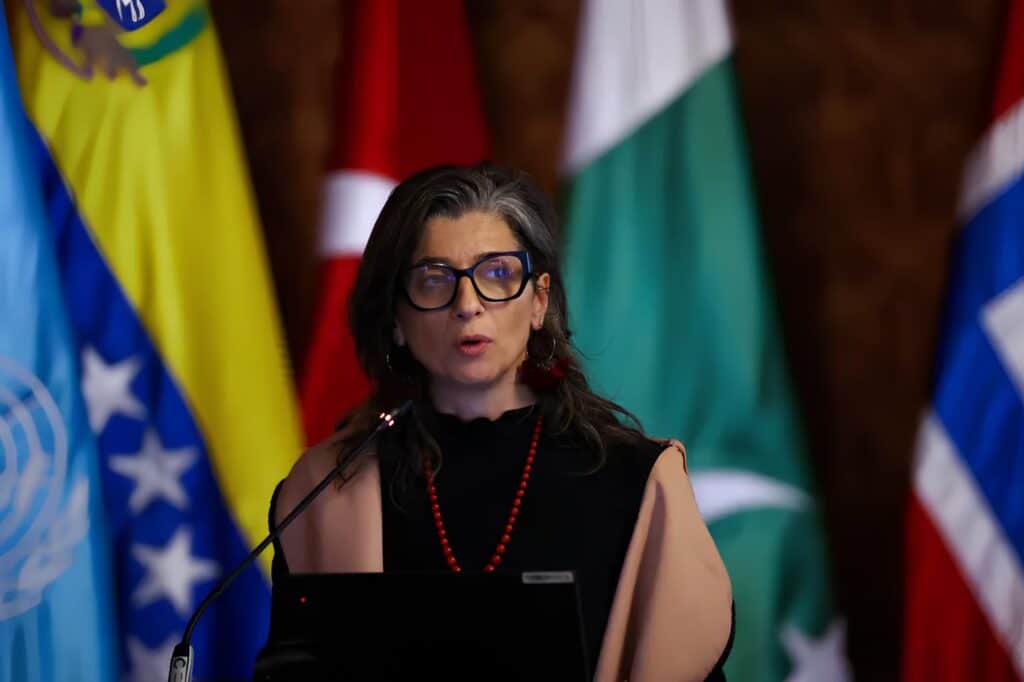
UN Special Rapporteur Francesca Albanese speaks at the Emergency Conference of States, hosted by Colombia and South Africa, to discuss measures against the Zionist entity for its genocide in Gaza, July 15, 2025, Bogota, Colombia. Photo: Luisa González/Reuters.
By Mario Campa – Jul 14, 2025
The US persecution of opponents has already reached independent experts appointed by international organizations. The case of the UN rapporteur on the human rights situation in the Palestinian territories, Francesca Albanese, is illustrative. In recent days, the Trump administration imposed sanctions on an indispensable voice that has denounced war atrocities amounting to a license to kill. US Secretary of State Marco Rubio announced that Albanese was sanctioned for collaborating with the International Criminal Court (ICC) in its efforts to prosecute US or Israeli citizens linked to the genocide in Gaza.
The publication of the special rapporteur’s report, “From the Economics of Occupation to the Economics of Genocide,” was the proverbial straw that broke the camel’s back.
In the document addressed to the UN Human Rights Council, Special Rapporteur Francesca Albanese exposes the corporate machinery that sustains the Israeli project of colonial settlement by displacement and replacement. While political leaders and governments look the other way, multinationals such as the Mexican companies Cemex and Orbia extract profits from the economy of illegal occupation, segregation, and from what experts now qualify as genocide. The network of complicity is the mere tip of an iceberg that only condemnation could melt. Hence Rubio’s unease.
The Albanese Report names those who provide the infrastructure for the Palestinian displacement. Arms companies, both Israeli (Elbit, Israel Aerospace Industries) and foreign (Lockheed Martin), develop, test, and certify their products as “battle-proven” in a perverse cycle of innovation that has become a pillar of Israeli exports. Tech giants like Microsoft, Google, and Amazon, along with specialized companies like Palantir, provide data, cloud, and artificial intelligence systems that enable mass surveillance of the Palestinian population, from biometric facial recognition to predictive algorithms. Heavy machinery companies such as Caterpillar, HD Hyundai, and Volvo supply essential equipment for the demolition of Palestinian homes and infrastructure.
In parallel, various accomplices reproduce an economy of construction and exploitation on confiscated land. The building of illegal settlements represents a boom subsidized by the Zionist state through companies such as Heidelberg Materials and CAF. Control over strategic resources such as water (Mekorot monopoly) and energy (Chevron and BP) creates a structural dependency for the Palestinian population, forced to buy resources extracted from their own territory.
The occupation economy could not sustain itself without the global financial system. International banks such as BNP and Barclays underwrite Israeli treasury bonds and finance the growing budget deficit fueled by military spending. Insurers like Allianz and AXA and sovereign wealth funds like that of Norway and pension funds like that of Quebec, Canada, as well as asset managers like Blackrock and Vanguard invest in stocks and bonds of the Israeli state and complicit companies. At the same time, law firms, accountants, and academics whitewash and legitimize the oiling of the steamroller.
The Albanese Report makes it possible to conceptualize a semantic alternative to the term “economy of genocide” to describe this self-sustaining barbarism because of the sting it arouses. The euphemism—by design—“economies of complicity” summarizes an interconnected system of corporate, financial, academic, and charitable actors that, knowingly or not, sustain, finance, and profit from the cleansing of an occupied territory, Palestine. In addition to the military industry, this web encompasses a wide range of sectors, such as surveillance technology, construction, finance, agribusiness, and tourism, which provide the material tools (weapons, machinery), technological infrastructure (surveillance, artificial intelligence), financial capital (investments, loans), and ideological normalization (academic research, business cases) that facilitate the displacement of the Palestinian population and its replacement by foreigners. The state apparatus, far from acting as an impartial regulator, reallocates assets (land and resources) and promotes an extractive economic model.
The ultimate goal of economies of complicity, as yet unknown, may be the creation of a concentration camp—as modeled by a Boston Consulting Group unit and reported by the Financial Times and Haaretz—or what Trump called a “Middle East Riviera.” In any case, as long as it endures, mass destruction generates profits under a system of oppression that works like the cogs of a crushing machine.
The US sanctions are likely to prevent Albanese from traveling to the United States and block any assets that she may have in the country, but the rapporteur managed to paint the picture of the devil. The open cases at the International Court of Justice (ICJ) and the International Criminal Court (ICC) transformed reputational risks into material and quantifiable liabilities for the Zionist entity. Given the condemnations, operational continuity implies a conscious decision to accept a level of criminal complicity which represents a financial and legal vulnerability for the entity. The long-term viability of the model falters with corporate exposure to a catastrophic market correction driven by the demand for legal, political, and economic accountability. Hence the value of the Albanese Report.
Musical chairs is a game of elimination in which chairs are placed—one less than the number of participants—and music is played while the players orbit the precarious thrones. It is a dance of longing and loss to the beat of an uncertain melody. When the pulse stops without warning, and silence falls, a rush of instinct triggers the search for refuge. In the Middle East, as international pressure rises and the music of the license to kill and expropriate stops, as it once stopped in apartheid South Africa, then terror will evaporate the drunkenness of those who today gain extraordinary profits. At that moment, the instinct of salvation will drive the participants in the horror to blow their whistles against each other. The economy of complicity will then be broken. The United States, whose goal is to make the music play and play, is today pursuing the brave woman who pressed the STOP button.
Mario Campa is a Mexican economist and political scientist.