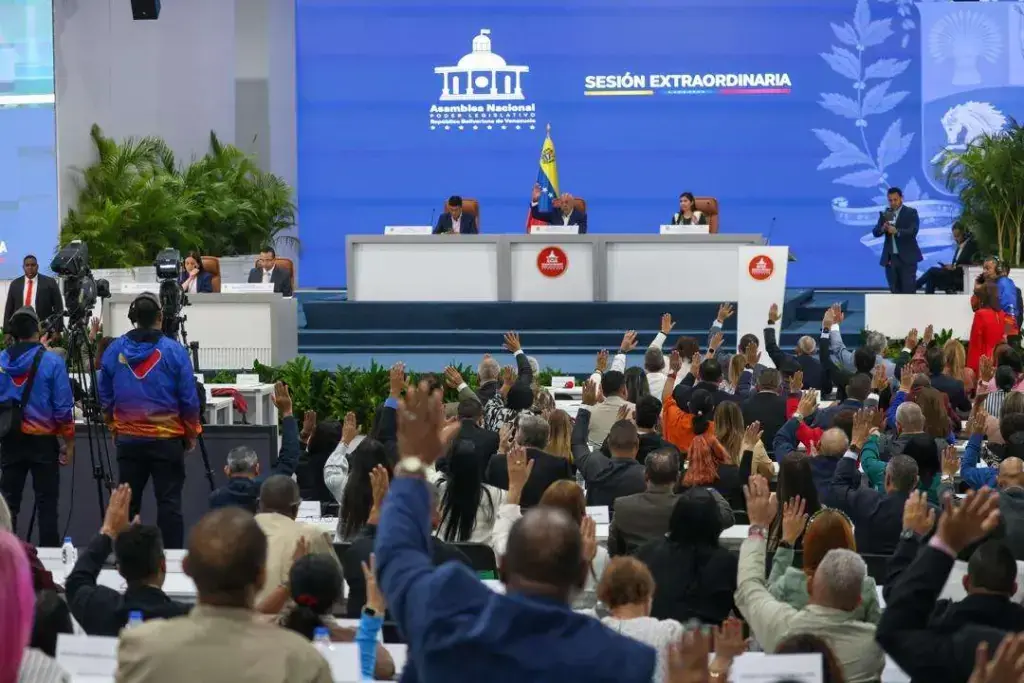
Extraordinary session of the National Assembly held on September 1 at the Parque Bolívar Convention Center in Caracas. Photo: Fausto Torrealba/AVN.
Extraordinary session of the National Assembly held on September 1 at the Parque Bolívar Convention Center in Caracas. Photo: Fausto Torrealba/AVN.
The Venezuelan National Assembly approved, unanimously and in its final discussion, the partial reform of the Organic Law of the Supreme Court of Justice (TSJ), the highest governing court in the country.
During an extraordinary session held this Tuesday at the La Carlota Convention Center, the deputies approved the establishment and operation of the Judicial Nominations Committee, which will serve for a period of two years and will be composed of participants from various sectors of society and in a manner that ensures gender parity.
It is worth recalling that in the first debate of this reform within the plenary, the vice president of the parliament, Deputy Pedro Infante, proposed modifying Article 65 of the Organic Law of the TSJ to raise the total number of members of the Nominations Committee from 21 to 23 members, with the purpose of increasing participation in civil society.
The reform proposed a structural change, as it stipulated that parliamentary representation would remain at 11 deputies and participation from sectors of civil society would increase from 10 to 12 members, providing civil society with a majority.
Similarly, the incorporation of a single transitory provision was approved, which establishes that once the reform is published in the Official Gazette, the National Assembly will appoint the Judicial Nominations Committee in accordance with what is established in Article 65.
This committee will have the purpose of initiating the constitutional and legal process for the appointment and designation of all magistrates of the Supreme Court of Justice, both principal and alternate, as well as their corresponding auxiliary bodies.
During the session, the repeal of the first and second final provisions of the current legislation was also approved, while the third final provision was modified and became the sole final provision, establishing that the law will enter into force from the date of its publication in the Official Gazette.
Although the reform was formally processed by the current National Assembly, it is directly linked to the negotiations initiated on August 6 between the Venezuelan delegation, led by National Assembly President Jorge Rodríguez, and former opposition deputies from the National Assembly elected in 2015, whose constitutional term expired in January 2021.
At the conclusion of the first round on August 12, both sides agreed to restart the process for renewing the TSJ, expand the Judicial Nominations Committee, appoint all its magistrates, and establish a body to verify the credentials of the nominees.
The negotiations are taking place amid the exceptional political conditions created by the January 3 US military attack on Venezuela, during which US forces bombed Caracas and other locations and abducted elected President Nicolás Maduro and First Lady Cilia Flores.
Following the operation, US President Donald Trump stated that Washington would “run” Venezuela until it could carry out a “transition.” Seven months later, the US State Department welcomed the talks with the 2015 opposition delegation as a “unique opportunity” within a three-phase plan culminating in a “political transition,” directly connecting the dialogue and institutional reforms with Washington’s broader plans for the country.
Grassroots Chavista organizations have criticized the controversial semi-colonial relationship between Venezuela and the US as interference and warned that the negotiations could be used to reshape Venezuela’s judicial and electoral institutions in accordance with the transition sought by Washington.


(Últimas Noticias) by Ariadna Eljuri with Orinoco Tribune content
Translation: Orinoco Tribune
OT/JRE/SL